
How many calories are in peanut butter?
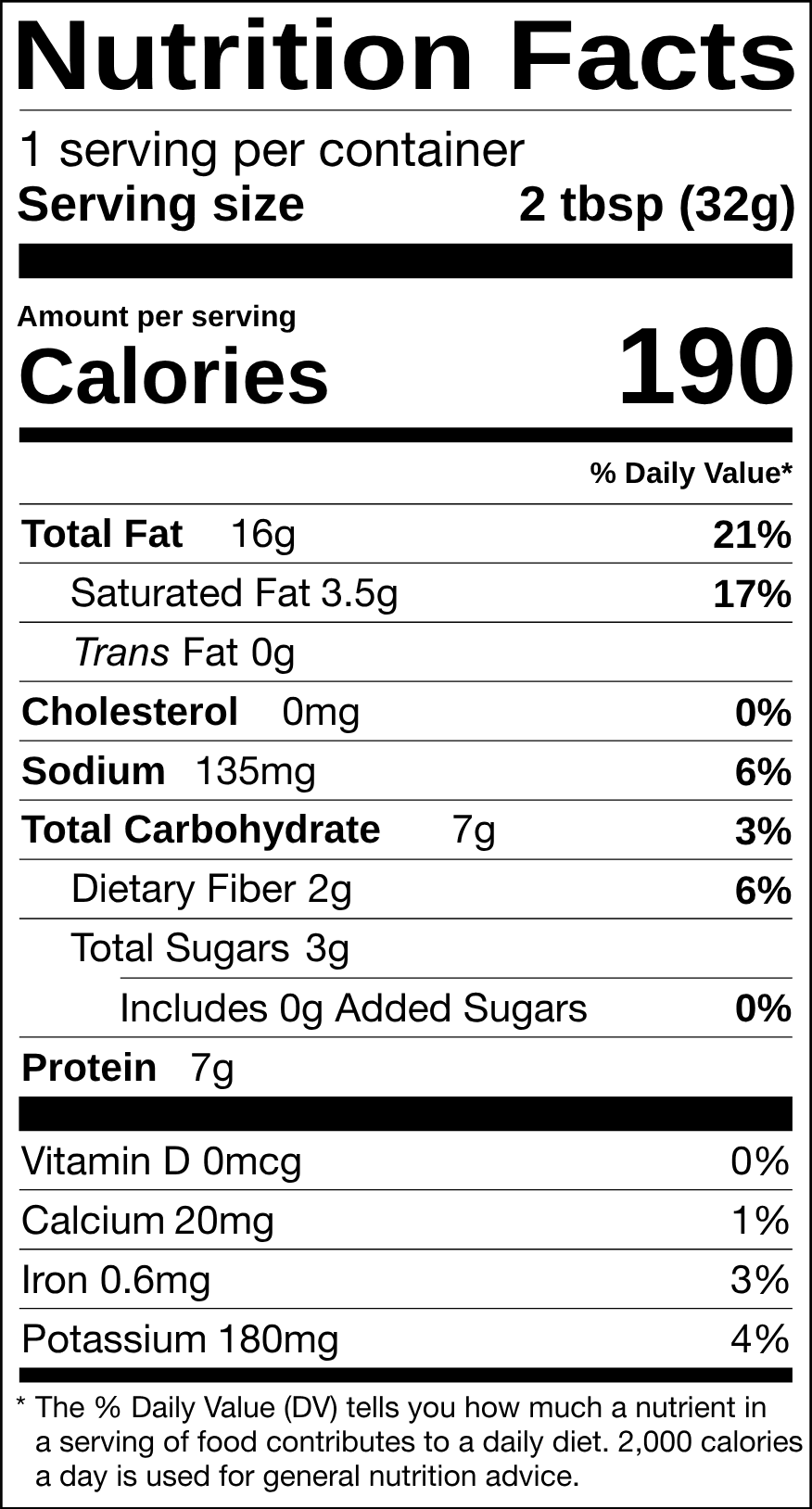
A 2-tablespoon serving of peanut butter (32 g) has 191 calories. 100 g has 598 calories. On a Nutrition Facts label, calories are rounded to the nearest 5 or 10, so the panel above may show 190.
Two tablespoons of smooth peanut butter (32 g) have 191 calories, 7.1 g of protein, 16.4 g of fat and 7.1 g of carbohydrate. The numbers are USDA's for regular smooth peanut butter made with salt; one level tablespoon is half of each.
FDA standard format. Values use the FDA rounding rules for the serving you pick. Nutrients USDA does not report for this food print as 0 on the panel and as "not reported" in the table.
Download this label: SVG · PNG Free to use as a reference. A label for a product you sell needs your full recipe and ingredient statement.
2 tbsp (32 g)
Opens the free label generator with this amount of peanut butter already added. Add the rest of your ingredients and the label updates as you go.
| Nutrient | Per serving | % DV* | Per 100 g |
|---|---|---|---|
| Calories and macronutrients | |||
| Calories | 191 | 598 | |
| Total fat | 16.4 g | 21% | 51.4 g |
| Saturated fat | 3.3 g | 17% | 10.3 g |
| Trans fat | <0.1 g | 0.08 g | |
| Monounsaturated fat | 8.3 g | 25.9 g | |
| Polyunsaturated fat | 4 g | 12.5 g | |
| Cholesterol | 0 mg | 0% | 0 mg |
| Sodium | 136 mg | 6% | 426 mg |
| Total carbohydrate | 7.1 g | 3% | 22.3 g |
| Dietary fiber | 1.6 g | 6% | 5 g |
| Total sugars | 3.4 g | 10.5 g | |
| Added sugars | not reported | ||
| Protein | 7.1 g | 22.2 g | |
| Vitamins | |||
| Vitamin D | 0 mcg | 0% | 0 mcg |
| Vitamin A | 0 mcg | 0% | 0 mcg |
| Vitamin C | 0 mg | 0% | 0 mg |
| Vitamin E | 2.9 mg | 19% | 9.1 mg |
| Vitamin K | 0.1 mcg | 0% | 0.3 mcg |
| Thiamin (B1) | <0.1 mg | 4% | 0.15 mg |
| Riboflavin (B2) | 0.06 mg | 5% | 0.19 mg |
| Niacin (B3) | 4.2 mg | 26% | 13.1 mg |
| Vitamin B6 | 0.14 mg | 8% | 0.44 mg |
| Folate (DFE) | 28 mcg | 7% | 87 mcg |
| Vitamin B12 | 0 mcg | 0% | 0 mcg |
| Choline | 20 mg | 4% | 63 mg |
| Minerals | |||
| Calcium | 16 mg | 1% | 49 mg |
| Iron | 0.56 mg | 3% | 1.74 mg |
| Potassium | 179 mg | 4% | 558 mg |
| Magnesium | 54 mg | 13% | 168 mg |
| Phosphorus | 107 mg | 9% | 335 mg |
| Zinc | 0.8 mg | 7% | 2.51 mg |
| Copper | 0.14 mg | 15% | 0.42 mg |
| Manganese | 0.53 mg | 23% | 1.67 mg |
| Selenium | 1.3 mcg | 2% | 4.1 mcg |
| Other | |||
| Water | 0.4 g | 1.23 g | |
| Caffeine | 0 mg | 0 mg | |
| Alcohol | 0 g | 0 g | |
* Percent Daily Values are based on a 2,000 calorie diet (FDA reference values for adults and children 4 years and older). Per-100 g values are USDA figures before label rounding.
Every serving below is a USDA household measure for this food, a fraction of one, or a unit conversion. Amounts are USDA values scaled by weight; only the Nutrition Facts panel applies the coarser FDA label rounding.
| Serving | Weight | Calories | Total carbohydrate | Protein | Total fat | Dietary fiber | Total sugars |
|---|---|---|---|---|---|---|---|
| 2 tbsp | 32 g | 191 | 7.1 g | 7.1 g | 16.4 g | 1.6 g | 3.4 g |
| 1 cup | 258 g | 1543 | 57.6 g | 57.3 g | 132.5 g | 12.9 g | 27.1 g |
| 1 tbsp | 16 g | 96 | 3.6 g | 3.6 g | 8.2 g | 0.8 g | 1.7 g |
| 100 g | 100 g | 598 | 22.3 g | 22.2 g | 51.4 g | 5 g | 10.5 g |
A 2-tablespoon serving of peanut butter (32 g) has 191 calories. 100 g has 598 calories. On a Nutrition Facts label, calories are rounded to the nearest 5 or 10, so the panel above may show 190.
A 2-tablespoon serving of peanut butter (32 g) has 7.1 g protein, 14% of the 50 g Daily Value. 100 g has 22.2 g. At 10 to 19% DV per serving, that meets the FDA threshold for a "good source" claim.
A 2-tablespoon serving of peanut butter (32 g) has 16.4 g total fat: 3.3 g saturated, 8.3 g monounsaturated and 4 g polyunsaturated.
A 2-tablespoon serving of peanut butter (32 g) has 3.3 g of saturated fat, 17% of the Daily Value. 100 g has 10.3 g.
A 2-tablespoon serving of peanut butter (32 g) has 136 mg of sodium, 6% of the Daily Value. 100 g has 426 mg.
A 2-tablespoon serving of peanut butter (32 g) has 179 mg of potassium, 4% of the Daily Value. 100 g has 558 mg. That is below the 10% DV a serving needs for a "good source" claim.
100 g of peanut butter has 598 calories, 22.2 g protein, 22.3 g carbohydrate, 5 g fiber, 10.5 g sugars and 51.4 g fat.
About 14% of the calories in peanut butter come from carbohydrate, 72% from fat and 14% from protein (Atwater factors of 4, 9 and 4 calories per gram).
In the United States, "peanut butter" has a federal standard of identity (21 CFR 164.150). It is made from ground roasted peanuts, and any seasoning and stabilizing ingredients, such as salt, sweeteners and hydrogenated vegetable oil, may make up no more than 10 percent of the finished weight. The fat content may not exceed 55 percent, and artificial sweeteners, artificial flavors, chemical preservatives and color additives are not allowed.
Products that fall outside the standard, such as most reduced-fat versions that replace some peanuts with other solids, are sold under a different name, usually "peanut spread." USDA's record on this page is for regular smooth peanut butter with salt, the familiar shelf-stable kind.
Because peanuts make up nearly all of every jar, calories, protein and fat per serving change little between these types. The real differences are in sugar and sodium, so compare the labels on those two lines.
Most peanut butter goes on bread or toast, but it also works as a cooking fat and flavoring:
Food manufacturers use it as a filling for crackers and candy, and as a binder in snack and protein bars.
Regular peanut butter is shelf stable and stays spreadable in the cupboard after opening. Natural peanut butter, without the stabilizing oil, keeps better in the refrigerator once opened: the cold slows separation and keeps the oil from going rancid, though it makes the peanut butter stiffer. Stir a new jar of natural peanut butter thoroughly before chilling it, so the oil does not stay on top.
Weigh peanut butter in grams rather than measuring it by the spoon: it is sticky, a heaped spoon can hold far more than a level one, and USDA's tablespoon here is a level 16 g. Enter the weight in the label generator with your other ingredients. When peanut butter is an ingredient in your product, the ingredient statement lists it with its own components in parentheses, which the ingredient formatter handles, and peanuts must be declared as a major allergen. If you sell peanut butter itself, the FDA reference amount for nut butters is two tablespoons; check other categories in the RACC lookup.
The same serving of peanut butter, drawn by the label formats other markets require: the Canadian bilingual Nutrition Facts table, the EU nutrition declaration (per 100 g, energy in kJ and kcal, salt instead of sodium) and the UK nutrition information table with reference intakes. The generator switches between these and many more from one recipe.
| Fat / Lipides | 16 g | 22 % |
| Saturated / Saturés | 3.3 g + Trans 0 g | 17 % |
| Cholesterol / Cholestérol | 0 mg | 0 % |
| Sodium | 135 mg | 6 % |
| Carbohydrate / Glucides | 7 g | 3 % |
| Fibre / Fibres | 2 g | 6 % |
| Sugars / Sucres | 3 g | 3 % |
| Protein / Protéines | 7 g | |
| Vitamin D / Vitamine D | 0 mcg | 0 % |
| Calcium | 16 mg | 1 % |
| Iron / Fer | 1 mg | 3 % |
| Potassium | 179 mg | 5 % |
| Per 100g | |
|---|---|
| Energy | 2502 kJ / 598 kcal |
| Fat | 51 g |
| of which saturates | 10 g |
| Carbohydrate | 22 g |
| of which sugars | 10 g |
| Protein | 22 g |
| Salt | 1.1 g |
| Per 100g | Per 32g | %RI* | |
|---|---|---|---|
| Energy | 2502 kJ 598 kcal |
801 kJ 191 kcal |
9.6% |
| Fat | 51g | 16g | 23% |
| of which saturates | 10g | 3.3g | 17% |
| Carbohydrate | 22g | 7.1g | 2.7% |
| of which sugars | 10g | 3.4g | 3.7% |
| Fibre | 5.0g | 1.6g | - |
| Protein | 22g | 7.1g | 14% |
| Salt | 1.1g | 0.34g | 5.7% |
Different forms of the same food are separate USDA records, so each has its own page. Per 100 g:
| Form | Calories | Protein | Total fat | Total carbohydrate |
|---|---|---|---|---|
| Peanut ButterPeanut butter, smooth style, with salt (Includes foods for USDA's Food Distribution Program) | 598 | 22.2 g | 51.4 g | 22.3 g |
| Chunky Peanut ButterPeanut butter, chunk style, with salt | 589 | 24.1 g | 49.9 g | 21.6 g |
| Reduced Fat Peanut ButterPeanut butter, smooth, reduced fat | 520 | 25.9 g | 34 g | 35.7 g |
| Unsalted Peanut ButterPeanut butter, smooth style, without salt | 598 | 22.2 g | 51.4 g | 22.3 g |
If you make and sell a product that contains peanut butter, these free tools cover the next steps.
Nutrient values are from USDA FoodData Central, SR Legacy (April 2018 release, public domain), record 174266: "Peanut butter, smooth style, with salt (Includes foods for USDA's Food Distribution Program)". Values are stored per 100 g exactly as USDA reports them and scaled to each serving by weight. The Nutrition Facts panel applies the FDA rounding rules in 21 CFR 101.9; tables and text show the scaled amounts at reading precision, so a figure can differ slightly from the panel. A nutrient USDA does not report for this food is shown as not reported, never as a guessed value.
SR Legacy predates the added sugars field, and this processed food may contain some, so added sugars are shown as not reported. The label panel prints 0 g because a row cannot be blank; a real product label needs the figure from its recipe. View the USDA record ↗