Tomato Nutrition Facts, Calories by Size and Slice
A medium tomato (123 g) has 22 calories, 4.8 g of carbohydrate and 17 mg of vitamin C (19% DV), and 100 g of tomato holds 94.5 g of water. A cherry tomato has 3 calories.
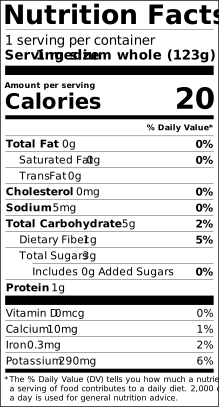
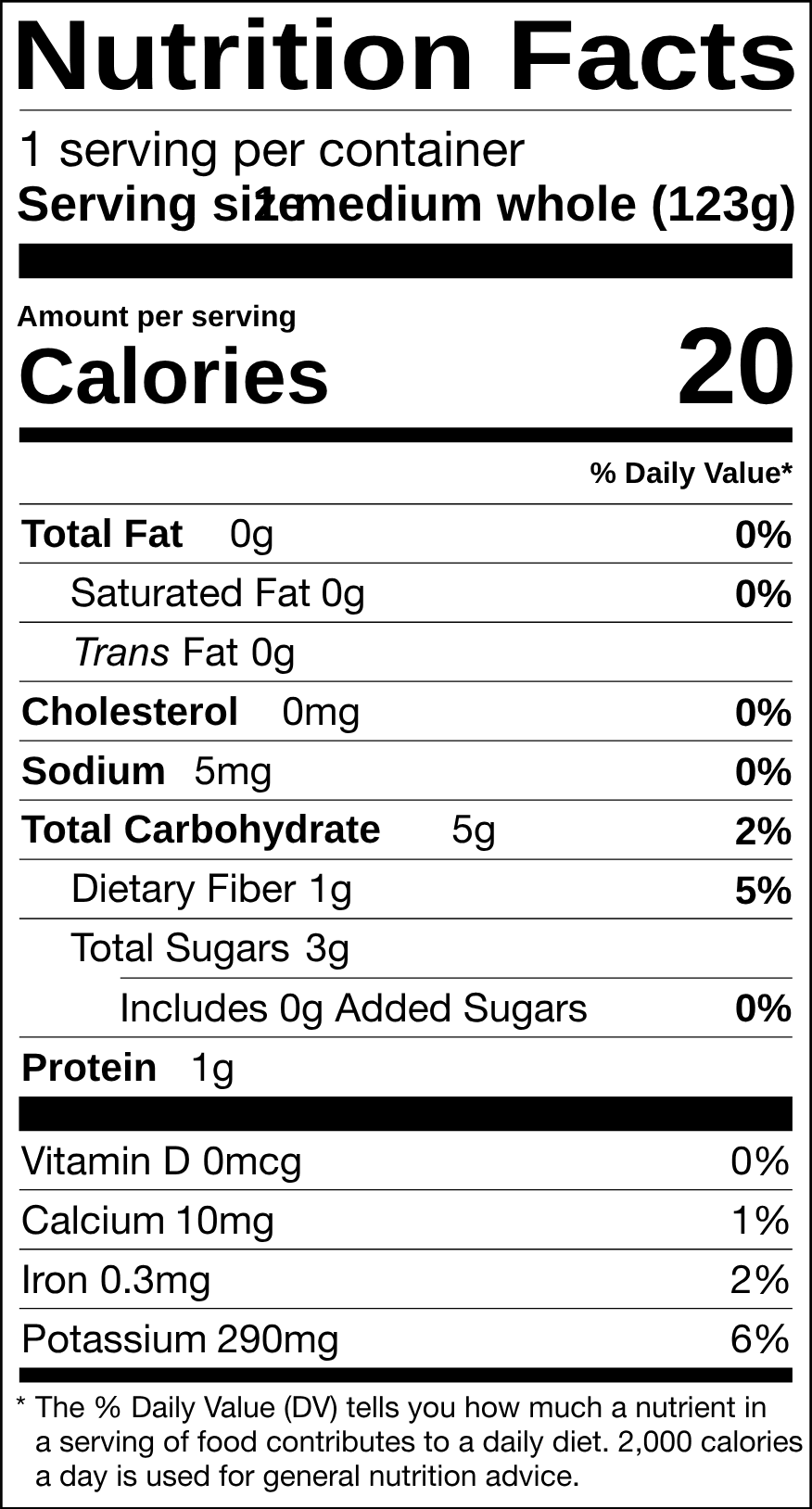
FDA standard format. Values use the FDA rounding rules for the serving you pick. Nutrients USDA does not report for this food print as 0 on the panel and as "not reported" in the table.
Download this label:SVG · PNG Free to use as a reference. A label for a product you sell needs your full recipe and ingredient statement.
Opens the free label generator with this amount of tomato already added. Add the rest of your ingredients and the label updates as you go.
All nutrients for this serving
1 medium whole (2-3/5" dia) (123 g)
Nutrient
Per serving
% DV*
Per 100 g
Calories and macronutrients
Calories
22
18
Total fat
0.2 g
0%
0.2 g
Saturated fat
<0.1 g
0%
0.03 g
Trans fat
0 g
0 g
Monounsaturated fat
<0.1 g
0.03 g
Polyunsaturated fat
0.1 g
0.08 g
Cholesterol
0 mg
0%
0 mg
Sodium
6.2 mg
0%
5 mg
Total carbohydrate
4.8 g
2%
3.89 g
Dietary fiber
1.5 g
5%
1.2 g
Total sugars
3.2 g
2.63 g
Added sugars
0 g
0%
0 g
Protein
1.1 g
0.88 g
Vitamins
Vitamin D
0 mcg
0%
0 mcg
Vitamin A
52 mcg
6%
42 mcg
Vitamin C
17 mg
19%
13.7 mg
Vitamin E
0.66 mg
4%
0.54 mg
Vitamin K
9.7 mcg
8%
7.9 mcg
Thiamin (B1)
<0.1 mg
4%
0.04 mg
Riboflavin (B2)
<0.1 mg
2%
0.02 mg
Niacin (B3)
0.73 mg
5%
0.59 mg
Vitamin B6
0.1 mg
6%
0.08 mg
Folate (DFE)
18 mcg
5%
15 mcg
Vitamin B12
0 mcg
0%
0 mcg
Choline
8.2 mg
1%
6.7 mg
Minerals
Calcium
12 mg
1%
10 mg
Iron
0.33 mg
2%
0.27 mg
Potassium
292 mg
6%
237 mg
Magnesium
14 mg
3%
11 mg
Phosphorus
30 mg
2%
24 mg
Zinc
0.21 mg
2%
0.17 mg
Copper
0.07 mg
8%
0.06 mg
Manganese
0.14 mg
6%
0.11 mg
Selenium
0 mcg
0%
0 mcg
Other
Water
116.3 g
94.5 g
Caffeine
0 mg
0 mg
Alcohol
0 g
0 g
* Percent Daily Values are based on a 2,000 calorie diet (FDA reference values for adults and children 4 years and older). Per-100 g values are USDA figures before label rounding.
Tomato nutrition by serving size
Every serving below is a USDA household measure for this food, a fraction of one, or a unit conversion. Amounts are USDA values scaled by weight; only the Nutrition Facts panel applies the coarser FDA label rounding.
Serving
Weight
Calories
Total carbohydrate
Protein
Total fat
Dietary fiber
Total sugars
1 cup cherry tomatoes
149 g
27
5.8 g
1.3 g
0.3 g
1.8 g
3.9 g
1 cup, chopped or sliced
180 g
32
7 g
1.6 g
0.4 g
2.2 g
4.7 g
1 Italian tomato
62 g
11
2.4 g
0.5 g
0.1 g
0.7 g
1.6 g
1 cherry
17 g
3
0.7 g
0.1 g
<0.1 g
0.2 g
0.4 g
1 large whole (3" dia)
182 g
33
7.1 g
1.6 g
0.4 g
2.2 g
4.8 g
1 medium whole (2-3/5" dia)
123 g
22
4.8 g
1.1 g
0.2 g
1.5 g
3.2 g
1 slice, medium (1/4" thick)
20 g
4
0.8 g
0.2 g
<0.1 g
0.2 g
0.5 g
1 plum tomato
62 g
11
2.4 g
0.5 g
0.1 g
0.7 g
1.6 g
1 small whole (2-2/5" dia)
91 g
16
3.5 g
0.8 g
0.2 g
1.1 g
2.4 g
1 slice, thick/large (1/2" thick)
27 g
5
1.1 g
0.2 g
0.1 g
0.3 g
0.7 g
1 wedge (1/4 of medium tomato)
31 g
6
1.2 g
0.3 g
0.1 g
0.4 g
0.8 g
1 slice, thin/small
15 g
3
0.6 g
0.1 g
<0.1 g
0.2 g
0.4 g
1 NLEA serving
148 g
27
5.8 g
1.3 g
0.3 g
1.8 g
3.9 g
100 g
100 g
18
3.9 g
0.9 g
0.2 g
1.2 g
2.6 g
Tomato calories by size
USDA weighs tomato in several sizes. Calories rise with weight:
Serving
Weight
Calories
Total carbohydrate
1 small whole (2-2/5" dia)
91 g
16
3.5 g
1 medium whole (2-3/5" dia)
123 g
22
4.8 g
1 large whole (3" dia)
182 g
33
7.1 g
How many carbs are in a tomato?
A medium tomato (123 g) has 4.8 g total carbohydrate, including 1.5 g dietary fiber and 3.2 g total sugars. Carbohydrate minus fiber is 3.3 g.
How much vitamin C is in a tomato?
A medium tomato (123 g) has 17 mg of vitamin C, 19% of the Daily Value. 100 g has 13.7 mg. At 10 to 19% DV per serving, that meets the FDA threshold for a "good source" claim.
How much potassium is in a tomato?
A medium tomato (123 g) has 292 mg of potassium, 6% of the Daily Value. 100 g has 237 mg. That is below the 10% DV a serving needs for a "good source" claim.
How much fiber is in a tomato?
A medium tomato (123 g) has 1.5 g of fiber, 5% of the Daily Value. 100 g has 1.2 g. That is below the 10% DV a serving needs for a "good source" claim.
How much sugar is in a tomato?
A medium tomato (123 g) has 3.2 g total sugars. None of it is added sugar.
Tomato nutrition per 100 grams
100 g of tomato has 18 calories, 0.88 g protein, 3.89 g carbohydrate, 1.2 g fiber, 2.63 g sugars and 0.2 g fat.
Cherry, Roma, beefsteak and heirloom tomatoes
USDA's record is a year-round average for ripe red tomatoes, and this page uses it for the common types. USDA also lists portion weights by type, which you can pick in the serving list:
Round (slicing) tomatoes: small, medium and large whole tomatoes, plus slices and wedges.
Plum or Roma tomatoes: oval, meaty and less juicy, the usual choice for sauce. One weighs 62 g.
Cherry tomatoes: bite-size, about 17 g each.
Beefsteak and heirloom: large slicing tomatoes; weigh them and use the per-100 g values.
Raw vs cooked tomatoes
Cooking tomatoes drives off water, so sauce, paste and sun-dried tomatoes pack more calories and carbohydrate into each gram than fresh tomatoes: the same solids are left in less water. Heat also changes individual nutrients in opposite directions: research on cooked tomatoes has found less vitamin C and more measurable lycopene, the red pigment, than in raw ones. USDA keeps separate records for canned, stewed and sun-dried tomatoes, so use the one that matches your ingredient.
Foods made with tomatoes
Pico de gallo. Chopped raw tomato, onion, chili, cilantro and lime. Onion · Avocado
Marinara sauce. Tomatoes simmered with garlic and olive oil, served over pasta. Garlic · Olive Oil · Pasta
Caprese salad. Sliced tomato and fresh mozzarella with basil and olive oil. Mozzarella · Olive Oil
Greek salad. Tomato wedges with cucumber, onion and olive oil. Cucumber · Onion · Olive Oil
Should tomatoes go in the refrigerator?
Keep whole tomatoes on the counter until they are fully ripe. Cold stops ripening and can make the flesh mealy and less flavorful, so unripe tomatoes should not be refrigerated. Very ripe tomatoes can go in the refrigerator for a day or two if you let them come back to room temperature before eating. Cut tomatoes belong in the refrigerator.
Labeling salsa, sauce and other tomato products
Enter fresh tomatoes by raw weight in the label generator. For a cooked sauce, the batch loses water as it simmers, so weigh the finished sauce and set servings from that weight; the recipe nutrition calculator accounts for the yield. If you use canned tomatoes, paste or puree, enter those instead of fresh, and include any salt they contain, since canned tomato products often carry added sodium. Serving sizes for salsa and sauces are in the RACC lookup.
Tomato nutrition label for Canada, the EU and the UK
The same serving of tomato, drawn by the label formats other markets require: the Canadian bilingual Nutrition Facts table, the EU nutrition declaration (per 100 g, energy in kJ and kcal, salt instead of sodium) and the UK nutrition information table with reference intakes. The generator switches between these and many more from one recipe.
Nutrition Facts
Valeur nutritive
Per 1 medium whole (123g) / pour 1 medium whole (123g)
Calories
20
% Daily Value* / % valeur quotidienne*
Fat / Lipides
0 g
0 %
Saturated / Saturés
0 g + Trans 0 g
0 %
Cholesterol / Cholestérol
0 mg
0 %
Sodium
5 mg
0 %
Carbohydrate / Glucides
5 g
2 %
Fibre / Fibres
1 g
5 %
Sugars / Sucres
3 g
3 %
Protein / Protéines
1 g
Vitamin D / Vitamine D
0 mcg
0 %
Calcium
12 mg
1 %
Iron / Fer
0 mg
2 %
Potassium
292 mg
9 %
*5% or less is a little, 15% or more is a lot
*5 % ou moins c'est peu, 15 % ou plus c'est beaucoup
Canada: bilingual table
Nutrition Declaration
Per 100g
Energy
75 kJ / 18 kcal
Fat
0.2 g
of which saturates
0.0 g
Carbohydrate
3.9 g
of which sugars
2.6 g
Protein
0.9 g
Salt
0.0 g
EU 1169/2011: per 100 g, kJ and kcal, salt
Nutrition Information
Typical values (1 servings per pack)
Per 100g
Per 123g
%RI*
Energy
75 kJ 18 kcal
93 kJ 22 kcal
1.1%
Fat
0 gg
0 gg
<1%
of which saturates
0 gg
0 gg
<1%
Carbohydrate
3.9g
4.8g
1.8%
of which sugars
2.6g
3.2g
3.6%
Fibre
1.2g
1.5g
-
Protein
0.9g
1.1g
2.2%
Salt
0 gg
0.02g
<1%
*Reference Intake of an average adult (8400 kJ / 2000 kcal).
This pack contains approximately 1 servings.
UK FIR 2014: per 100 g and per serving, %RI
Frequently asked questions about tomato
How many calories are in a slice of tomato?+
A medium slice, about 1/4 inch thick (20 g), has 4 calories. A thick slice (27 g) has 5 and a thin slice has 3.
How many calories are in a cup of cherry tomatoes?+
A cup of cherry tomatoes (149 g) has 27 calories and 5.8 g of carbohydrate. One cherry tomato has 3.
Is a tomato a fruit or a vegetable?+
Botanically, a tomato is a fruit, because it develops from the flower and holds the seeds. In cooking and in US dietary guidance it is treated as a vegetable, and in 1893 the US Supreme Court (Nix v. Hedden) ruled it a vegetable for import tariffs.
Do Roma tomatoes have different nutrition from round tomatoes?+
USDA uses the same raw tomato record for both, so per gram they match on this page. A Roma has less juice and fewer seeds, which is why it is preferred for sauce, and a single Roma (62 g) has 11 calories.
What is a serving of tomato?+
This page defaults to 1 medium whole (2-3/5" dia) (123 g), a USDA household measure. The serving size on a packaged food label is set by the FDA reference amount (RACC) for its category, so a product label can use a different amount. The selector above shows every USDA measure for tomato.
Can I use tomato in a Nutrition Facts label calculation?+
Yes. Open the generator with tomato added, enter the weight you use, add your other ingredients and the label is calculated from the same USDA record shown here. A label for a product you sell must reflect your actual recipe and finished serving.
Tomato compared with other forms
Different forms of the same food are separate USDA records, so each has its own page. Per 100 g:
Form
Calories
Protein
Total fat
Total carbohydrate
TomatoTomatoes, red, ripe, raw, year round average
18
0.88 g
0.2 g
3.89 g
Canned TomatoesTomatoes, red, ripe, canned, packed in tomato juice
Nutrient values are from USDA FoodData Central, SR Legacy (April 2018 release, public domain), record 170457: "Tomatoes, red, ripe, raw, year round average". Values are stored per 100 g exactly as USDA reports them and scaled to each serving by weight. The Nutrition Facts panel applies the FDA rounding rules in 21 CFR 101.9; tables and text show the scaled amounts at reading precision, so a figure can differ slightly from the panel. A nutrient USDA does not report for this food is shown as not reported, never as a guessed value.
SR Legacy predates the added sugars field. This is a whole or unsweetened food, so added sugars are shown as 0 g. View the USDA record ↗
Make a Nutrition Facts label with tomato
Add tomato and the rest of your recipe. The label, %DV and serving math are done for you. Free to start.