How many calories are in oats?
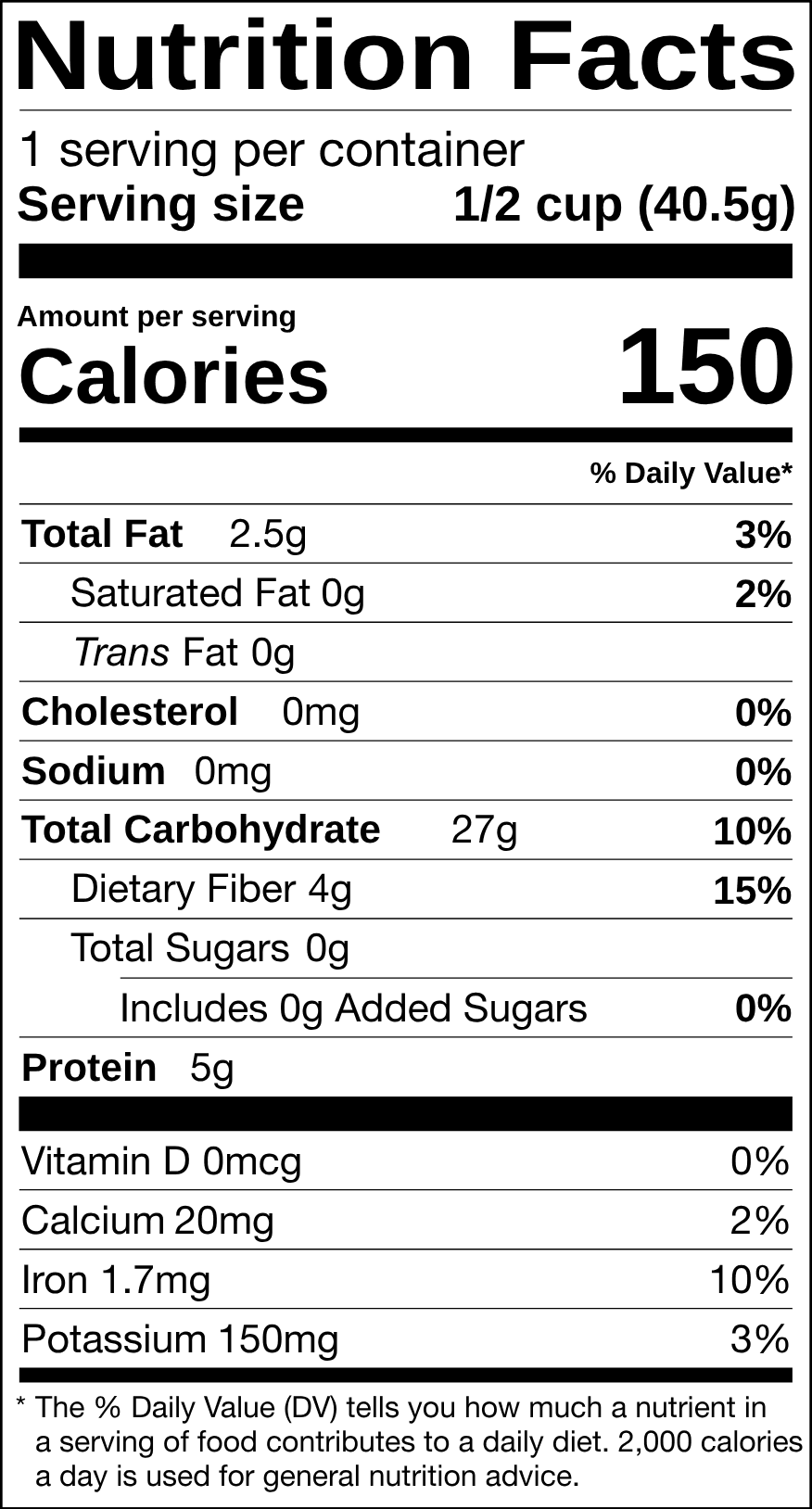
A half cup of dry oats (40.5 g) has 153 calories. 100 g has 379 calories. On a Nutrition Facts label, calories are rounded to the nearest 5 or 10, so the panel above may show 150.
Half a cup of dry rolled or quick oats (40.5 g) has 153 calories, 5.3 g of protein, 4.1 g of fiber and 27.4 g of carbohydrate. These are USDA's numbers for plain, unfortified oats before cooking; water adds no calories, so a bowl of oatmeal made from that half cup with water has the same totals.
FDA standard format. Values use the FDA rounding rules for the serving you pick. Nutrients USDA does not report for this food print as 0 on the panel and as "not reported" in the table.
Download this label: SVG · PNG Free to use as a reference. A label for a product you sell needs your full recipe and ingredient statement.
1/2 cup (40.5 g)
Opens the free label generator with this amount of oats already added. Add the rest of your ingredients and the label updates as you go.
| Nutrient | Per serving | % DV* | Per 100 g |
|---|---|---|---|
| Calories and macronutrients | |||
| Calories | 153 | 379 | |
| Total fat | 2.6 g | 3% | 6.52 g |
| Saturated fat | 0.4 g | 2% | 1.11 g |
| Trans fat | not reported | ||
| Monounsaturated fat | 0.8 g | 1.98 g | |
| Polyunsaturated fat | 0.9 g | 2.3 g | |
| Cholesterol | 0 mg | 0% | 0 mg |
| Sodium | 2.4 mg | 0% | 6 mg |
| Total carbohydrate | 27.4 g | 10% | 67.7 g |
| Dietary fiber | 4.1 g | 15% | 10.1 g |
| Total sugars | 0.4 g | 0.99 g | |
| Added sugars | 0 g | 0% | 0 g |
| Protein | 5.3 g | 13.2 g | |
| Vitamins | |||
| Vitamin D | 0 mcg | 0% | 0 mcg |
| Vitamin A | 0 mcg | 0% | 0 mcg |
| Vitamin C | 0 mg | 0% | 0 mg |
| Vitamin E | 0.17 mg | 1% | 0.42 mg |
| Vitamin K | 0.81 mcg | 1% | 2 mcg |
| Thiamin (B1) | 0.19 mg | 16% | 0.46 mg |
| Riboflavin (B2) | 0.06 mg | 5% | 0.16 mg |
| Niacin (B3) | 0.46 mg | 3% | 1.13 mg |
| Vitamin B6 | <0.1 mg | 2% | 0.1 mg |
| Folate (DFE) | 13 mcg | 3% | 32 mcg |
| Vitamin B12 | 0 mcg | 0% | 0 mcg |
| Choline | 16 mg | 3% | 40.4 mg |
| Minerals | |||
| Calcium | 21 mg | 2% | 52 mg |
| Iron | 1.7 mg | 10% | 4.25 mg |
| Potassium | 147 mg | 3% | 362 mg |
| Magnesium | 56 mg | 13% | 138 mg |
| Phosphorus | 166 mg | 13% | 410 mg |
| Zinc | 1.5 mg | 13% | 3.64 mg |
| Copper | 0.16 mg | 18% | 0.39 mg |
| Manganese | 1.5 mg | 64% | 3.63 mg |
| Selenium | 12 mcg | 21% | 28.9 mcg |
| Other | |||
| Water | 4.4 g | 10.8 g | |
| Caffeine | 0 mg | 0 mg | |
| Alcohol | 0 g | 0 g | |
* Percent Daily Values are based on a 2,000 calorie diet (FDA reference values for adults and children 4 years and older). Per-100 g values are USDA figures before label rounding.
Every serving below is a USDA household measure for this food, a fraction of one, or a unit conversion. Amounts are USDA values scaled by weight; only the Nutrition Facts panel applies the coarser FDA label rounding.
| Serving | Weight | Calories | Total carbohydrate | Protein | Total fat | Dietary fiber | Total sugars |
|---|---|---|---|---|---|---|---|
| 1 cup | 81 g | 307 | 54.8 g | 10.7 g | 5.3 g | 8.2 g | 0.8 g |
| 1/3 cup | 27 g | 102 | 18.3 g | 3.6 g | 1.8 g | 2.7 g | 0.3 g |
| 1/2 cup | 40.5 g | 153 | 27.4 g | 5.3 g | 2.6 g | 4.1 g | 0.4 g |
| 100 g | 100 g | 379 | 67.7 g | 13.2 g | 6.5 g | 10.1 g | 1 g |
A half cup of dry oats (40.5 g) has 153 calories. 100 g has 379 calories. On a Nutrition Facts label, calories are rounded to the nearest 5 or 10, so the panel above may show 150.
A half cup of dry oats (40.5 g) has 27.4 g total carbohydrate, including 4.1 g dietary fiber and 0.4 g total sugars. Carbohydrate minus fiber is 23.3 g.
A half cup of dry oats (40.5 g) has 4.1 g of fiber, 15% of the Daily Value. 100 g has 10.1 g. At 10 to 19% DV per serving, that meets the FDA threshold for a "good source" claim.
A half cup of dry oats (40.5 g) has 5.3 g protein, 11% of the 50 g Daily Value. 100 g has 13.2 g. At 10 to 19% DV per serving, that meets the FDA threshold for a "good source" claim.
A half cup of dry oats (40.5 g) has 1.7 mg of iron, 10% of the Daily Value. 100 g has 4.25 mg. At 10 to 19% DV per serving, that meets the FDA threshold for a "good source" claim.
A half cup of dry oats (40.5 g) has 1.5 mg of manganese, 64% of the Daily Value. 100 g has 3.63 mg. At 20% DV or more per serving, that meets the FDA threshold for an "excellent source" claim.
100 g of oats has 379 calories, 13.2 g protein, 67.7 g carbohydrate, 10.1 g fiber, 0.99 g sugars and 6.52 g fat.
About 71% of the calories in oats come from carbohydrate, 15% from fat and 14% from protein (Atwater factors of 4, 9 and 4 calories per gram).
Oats are a cereal grain, and every common form of plain oats is a whole grain: the hull is removed, but the bran, germ and endosperm of the kernel (the groat) stay together. The record on this page covers regular (old-fashioned) rolled oats and quick oats, measured dry and without added vitamins or minerals.
That last point matters when you compare labels. Many instant oatmeal packets are fortified with added iron and B vitamins, and flavored ones contain added sugar and salt, so their panels can look quite different from plain oats even though the grain is the same.
Per gram, plain oats in all these forms have nearly the same nutrition. Per cup they do not: steel-cut oats are dense, so packages typically list a quarter cup of steel-cut oats as a serving against half a cup of rolled oats for about the same weight. Weigh oats, or compare labels by grams, rather than by cups.
Oats absorb liquid as they cook, so half a cup of dry rolled oats becomes about a cup of oatmeal. The calories do not change, they are just spread through more weight. That is why cooked oatmeal looks low in calories per 100 g; most of that weight is water. Count oatmeal by the dry oats you started with.
Cooking oats in milk instead of water adds the milk's calories, protein, fat and sugar. Overnight oats work the same way: the oats are unchanged, and the total is the oats plus the milk, yogurt and toppings you add.
Beyond hot oatmeal and overnight oats, rolled oats go into granola, muesli, oatmeal cookies, muffins and the crumble topping on fruit crisps. They are blended into smoothies, ground into flour for pancakes, and used as a binder in meatballs and meatloaf in place of breadcrumbs. Food manufacturers use oats in breakfast cereals, granola and snack bars, baked goods, and oat-based drinks.
Stir rolled oats and chia seeds into milk in a jar, refrigerate overnight, and top with blueberries.
Oats · Whole Milk · Chia Seeds · Blueberries
Blend oats, a ripe banana, an egg and a splash of milk into a batter and cook small pancakes in a pan.
Oats · Banana · Egg · Whole Milk
Mix oats with peanut butter and honey, fold in chocolate chips, roll into balls and chill.
Keep oats in an airtight container in a cool, dry pantry, where they keep for months. Because the whole grain includes the germ, with its small amount of natural fat, very old oats can taste stale; buy amounts you will use. Cooked oatmeal and overnight oats keep a few days in the refrigerator.
For granola, bars, cookies or overnight oats, weigh the dry oats that go into the recipe and use dry data like this page, then set servings from the finished product weight. Oats contain no gluten themselves, but regular oats are often contaminated with wheat or barley during growing and milling. A product labeled gluten-free must contain fewer than 20 parts per million of gluten, which in practice means using oats sourced and tested as gluten-free. Build the recipe in the label generator or the recipe nutrition calculator, and check the reference amount for your category, such as cereal or bars, in the RACC lookup.
The same serving of oats, drawn by the label formats other markets require: the Canadian bilingual Nutrition Facts table, the EU nutrition declaration (per 100 g, energy in kJ and kcal, salt instead of sodium) and the UK nutrition information table with reference intakes. The generator switches between these and many more from one recipe.
| Fat / Lipides | 2.6 g | 4 % |
| Saturated / Saturés | 0.4 g + Trans 0 g | 2 % |
| Cholesterol / Cholestérol | 0 mg | 0 % |
| Sodium | 0 mg | 0 % |
| Carbohydrate / Glucides | 27 g | 10 % |
| Fibre / Fibres | 4 g | 15 % |
| Sugars / Sucres | 0 g | 0 % |
| Protein / Protéines | 5 g | |
| Vitamin D / Vitamine D | 0 mcg | 0 % |
| Calcium | 21 mg | 2 % |
| Iron / Fer | 2 mg | 10 % |
| Potassium | 147 mg | 4 % |
| Per 100g | |
|---|---|
| Energy | 1586 kJ / 379 kcal |
| Fat | 6.5 g |
| of which saturates | 1.1 g |
| Carbohydrate | 68 g |
| of which sugars | 1.0 g |
| Protein | 13 g |
| Salt | 0.0 g |
| Per 100g | Per 40.5g | %RI* | |
|---|---|---|---|
| Energy | 1586 kJ 379 kcal |
642 kJ 153 kcal |
7.7% |
| Fat | 6.5g | 2.6g | 3.8% |
| of which saturates | 1.1g | 0.4g | 2.2% |
| Carbohydrate | 68g | 27g | 11% |
| of which sugars | 1.0g | 0 gg | <1% |
| Fibre | 10g | 4.1g | - |
| Protein | 13g | 5.3g | 11% |
| Salt | 0.02g | 0 gg | <1% |
Different forms of the same food are separate USDA records, so each has its own page. Per 100 g:
| Form | Calories | Protein | Total fat | Total carbohydrate |
|---|---|---|---|---|
| OatsCereals, oats, regular and quick, not fortified, dry | 379 | 13.2 g | 6.52 g | 67.7 g |
| OatmealCereals, oats, regular and quick, unenriched, cooked with water (includes boiling and microwaving), without salt | 71 | 2.54 g | 1.52 g | 12 g |
If you make and sell a product that contains oats, these free tools cover the next steps.
Nutrient values are from USDA FoodData Central, SR Legacy (April 2018 release, public domain), record 173904: "Cereals, oats, regular and quick, not fortified, dry". Values are stored per 100 g exactly as USDA reports them and scaled to each serving by weight. The Nutrition Facts panel applies the FDA rounding rules in 21 CFR 101.9; tables and text show the scaled amounts at reading precision, so a figure can differ slightly from the panel. A nutrient USDA does not report for this food is shown as not reported, never as a guessed value.
SR Legacy predates the added sugars field. This is a whole or unsweetened food, so added sugars are shown as 0 g. View the USDA record ↗