Canada Nutrition Facts table requirements: CFIA rules, bilingual format, 2026 front-of-package symbol
What a prepackaged food sold in Canada must carry under the Food and Drug Regulations: the bilingual Nutrition Facts table and its permitted formats, the 13 core nutrients and Canadian Daily Values, serving sizes from the reference amounts, the priority allergens, and the "High in / Élevé en" front-of-package symbol that became mandatory on 1 January 2026. Every format below opens in the generator, pre-set to the rule.
Reviewed against Food and Drug Regulations, Sch K.1 + K.2 + L · Page updated October 2, 2026
What the rules cover
Nutrition labelling in Canada is set by the Food and Drug Regulations (FDR, Part B, Division 1, sections B.01.401 onward, with the table formats in Schedule K.1 as incorporated by reference), administered by Health Canada and enforced by the Canadian Food Inspection Agency (CFIA). The 2016 amendments (SOR/2016-305) modernised the table; industry had until 14 December 2022 to comply, so every label printed today must follow the new format. A second set of amendments (SOR/2022-168) added the front-of-package nutrition symbol, with a compliance date of 1 January 2026.
The table never ships alone. The same package must carry a bilingual list of ingredients with the priority allergens declared, a common name, a net quantity in metric units, the dealer's name and principal place of business, a durable-life date ("best before / meilleur avant") where shelf life is 90 days or less, and the country of origin where required. Licensing, traceability and recall duties come from the separate Safe Food for Canadians Regulations (SFCR). This page covers the nutrition table, the ingredient and allergen rules, and the front-of-package symbol; the CFIA's Industry Labelling Tool is the reference for the rest.
This page is written from the regulation text and Health Canada's guidance; the review date and source appear under the title. A US Nutrition Facts panel does not satisfy any of it.
The 13 core nutrients and the Canadian Daily Values
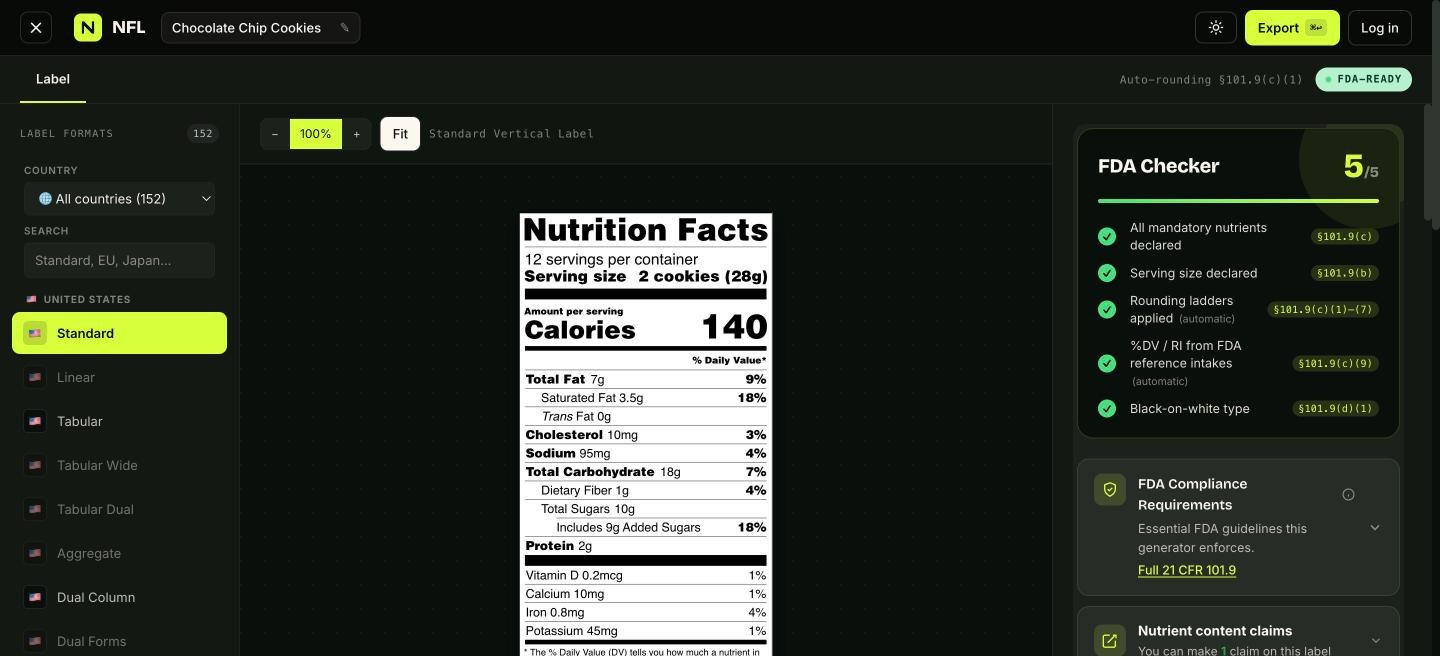
Every standard table lists, in this order: Calories; Fat with Saturated and + Trans indented beneath it and a single combined %DV for the pair; Carbohydrate with Fibre and Sugars indented; Protein; Cholesterol; Sodium; then Potassium, Calcium and Iron below a rule, each with an absolute amount and a %DV. The 2016 update removed vitamins A and C from the mandatory list, added potassium, gave sugars a %DV (based on a 100 g reference) and added the interpretive footnote: "5% or less is a little, 15% or more is a lot" ("5 % ou moins c'est peu, 15 % ou plus c'est beaucoup"). Protein has no %DV.
The Daily Values differ from the US ones, which is the first reason a US panel cannot be reused: fat 75 g, saturated + trans fat 20 g, cholesterol 300 mg, sodium 2,300 mg, carbohydrate 275 g, fibre 28 g, sugars 100 g, calcium 1,300 mg, iron 18 mg, with the full table (including the values for infants and children one to three years) published by Health Canada as the Table of Daily Values. The generator uses that table; when Health Canada revises a value, the weekly regulatory watch that feeds this site picks it up.
Other nutrients are voluntary unless a claim or fortification makes them mandatory; they are declared in the prescribed order with the Canadian units and Daily Values, never with the US ones.
| Per 100g | |
|---|---|
| Energy | 2092 kJ / 500 kcal |
| Fat | 25 g |
| of which saturates | 13 g |
| Carbohydrate | 64 g |
| of which sugars | 36 g |
| Protein | 7.1 g |
| Salt | 0.8 g |
| Fat / Lipides | 7 g | 9 % |
| Saturated / Saturés | 3.5 g + Trans 0 g | 18 % |
| Cholesterol / Cholestérol | 10 mg | 3 % |
| Sodium | 95 mg | 4 % |
| Carbohydrate / Glucides | 18 g | 7 % |
| Fibre / Fibres | 1 g | 4 % |
| Sugars / Sucres | 10 g | 10 % |
| Protein / Protéines | 2 g | |
| Vitamin D / Vitamine D | 0 mcg | 0 % |
| Calcium | 10 mg | 1 % |
| Iron / Fer | 1 mg | 4 % |
| Potassium | 45 mg | 1 % |
*5 % ou moins c'est peu, 15 % ou plus c'est beaucoup
Bilingual by law: the table formats
Canada calls it the Nutrition Facts table (tableau de la valeur nutritive), and the nutrition information must appear in both English and French for almost every prepackaged product. Two approaches are permitted: one bilingual table with each line in both languages ("Fat / Lipides", "Sodium / Sodium"), or separate English and French tables. The bilingual table is what most national brands use, and it is the default here.
Schedule K.1 prescribes a family of layouts: the standard format, a narrow standard, a horizontal format, a linear format for very small packages, and simplified variants for foods that contain insignificant amounts of most nutrients, in English-only, French-only and bilingual versions. You must pick the format the available display surface allows rather than shrink the standard table: the regulations tie the minimum type size, the line spacing and the rule weights to each format, and the CFIA measures them. The table is black on a white or neutral background, in a sans-serif face, with the "Nutrition Facts / Valeur nutritive" title in bold.
Natural health products (vitamins, minerals, herbal remedies, probiotics) are not foods: they carry a Product Facts table under the Natural Health Products Regulations, and supplemented foods with added vitamins, minerals, amino acids or caffeine carry a Supplemented Food Facts table with cautionary statements under the 2022 supplemented-foods regulations, also fully in force since 1 January 2026.
Serving size comes from the reference amount
As in the US, the serving size is not a free choice. Health Canada's Table of Reference Amounts for Food fixes a reference amount for each category, and the serving size on the label must be based on it, stated in a household measure followed by the metric equivalent: "Per 1 cup (250 mL)", "Per 3 crackers (20 g)", "pour 1 tasse (250 mL)". The 2016 amendments standardised the household measures so that competing products in a category show comparable servings, and require a package that could reasonably be eaten in one sitting to be labelled as one serving.
The generator holds the reference-amount table: choose the category, and the serving line, the household measure and the per-serving values follow. If you also sell the product in the United States, note that the US Reference Amounts Customarily Consumed are a different table with different values for many categories, so the same package can carry a different serving size in each country.
Rounding and the compliance test
The regulations set a rounding increment for every nutrient, and they are not the FDA's. Calories under 5 are shown as 0, up to 50 they round to the nearest 5, and above 50 to the nearest 10; fat, saturated and trans fat, cholesterol, sodium, carbohydrate, fibre, sugars and protein each have their own thresholds and increments, and the %DV is calculated from the declared, rounded amount, then rounded to the nearest whole percent (with small values shown as 0% or as "less than 1%" where the rules allow). The generator applies the Canadian tables automatically; the Daily Value calculator lets you check any single nutrient.
The CFIA verifies labels by laboratory analysis against defined compliance tolerances: nutrients you are expected to keep low (fat, saturated fat, trans fat, cholesterol, sodium, sugars) may not exceed the declared value by more than the tolerance, and nutrients you are expected to provide (fibre, protein, vitamins, minerals) may not fall short of it. A label computed from a database is acceptable if the underlying recipe data is accurate; the numbers, not the formatting, are what a port-of-entry or retail inspection tests.
The 2026 front-of-package nutrition symbol
Since 1 January 2026, most prepackaged foods that meet or exceed the thresholds for saturated fat, sugars or sodium must display Health Canada's black-and-white magnifying-glass symbol on the principal display panel, with the words "High in / Élevé en" and the names of the nutrients concerned, in both languages. The general threshold is 15% of the Daily Value per reference amount or per serving, whichever is greater; it drops to 10% for foods with a reference amount of 30 g or 30 mL or less, and rises to 30% for main dishes with a reference amount of 200 g or more.
Exemptions cover fresh, frozen, canned and dried fruits and vegetables without added ingredients that trigger the symbol; plain milk and eggs; certain foods the regulation recognises as having protective benefits (for example some dairy products and whole nuts and seeds); products where the nutrient is obvious, such as butter, sugar and salt; very small packages; and foods sold only at the establishment where they are prepared. Prescribed size, placement and colour rules apply to the symbol itself, and it cannot be obscured by other artwork.
The free Canada FOP symbol checker takes your per-serving values and returns the verdict: whether the symbol is required, for which nutrients, and the compliant rendering. In the generator the same logic runs live on the Canada FOP format; the compliance-deadline guide covers the thresholds in detail.
Ingredients and the priority allergens
The list of ingredients is bilingual, in descending order by weight, with components of compound ingredients in parentheses. The 2016 amendments changed its appearance: it must be in black type on a white or neutral background, in a minimum type height, with ingredients separated by bullets or commas, and sugars-based ingredients grouped in parentheses after the word "Sugars / Sucres" so that a product cannot hide sugar across several ingredient names. Food colours must be named individually rather than as "colour".
Canada's priority allergens are not the US list: eggs, milk, mustard, peanuts, crustaceans and molluscs, fish, sesame seeds, soy, sulphites at 10 ppm or more, tree nuts, and wheat and triticale, plus gluten sources (barley, oats, rye, triticale, wheat). Each must be declared by its common name either in the ingredient list or in a "Contains / Contient" statement immediately after it; if you use the statement it must be complete. The generator's allergen module carries the Canadian list, names the specific source (for example "almonds" rather than "tree nuts"). Canada, unlike the EU and UK, does not require the allergen names to be emphasised in bold.
The rest of the package follows the CFIA's Industry Labelling Tool: a common name that is not misleading, net quantity in metric on the principal display panel, the dealer's name and address, lot code, the durable-life date, and, for imported products, "Imported by / Importé par" wording. The ingredient statement and allergen features handle the first two automatically from your recipe.
Who is exempt
The Nutrition Facts table is mandatory for most prepackaged foods, with exemptions in B.01.401(2): fresh fruits and vegetables; raw single-ingredient meat, poultry and fish; foods sold only at the retail establishment where they are prepared and processed (the bakery counter, the deli); individual servings sold for immediate consumption; foods with a display surface too small to carry the table in any permitted format; and alcoholic beverages over 0.5% alcohol. Very small packages may use the linear format or an alternative means of presentation.
Every exemption is lost the moment the label carries a nutrient content claim ("low in sodium", "source of fibre"), a health claim, added vitamins or minerals, or a sweetener; at that point the full table is required. The claims themselves are regulated separately (FDR B.01.500 onward and the Table of Permitted Nutrient Content Statements and Claims), and the claim validator checks the Canadian conditions alongside the US ones.
One recipe, two countries
Selling into both the US and Canada is the most common reason a small producer meets this page. Keep one master recipe and render two labels: the FDA panel with US Daily Values, US reference amounts and the "Contains" allergen line for the nine US allergens, and the Canadian bilingual table with Canadian Daily Values, Canadian reference amounts and the eleven priority allergens, plus the front-of-package symbol where the thresholds are met. The generator holds both rule sets and the recipe once; the US FDA requirements guide is the companion to this page, and the US-vs-Canada comparison lists the differences side by side.
For markets beyond North America the same recipe re-renders to the EU 1169/2011 declaration, the UK back-of-pack table and 100 more formats; the coverage page lists every jurisdiction.