
How many calories are in almonds?
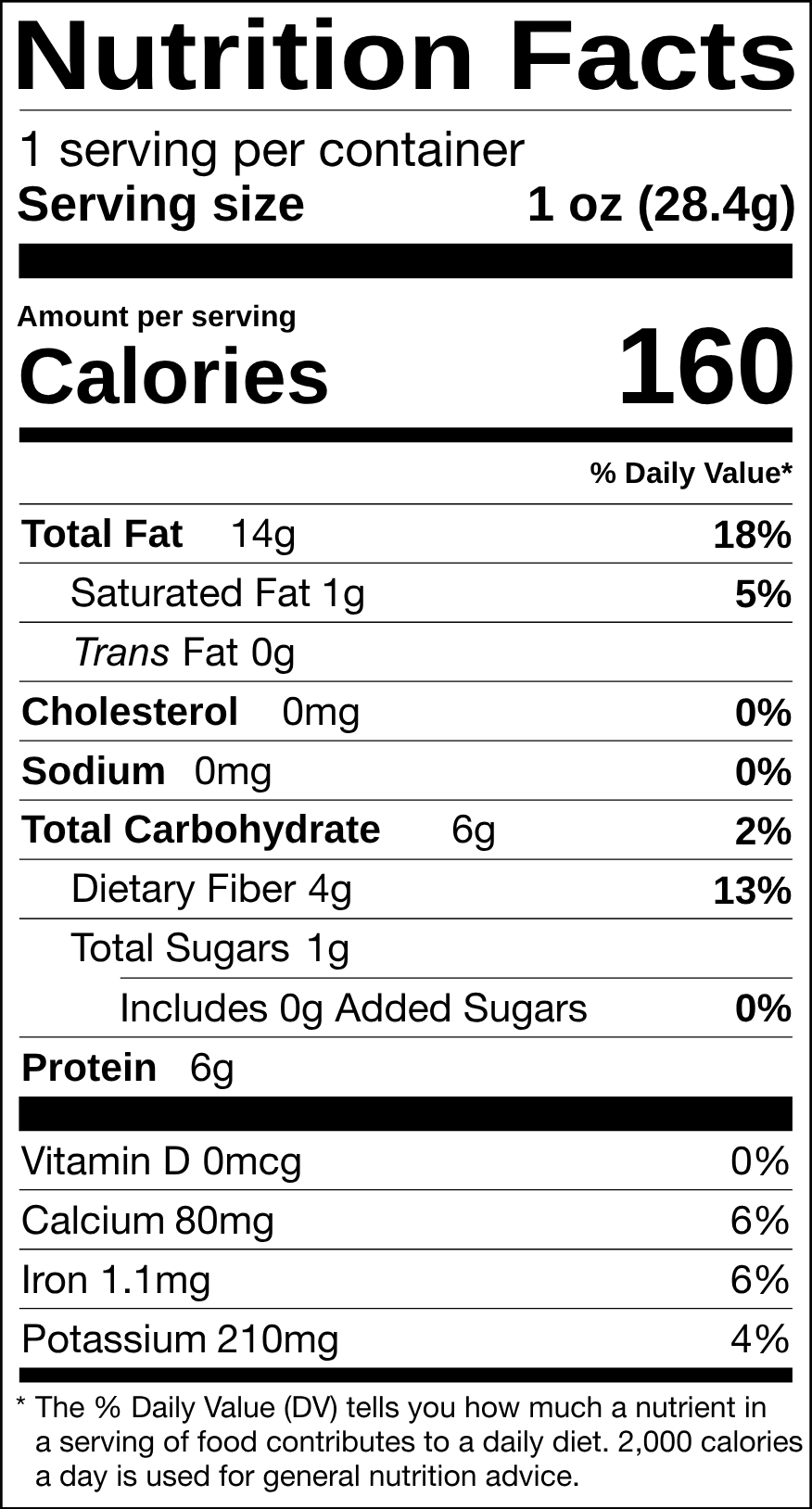
An ounce of almonds (28.4 g) has 164 calories. 100 g has 579 calories. On a Nutrition Facts label, calories are rounded to the nearest 5 or 10, so the panel above may show 160.
An ounce of almonds, about 23 whole nuts (28.4 g), has 164 calories, 6 g of protein, 14.2 g of fat and 3.5 g of fiber. The figures are USDA's for plain whole almonds with the skin on, not roasted and not salted.
FDA standard format. Values use the FDA rounding rules for the serving you pick. Nutrients USDA does not report for this food print as 0 on the panel and as "not reported" in the table.
Download this label: SVG · PNG Free to use as a reference. A label for a product you sell needs your full recipe and ingredient statement.
1 oz (23 whole kernels) (28.4 g)
Opens the free label generator with this amount of almonds already added. Add the rest of your ingredients and the label updates as you go.
| Nutrient | Per serving | % DV* | Per 100 g |
|---|---|---|---|
| Calories and macronutrients | |||
| Calories | 164 | 579 | |
| Total fat | 14.2 g | 18% | 49.9 g |
| Saturated fat | 1.1 g | 5% | 3.8 g |
| Trans fat | <0.1 g | 0.02 g | |
| Monounsaturated fat | 8.9 g | 31.6 g | |
| Polyunsaturated fat | 3.5 g | 12.3 g | |
| Cholesterol | 0 mg | 0% | 0 mg |
| Sodium | 0.28 mg | 0% | 1 mg |
| Total carbohydrate | 6.1 g | 2% | 21.6 g |
| Dietary fiber | 3.5 g | 13% | 12.5 g |
| Total sugars | 1.2 g | 4.35 g | |
| Added sugars | 0 g | 0% | 0 g |
| Protein | 6 g | 21.2 g | |
| Vitamins | |||
| Vitamin D | 0 mcg | 0% | 0 mcg |
| Vitamin A | 0 mcg | 0% | 0 mcg |
| Vitamin C | 0 mg | 0% | 0 mg |
| Vitamin E | 7.3 mg | 48% | 25.6 mg |
| Vitamin K | 0 mcg | 0% | 0 mcg |
| Thiamin (B1) | 0.06 mg | 5% | 0.21 mg |
| Riboflavin (B2) | 0.32 mg | 25% | 1.14 mg |
| Niacin (B3) | 1 mg | 6% | 3.62 mg |
| Vitamin B6 | <0.1 mg | 2% | 0.14 mg |
| Folate (DFE) | 12 mcg | 3% | 44 mcg |
| Vitamin B12 | 0 mcg | 0% | 0 mcg |
| Choline | 15 mg | 3% | 52.1 mg |
| Minerals | |||
| Calcium | 76 mg | 6% | 269 mg |
| Iron | 1.1 mg | 6% | 3.71 mg |
| Potassium | 208 mg | 4% | 733 mg |
| Magnesium | 77 mg | 18% | 270 mg |
| Phosphorus | 136 mg | 11% | 481 mg |
| Zinc | 0.88 mg | 8% | 3.12 mg |
| Copper | 0.29 mg | 32% | 1.03 mg |
| Manganese | 0.62 mg | 27% | 2.18 mg |
| Selenium | 1.2 mcg | 2% | 4.1 mcg |
| Other | |||
| Water | 1.3 g | 4.41 g | |
| Caffeine | 0 mg | 0 mg | |
| Alcohol | 0 g | 0 g | |
* Percent Daily Values are based on a 2,000 calorie diet (FDA reference values for adults and children 4 years and older). Per-100 g values are USDA figures before label rounding.
Every serving below is a USDA household measure for this food, a fraction of one, or a unit conversion. Amounts are USDA values scaled by weight; only the Nutrition Facts panel applies the coarser FDA label rounding.
| Serving | Weight | Calories | Total carbohydrate | Protein | Total fat | Dietary fiber | Total sugars |
|---|---|---|---|---|---|---|---|
| 1 cup, whole | 143 g | 828 | 30.8 g | 30.2 g | 71.4 g | 17.9 g | 6.2 g |
| 1 cup, sliced | 92 g | 533 | 19.8 g | 19.5 g | 45.9 g | 11.5 g | 4 g |
| 1 cup, slivered | 108 g | 625 | 23.3 g | 22.8 g | 53.9 g | 13.5 g | 4.7 g |
| 1 cup, ground | 95 g | 550 | 20.5 g | 20.1 g | 47.4 g | 11.9 g | 4.1 g |
| 1 oz (23 whole kernels) | 28.4 g | 164 | 6.1 g | 6 g | 14.2 g | 3.5 g | 1.2 g |
| 1 almond | 1.2 g | 7 | 0.3 g | 0.3 g | 0.6 g | 0.2 g | 0.1 g |
| 100 g | 100 g | 579 | 21.6 g | 21.2 g | 49.9 g | 12.5 g | 4.4 g |
An ounce of almonds (28.4 g) has 164 calories. 100 g has 579 calories. On a Nutrition Facts label, calories are rounded to the nearest 5 or 10, so the panel above may show 160.
An ounce of almonds (28.4 g) has 6 g protein, 12% of the 50 g Daily Value. 100 g has 21.2 g. At 10 to 19% DV per serving, that meets the FDA threshold for a "good source" claim.
An ounce of almonds (28.4 g) has 6.1 g total carbohydrate, including 3.5 g dietary fiber and 1.2 g total sugars. Carbohydrate minus fiber is 2.6 g.
An ounce of almonds (28.4 g) has 14.2 g total fat: 1.1 g saturated, 8.9 g monounsaturated and 3.5 g polyunsaturated.
An ounce of almonds (28.4 g) has 77 mg of magnesium, 18% of the Daily Value. 100 g has 270 mg. At 10 to 19% DV per serving, that meets the FDA threshold for a "good source" claim.
An ounce of almonds (28.4 g) has 76 mg of calcium, 6% of the Daily Value. 100 g has 269 mg. That is below the 10% DV a serving needs for a "good source" claim.
100 g of almonds has 579 calories, 21.2 g protein, 21.6 g carbohydrate, 12.5 g fiber, 4.35 g sugars and 49.9 g fat.
About 14% of the calories in almonds come from carbohydrate, 72% from fat and 14% from protein (Atwater factors of 4, 9 and 4 calories per gram).
An almond is the seed of the almond tree, a close relative of the peach and the plum. Instead of juicy flesh, the fruit has a leathery green hull that splits open as it dries, exposing a hard shell with the kernel inside. Almonds are sold in the shell, shelled with their brown skin (often called natural almonds), or blanched, which means the skin has been slipped off after a short soak in hot water.
Nearly all almonds grown in the United States come from California, and since 2007 California almonds sold to consumers in North America have had to be pasteurized, usually with steam or another approved treatment. On a package, raw therefore means unroasted rather than untreated. USDA's record on this page is for these unroasted, unsalted almonds.
A cup of almonds weighs very different amounts depending on the cut, because small pieces pack differently from whole nuts. USDA lists four cup measures for the same record:
Roasted almonds have lost a little water, so they carry slightly more calories per gram than raw ones; oil-roasted and salted almonds also add fat and sodium. Almond flour is usually made from blanched almonds and has its own page, while almond meal is often ground with the skins on.
Toast sliced almonds in a dry skillet, stirring often, until they smell nutty and turn light gold. Scatter over a spinach salad with strawberries.
Almonds · Spinach · Strawberry
Top Greek yogurt with chopped almonds, blueberries and a drizzle of honey.
Almonds · Greek Yogurt · Blueberries · Honey
Almonds keep longer than most nuts, but their oil still turns stale and bitter with heat, light and air. Keep them in a sealed container in a cool, dark cupboard for everyday use, and in the refrigerator or freezer for longer storage. Chopped, sliced and ground almonds go stale faster than whole ones because more of the nut is exposed to air.
Weigh almonds in the form you actually use (whole, sliced or as flour), because a cup measure varies so much between cuts. If you roast them in oil or salt them, enter the oil and salt as separate ingredients in the label generator rather than using raw almonds alone. Almonds are a tree nut, one of the major food allergens that must be declared on a US label; the ingredient formatter helps you build the ingredient statement. For plain nuts and nut mixes, the FDA reference amount is close to one ounce, and the RACC lookup gives the exact figure for your product category.
The same serving of almonds, drawn by the label formats other markets require: the Canadian bilingual Nutrition Facts table, the EU nutrition declaration (per 100 g, energy in kJ and kcal, salt instead of sodium) and the UK nutrition information table with reference intakes. The generator switches between these and many more from one recipe.
| Fat / Lipides | 14 g | 19 % |
| Saturated / Saturés | 1.1 g + Trans 0 g | 5 % |
| Cholesterol / Cholestérol | 0 mg | 0 % |
| Sodium | 0 mg | 0 % |
| Carbohydrate / Glucides | 6 g | 2 % |
| Fibre / Fibres | 4 g | 13 % |
| Sugars / Sucres | 1 g | 1 % |
| Protein / Protéines | 6 g | |
| Vitamin D / Vitamine D | 0 mcg | 0 % |
| Calcium | 76 mg | 6 % |
| Iron / Fer | 1 mg | 6 % |
| Potassium | 208 mg | 6 % |
| Per 100g | |
|---|---|
| Energy | 2418 kJ / 578 kcal |
| Fat | 50 g |
| of which saturates | 3.8 g |
| Carbohydrate | 22 g |
| of which sugars | 4.3 g |
| Protein | 21 g |
| Salt | 0.0 g |
| Per 100g | Per 28.4g | %RI* | |
|---|---|---|---|
| Energy | 2418 kJ 578 kcal |
687 kJ 164 kcal |
8.2% |
| Fat | 50g | 14g | 20% |
| of which saturates | 3.8g | 1.1g | 5.4% |
| Carbohydrate | 22g | 6.1g | 2.3% |
| of which sugars | 4.3g | 1.2g | 1.4% |
| Fibre | 12g | 3.5g | - |
| Protein | 21g | 6.0g | 12% |
| Salt | 0 gg | 0 gg | <1% |
Different forms of the same food are separate USDA records, so each has its own page. Per 100 g:
| Form | Calories | Protein | Total fat | Total carbohydrate |
|---|---|---|---|---|
| AlmondsNuts, almonds | 579 | 21.2 g | 49.9 g | 21.6 g |
| Honey Roasted AlmondsNuts, almonds, honey roasted, unblanched | 594 | 18.2 g | 49.9 g | 27.9 g |
| Oil Roasted AlmondsNuts, almonds, oil roasted, without salt added | 607 | 21.2 g | 55.2 g | 17.7 g |
| Roasted AlmondsNuts, almonds, dry roasted, without salt added | 598 | 21 g | 52.5 g | 21 g |
If you make and sell a product that contains almonds, these free tools cover the next steps.
Nutrient values are from USDA FoodData Central, SR Legacy (April 2018 release, public domain), record 170567: "Nuts, almonds". Values are stored per 100 g exactly as USDA reports them and scaled to each serving by weight. The Nutrition Facts panel applies the FDA rounding rules in 21 CFR 101.9; tables and text show the scaled amounts at reading precision, so a figure can differ slightly from the panel. A nutrient USDA does not report for this food is shown as not reported, never as a guessed value.
SR Legacy predates the added sugars field. This is a whole or unsweetened food, so added sugars are shown as 0 g. View the USDA record ↗