How many calories are in whole milk?
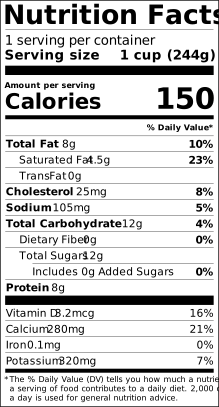
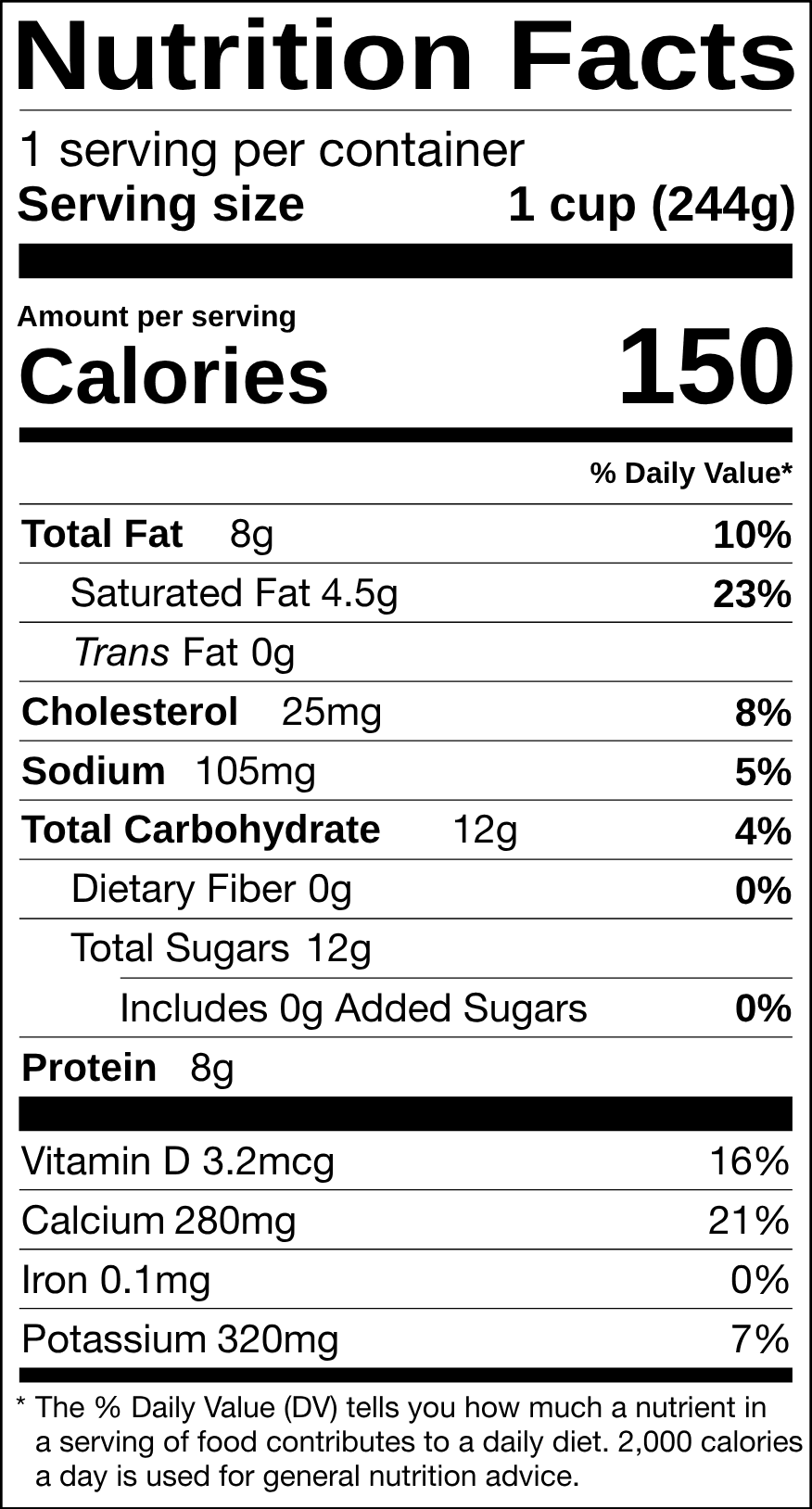
A cup of whole milk (244 g) has 149 calories. 100 g has 61 calories. On a Nutrition Facts label, calories are rounded to the nearest 5 or 10, so the panel above may show 150.
A cup of whole milk (244 g, 8 fluid ounces) has 149 calories, 7.7 g of protein, 7.9 g of fat and 12.3 g of naturally occurring sugar. The figures are USDA's for pasteurized whole cow's milk with added vitamin D.
FDA standard format. Values use the FDA rounding rules for the serving you pick. Nutrients USDA does not report for this food print as 0 on the panel and as "not reported" in the table.
Download this label: SVG · PNG Free to use as a reference. A label for a product you sell needs your full recipe and ingredient statement.
1 cup (244 g)
Opens the free label generator with this amount of whole milk already added. Add the rest of your ingredients and the label updates as you go.
| Nutrient | Per serving | % DV* | Per 100 g |
|---|---|---|---|
| Calories and macronutrients | |||
| Calories | 149 | 61 | |
| Total fat | 7.9 g | 10% | 3.25 g |
| Saturated fat | 4.6 g | 23% | 1.87 g |
| Trans fat | not reported | ||
| Monounsaturated fat | 2 g | 0.81 g | |
| Polyunsaturated fat | 0.5 g | 0.2 g | |
| Cholesterol | 24 mg | 8% | 10 mg |
| Sodium | 105 mg | 5% | 43 mg |
| Total carbohydrate | 11.7 g | 4% | 4.8 g |
| Dietary fiber | 0 g | 0% | 0 g |
| Total sugars | 12.3 g | 5.05 g | |
| Added sugars | 0 g | 0% | 0 g |
| Protein | 7.7 g | 3.15 g | |
| Vitamins | |||
| Vitamin D | 3.2 mcg | 16% | 1.3 mcg |
| Vitamin A | 112 mcg | 12% | 46 mcg |
| Vitamin C | 0 mg | 0% | 0 mg |
| Vitamin E | 0.17 mg | 1% | 0.07 mg |
| Vitamin K | 0.73 mcg | 1% | 0.3 mcg |
| Thiamin (B1) | 0.11 mg | 9% | 0.05 mg |
| Riboflavin (B2) | 0.41 mg | 32% | 0.17 mg |
| Niacin (B3) | 0.22 mg | 1% | 0.09 mg |
| Vitamin B6 | 0.09 mg | 5% | 0.04 mg |
| Folate (DFE) | 12 mcg | 3% | 5 mcg |
| Vitamin B12 | 1.1 mcg | 46% | 0.45 mcg |
| Choline | 35 mg | 6% | 14.3 mg |
| Minerals | |||
| Calcium | 276 mg | 21% | 113 mg |
| Iron | 0.07 mg | 0% | 0.03 mg |
| Potassium | 322 mg | 7% | 132 mg |
| Magnesium | 24 mg | 6% | 10 mg |
| Phosphorus | 205 mg | 16% | 84 mg |
| Zinc | 0.9 mg | 8% | 0.37 mg |
| Copper | 0.06 mg | 7% | 0.03 mg |
| Manganese | <0.1 mg | 0% | 0 mg |
| Selenium | 9 mcg | 16% | 3.7 mcg |
| Other | |||
| Water | 215 g | 88.1 g | |
| Caffeine | 0 mg | 0 mg | |
| Alcohol | 0 g | 0 g | |
* Percent Daily Values are based on a 2,000 calorie diet (FDA reference values for adults and children 4 years and older). Per-100 g values are USDA figures before label rounding.
Every serving below is a USDA household measure for this food, a fraction of one, or a unit conversion. Amounts are USDA values scaled by weight; only the Nutrition Facts panel applies the coarser FDA label rounding.
| Serving | Weight | Calories | Total carbohydrate | Protein | Total fat | Dietary fiber | Total sugars |
|---|---|---|---|---|---|---|---|
| 1 cup | 244 g | 149 | 11.7 g | 7.7 g | 7.9 g | 0 g | 12.3 g |
| 1 fl oz | 30.5 g | 19 | 1.5 g | 1 g | 1 g | 0 g | 1.5 g |
| 1 tbsp | 15 g | 9 | 0.7 g | 0.5 g | 0.5 g | 0 g | 0.8 g |
| 1 quart | 976 g | 595 | 46.8 g | 30.7 g | 31.7 g | 0 g | 49.3 g |
| 100 g | 100 g | 61 | 4.8 g | 3.2 g | 3.3 g | 0 g | 5.1 g |
A cup of whole milk (244 g) has 149 calories. 100 g has 61 calories. On a Nutrition Facts label, calories are rounded to the nearest 5 or 10, so the panel above may show 150.
A cup of whole milk (244 g) has 7.7 g protein, 15% of the 50 g Daily Value. 100 g has 3.15 g. At 10 to 19% DV per serving, that meets the FDA threshold for a "good source" claim.
A cup of whole milk (244 g) has 12.3 g total sugars. None of it is added sugar.
A cup of whole milk (244 g) has 7.9 g total fat: 4.6 g saturated, 2 g monounsaturated and 0.5 g polyunsaturated.
A cup of whole milk (244 g) has 276 mg of calcium, 21% of the Daily Value. 100 g has 113 mg. At 20% DV or more per serving, that meets the FDA threshold for an "excellent source" claim.
A cup of whole milk (244 g) has 3.2 mcg of vitamin D, 16% of the Daily Value. 100 g has 1.3 mcg. At 10 to 19% DV per serving, that meets the FDA threshold for a "good source" claim.
100 g of whole milk has 61 calories, 3.15 g protein, 4.8 g carbohydrate, 0 g fiber, 5.05 g sugars and 3.25 g fat.
About 31% of the calories in whole milk come from carbohydrate, 48% from fat and 21% from protein (Atwater factors of 4, 9 and 4 calories per gram).
Whole milk is cow's milk with none of its fat removed, standardized so the fat content is consistent from carton to carton. The record behind this page is plain whole milk with added vitamin D, the most common kind on US shelves. Adding vitamin D to whole milk is optional, so a carton without it will show less on its label.
The sugar in plain milk is lactose, which comes from the milk itself. That is why the label shows several grams of total sugars but zero added sugars, while chocolate and other flavored milks carry added sugar on top.
The milks in the dairy case differ mainly in fat:
Milk is drunk on its own and poured over cereal, but it also does specific work in recipes. In baking it adds moisture and its sugar and protein help crusts brown. In sauces it is the base of bechamel and cheese sauce. It sets custards and puddings with eggs or starch, and it is the starting point for yogurt, cheese and butter. Food manufacturers use milk in liquid, condensed, evaporated and dried forms; nonfat dry milk is common in baked goods and mixes because it stores without refrigeration.
Blend a cup of milk with a frozen banana and a spoon of peanut butter until smooth.
Stir rolled oats and chia seeds into milk in a jar, refrigerate overnight, and top with berries in the morning.
Whole Milk · Oats · Chia Seeds · Blueberries
Cook butter and flour together, whisk in milk until thick, then melt in shredded cheddar. Serve over pasta or broccoli.
Keep milk on a shelf in the main part of the refrigerator rather than in the door, which warms up every time it opens, and put it back promptly after pouring. Once opened, milk is best used within about a week. Milk can be frozen for cooking and baking, but it separates when thawed, so it is better in recipes than in a glass.
Milk is one of the major food allergens, so any product containing milk or milk ingredients such as whey, casein, butter or cheese must declare milk. For the nutrition panel, enter milk by weight rather than by volume: a cup of whole milk weighs 244 g, a little more than a cup of water. Note which milk you use, since whole, 2% and skim differ in fat and calories. Build the recipe in the label generator, use the ingredient formatter for the allergen statement, and look up your product category in the RACC lookup. The lactose from milk counts as total sugars but not as added sugars.
The same serving of whole milk, drawn by the label formats other markets require: the Canadian bilingual Nutrition Facts table, the EU nutrition declaration (per 100 g, energy in kJ and kcal, salt instead of sodium) and the UK nutrition information table with reference intakes. The generator switches between these and many more from one recipe.
| Fat / Lipides | 8 g | 11 % |
| Saturated / Saturés | 4.6 g + Trans 0 g | 23 % |
| Cholesterol / Cholestérol | 24 mg | 8 % |
| Sodium | 105 mg | 5 % |
| Carbohydrate / Glucides | 12 g | 4 % |
| Fibre / Fibres | 0 g | 0 % |
| Sugars / Sucres | 12 g | 12 % |
| Protein / Protéines | 8 g | |
| Vitamin D / Vitamine D | 3 mcg | 16 % |
| Calcium | 276 mg | 21 % |
| Iron / Fer | 0 mg | 0 % |
| Potassium | 322 mg | 9 % |
| Per 100g | |
|---|---|
| Energy | 255 kJ / 61 kcal |
| Fat | 3.3 g |
| of which saturates | 1.9 g |
| Carbohydrate | 4.8 g |
| of which sugars | 5.1 g |
| Protein | 3.1 g |
| Salt | 0.1 g |
| Per 100g | Per 244g | %RI* | |
|---|---|---|---|
| Energy | 255 kJ 61 kcal |
623 kJ 149 kcal |
7.4% |
| Fat | 3.3g | 7.9g | 11% |
| of which saturates | 1.9g | 4.6g | 23% |
| Carbohydrate | 4.8g | 12g | 4.5% |
| of which sugars | 5.1g | 12g | 14% |
| Fibre | 0 gg | 0 gg | - |
| Protein | 3.1g | 7.7g | 15% |
| Salt | 0.11g | 0.26g | 4.4% |
Different forms of the same food are separate USDA records, so each has its own page. Per 100 g:
| Form | Calories | Protein | Total fat | Total carbohydrate |
|---|---|---|---|---|
| Whole MilkMilk, whole, 3.25% milkfat, with added vitamin D | 61 | 3.15 g | 3.25 g | 4.8 g |
| 1% MilkMilk, lowfat, fluid, 1% milkfat, with added vitamin A and vitamin D | 42 | 3.37 g | 0.97 g | 4.99 g |
| 2% MilkMilk, reduced fat, fluid, 2% milkfat, with added vitamin A and vitamin D | 50 | 3.3 g | 1.98 g | 4.8 g |
| Skim MilkMilk, nonfat, fluid, with added vitamin A and vitamin D (fat free or skim) | 34 | 3.37 g | 0.08 g | 4.96 g |
If you make and sell a product that contains whole milk, these free tools cover the next steps.
Nutrient values are from USDA FoodData Central, SR Legacy (April 2018 release, public domain), record 171265: "Milk, whole, 3.25% milkfat, with added vitamin D". Values are stored per 100 g exactly as USDA reports them and scaled to each serving by weight. The Nutrition Facts panel applies the FDA rounding rules in 21 CFR 101.9; tables and text show the scaled amounts at reading precision, so a figure can differ slightly from the panel. A nutrient USDA does not report for this food is shown as not reported, never as a guessed value.
SR Legacy predates the added sugars field. This is a whole or unsweetened food, so added sugars are shown as 0 g. View the USDA record ↗