How many calories are in chicken breast?
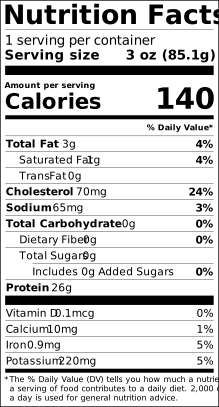
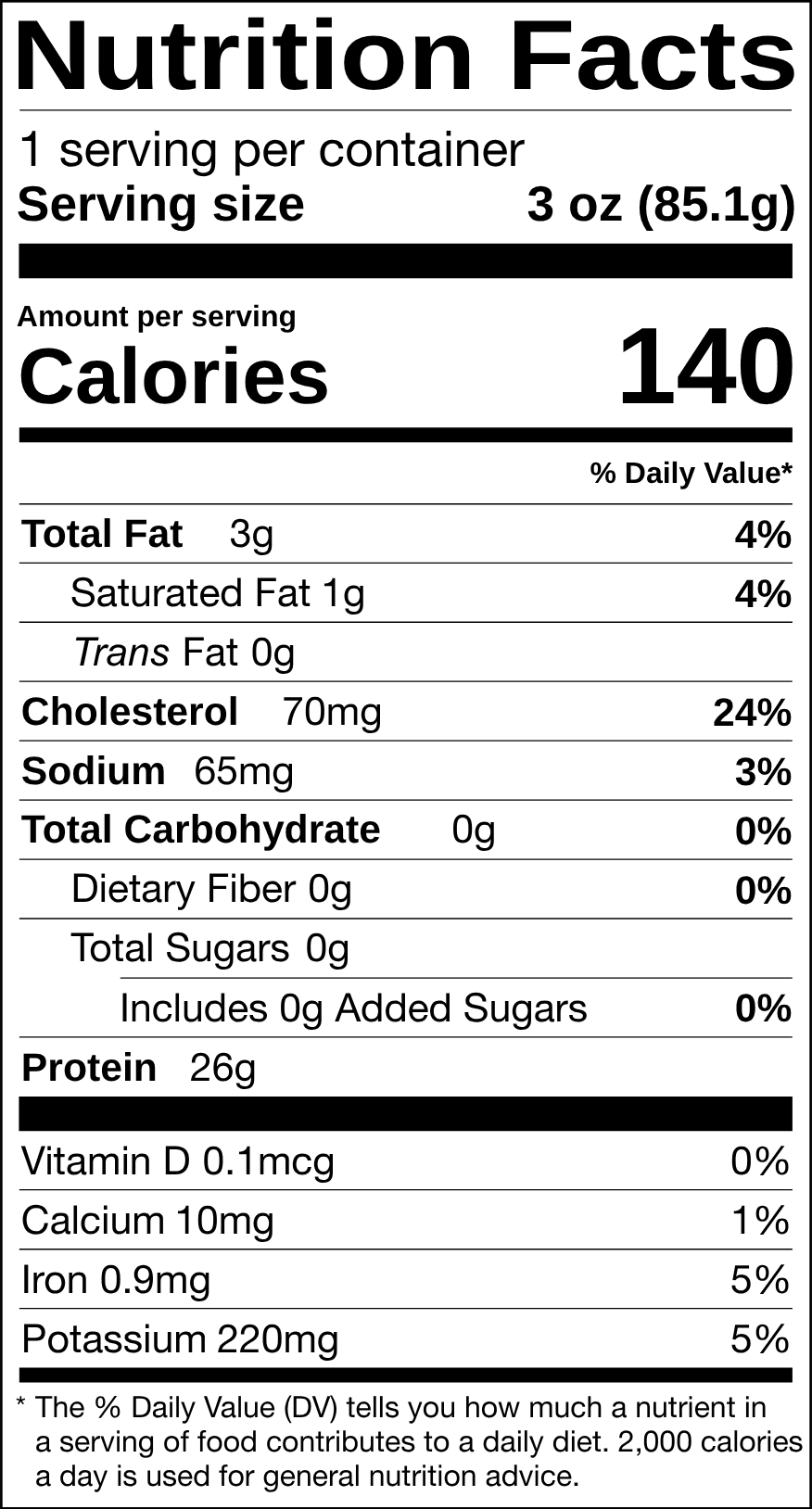
3 oz of chicken breast (85.1 g) has 140 calories. 100 g has 165 calories. On a Nutrition Facts label, calories are rounded to the nearest 5 or 10, so the panel above may show 140.
Three ounces of skinless roasted chicken breast (85.1 g) has 140 calories, 26.4 g of protein and 3 g of fat, with no carbohydrate. These are USDA's numbers for cooked meat with no skin or bone, so they apply to chicken weighed after cooking.
FDA standard format. Values use the FDA rounding rules for the serving you pick. Nutrients USDA does not report for this food print as 0 on the panel and as "not reported" in the table.
Download this label: SVG · PNG Free to use as a reference. A label for a product you sell needs your full recipe and ingredient statement.
3 oz (85.1 g)
Opens the free label generator with this amount of chicken breast already added. Add the rest of your ingredients and the label updates as you go.
| Nutrient | Per serving | % DV* | Per 100 g |
|---|---|---|---|
| Calories and macronutrients | |||
| Calories | 140 | 165 | |
| Total fat | 3 g | 4% | 3.57 g |
| Saturated fat | 0.9 g | 4% | 1.01 g |
| Trans fat | not reported | ||
| Monounsaturated fat | 1.1 g | 1.24 g | |
| Polyunsaturated fat | 0.7 g | 0.77 g | |
| Cholesterol | 72 mg | 24% | 85 mg |
| Sodium | 63 mg | 3% | 74 mg |
| Total carbohydrate | 0 g | 0% | 0 g |
| Dietary fiber | 0 g | 0% | 0 g |
| Total sugars | 0 g | 0 g | |
| Added sugars | 0 g | 0% | 0 g |
| Protein | 26.4 g | 31 g | |
| Vitamins | |||
| Vitamin D | 0.09 mcg | 0% | 0.1 mcg |
| Vitamin A | 5.1 mcg | 1% | 6 mcg |
| Vitamin C | 0 mg | 0% | 0 mg |
| Vitamin E | 0.23 mg | 2% | 0.27 mg |
| Vitamin K | 0.26 mcg | 0% | 0.3 mcg |
| Thiamin (B1) | 0.06 mg | 5% | 0.07 mg |
| Riboflavin (B2) | 0.1 mg | 7% | 0.11 mg |
| Niacin (B3) | 12 mg | 73% | 13.7 mg |
| Vitamin B6 | 0.51 mg | 30% | 0.6 mg |
| Folate (DFE) | 3.4 mcg | 1% | 4 mcg |
| Vitamin B12 | 0.29 mcg | 12% | 0.34 mcg |
| Choline | 73 mg | 13% | 85.3 mg |
| Minerals | |||
| Calcium | 13 mg | 1% | 15 mg |
| Iron | 0.88 mg | 5% | 1.04 mg |
| Potassium | 218 mg | 5% | 256 mg |
| Magnesium | 25 mg | 6% | 29 mg |
| Phosphorus | 194 mg | 16% | 228 mg |
| Zinc | 0.85 mg | 8% | 1 mg |
| Copper | <0.1 mg | 5% | 0.05 mg |
| Manganese | <0.1 mg | 1% | 0.02 mg |
| Selenium | 23 mcg | 43% | 27.6 mcg |
| Other | |||
| Water | 55.5 g | 65.3 g | |
| Caffeine | 0 mg | 0 mg | |
| Alcohol | 0 g | 0 g | |
* Percent Daily Values are based on a 2,000 calorie diet (FDA reference values for adults and children 4 years and older). Per-100 g values are USDA figures before label rounding.
Every serving below is a USDA household measure for this food, a fraction of one, or a unit conversion. Amounts are USDA values scaled by weight; only the Nutrition Facts panel applies the coarser FDA label rounding.
| Serving | Weight | Calories | Total carbohydrate | Protein | Total fat | Dietary fiber | Total sugars |
|---|---|---|---|---|---|---|---|
| 1 cup, chopped or diced | 140 g | 231 | 0 g | 43.4 g | 5 g | 0 g | 0 g |
| 1 unit (yield from 1 lb ready-to-cook chicken) | 52 g | 86 | 0 g | 16.1 g | 1.9 g | 0 g | 0 g |
| 1/2 breast, bone and skin removed | 86 g | 142 | 0 g | 26.7 g | 3.1 g | 0 g | 0 g |
| 3 oz | 85.1 g | 140 | 0 g | 26.4 g | 3 g | 0 g | 0 g |
| 4 oz | 113.4 g | 187 | 0 g | 35.2 g | 4 g | 0 g | 0 g |
| 100 g | 100 g | 165 | 0 g | 31 g | 3.6 g | 0 g | 0 g |
3 oz of chicken breast (85.1 g) has 140 calories. 100 g has 165 calories. On a Nutrition Facts label, calories are rounded to the nearest 5 or 10, so the panel above may show 140.
3 oz of chicken breast (85.1 g) has 26.4 g protein, 53% of the 50 g Daily Value. 100 g has 31 g. At 20% DV or more per serving, that meets the FDA threshold for an "excellent source" claim.
100 g of chicken breast has 165 calories, 31 g protein, 0 g carbohydrate, 0 g fiber, 0 g sugars and 3.57 g fat.
3 oz of chicken breast (85.1 g) has 3 g total fat: 0.9 g saturated, 1.1 g monounsaturated and 0.7 g polyunsaturated.
3 oz of chicken breast (85.1 g) has 72 mg of cholesterol, 24% of the Daily Value. 100 g has 85 mg. That is 20% DV or more per serving, which the FDA treats as high.
3 oz of chicken breast (85.1 g) has 63 mg of sodium, 3% of the Daily Value. 100 g has 74 mg.
About 0% of the calories in chicken breast come from carbohydrate, 21% from fat and 79% from protein (Atwater factors of 4, 9 and 4 calories per gram).
The record on this page is breast meat only, roasted, from standard broiler chickens: no skin, no bone, no breading, no marinade. Grilled or baked skinless breast cooked without oil or sauce is close to it, since all three are dry-heat methods. The figures drift mainly with how long the meat is cooked, because more cooking drives out more water and concentrates what is left.
A "chicken breast" from the store is not a fixed size. USDA's half breast, one side of the bird with skin and bone removed, is 86 g cooked, but supermarket boneless breasts are often much larger. Weighing your portion is the only reliable way to match these numbers.
Chicken breast loses roughly a quarter of its weight as it cooks, almost all of it water. The protein, fat and calories stay in the meat, so every gram of cooked chicken carries more of them than a gram of raw chicken. As a rule of thumb, about 4 ounces of raw boneless breast cooks down to about 3 ounces.
This is the most common source of error in tracking chicken: weighing it raw and then using cooked figures, or the reverse. If you weigh after cooking, use this page. If you weigh raw, use raw chicken values or adjust for the water lost. Either way, cook chicken to the USDA safe minimum internal temperature of 165 °F.
Because it is lean and mild, chicken breast takes on whatever it is cooked with. It is grilled or roasted and sliced over salads and grain bowls, cut into strips for stir-fries and fajitas, poached and shredded for chicken salad, soup and enchiladas, or pounded thin into cutlets for breading. The same leanness makes it easy to overcook into dry meat, which is why brining and marinating are common. In food manufacturing, breast meat goes into deli slices, canned chicken, frozen entrees and breaded nuggets and tenders.
Toss chicken pieces and broccoli florets with olive oil, garlic and salt, spread on one pan and roast until the chicken is cooked through.
Slice grilled chicken over brown rice and black beans, then top with avocado and chopped tomato.
Chicken Breast · Brown Rice · Black Beans · Avocado · Tomato
Mix shredded cooked chicken with Greek yogurt, diced cucumber and a little garlic, and serve in lettuce leaves.
Chicken Breast · Greek Yogurt · Cucumber · Green Leaf Lettuce
Raw chicken breast keeps for one to two days in the refrigerator; freeze it if you will not cook it by then. Cooked chicken keeps three to four days refrigerated. For meal prep, cool cooked chicken quickly and store it in shallow containers, and weigh portions after cooking so the numbers on this page apply.
Products containing poultry are labeled under USDA FSIS rules, which set one reference amount for ready-to-serve poultry and a larger one for raw, ready-to-cook poultry, so be clear which you sell. For prepared foods such as salads, wraps or meal-prep bowls, weigh the cooked chicken that goes into each portion and use cooked data like this page. If your recipe starts from raw chicken, account for the water lost in cooking, since the finished weight is what the serving size is based on. Build the recipe in the label generator or the recipe nutrition calculator, and check the reference amount in the RACC lookup. Brines and marinades add sodium, so include them as ingredients.
The same serving of chicken breast, drawn by the label formats other markets require: the Canadian bilingual Nutrition Facts table, the EU nutrition declaration (per 100 g, energy in kJ and kcal, salt instead of sodium) and the UK nutrition information table with reference intakes. The generator switches between these and many more from one recipe.
| Fat / Lipides | 3.0 g | 4 % |
| Saturated / Saturés | 0.9 g + Trans 0 g | 4 % |
| Cholesterol / Cholestérol | 72 mg | 24 % |
| Sodium | 65 mg | 3 % |
| Carbohydrate / Glucides | 0 g | 0 % |
| Fibre / Fibres | 0 g | 0 % |
| Sugars / Sucres | 0 g | 0 % |
| Protein / Protéines | 26 g | |
| Vitamin D / Vitamine D | 0 mcg | 0 % |
| Calcium | 13 mg | 1 % |
| Iron / Fer | 1 mg | 5 % |
| Potassium | 218 mg | 6 % |
| Per 100g | |
|---|---|
| Energy | 690 kJ / 165 kcal |
| Fat | 3.6 g |
| of which saturates | 1.0 g |
| Carbohydrate | 0.0 g |
| of which sugars | 0.0 g |
| Protein | 31 g |
| Salt | 0.2 g |
| Per 100g | Per 85.1g | %RI* | |
|---|---|---|---|
| Energy | 690 kJ 165 kcal |
587 kJ 140 kcal |
7% |
| Fat | 3.6g | 3.0g | 4.3% |
| of which saturates | 1.0g | 0.9g | 4.3% |
| Carbohydrate | 0 gg | 0 gg | <1% |
| of which sugars | 0 gg | 0 gg | <1% |
| Fibre | 0 gg | 0 gg | - |
| Protein | 31g | 26g | 53% |
| Salt | 0.18g | 0.16g | 2.6% |
Different forms of the same food are separate USDA records, so each has its own page. Per 100 g:
| Form | Calories | Protein | Total fat | Total carbohydrate |
|---|---|---|---|---|
| Chicken BreastChicken, broilers or fryers, breast, meat only, cooked, roasted | 165 | 31 g | 3.57 g | 0 g |
| Boiled Chicken BreastChicken, broilers or fryers, breast, meat only, cooked, stewed | 151 | 29 g | 3.03 g | 0 g |
| Chicken Breast with SkinChicken, broilers or fryers, breast, meat and skin, cooked, roasted | 197 | 29.8 g | 7.78 g | 0 g |
| Fried Chicken BreastChicken, broilers or fryers, breast, meat and skin, cooked, fried, batter | 260 | 24.8 g | 13.2 g | 8.99 g |
| Grilled Chicken BreastChicken, broiler or fryers, breast, skinless, boneless, meat only, cooked, grilled | 151 | 30.5 g | 3.17 g | 0 g |
| Raw Chicken BreastChicken, broiler or fryers, breast, skinless, boneless, meat only, raw | 120 | 22.5 g | 2.62 g | 0 g |
If you make and sell a product that contains chicken breast, these free tools cover the next steps.
Nutrient values are from USDA FoodData Central, SR Legacy (April 2018 release, public domain), record 171477: "Chicken, broilers or fryers, breast, meat only, cooked, roasted". Values are stored per 100 g exactly as USDA reports them and scaled to each serving by weight. The Nutrition Facts panel applies the FDA rounding rules in 21 CFR 101.9; tables and text show the scaled amounts at reading precision, so a figure can differ slightly from the panel. A nutrient USDA does not report for this food is shown as not reported, never as a guessed value.
SR Legacy predates the added sugars field. This is a whole or unsweetened food, so added sugars are shown as 0 g. View the USDA record ↗