FDA Nutrition Facts label requirements (21 CFR 101.9)
What the US Nutrition Facts label must contain, which of the fifteen FDA formats your package is allowed to use, who is exempt, and how the rounding and Daily Values work. Every format below opens in the generator, pre-set to the rule.
Reviewed against 21 CFR § 101.9 (Nutrition labeling of food) · Page updated October 2, 2026
What the rule covers
The Nutrition Facts label is set by 21 CFR 101.9, the FDA regulation that fixes what a packaged food sold in the United States must declare, in what order, at what type size, and with which rounding. The current design comes from the 2016 final rule; large manufacturers had to comply by 1 January 2020 and everyone else by 1 January 2021, so every label on shelf today should already be in the new format. If yours still shows "Calories from Fat" or lists vitamins A and C as mandatory, it is out of date.
The label sits inside a wider set of requirements that ship together on the same package: the ingredient statement (21 CFR 101.4, descending order by weight), the allergen declaration (FALCPA plus the FASTER Act, which made sesame the ninth major allergen from 1 January 2023), the statement of identity (101.3), the net quantity of contents (101.7) on the principal display panel, and the name and place of business (101.5). The free FDA label requirement checklist walks through all of them for your product type; this page is about the panel itself.
This page is written from the regulation text and FDA's labeling guidance, dated 2 September 2026. Thresholds and Daily Values below are the ones in force on that date.
The fifteen mandatory nutrients, in order
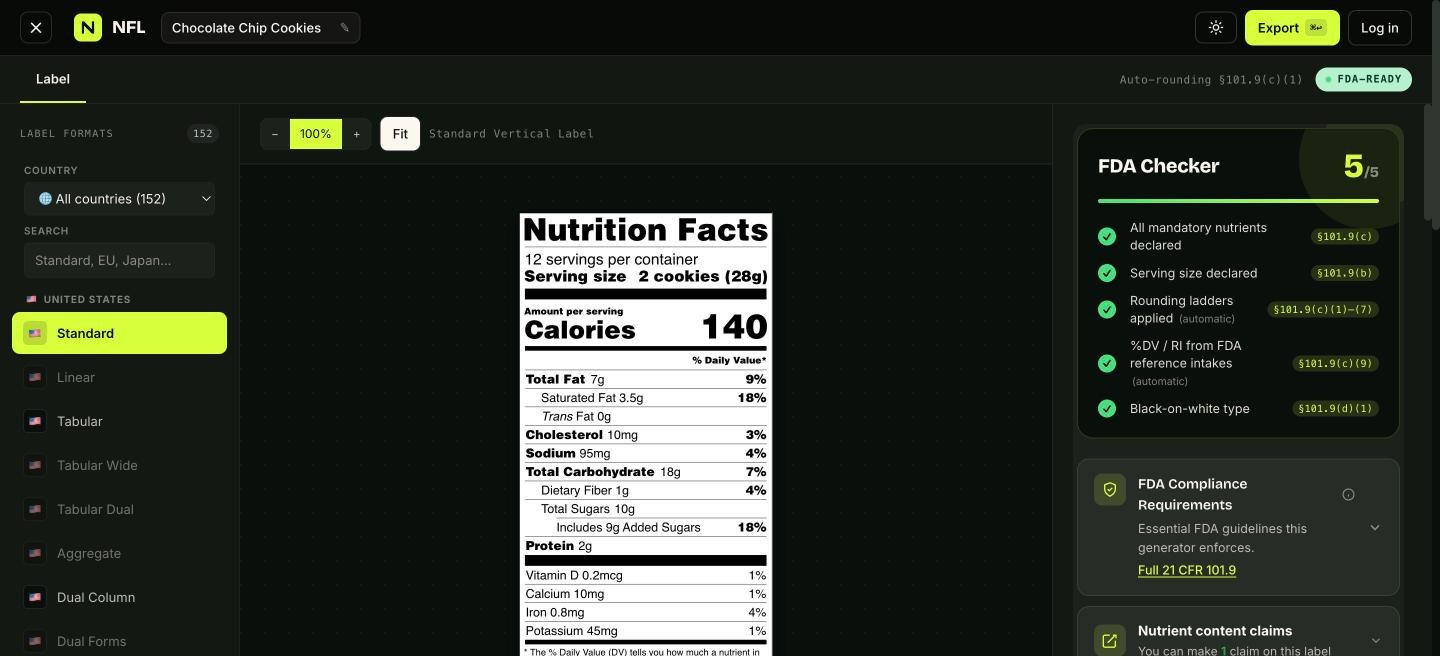
Every standard panel lists, in this order and with this indentation: Calories; Total Fat with Saturated Fat and Trans Fat indented beneath it; Cholesterol; Sodium; Total Carbohydrate with Dietary Fiber, Total Sugars and, indented under sugars, Added Sugars; Protein; then, below the thick bar, Vitamin D, Calcium, Iron and Potassium with their absolute amounts and %DV.
Vitamins A and C, thiamin, riboflavin, niacin, folate and the rest are voluntary: you may list them, and you must list them if you make a claim about them or add them as a fortificant. Polyunsaturated and monounsaturated fat, soluble and insoluble fiber, and sugar alcohols follow the same voluntary-unless-claimed logic. The generator's claim validator tells you which nutrient a claim drags onto the panel.
Daily Values are the 2016 set on a 2,000-calorie diet: total fat 78 g, saturated fat 20 g, cholesterol 300 mg, sodium 2,300 mg, total carbohydrate 275 g, dietary fiber 28 g, added sugars 50 g, protein 50 g, vitamin D 20 mcg, calcium 1,300 mg, iron 18 mg, potassium 4,700 mg. Trans fat and total sugars carry no Daily Value and no %DV. The %DV calculator does the arithmetic for any nutrient, including the voluntary ones.
Serving size: the RACC decides, not you
The serving size on a US label is not a marketing choice. It is derived from the Reference Amount Customarily Consumed for the food category in 21 CFR 101.12, expressed in a household measure (2 cookies, 1 cup, 3 pieces) followed by the metric weight in parentheses. The 2016 rule updated many RACCs to what people actually eat: ice cream went from ½ cup to ⅔ cup, soda from 8 fl oz to 12 fl oz.
Two consequences follow. First, a package that holds between 200% and 300% of the RACC, and could reasonably be eaten in one sitting, must use the dual-column format showing per-serving and per-container values. Second, a package holding less than 200% of the RACC is a single serving, and the whole package is the serving size, whatever your portion intentions. The RACC lookup returns the reference amount for 140-plus categories; the generator applies it automatically when you choose a category.
"Servings per container" is rounded to the nearest whole number, with two exceptions: between 2 and 5 servings rounds to the nearest 0.5, and anything that cannot be stated precisely is written "about 3".
Rounding: every nutrient has its own rule
101.9(c) sets a rounding increment per nutrient, and getting these wrong is the most common defect in home-made labels. Calories round to the nearest 5 up to 50, and to the nearest 10 above that; under 5 calories is declared as 0. Total fat, saturated fat and trans fat round to the nearest 0.5 g below 5 g and the nearest gram above; under 0.5 g is "0 g". Cholesterol rounds to the nearest 5 mg; under 2 mg is "0 mg", and 2 to 5 mg is "less than 5 mg". Sodium rounds to the nearest 5 mg up to 140 mg and the nearest 10 mg above; under 5 mg is "0 mg". Carbohydrate, fiber, sugars, added sugars and protein round to the nearest gram, with "less than 1 g" for anything between 0.5 and 1 g and "0 g" below 0.5.
%DV rounds to the nearest whole percent, and it is computed from the unrounded nutrient amount, not the number you printed. That is why two labels showing "1 g" of fiber can honestly show 3% and 4%. The generator keeps both figures and rounds each independently; if you are typing values by hand, the unit converter and the rounding notes on each format page cover the edge cases.
| Per 100g | |
|---|---|
| Energy | 2092 kJ / 500 kcal |
| Fat | 25 g |
| of which saturates | 13 g |
| Carbohydrate | 64 g |
| of which sugars | 36 g |
| Protein | 7.1 g |
| Salt | 0.8 g |
| Fat / Lipides | 7 g | 9 % |
| Saturated / Saturés | 3.5 g + Trans 0 g | 18 % |
| Cholesterol / Cholestérol | 10 mg | 3 % |
| Sodium | 95 mg | 4 % |
| Carbohydrate / Glucides | 18 g | 7 % |
| Fibre / Fibres | 1 g | 4 % |
| Sugars / Sucres | 10 g | 10 % |
| Protein / Protéines | 2 g | |
| Vitamin D / Vitamine D | 0 mcg | 0 % |
| Calcium | 10 mg | 1 % |
| Iron / Fer | 1 mg | 4 % |
| Potassium | 45 mg | 1 % |
*5 % ou moins c'est peu, 15 % ou plus c'est beaucoup
Which format is your package allowed to use
The standard vertical panel is the default, and most of the other fourteen are permitted only when a condition in 101.9(d), (e), (f) or (j) is met. The conditions are about available label space, package contents and the consumer, not preference. Each card links the format's own page, which cites the paragraph that permits it and opens the generator on that layout.
Two of these deserve a warning. The simplified format is not a small-package option; it is for foods where eight or more of the fifteen mandatory nutrients are present in insignificant amounts (a bottle of water, a plain tea). The tabular and linear formats are tied to measured surface area, 40 sq in and 12 sq in respectively, and the PDP area and type-size calculator does that measurement, including the minimum type sizes that scale with it.
Supplement Facts is a different panel
Dietary supplements are labeled under 21 CFR 101.36, not 101.9. The panel is titled "Supplement Facts", dietary ingredients without a Daily Value sit below a heavy bar with a dagger footnote, source ingredients appear in parentheses, and proprietary blends are declared by total weight with ingredients in descending order. Putting a supplement in a Nutrition Facts panel, or a food in a Supplement Facts panel, is a misbranding issue in itself. The nine US variants:
The differences are set out in Supplement Facts vs Nutrition Facts, and the Supplement Facts generator handles the 101.36 rules directly.
Type size, layout and the things inspectors measure
101.9(d) fixes the look. "Nutrition Facts" is set larger than any other type on the panel. The calorie number is the largest figure on the label, in bold, with "Calories" above it in smaller bold type. Serving size and servings per container sit at the top, with the serving-size value in bold. All text is no smaller than 8 point, except the footnote, which may drop to 6 point, and the whole panel is enclosed in a box with hairline rules between nutrients and heavier bars separating the calorie block and the vitamin block. Type must be a single easy-to-read face, with at least one point of leading, on a contrasting background.
The footnote is fixed text: "The % Daily Value (DV) tells you how much a nutrient in a serving of food contributes to a daily diet. 2,000 calories a day is used for general nutrition advice." Labels on packages with less than 40 sq in may shorten it, and the simplified format may drop it in favor of "% DV = % Daily Value". Every format the generator renders carries the footnote text the rule prescribes for that format; it is one of the details a print shop's template gets wrong most often.
Who does not need a Nutrition Facts label
101.9(j) lists the exemptions, and most small producers fall under at least one. Small businesses with fewer than 100 full-time equivalent employees and fewer than 100,000 units sold in the US per year are exempt, but only if they file the small-business notice with FDA each year and make no nutrient content or health claims. Packages with less than 12 square inches of total surface area may replace the panel with a telephone number or address where the information can be obtained, again provided no claims are made. Food served in restaurants and for immediate consumption, raw fruit, vegetables and fish (which fall under the voluntary program in 101.45), foods of no nutritional significance such as plain coffee and tea, and infant formula (which has its own rule in 107) are also outside 101.9.
Two traps. First, the moment you print "low fat", "good source of fiber" or any other claim, every exemption above evaporates and a full panel is required. Second, state cottage-food laws are separate: they may exempt you from a Nutrition Facts panel but still require an ingredient list, allergen statement and a "made in a home kitchen" disclosure, and they only apply to intrastate sales. Selling across a state line, or online to another state, puts you back under federal rules.
The rest of the package
Ingredient statement (101.4): every ingredient by common or usual name, descending order by weight, sub-ingredients of compound ingredients in parentheses, and the specific source named for oils, flours and sweeteners. Ingredients at 2% or less may be grouped after a "contains 2% or less of" lead-in. The ingredient formatter produces the statement from a recipe.
Allergens: milk, eggs, fish, crustacean shellfish, tree nuts, peanuts, wheat, soybeans and sesame must be declared, either by name inside the ingredient list or in a "Contains:" statement immediately after it. The species of fish, shellfish and tree nut must be named. "May contain" advisory statements are voluntary and unregulated in the US; they never substitute for a required declaration. The allergen detector scans an ingredient list against all nine.
Net quantity (101.7): on the principal display panel, in the bottom 30% of the panel, in both US customary and metric units, at a type size scaled to the panel area. Name and place of business (101.5): manufacturer, packer or distributor, with the qualifying phrase ("Distributed by") when it is not the manufacturer. Bioengineered food disclosure (USDA, 7 CFR 66) applies if the product contains detectable modified genetic material and is not exempt; the QR code generator produces the electronic-disclosure code.
What changed recently, and what is coming
The 2016 redesign is settled law, but the surroundings keep moving. FDA's updated definition of the "healthy" nutrient content claim was finalised in December 2024 with a three-year compliance window, and it is built on limits for added sugars, sodium and saturated fat rather than the old fat-and-cholesterol logic. FDA has proposed a front-of-package nutrition information box (a "Nutrition Info" box flagging saturated fat, sodium and added sugars as low, medium or high); as of this page's date it is a proposal, not a requirement, and the generator will add it as a format when it becomes final. The sesame allergen rule and the bioengineered disclosure are both fully in force.
The weekly regulatory watch that feeds this site flags changes to 101.9, 101.36, 101.12 and the allergen rules; the FDA food labeling requirements checklist is kept current from it.
Selling beyond the US
The US panel is not accepted anywhere else, and no other country's panel is accepted in the US. If the same product ships to Canada, it needs the bilingual Nutrition Facts table with Canadian Daily Values and the 2026 front-of-package symbol; to the EU or the UK, a per-100 g nutrition declaration with energy in kJ and kcal and salt instead of sodium; to Mexico, a Spanish table plus warning octagons; to Australia, a Nutrition Information Panel per serving and per 100 g. The generator keeps one recipe and re-renders it to each market's rule, which is the whole reason it exists.