A regular slice of commercial white bread (29 g) has 77 calories, 14.3 g of carbohydrate, 2.6 g of protein and 142 mg of sodium. USDA weighs thin, regular and large slices separately, so the numbers below follow the slice you actually eat.
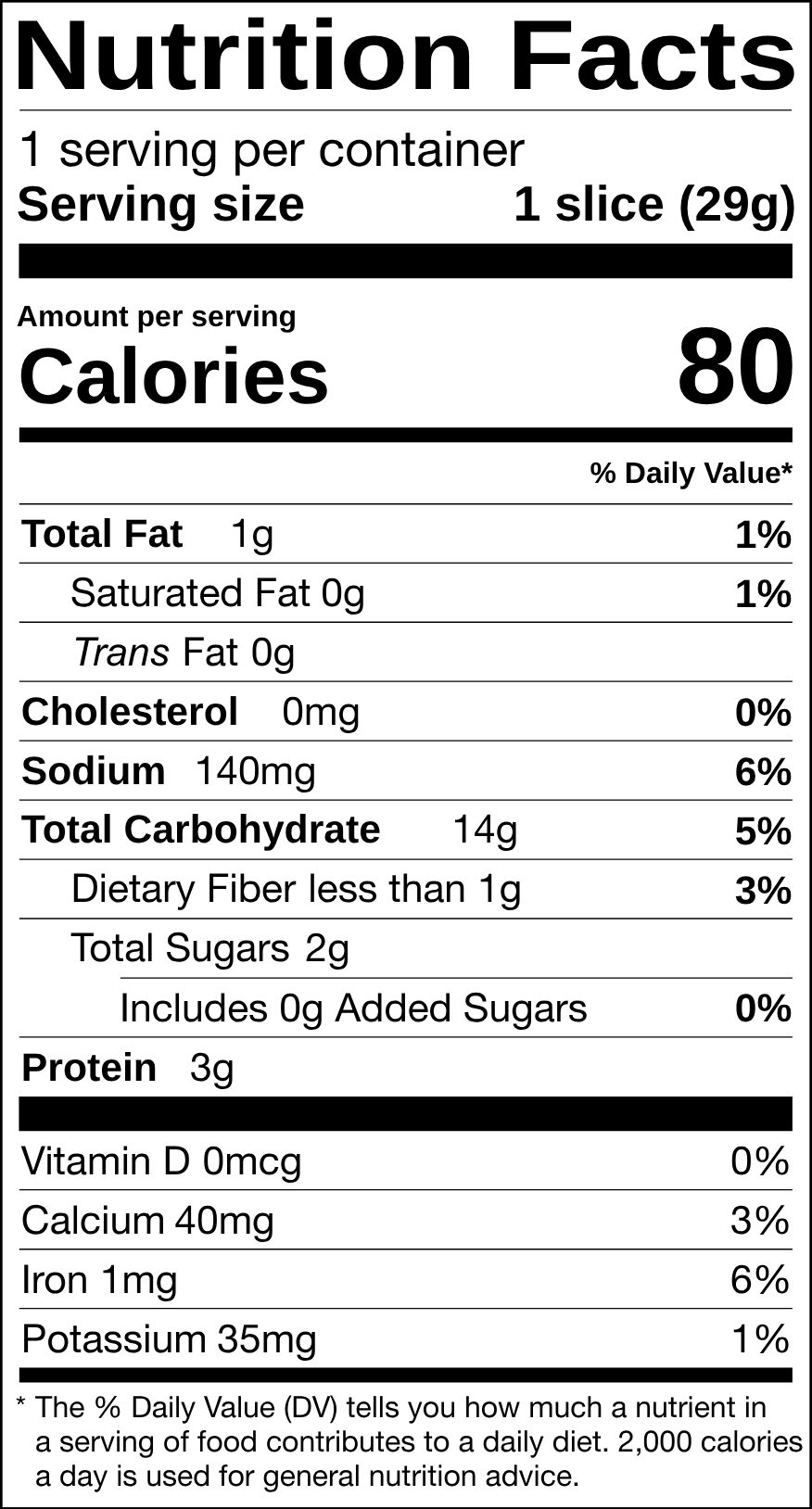
FDA standard format. Values use the FDA rounding rules for the serving you pick. Nutrients USDA does not report for this food print as 0 on the panel and as "not reported" in the table.
Download this label:SVG · PNG Free to use as a reference. A label for a product you sell needs your full recipe and ingredient statement.
Opens the free label generator with this amount of white bread already added. Add the rest of your ingredients and the label updates as you go.
All nutrients for this serving
1 slice (29 g)
Nutrient
Per serving
% DV*
Per 100 g
Calories and macronutrients
Calories
77
266
Total fat
1 g
1%
3.33 g
Saturated fat
0.2 g
1%
0.7 g
Trans fat
<0.1 g
0.03 g
Monounsaturated fat
0.2 g
0.6 g
Polyunsaturated fat
0.5 g
1.6 g
Cholesterol
0 mg
0%
0 mg
Sodium
142 mg
6%
490 mg
Total carbohydrate
14.3 g
5%
49.4 g
Dietary fiber
0.8 g
3%
2.7 g
Total sugars
1.6 g
5.67 g
Added sugars
not reported
Protein
2.6 g
8.85 g
Vitamins
Vitamin D
0 mcg
0%
0 mcg
Vitamin A
0 mcg
0%
0 mcg
Vitamin C
0 mg
0%
0 mg
Vitamin E
0.06 mg
0%
0.22 mg
Vitamin K
0.06 mcg
0%
0.2 mcg
Thiamin (B1)
0.15 mg
13%
0.53 mg
Riboflavin (B2)
0.07 mg
5%
0.24 mg
Niacin (B3)
1.4 mg
9%
4.78 mg
Vitamin B6
<0.1 mg
1%
0.09 mg
Folate (DFE)
50 mcg
12%
171 mcg
Vitamin B12
0 mcg
0%
0 mcg
Choline
4.2 mg
1%
14.6 mg
Minerals
Calcium
42 mg
3%
144 mg
Iron
1 mg
6%
3.61 mg
Potassium
37 mg
1%
126 mg
Magnesium
6.7 mg
2%
23 mg
Phosphorus
28 mg
2%
98 mg
Zinc
0.21 mg
2%
0.74 mg
Copper
<0.1 mg
3%
0.1 mg
Manganese
0.16 mg
7%
0.54 mg
Selenium
6.4 mcg
12%
22 mcg
Other
Water
10.6 g
36.4 g
Caffeine
0 mg
0 mg
Alcohol
0 g
0 g
* Percent Daily Values are based on a 2,000 calorie diet (FDA reference values for adults and children 4 years and older). Per-100 g values are USDA figures before label rounding.
White Bread nutrition by serving size
Every serving below is a USDA household measure for this food, a fraction of one, or a unit conversion. Amounts are USDA values scaled by weight; only the Nutrition Facts panel applies the coarser FDA label rounding.
Serving
Weight
Calories
Total carbohydrate
Protein
Total fat
Dietary fiber
Total sugars
1 slice
29 g
77
14.3 g
2.6 g
1 g
0.8 g
1.6 g
1 cup, crumbs
45 g
120
22.2 g
4 g
1.5 g
1.2 g
2.6 g
1 cup, cubes
35 g
93
17.3 g
3.1 g
1.2 g
0.9 g
2 g
1 slice, large
30 g
80
14.8 g
2.7 g
1 g
0.8 g
1.7 g
1 slice crust not eaten
12 g
32
5.9 g
1.1 g
0.4 g
0.3 g
0.7 g
1 slice, thin
20 g
53
9.9 g
1.8 g
0.7 g
0.5 g
1.1 g
1 slice thin, crust not eaten
9 g
24
4.4 g
0.8 g
0.3 g
0.2 g
0.5 g
1 slice, very thin
15 g
40
7.4 g
1.3 g
0.5 g
0.4 g
0.9 g
100 g
100 g
266
49.4 g
8.9 g
3.3 g
2.7 g
5.7 g
White Bread calories by size
USDA weighs white bread in several sizes. Calories rise with weight:
Serving
Weight
Calories
Total carbohydrate
1 slice, very thin
15 g
40
7.4 g
1 slice, thin
20 g
53
9.9 g
1 slice
29 g
77
14.3 g
1 slice, large
30 g
80
14.8 g
How many carbs are in a slice of white bread?
A regular slice of white bread (29 g) has 14.3 g total carbohydrate, including 0.8 g dietary fiber and 1.6 g total sugars. Carbohydrate minus fiber is 13.5 g.
How much protein is in a slice of white bread?
A regular slice of white bread (29 g) has 2.6 g protein, 5% of the 50 g Daily Value. 100 g has 8.85 g. That is below the 10% DV a serving needs for a "good source" claim.
How much fiber is in a slice of white bread?
A regular slice of white bread (29 g) has 0.8 g of fiber, 3% of the Daily Value. 100 g has 2.7 g. That is below the 10% DV a serving needs for a "good source" claim.
How much sodium is in a slice of white bread?
A regular slice of white bread (29 g) has 142 mg of sodium, 6% of the Daily Value. 100 g has 490 mg.
White Bread nutrition per 100 grams
100 g of white bread has 266 calories, 8.85 g protein, 49.4 g carbohydrate, 2.7 g fiber, 5.67 g sugars and 3.33 g fat.
Where the calories in white bread come from
About 75% of the calories in white bread come from carbohydrate, 11% from fat and 13% from protein (Atwater factors of 4, 9 and 4 calories per gram).
What counts as white bread?
White bread is a yeast loaf made from refined wheat flour, water, yeast and salt, usually with a little sugar and fat for a soft crumb. The USDA record on this page is for commercially prepared, sliced white bread, the kind sold as sandwich bread, and it also covers fresh soft bread crumbs made from it.
Commercial loaves are almost always made with enriched flour, which is why a slice shows 50 mcg of folate (12% DV). At 10 to 19% DV per serving, that meets the FDA threshold for a "good source" claim. It also has 1 mg of iron. Homemade white bread made with unenriched flour would be lower in those two.
Grilled cheese. Buttered slices toasted in a pan around melted cheese. Butter · Cheddar Cheese
French toast. Slices soaked in egg and milk, then cooked in butter. Slightly stale bread soaks up the custard without falling apart. Egg · Whole Milk · Butter
Bread pudding. Cubes of day-old bread baked in a sweet custard; USDA lists a cup of cubes for this kind of measuring. Egg · Whole Milk · Sugar
Breadcrumbs and croutons. Soft crumbs bind meatballs and meatloaf; toasted cubes go on salads and soups. Ground Beef · Olive Oil
Stuffing. Dried bread cubes moistened with broth and cooked with onion and butter. Onion · Butter
How to keep white bread fresh
Keep sliced white bread sealed in its bag at room temperature and use it within a few days. For longer storage, freeze it; slices can go straight from the freezer to the toaster. The refrigerator is the worst place for bread: cold temperatures speed up staling, so the crumb turns dry and firm faster than on the counter.
Labeling a bread you bake
A bakery label has to come from your own recipe. Enter the flour, water, yeast, sugar, fat and salt by weight in the label generator, then base the serving on the baked loaf, which weighs less than the dough because water evaporates in the oven. Weigh several slices to get an average slice weight. Bread has its own FDA reference amount, so check the RACC lookup to see whether one slice or two is the right serving for your slice size.
White Bread nutrition label for Canada, the EU and the UK
The same serving of white bread, drawn by the label formats other markets require: the Canadian bilingual Nutrition Facts table, the EU nutrition declaration (per 100 g, energy in kJ and kcal, salt instead of sodium) and the UK nutrition information table with reference intakes. The generator switches between these and many more from one recipe.
Nutrition Facts
Valeur nutritive
Per 1 slice (29g) / pour 1 slice (29g)
Calories
80
% Daily Value* / % valeur quotidienne*
Fat / Lipides
1.0 g
1 %
Saturated / Saturés
0.2 g + Trans 0 g
1 %
Cholesterol / Cholestérol
0 mg
0 %
Sodium
140 mg
6 %
Carbohydrate / Glucides
14 g
5 %
Fibre / Fibres
1 g
3 %
Sugars / Sucres
2 g
2 %
Protein / Protéines
3 g
Vitamin D / Vitamine D
0 mcg
0 %
Calcium
42 mg
3 %
Iron / Fer
1 mg
6 %
Potassium
37 mg
1 %
*5% or less is a little, 15% or more is a lot
*5 % ou moins c'est peu, 15 % ou plus c'est beaucoup
Canada: bilingual table
Nutrition Declaration
Per 100g
Energy
1113 kJ / 266 kcal
Fat
3.3 g
of which saturates
0.7 g
Carbohydrate
49 g
of which sugars
5.7 g
Protein
8.8 g
Salt
1.2 g
EU 1169/2011: per 100 g, kJ and kcal, salt
Nutrition Information
Typical values (1 servings per pack)
Per 100g
Per 29g
%RI*
Energy
1113 kJ 266 kcal
323 kJ 77 kcal
3.9%
Fat
3.3g
1.0g
1.4%
of which saturates
0.7g
0.2g
1%
Carbohydrate
49g
14g
5.5%
of which sugars
5.7g
1.6g
1.8%
Fibre
2.7g
0.8g
-
Protein
8.8g
2.6g
5.1%
Salt
1.2g
0.36g
5.9%
*Reference Intake of an average adult (8400 kJ / 2000 kcal).
This pack contains approximately 1 servings.
UK FIR 2014: per 100 g and per serving, %RI
Frequently asked questions about white bread
How many calories are in 2 slices of white bread?+
Two regular slices have twice the 77 calories of one slice. With thin slices (20 g each) the pair is lower, at twice 53 calories.
Does toasting bread change the calories?+
Toasting drives water out of the slice, so it gets lighter, but the calories stay essentially the same. Toast therefore has more calories per gram than untoasted bread, which matters if you weigh it.
Does cutting off the crust save calories?+
Only because you eat less bread. USDA weighs a regular slice without its crust at 12 g, which has 32 calories.
How much sugar is in white bread?+
A regular slice has 1.6 g of total sugars. Most commercial recipes include some sugar or syrup, and USDA's record does not separate added from naturally present sugars, so check a product's own label for the added sugars line.
White bread vs whole wheat bread: what is the difference?+
Whole wheat bread is made from flour that keeps the bran and germ, so it usually has more fiber per slice. White bread uses refined, enriched flour, which adds back iron and some B vitamins but not the fiber. Calories per slice are often similar and depend mostly on slice size.
Do white bread and sourdough have different calories?+
Gram for gram they are close, since both are mostly wheat flour and water. Sourdough loaves are often cut into larger, denser slices, so a slice of sourdough can carry more calories than a slice of sandwich bread.
What is a serving of white bread?+
This page defaults to 1 slice (29 g), a USDA household measure. The serving size on a packaged food label is set by the FDA reference amount (RACC) for its category, so a product label can use a different amount. The selector above shows every USDA measure for white bread.
Can I use white bread in a Nutrition Facts label calculation?+
Yes. Open the generator with white bread added, enter the weight you use, add your other ingredients and the label is calculated from the same USDA record shown here. A label for a product you sell must reflect your actual recipe and finished serving.
White Bread compared with other forms
Different forms of the same food are separate USDA records, so each has its own page. Per 100 g:
Form
Calories
Protein
Total fat
Total carbohydrate
White BreadBread, white, commercially prepared (includes soft bread crumbs)
Nutrient values are from USDA FoodData Central, SR Legacy (April 2018 release, public domain), record 174924: "Bread, white, commercially prepared (includes soft bread crumbs)". Values are stored per 100 g exactly as USDA reports them and scaled to each serving by weight. The Nutrition Facts panel applies the FDA rounding rules in 21 CFR 101.9; tables and text show the scaled amounts at reading precision, so a figure can differ slightly from the panel. A nutrient USDA does not report for this food is shown as not reported, never as a guessed value.
SR Legacy predates the added sugars field, and this processed food may contain some, so added sugars are shown as not reported. The label panel prints 0 g because a row cannot be blank; a real product label needs the figure from its recipe. View the USDA record ↗
Make a Nutrition Facts label with white bread
Add white bread and the rest of your recipe. The label, %DV and serving math are done for you. Free to start.