
How many calories are in an egg?
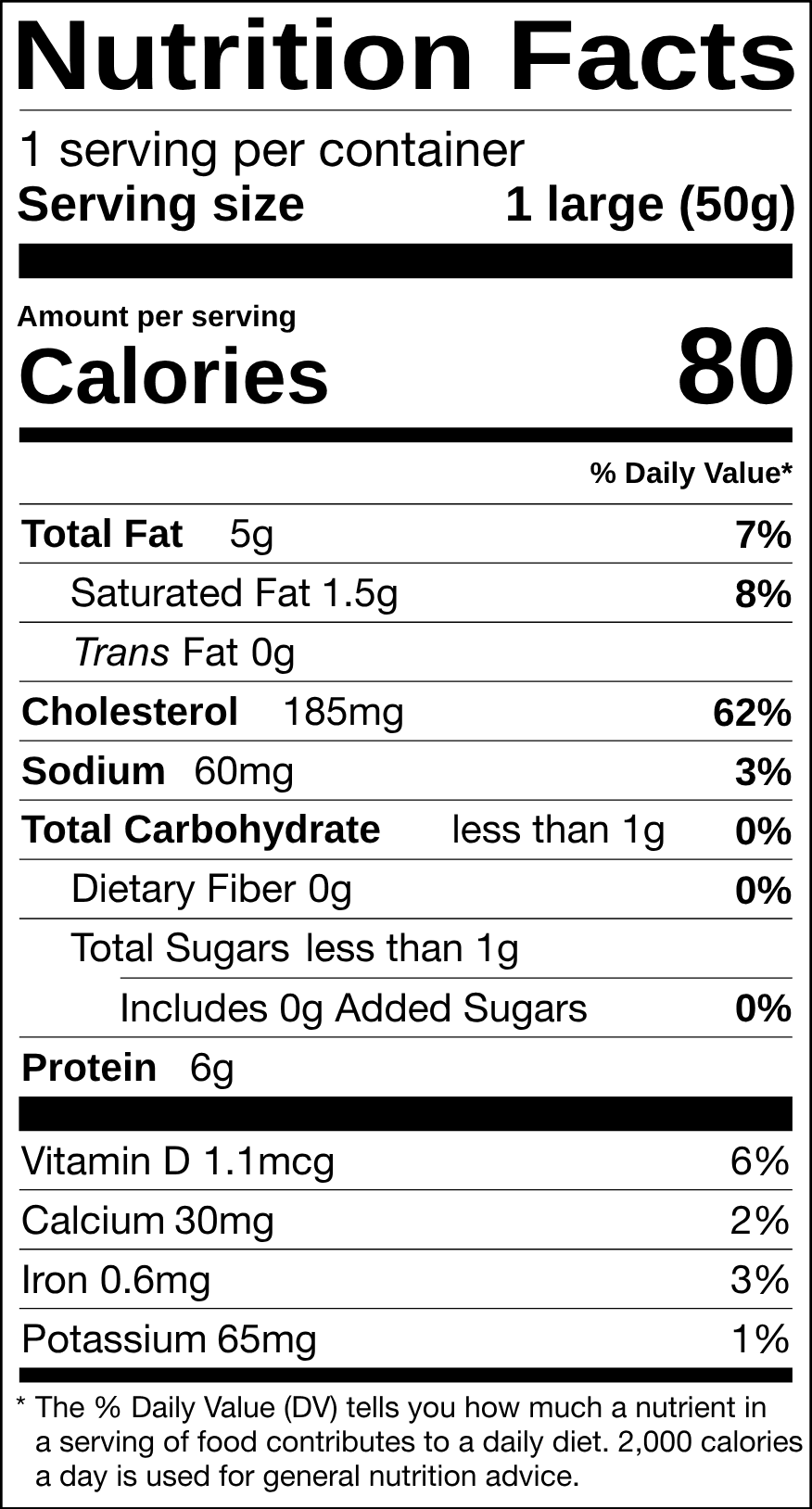
A large egg (50 g) has 78 calories. 100 g has 155 calories. On a Nutrition Facts label, calories are rounded to the nearest 5 or 10, so the panel above may show 80.
A large hard-boiled egg (50 g without the shell) has 78 calories, 6.3 g of protein and 5.3 g of fat, with almost no carbohydrate. The numbers are USDA's for a whole chicken egg cooked in the shell, the closest match to a plain egg with nothing added.
FDA standard format. Values use the FDA rounding rules for the serving you pick. Nutrients USDA does not report for this food print as 0 on the panel and as "not reported" in the table.
Download this label: SVG · PNG Free to use as a reference. A label for a product you sell needs your full recipe and ingredient statement.
1 large (50 g)
Opens the free label generator with this amount of egg already added. Add the rest of your ingredients and the label updates as you go.
| Nutrient | Per serving | % DV* | Per 100 g |
|---|---|---|---|
| Calories and macronutrients | |||
| Calories | 78 | 155 | |
| Total fat | 5.3 g | 7% | 10.6 g |
| Saturated fat | 1.6 g | 8% | 3.27 g |
| Trans fat | not reported | ||
| Monounsaturated fat | 2 g | 4.08 g | |
| Polyunsaturated fat | 0.7 g | 1.41 g | |
| Cholesterol | 187 mg | 62% | 373 mg |
| Sodium | 62 mg | 3% | 124 mg |
| Total carbohydrate | 0.6 g | 0% | 1.12 g |
| Dietary fiber | 0 g | 0% | 0 g |
| Total sugars | 0.6 g | 1.12 g | |
| Added sugars | 0 g | 0% | 0 g |
| Protein | 6.3 g | 12.6 g | |
| Vitamins | |||
| Vitamin D | 1.1 mcg | 6% | 2.2 mcg |
| Vitamin A | 75 mcg | 8% | 149 mcg |
| Vitamin C | 0 mg | 0% | 0 mg |
| Vitamin E | 0.52 mg | 3% | 1.03 mg |
| Vitamin K | 0.15 mcg | 0% | 0.3 mcg |
| Thiamin (B1) | <0.1 mg | 3% | 0.07 mg |
| Riboflavin (B2) | 0.26 mg | 20% | 0.51 mg |
| Niacin (B3) | <0.1 mg | 0% | 0.06 mg |
| Vitamin B6 | 0.06 mg | 4% | 0.12 mg |
| Folate (DFE) | 22 mcg | 6% | 44 mcg |
| Vitamin B12 | 0.56 mcg | 23% | 1.11 mcg |
| Choline | 147 mg | 27% | 294 mg |
| Minerals | |||
| Calcium | 25 mg | 2% | 50 mg |
| Iron | 0.6 mg | 3% | 1.19 mg |
| Potassium | 63 mg | 1% | 126 mg |
| Magnesium | 5 mg | 1% | 10 mg |
| Phosphorus | 86 mg | 7% | 172 mg |
| Zinc | 0.53 mg | 5% | 1.05 mg |
| Copper | <0.1 mg | 1% | 0.01 mg |
| Manganese | <0.1 mg | 1% | 0.03 mg |
| Selenium | 15 mcg | 28% | 30.8 mcg |
| Other | |||
| Water | 37.3 g | 74.6 g | |
| Caffeine | 0 mg | 0 mg | |
| Alcohol | 0 g | 0 g | |
* Percent Daily Values are based on a 2,000 calorie diet (FDA reference values for adults and children 4 years and older). Per-100 g values are USDA figures before label rounding.
Every serving below is a USDA household measure for this food, a fraction of one, or a unit conversion. Amounts are USDA values scaled by weight; only the Nutrition Facts panel applies the coarser FDA label rounding.
| Serving | Weight | Calories | Total carbohydrate | Protein | Total fat | Dietary fiber | Total sugars |
|---|---|---|---|---|---|---|---|
| 1 cup, chopped | 136 g | 211 | 1.5 g | 17.1 g | 14.4 g | 0 g | 1.5 g |
| 1 tbsp | 8.5 g | 13 | 0.1 g | 1.1 g | 0.9 g | 0 g | 0.1 g |
| 1 large | 50 g | 78 | 0.6 g | 6.3 g | 5.3 g | 0 g | 0.6 g |
| 100 g | 100 g | 155 | 1.1 g | 12.6 g | 10.6 g | 0 g | 1.1 g |
A large egg (50 g) has 78 calories. 100 g has 155 calories. On a Nutrition Facts label, calories are rounded to the nearest 5 or 10, so the panel above may show 80.
A large egg (50 g) has 6.3 g protein, 13% of the 50 g Daily Value. 100 g has 12.6 g. At 10 to 19% DV per serving, that meets the FDA threshold for a "good source" claim.
A large egg (50 g) has 5.3 g total fat: 1.6 g saturated, 2 g monounsaturated and 0.7 g polyunsaturated.
A large egg (50 g) has 187 mg of cholesterol, 62% of the Daily Value. 100 g has 373 mg. That is 20% DV or more per serving, which the FDA treats as high.
A large egg (50 g) has 0.56 mcg of vitamin B12, 23% of the Daily Value. 100 g has 1.11 mcg. At 20% DV or more per serving, that meets the FDA threshold for an "excellent source" claim.
A large egg (50 g) has 0.6 mg of iron, 3% of the Daily Value. 100 g has 1.19 mg. That is below the 10% DV a serving needs for a "good source" claim.
100 g of egg has 155 calories, 12.6 g protein, 1.12 g carbohydrate, 0 g fiber, 1.12 g sugars and 10.6 g fat.
About 3% of the calories in egg come from carbohydrate, 64% from fat and 33% from protein (Atwater factors of 4, 9 and 4 calories per gram).
This page uses USDA's record for a whole hard-boiled egg, weighed without the shell. Boiling in the shell adds nothing to the egg, so its numbers are a fair stand-in for a plain cooked egg. A fried or scrambled egg is a different case, because the butter, oil or milk in the pan becomes part of what you eat.
US egg sizes (medium, large, extra large, jumbo) are weight classes set by the minimum weight of a dozen eggs, separate from quality grades such as AA and A. Large is the size most recipes and nutrition references assume. Shell color comes from the breed of hen; a brown egg and a white egg of the same size are nutritionally alike.
The two parts of an egg are very different:
That split is why "egg whites only" cuts calories and removes the cholesterol while keeping most of the protein. See egg white nutrition for USDA's numbers on whites alone.
How you cook an egg changes its nutrition mainly through what you add. A boiled or poached egg has the same calories as the raw egg it came from. A fried egg picks up some of the fat from the pan, and scrambled eggs and omelets usually include butter, milk or cheese. To count those, add each one as an ingredient rather than looking for a single "scrambled egg" number, which depends entirely on the recipe.
Eggs are in so many recipes because they do several jobs at once:
Commercial bakeries and food plants often use egg products instead of shell eggs: liquid, frozen or dried whole egg, whites or yolks.
Wilt a handful of spinach in a pan, add beaten eggs and stir gently, then fold in shredded cheddar.
Egg · Spinach · Cheddar Cheese
Chop hard-boiled eggs, mix with a spoon of mayonnaise, salt and pepper, and serve on bread or lettuce.
Mash avocado onto toast and top with a sliced boiled or fried egg.
Egg · Avocado · White Bread
Store raw eggs in their carton in the main part of the refrigerator rather than the door, where the temperature swings each time it opens. Raw shell eggs keep for three to five weeks. Hard-boiled eggs should go into the refrigerator within two hours of cooking and be eaten within a week; peeled or unpeeled makes little difference to that window.
Egg is one of the major food allergens, so any product made with egg in any form, including whites, yolks or dried egg, must declare it on the label. For the nutrition panel, weigh eggs out of the shell; recipes that list "2 large eggs" can be converted using USDA's large-egg weight shown on this page. Enter the eggs with your other ingredients in the label generator, use the ingredient formatter to build an ingredient list that names egg, and check your product category's reference amount in the RACC lookup. For baked goods, set servings from the finished weight, since water evaporates in the oven.
The same serving of egg, drawn by the label formats other markets require: the Canadian bilingual Nutrition Facts table, the EU nutrition declaration (per 100 g, energy in kJ and kcal, salt instead of sodium) and the UK nutrition information table with reference intakes. The generator switches between these and many more from one recipe.
| Fat / Lipides | 5 g | 7 % |
| Saturated / Saturés | 1.6 g + Trans 0 g | 8 % |
| Cholesterol / Cholestérol | 187 mg | 62 % |
| Sodium | 60 mg | 3 % |
| Carbohydrate / Glucides | 1 g | 0 % |
| Fibre / Fibres | 0 g | 0 % |
| Sugars / Sucres | 1 g | 1 % |
| Protein / Protéines | 6 g | |
| Vitamin D / Vitamine D | 1 mcg | 6 % |
| Calcium | 25 mg | 2 % |
| Iron / Fer | 1 mg | 3 % |
| Potassium | 63 mg | 2 % |
| Per 100g | |
|---|---|
| Energy | 649 kJ / 155 kcal |
| Fat | 11 g |
| of which saturates | 3.3 g |
| Carbohydrate | 1.1 g |
| of which sugars | 1.1 g |
| Protein | 13 g |
| Salt | 0.3 g |
| Per 100g | Per 50g | %RI* | |
|---|---|---|---|
| Energy | 649 kJ 155 kcal |
324 kJ 78 kcal |
3.9% |
| Fat | 11g | 5.3g | 7.6% |
| of which saturates | 3.3g | 1.6g | 8.2% |
| Carbohydrate | 1.1g | 0.6g | <1% |
| of which sugars | 1.1g | 0.6g | <1% |
| Fibre | 0 gg | 0 gg | - |
| Protein | 13g | 6.3g | 13% |
| Salt | 0.31g | 0.16g | 2.6% |
Different forms of the same food are separate USDA records, so each has its own page. Per 100 g:
| Form | Calories | Protein | Total fat | Total carbohydrate |
|---|---|---|---|---|
| EggEgg, whole, cooked, hard-boiled | 155 | 12.6 g | 10.6 g | 1.12 g |
| Egg WhiteEgg, white, raw, fresh | 52 | 10.9 g | 0.17 g | 0.73 g |
| Fried EggEgg, whole, cooked, fried | 196 | 13.6 g | 14.8 g | 0.83 g |
| OmeletEgg, whole, cooked, omelet | 154 | 10.6 g | 11.7 g | 0.64 g |
| Poached EggEgg, whole, cooked, poached | 143 | 12.5 g | 9.47 g | 0.71 g |
| Powdered EggEgg, whole, dried | 592 | 48.1 g | 43.9 g | 1.13 g |
| Powdered Egg WhiteEgg, white, dried | 382 | 81.1 g | 0 g | 7.8 g |
| Raw EggEgg, whole, raw, fresh | 143 | 12.6 g | 9.51 g | 0.72 g |
| Scrambled EggsEgg, whole, cooked, scrambled | 149 | 9.99 g | 11 g | 1.61 g |
If you make and sell a product that contains egg, these free tools cover the next steps.
Nutrient values are from USDA FoodData Central, SR Legacy (April 2018 release, public domain), record 173424: "Egg, whole, cooked, hard-boiled". Values are stored per 100 g exactly as USDA reports them and scaled to each serving by weight. The Nutrition Facts panel applies the FDA rounding rules in 21 CFR 101.9; tables and text show the scaled amounts at reading precision, so a figure can differ slightly from the panel. A nutrient USDA does not report for this food is shown as not reported, never as a guessed value.
SR Legacy predates the added sugars field. This is a whole or unsweetened food, so added sugars are shown as 0 g. View the USDA record ↗