Sweet Potato calories by size
USDA weighs sweet potato in several sizes. Calories rise with weight:
| Serving | Weight | Calories | Total carbohydrate |
|---|---|---|---|
| 1 small | 60 g | 54 | 12.4 g |
| 1 medium (2" dia, 5" long, raw) | 114 g | 103 | 23.6 g |
| 1 large | 180 g | 162 | 37.3 g |
A medium sweet potato baked in its skin yields 114 g of flesh with 103 calories, 23.6 g of carbohydrate and 3.8 g of fiber. USDA's record is for the baked flesh, eaten without the skin and without salt; its medium size is a sweet potato about 2 inches across and 5 inches long before baking.
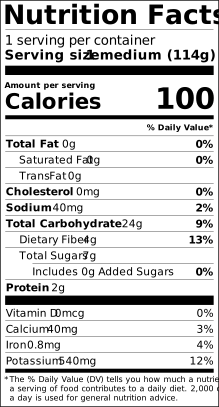
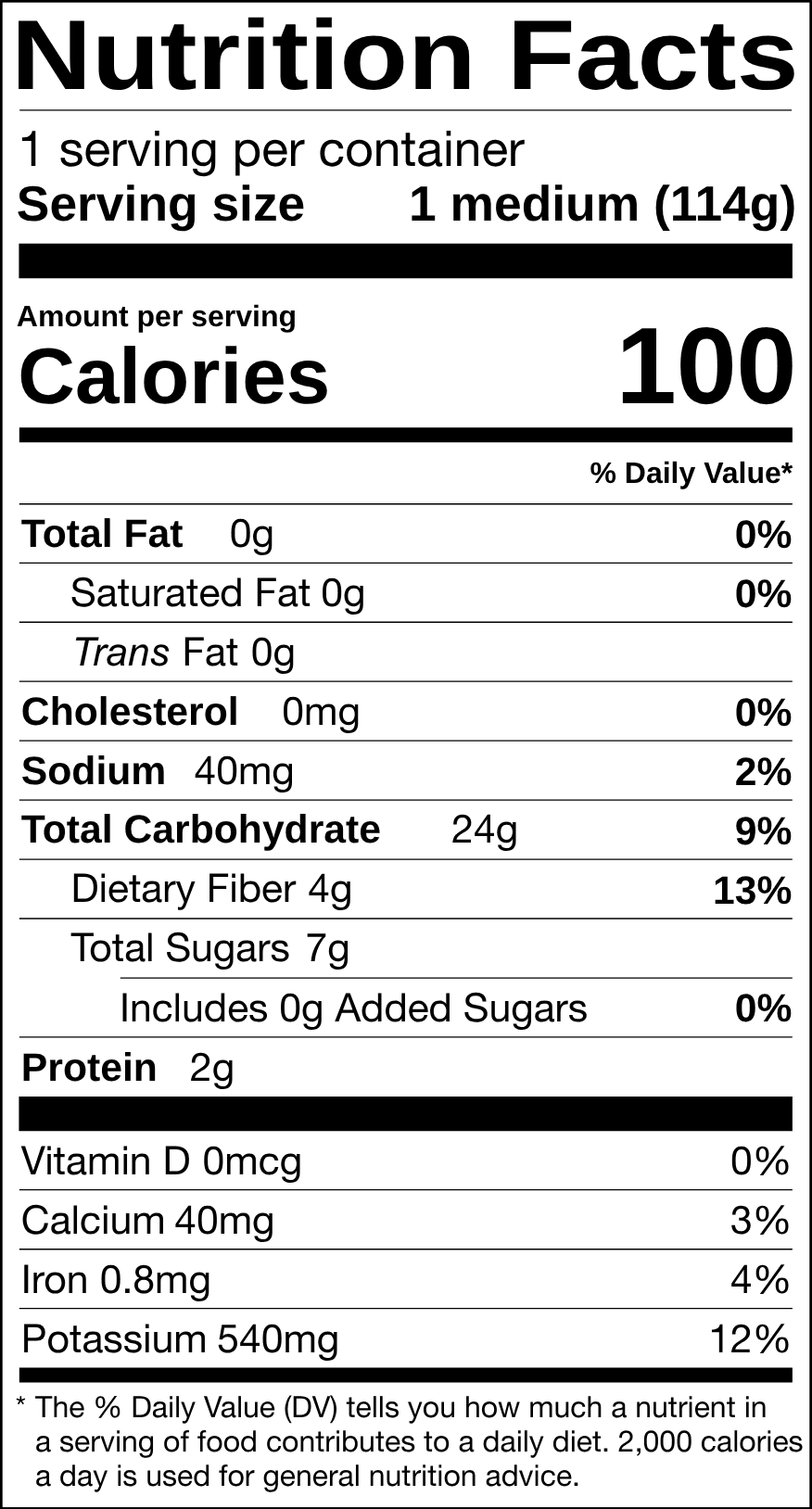
FDA standard format. Values use the FDA rounding rules for the serving you pick. Nutrients USDA does not report for this food print as 0 on the panel and as "not reported" in the table.
Download this label: SVG · PNG Free to use as a reference. A label for a product you sell needs your full recipe and ingredient statement.
1 medium (2" dia, 5" long, raw) (114 g)
Opens the free label generator with this amount of sweet potato already added. Add the rest of your ingredients and the label updates as you go.
| Nutrient | Per serving | % DV* | Per 100 g |
|---|---|---|---|
| Calories and macronutrients | |||
| Calories | 103 | 90 | |
| Total fat | 0.2 g | 0% | 0.15 g |
| Saturated fat | 0.1 g | 0% | 0.05 g |
| Trans fat | 0 g | 0 g | |
| Monounsaturated fat | <0.1 g | 0 g | |
| Polyunsaturated fat | 0.1 g | 0.09 g | |
| Cholesterol | 0 mg | 0% | 0 mg |
| Sodium | 41 mg | 2% | 36 mg |
| Total carbohydrate | 23.6 g | 9% | 20.7 g |
| Dietary fiber | 3.8 g | 13% | 3.3 g |
| Total sugars | 7.4 g | 6.48 g | |
| Added sugars | 0 g | 0% | 0 g |
| Protein | 2.3 g | 2.01 g | |
| Vitamins | |||
| Vitamin D | 0 mcg | 0% | 0 mcg |
| Vitamin A | 1096 mcg | 122% | 961 mcg |
| Vitamin C | 22 mg | 25% | 19.6 mg |
| Vitamin E | 0.81 mg | 5% | 0.71 mg |
| Vitamin K | 2.6 mcg | 2% | 2.3 mcg |
| Thiamin (B1) | 0.12 mg | 10% | 0.11 mg |
| Riboflavin (B2) | 0.12 mg | 9% | 0.11 mg |
| Niacin (B3) | 1.7 mg | 11% | 1.49 mg |
| Vitamin B6 | 0.33 mg | 19% | 0.29 mg |
| Folate (DFE) | 6.8 mcg | 2% | 6 mcg |
| Vitamin B12 | 0 mcg | 0% | 0 mcg |
| Choline | 15 mg | 3% | 13.1 mg |
| Minerals | |||
| Calcium | 43 mg | 3% | 38 mg |
| Iron | 0.79 mg | 4% | 0.69 mg |
| Potassium | 542 mg | 12% | 475 mg |
| Magnesium | 31 mg | 7% | 27 mg |
| Phosphorus | 62 mg | 5% | 54 mg |
| Zinc | 0.36 mg | 3% | 0.32 mg |
| Copper | 0.18 mg | 20% | 0.16 mg |
| Manganese | 0.57 mg | 25% | 0.5 mg |
| Selenium | 0.23 mcg | 0% | 0.2 mcg |
| Other | |||
| Water | 86.4 g | 75.8 g | |
| Caffeine | 0 mg | 0 mg | |
| Alcohol | 0 g | 0 g | |
* Percent Daily Values are based on a 2,000 calorie diet (FDA reference values for adults and children 4 years and older). Per-100 g values are USDA figures before label rounding.
Every serving below is a USDA household measure for this food, a fraction of one, or a unit conversion. Amounts are USDA values scaled by weight; only the Nutrition Facts panel applies the coarser FDA label rounding.
| Serving | Weight | Calories | Total carbohydrate | Protein | Total fat | Dietary fiber | Total sugars |
|---|---|---|---|---|---|---|---|
| 1 cup | 200 g | 180 | 41.4 g | 4 g | 0.3 g | 6.6 g | 13 g |
| 1 large | 180 g | 162 | 37.3 g | 3.6 g | 0.3 g | 5.9 g | 11.7 g |
| 1 medium (2" dia, 5" long, raw) | 114 g | 103 | 23.6 g | 2.3 g | 0.2 g | 3.8 g | 7.4 g |
| 1 small | 60 g | 54 | 12.4 g | 1.2 g | 0.1 g | 2 g | 3.9 g |
| 100 g | 100 g | 90 | 20.7 g | 2 g | 0.2 g | 3.3 g | 6.5 g |
USDA weighs sweet potato in several sizes. Calories rise with weight:
| Serving | Weight | Calories | Total carbohydrate |
|---|---|---|---|
| 1 small | 60 g | 54 | 12.4 g |
| 1 medium (2" dia, 5" long, raw) | 114 g | 103 | 23.6 g |
| 1 large | 180 g | 162 | 37.3 g |
A medium baked sweet potato (114 g) has 23.6 g total carbohydrate, including 3.8 g dietary fiber and 7.4 g total sugars. Carbohydrate minus fiber is 19.8 g.
A medium baked sweet potato (114 g) has 7.4 g total sugars. None of it is added sugar.
A medium baked sweet potato (114 g) has 1096 mcg of vitamin A, 122% of the Daily Value. 100 g has 961 mcg. At 20% DV or more per serving, that meets the FDA threshold for an "excellent source" claim.
A medium baked sweet potato (114 g) has 22 mg of vitamin C, 25% of the Daily Value. 100 g has 19.6 mg. At 20% DV or more per serving, that meets the FDA threshold for an "excellent source" claim.
A medium baked sweet potato (114 g) has 542 mg of potassium, 12% of the Daily Value. 100 g has 475 mg. At 10 to 19% DV per serving, that meets the FDA threshold for a "good source" claim.
A medium baked sweet potato (114 g) has 2.3 g protein, 5% of the 50 g Daily Value. 100 g has 2.01 g. That is below the 10% DV a serving needs for a "good source" claim.
100 g of sweet potato has 90 calories, 2.01 g protein, 20.7 g carbohydrate, 3.3 g fiber, 6.48 g sugars and 0.15 g fat.
The orange "yams" in most US supermarkets are sweet potatoes. True yams are the starchy tubers of a different plant family, grown mainly in Africa, Asia and the Caribbean, with rough, bark-like skin and white or purple flesh that is not sweet. Sweet potatoes belong to the morning glory family. The name "yam" stuck to soft, orange sweet potatoes in the United States, and USDA requires produce labeled "yam" to also carry the term "sweet potato."
The orange color comes from beta-carotene, which the body converts to vitamin A. That is why the vitamin A figure on this page, given as retinol activity equivalents (RAE), is so high for an orange-fleshed sweet potato.
The vitamin A level in USDA's record reflects orange flesh, so if you cook or sell a pale or purple variety, treat the vitamin A figures here as not applying to it.
Baking drives water out of a sweet potato, so baked flesh has a little more of everything per gram than raw. Slow baking also lets the potato's own enzymes break some starch into maltose, which is why a baked sweet potato tastes sweeter and USDA's baked record lists more sugar per 100 g than its raw record. Boiled, peeled sweet potato picks up some water and has slightly fewer calories per gram than baked.
The record here excludes the skin. The skin is edible once scrubbed, and eating it adds a little weight and fiber that these numbers do not count.
Store raw sweet potatoes somewhere cool, dry and dark, such as a pantry, rather than in the refrigerator. Cold storage can cause chilling injury: a hard center that will not soften when cooked, and an off flavor. Once cooked, sweet potatoes do belong in the refrigerator, and mashed sweet potato freezes well.
This record is for cooked flesh, so it fits recipes where you weigh sweet potato after baking and peeling. If your recipe starts from raw sweet potato that then cooks inside the product, as in a pie or a baked bar, weigh the raw peeled potato and account for the water lost in baking by setting the final batch weight in the recipe nutrition calculator or the label generator. Toppings such as sugar, butter and marshmallows usually change the label more than the potato does. The FDA reference amount for your product type is in the RACC lookup.
The same serving of sweet potato, drawn by the label formats other markets require: the Canadian bilingual Nutrition Facts table, the EU nutrition declaration (per 100 g, energy in kJ and kcal, salt instead of sodium) and the UK nutrition information table with reference intakes. The generator switches between these and many more from one recipe.
| Fat / Lipides | 0 g | 0 % |
| Saturated / Saturés | 0 g + Trans 0 g | 0 % |
| Cholesterol / Cholestérol | 0 mg | 0 % |
| Sodium | 40 mg | 2 % |
| Carbohydrate / Glucides | 24 g | 9 % |
| Fibre / Fibres | 4 g | 13 % |
| Sugars / Sucres | 7 g | 7 % |
| Protein / Protéines | 2 g | |
| Vitamin D / Vitamine D | 0 mcg | 0 % |
| Calcium | 43 mg | 3 % |
| Iron / Fer | 1 mg | 4 % |
| Potassium | 542 mg | 16 % |
| Per 100g | |
|---|---|
| Energy | 377 kJ / 90 kcal |
| Fat | 0.1 g |
| of which saturates | 0.1 g |
| Carbohydrate | 21 g |
| of which sugars | 6.5 g |
| Protein | 2.0 g |
| Salt | 0.1 g |
| Per 100g | Per 114g | %RI* | |
|---|---|---|---|
| Energy | 377 kJ 90 kcal |
429 kJ 103 kcal |
5.1% |
| Fat | 0 gg | 0 gg | <1% |
| of which saturates | 0 gg | 0 gg | <1% |
| Carbohydrate | 21g | 24g | 9.1% |
| of which sugars | 6.5g | 7.4g | 8.2% |
| Fibre | 3.3g | 3.8g | - |
| Protein | 2.0g | 2.3g | 4.6% |
| Salt | 0.09g | 0.10g | 1.7% |
Different forms of the same food are separate USDA records, so each has its own page. Per 100 g:
| Form | Calories | Protein | Total fat | Total carbohydrate |
|---|---|---|---|---|
| Sweet PotatoSweet potato, cooked, baked in skin, flesh, without salt | 90 | 2.01 g | 0.15 g | 20.7 g |
| Boiled Sweet PotatoSweet potato, cooked, boiled, without skin | 76 | 1.37 g | 0.14 g | 17.7 g |
| Canned Sweet PotatoesSweet potato, canned, syrup pack, drained solids | 108 | 1.28 g | 0.32 g | 25.4 g |
| Raw Sweet PotatoSweet potato, raw, unprepared (Includes foods for USDA's Food Distribution Program) | 86 | 1.57 g | 0.05 g | 20.1 g |
If you make and sell a product that contains sweet potato, these free tools cover the next steps.
Nutrient values are from USDA FoodData Central, SR Legacy (April 2018 release, public domain), record 168483: "Sweet potato, cooked, baked in skin, flesh, without salt". Values are stored per 100 g exactly as USDA reports them and scaled to each serving by weight. The Nutrition Facts panel applies the FDA rounding rules in 21 CFR 101.9; tables and text show the scaled amounts at reading precision, so a figure can differ slightly from the panel. A nutrient USDA does not report for this food is shown as not reported, never as a guessed value.
SR Legacy predates the added sugars field. This is a whole or unsweetened food, so added sugars are shown as 0 g. View the USDA record ↗