UK food labelling requirements: back-of-pack nutrition, traffic lights, allergens and PPDS
What a prepacked food sold in Great Britain must carry under assimilated Regulation 1169/2011 and the Food Information Regulations 2014: the mandatory back-of-pack nutrition declaration, the voluntary front-of-pack traffic-light scheme and its thresholds, the 14 allergens emphasised in the ingredient list, the Natasha's Law rules for food prepacked for direct sale, and the HFSS restrictions. Every format below opens in the generator, pre-set to the rule.
Reviewed against Food Information Regulations 2014 (retaining EU 1169/2011) · Page updated October 2, 2026
What the rules are, after Brexit
The UK kept the EU's Food Information to Consumers regulation when it left: Regulation (EU) No 1169/2011 applies in Great Britain as assimilated (retained) law, enforced through the Food Information Regulations 2014 in England and the parallel Scottish and Welsh regulations. Northern Ireland continues to follow the EU regulation directly under the Windsor Framework. The practical consequence is that the nutrition declaration, the allergen rules, QUID, date marking and the rest are the same as the EU rules, with a handful of UK-specific additions: the address must be a UK address (or an EU address for goods placed on the NI market), the front-of-pack traffic-light scheme is a UK-only convention, Natasha's Law extends full ingredient labelling to food prepacked for direct sale, and the HFSS rules restrict where and how less-healthy products are promoted.
The Food Standards Agency (England, Wales and Northern Ireland) and Food Standards Scotland publish the guidance; local authority trading standards and environmental health officers enforce it. This page is written from the assimilated regulation, the 2014 regulations and the DHSC/FSA front-of-pack guidance, with the review date and source under the title.
The mandatory back-of-pack declaration
Identical to the EU declaration: energy in kJ and kcal, then fat, saturates, carbohydrate, sugars, protein and salt, per 100 g or 100 ml, in that order and with those names, in a table with aligned figures where space allows. Per-portion values and percentages of the reference intakes (8,400 kJ / 2,000 kcal, fat 70 g, saturates 20 g, carbohydrate 260 g, sugars 90 g, protein 50 g, salt 6 g) may be added; fibre, mono- and polyunsaturates, polyols, starch and significant vitamins and minerals may be added in their fixed positions and nothing else may. Salt is sodium × 2.5. Minimum x-height 1.2 mm (0.9 mm on packs under 80 cm²). The rounding and tolerance conventions are the Commission's 2012 guidance, which UK enforcement continues to use.
The exemptions are the EU's Annex V list (single-ingredient unprocessed foods, water, herbs and spices, tea and coffee, packs under 25 cm², small producers supplying direct) plus the exemption for drinks over 1.2% alcohol. Any nutrition or health claim, made under assimilated Regulation (EC) No 1924/2006 and the UK's nutrition and health claims register, makes the full declaration mandatory.
| Per 100g | |
|---|---|
| Energy | 2092 kJ / 500 kcal |
| Fat | 25 g |
| of which saturates | 13 g |
| Carbohydrate | 64 g |
| of which sugars | 36 g |
| Protein | 7.1 g |
| Salt | 0.8 g |
| Fat / Lipides | 7 g | 9 % |
| Saturated / Saturés | 3.5 g + Trans 0 g | 18 % |
| Cholesterol / Cholestérol | 10 mg | 3 % |
| Sodium | 95 mg | 4 % |
| Carbohydrate / Glucides | 18 g | 7 % |
| Fibre / Fibres | 1 g | 4 % |
| Sugars / Sucres | 10 g | 10 % |
| Protein / Protéines | 2 g | |
| Vitamin D / Vitamine D | 0 mcg | 0 % |
| Calcium | 10 mg | 1 % |
| Iron / Fer | 1 mg | 4 % |
| Potassium | 45 mg | 1 % |
*5 % ou moins c'est peu, 15 % ou plus c'est beaucoup
Front of pack: the traffic-light scheme and its thresholds
The UK's multiple-traffic-light label is voluntary, but most retailers require it from their suppliers and most consumers expect it. The 2016 DHSC/FSA Guide to creating a front of pack nutrition label fixes the design: five tiles for energy, fat, saturates, sugars and salt, each showing the amount per portion, the percentage of the reference intake, and (for the last four) a red, amber or green colour and the word "HIGH", "MED" or "LOW". Energy is never coloured. The portion must be the same one used in the back-of-pack table and must be a realistic single-consumption amount.
The colour bands are set per 100 g for food, with a per-portion override for red: fat green at 3 g or less, amber up to 17.5 g, red above 17.5 g per 100 g or above 21 g per portion; saturates 1.5 g / 5 g / 6 g per portion; sugars 5 g / 22.5 g / 27 g per portion; salt 0.3 g / 1.5 g / 1.8 g per portion. Drinks use different, lower bands per 100 ml (fat 1.5 g / 8.75 g, saturates 0.75 g / 2.5 g, sugars 2.5 g / 11.25 g, salt 0.3 g / 0.75 g, with red also triggered per portion at 10.5 g fat, 3 g saturates, 13.5 g sugars and 0.9 g salt). The portion override matters: a 100 g serving of a product that is amber per 100 g can still turn red.
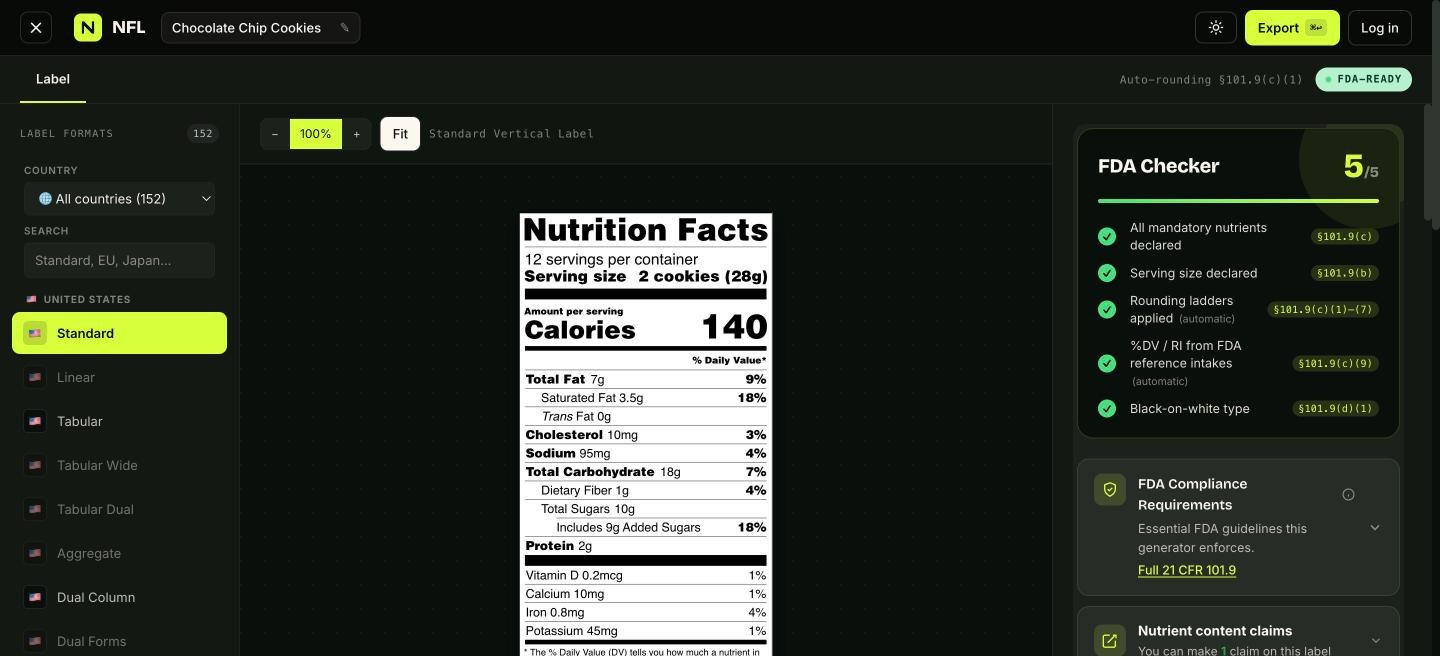
The free UK traffic-light checker colours a product from its per-100 g and per-portion values; the traffic-light format and the combined format render the tiles in the generator, computed from the same recipe as the table so the two can never disagree.
Allergens: the 14, emphasised, and Natasha's Law
The UK uses the same 14 allergens as the EU (cereals containing gluten, crustaceans, eggs, fish, peanuts, soybeans, milk, nuts, celery, mustard, sesame, sulphur dioxide and sulphites above 10 mg/kg, lupin, molluscs), each declared by its specific name within the ingredient list and emphasised in bold, italics, capitals or a contrasting colour. A "Contains" box does not replace the emphasis. "May contain" statements are voluntary precautionary labelling and should reflect a genuine risk assessment; the FSA's 2023 guidance on precautionary allergen labelling sets out when they are appropriate.
Natasha's Law, in force since 1 October 2021, extended full labelling to food that is prepacked for direct sale (PPDS): sandwiches, salads, cakes and other items packed on the premises before the customer orders them. Every PPDS item must carry the name of the food and a full ingredient list with the allergens emphasised, on the packaging, at the point of sale. Food packed after ordering, and loose food, may still be labelled by other means (a notice, verbal information), but a PPDS label is the same job as a prepacked label and the generator produces it from the recipe; the Natasha's Law guide explains the boundary cases.
HFSS: the nutrient profiling model and the promotion rules
Since 1 October 2022, products classified as high in fat, sugar or salt under the 2004/05 Nutrient Profiling Model (NPM) and falling into the specified categories (soft drinks, savoury snacks, breakfast cereals, confectionery, ice cream, cakes, biscuits, morning goods, desserts, sweetened yogurt, pizza, chips and similar, ready meals and the like) may not be placed in store entrances, aisle ends or checkouts, or on their online equivalents, in larger retailers in England. Volume-price promotions ("buy one get one free") and the advertising restrictions for these products, a 9 pm watershed on TV and a ban on paid online advertising, follow from January 2026. Wales and Scotland have their own timetables.
The NPM scores a product per 100 g on energy, saturated fat, total sugar and sodium against fruit, vegetable and nut content, fibre and protein; a food scoring 4 or more (a drink scoring 1 or more) is "less healthy". The score needs the full nutrient profile per 100 g, including fibre, protein and the fruit, vegetable and nut share, so it is worked out from the recipe rather than from the label; the FSA's NPM technical guidance sets out the scoring tables, and the traffic-light checker flags the products most likely to need an HFSS check.
The rest of the label
Name of the food with any required treatment descriptor; QUID for characterising ingredients; net quantity in metric (imperial may be added); date marking with "use by" for highly perishable food and "best before" for the rest, and the storage conditions that go with it; the name and UK address of the food business operator; country of origin where omission would mislead and for specific categories including beef, lamb, pork, poultry, honey and olive oil; instructions for use where needed; and alcoholic strength for drinks over 1.2% ABV. Lot marking is required under the separate Food (Lot Marking) Regulations.
The generator produces the nutrition table, the traffic-light tiles, the ingredient list with emphasised allergens and the QUID from one recipe. The same recipe re-renders to the EU declaration (identical table, EU address) for the Republic of Ireland and the rest of the single market, and to the US panel for exports.