
How many calories are in a chicken thigh?
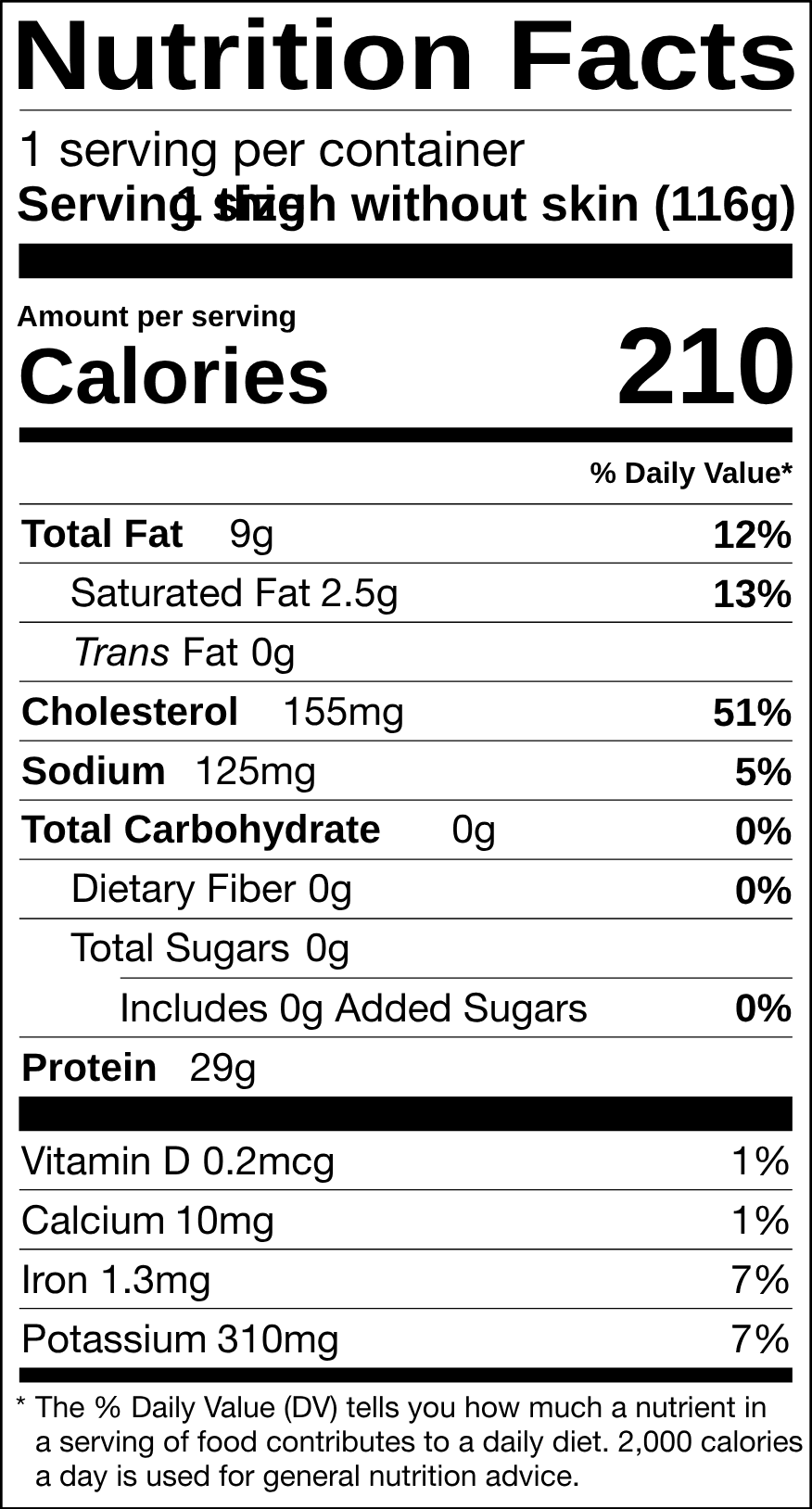
A roasted chicken thigh without skin (116 g) has 208 calories. 100 g has 179 calories. On a Nutrition Facts label, calories are rounded to the nearest 5 or 10, so the panel above may show 210.
One roasted chicken thigh with the skin removed (116 g) has 208 calories, 28.7 g of protein, 9.5 g of fat and no carbohydrate. The numbers are USDA's for thigh meat only, cooked by roasting and weighed without skin or bone.
FDA standard format. Values use the FDA rounding rules for the serving you pick. Nutrients USDA does not report for this food print as 0 on the panel and as "not reported" in the table.
Download this label: SVG · PNG Free to use as a reference. A label for a product you sell needs your full recipe and ingredient statement.
1 thigh without skin (116 g)
Opens the free label generator with this amount of chicken thigh already added. Add the rest of your ingredients and the label updates as you go.
| Nutrient | Per serving | % DV* | Per 100 g |
|---|---|---|---|
| Calories and macronutrients | |||
| Calories | 208 | 179 | |
| Total fat | 9.5 g | 12% | 8.15 g |
| Saturated fat | 2.7 g | 13% | 2.31 g |
| Trans fat | 0.1 g | 0.04 g | |
| Monounsaturated fat | 3.9 g | 3.36 g | |
| Polyunsaturated fat | 2 g | 1.7 g | |
| Cholesterol | 154 mg | 51% | 133 mg |
| Sodium | 123 mg | 5% | 106 mg |
| Total carbohydrate | 0 g | 0% | 0 g |
| Dietary fiber | 0 g | 0% | 0 g |
| Total sugars | 0 g | 0 g | |
| Added sugars | 0 g | 0% | 0 g |
| Protein | 28.7 g | 24.8 g | |
| Vitamins | |||
| Vitamin D | 0.23 mcg | 1% | 0.2 mcg |
| Vitamin A | 9.3 mcg | 1% | 8 mcg |
| Vitamin C | 0 mg | 0% | 0 mg |
| Vitamin E | 0.21 mg | 1% | 0.18 mg |
| Vitamin K | 4.5 mcg | 4% | 3.9 mcg |
| Thiamin (B1) | 0.11 mg | 9% | 0.1 mg |
| Riboflavin (B2) | 0.25 mg | 19% | 0.22 mg |
| Niacin (B3) | 7.2 mg | 45% | 6.21 mg |
| Vitamin B6 | 0.54 mg | 32% | 0.46 mg |
| Folate (DFE) | 5.8 mcg | 1% | 5 mcg |
| Vitamin B12 | 0.49 mcg | 20% | 0.42 mcg |
| Choline | 83 mg | 15% | 71.8 mg |
| Minerals | |||
| Calcium | 10 mg | 1% | 9 mg |
| Iron | 1.3 mg | 7% | 1.13 mg |
| Potassium | 312 mg | 7% | 269 mg |
| Magnesium | 28 mg | 7% | 24 mg |
| Phosphorus | 267 mg | 21% | 230 mg |
| Zinc | 2.2 mg | 20% | 1.92 mg |
| Copper | 0.08 mg | 9% | 0.07 mg |
| Manganese | <0.1 mg | 1% | 0.02 mg |
| Selenium | 31 mcg | 57% | 27.1 mcg |
| Other | |||
| Water | 77.7 g | 67 g | |
| Caffeine | 0 mg | 0 mg | |
| Alcohol | 0 g | 0 g | |
* Percent Daily Values are based on a 2,000 calorie diet (FDA reference values for adults and children 4 years and older). Per-100 g values are USDA figures before label rounding.
Every serving below is a USDA household measure for this food, a fraction of one, or a unit conversion. Amounts are USDA values scaled by weight; only the Nutrition Facts panel applies the coarser FDA label rounding.
| Serving | Weight | Calories | Total carbohydrate | Protein | Total fat | Dietary fiber | Total sugars |
|---|---|---|---|---|---|---|---|
| 3 oz | 85 g | 152 | 0 g | 21 g | 6.9 g | 0 g | 0 g |
| 1 thigh without skin | 116 g | 208 | 0 g | 28.7 g | 9.5 g | 0 g | 0 g |
| 1 thigh with skin | 137 g | 245 | 0 g | 33.9 g | 11.2 g | 0 g | 0 g |
| 100 g | 100 g | 179 | 0 g | 24.8 g | 8.2 g | 0 g | 0 g |
A roasted chicken thigh without skin (116 g) has 208 calories. 100 g has 179 calories. On a Nutrition Facts label, calories are rounded to the nearest 5 or 10, so the panel above may show 210.
A roasted chicken thigh without skin (116 g) has 28.7 g protein, 57% of the 50 g Daily Value. 100 g has 24.8 g. At 20% DV or more per serving, that meets the FDA threshold for an "excellent source" claim.
A roasted chicken thigh without skin (116 g) has 9.5 g total fat: 2.7 g saturated, 3.9 g monounsaturated and 2 g polyunsaturated.
A roasted chicken thigh without skin (116 g) has 154 mg of cholesterol, 51% of the Daily Value. 100 g has 133 mg. That is 20% DV or more per serving, which the FDA treats as high.
A roasted chicken thigh without skin (116 g) has 2.2 mg of zinc, 20% of the Daily Value. 100 g has 1.92 mg. At 20% DV or more per serving, that meets the FDA threshold for an "excellent source" claim.
100 g of chicken thigh has 179 calories, 24.8 g protein, 0 g carbohydrate, 0 g fiber, 0 g sugars and 8.15 g fat.
About 0% of the calories in chicken thigh come from carbohydrate, 43% from fat and 57% from protein (Atwater factors of 4, 9 and 4 calories per gram).
The thigh is the upper part of the chicken's leg. Leg muscles work to support and move the bird, and they contain more myoglobin, the protein that gives the meat its darker color, than the breast does. Thigh meat also carries more fat between the muscle fibers, which is why it stays juicy through longer cooking.
Thighs are sold bone-in with skin, boneless and skinless, or as whole legs with the drumstick attached. Whichever you buy, the record on this page describes only the cooked meat.
Skin: USDA's separate record for roasted thigh meat with the skin has nearly twice the fat per 100 g of the meat-only record used here, and more calories. The "1 thigh with skin" weight in the serving list (137 g) is scaled with these same meat-only values, so it does not add the fat of the skin itself. If you eat the skin, expect more fat and calories than this page shows.
Raw vs cooked: roasting drives out water, so a thigh weighs less after cooking than before. The same protein and fat end up in fewer grams, which is why cooked thigh has more calories per 100 g than raw thigh. Breaded or batter-fried thighs add carbohydrate and absorb frying oil, so their numbers are very different from plain roasted meat.
Because thigh meat tolerates heat without drying out, cooks pick it for methods that would toughen breast meat:
Match the weight you enter to the state of the meat. These values are for cooked meat without skin or bone, so weigh the thigh meat after cooking and trimming, or, if you weigh raw thighs, use a raw chicken record instead and account for cooking loss in the finished product. Bone-in thighs need the bone subtracted, since only the edible meat counts. Enter the weights in the label generator, or build the whole dish in the recipe nutrition calculator. Your serving size should follow the FDA reference amount for your product type in the RACC lookup.
The same serving of chicken thigh, drawn by the label formats other markets require: the Canadian bilingual Nutrition Facts table, the EU nutrition declaration (per 100 g, energy in kJ and kcal, salt instead of sodium) and the UK nutrition information table with reference intakes. The generator switches between these and many more from one recipe.
| Fat / Lipides | 9 g | 13 % |
| Saturated / Saturés | 2.7 g + Trans 0 g | 14 % |
| Cholesterol / Cholestérol | 154 mg | 51 % |
| Sodium | 125 mg | 5 % |
| Carbohydrate / Glucides | 0 g | 0 % |
| Fibre / Fibres | 0 g | 0 % |
| Sugars / Sucres | 0 g | 0 % |
| Protein / Protéines | 29 g | |
| Vitamin D / Vitamine D | 0 mcg | 1 % |
| Calcium | 10 mg | 1 % |
| Iron / Fer | 1 mg | 7 % |
| Potassium | 312 mg | 9 % |
| Per 100g | |
|---|---|
| Energy | 749 kJ / 179 kcal |
| Fat | 8.2 g |
| of which saturates | 2.3 g |
| Carbohydrate | 0.0 g |
| of which sugars | 0.0 g |
| Protein | 25 g |
| Salt | 0.3 g |
| Per 100g | Per 116g | %RI* | |
|---|---|---|---|
| Energy | 749 kJ 179 kcal |
869 kJ 208 kcal |
10% |
| Fat | 8.2g | 9.5g | 14% |
| of which saturates | 2.3g | 2.7g | 13% |
| Carbohydrate | 0 gg | 0 gg | <1% |
| of which sugars | 0 gg | 0 gg | <1% |
| Fibre | 0 gg | 0 gg | - |
| Protein | 25g | 29g | 57% |
| Salt | 0.27g | 0.31g | 5.1% |
Different forms of the same food are separate USDA records, so each has its own page. Per 100 g:
| Form | Calories | Protein | Total fat | Total carbohydrate |
|---|---|---|---|---|
| Chicken ThighChicken, broilers or fryers, thigh, meat only, cooked, roasted | 179 | 24.8 g | 8.15 g | 0 g |
| Chicken Thigh with SkinChicken, broilers or fryers, thigh, meat and skin, cooked, roasted | 232 | 23.3 g | 14.7 g | 0 g |
| Fried Chicken ThighChicken, broilers or fryers, thigh, meat and skin, cooked, fried, batter | 277 | 21.6 g | 16.5 g | 9.08 g |
| Raw Chicken ThighChicken, broilers or fryers, dark meat, thigh, meat only, raw | 121 | 19.7 g | 4.12 g | 0 g |
If you make and sell a product that contains chicken thigh, these free tools cover the next steps.
Nutrient values are from USDA FoodData Central, SR Legacy (April 2018 release, public domain), record 172388: "Chicken, broilers or fryers, thigh, meat only, cooked, roasted". Values are stored per 100 g exactly as USDA reports them and scaled to each serving by weight. The Nutrition Facts panel applies the FDA rounding rules in 21 CFR 101.9; tables and text show the scaled amounts at reading precision, so a figure can differ slightly from the panel. A nutrient USDA does not report for this food is shown as not reported, never as a guessed value.
SR Legacy predates the added sugars field. This is a whole or unsweetened food, so added sugars are shown as 0 g. View the USDA record ↗