How many calories are in Greek yogurt?
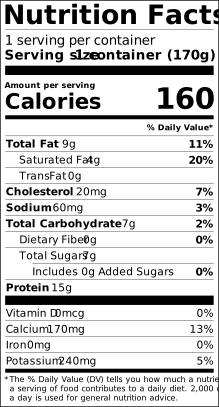
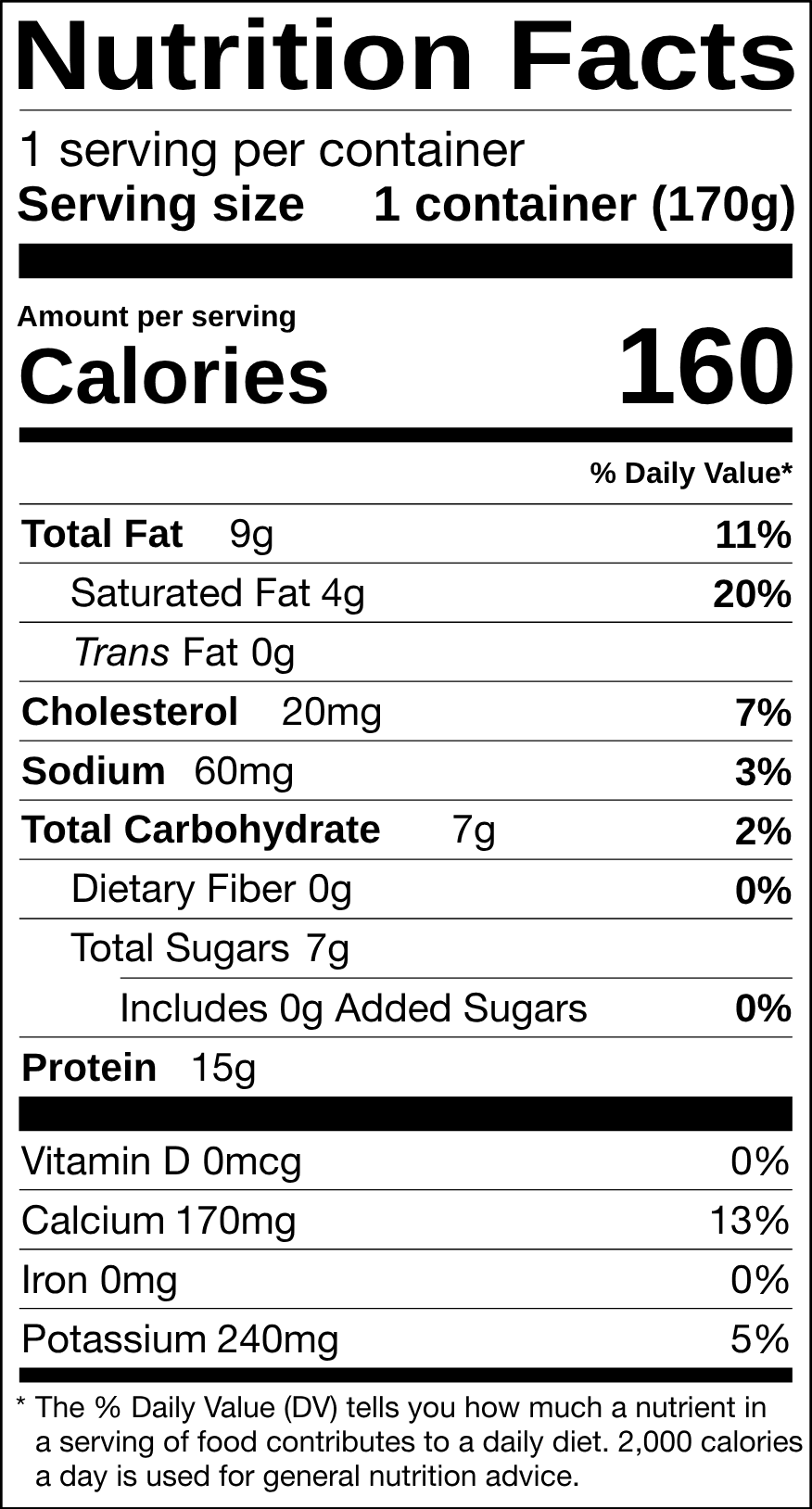
A single-serve container of plain whole-milk Greek yogurt has 165 calories. 100 g has 97 calories. On a Nutrition Facts label, calories are rounded to the nearest 5 or 10, so the panel above may show 160.
A single-serve container of plain whole-milk Greek yogurt (170 g) has 165 calories, 15.3 g of protein, 8.5 g of fat and 6.8 g of carbohydrate, all of it sugars that come from the milk. The figures are USDA's for plain, unsweetened Greek yogurt made with whole milk.
FDA standard format. Values use the FDA rounding rules for the serving you pick. Nutrients USDA does not report for this food print as 0 on the panel and as "not reported" in the table.
Download this label: SVG · PNG Free to use as a reference. A label for a product you sell needs your full recipe and ingredient statement.
1 container (170 g) (170 g)
Opens the free label generator with this amount of Greek yogurt already added. Add the rest of your ingredients and the label updates as you go.
| Nutrient | Per serving | % DV* | Per 100 g |
|---|---|---|---|
| Calories and macronutrients | |||
| Calories | 165 | 97 | |
| Total fat | 8.5 g | 11% | 5 g |
| Saturated fat | 4.1 g | 20% | 2.4 g |
| Trans fat | 0 g | 0 g | |
| Monounsaturated fat | 3.6 g | 2.14 g | |
| Polyunsaturated fat | 0.8 g | 0.47 g | |
| Cholesterol | 22 mg | 7% | 13 mg |
| Sodium | 60 mg | 3% | 35 mg |
| Total carbohydrate | 6.8 g | 2% | 3.98 g |
| Dietary fiber | 0 g | 0% | 0 g |
| Total sugars | 6.8 g | 4 g | |
| Added sugars | 0 g | 0% | 0 g |
| Protein | 15.3 g | 9 g | |
| Vitamins | |||
| Vitamin D | 0 mcg | 0% | 0 mcg |
| Vitamin A | 3.4 mcg | 0% | 2 mcg |
| Vitamin C | 0 mg | 0% | 0 mg |
| Vitamin E | <0.1 mg | 0% | 0.01 mg |
| Vitamin K | 0 mcg | 0% | 0 mcg |
| Thiamin (B1) | <0.1 mg | 3% | 0.02 mg |
| Riboflavin (B2) | 0.47 mg | 36% | 0.28 mg |
| Niacin (B3) | 0.35 mg | 2% | 0.21 mg |
| Vitamin B6 | 0.11 mg | 6% | 0.06 mg |
| Folate (DFE) | 8.5 mcg | 2% | 5 mcg |
| Vitamin B12 | 1.3 mcg | 53% | 0.75 mcg |
| Choline | 26 mg | 5% | 15.1 mg |
| Minerals | |||
| Calcium | 170 mg | 13% | 100 mg |
| Iron | 0 mg | 0% | 0 mg |
| Potassium | 240 mg | 5% | 141 mg |
| Magnesium | 19 mg | 4% | 11 mg |
| Phosphorus | 230 mg | 18% | 135 mg |
| Zinc | 0.88 mg | 8% | 0.52 mg |
| Copper | <0.1 mg | 3% | 0.02 mg |
| Manganese | <0.1 mg | 1% | 0.01 mg |
| Selenium | 16 mcg | 30% | 9.7 mcg |
| Other | |||
| Water | 138.2 g | 81.3 g | |
| Caffeine | 0 mg | 0 mg | |
| Alcohol | 0 g | 0 g | |
* Percent Daily Values are based on a 2,000 calorie diet (FDA reference values for adults and children 4 years and older). Per-100 g values are USDA figures before label rounding.
Every serving below is a USDA household measure for this food, a fraction of one, or a unit conversion. Amounts are USDA values scaled by weight; only the Nutrition Facts panel applies the coarser FDA label rounding.
| Serving | Weight | Calories | Total carbohydrate | Protein | Total fat | Dietary fiber | Total sugars |
|---|---|---|---|---|---|---|---|
| 1 container (170 g) | 170 g | 165 | 6.8 g | 15.3 g | 8.5 g | 0 g | 6.8 g |
| 100 g | 100 g | 97 | 4 g | 9 g | 5 g | 0 g | 4 g |
| 1 oz | 28.4 g | 27 | 1.1 g | 2.6 g | 1.4 g | 0 g | 1.1 g |
A single-serve container of plain whole-milk Greek yogurt has 165 calories. 100 g has 97 calories. On a Nutrition Facts label, calories are rounded to the nearest 5 or 10, so the panel above may show 160.
A single-serve container of plain whole-milk Greek yogurt has 15.3 g protein, 31% of the 50 g Daily Value. 100 g has 9 g. At 20% DV or more per serving, that meets the FDA threshold for an "excellent source" claim.
A single-serve container of plain whole-milk Greek yogurt has 8.5 g total fat: 4.1 g saturated, 3.6 g monounsaturated and 0.8 g polyunsaturated.
A single-serve container of plain whole-milk Greek yogurt has 6.8 g total sugars. None of it is added sugar.
A single-serve container of plain whole-milk Greek yogurt has 170 mg of calcium, 13% of the Daily Value. 100 g has 100 mg. At 10 to 19% DV per serving, that meets the FDA threshold for a "good source" claim.
A single-serve container of plain whole-milk Greek yogurt has 1.3 mcg of vitamin B12, 53% of the Daily Value. 100 g has 0.75 mcg. At 20% DV or more per serving, that meets the FDA threshold for an "excellent source" claim.
100 g of Greek yogurt has 97 calories, 9 g protein, 3.98 g carbohydrate, 0 g fiber, 4 g sugars and 5 g fat.
About 16% of the calories in Greek yogurt come from carbohydrate, 46% from fat and 37% from protein (Atwater factors of 4, 9 and 4 calories per gram).
Greek yogurt is yogurt that has been strained to remove much of its liquid whey. Straining leaves a thicker yogurt with more protein per gram, and because some of the milk sugar (lactose) and minerals leave with the whey, it has a little less sugar and calcium per gram than the unstrained yogurt it started from. Icelandic skyr and labneh are made in a similar way, with labneh strained even further.
"Greek" is not a defined term in US regulations, which set a standard only for yogurt itself. Most Greek yogurt is strained, but some "Greek-style" products reach a similar thickness by adding milk protein concentrate, starch or other thickeners instead, so protein and texture vary from one product to the next. The record on this page is for plain, strained Greek yogurt made from whole milk.
When comparing products, look at the fat content and the Added Sugars line first; those are where Greek yogurts differ most.
Its thickness lets Greek yogurt stand in for richer dairy:
When heating it in a sauce, stir it in off the heat or temper it first; full-fat yogurt resists curdling better than nonfat.
The thin liquid that collects on the surface is whey separating out of the yogurt, which is normal. Stir it back in to keep the yogurt as labeled, or pour it off for a slightly thicker yogurt; pouring it off removes a small amount of protein, calcium and milk sugar. Keep yogurt refrigerated and covered, and use a clean spoon each time.
The FDA reference amount for yogurt matches the 170 g container on this page, so a single-serve cup of plain yogurt usually uses that as its serving. If you add fruit, honey or sugar, enter each ingredient by weight in the label generator; the sweeteners count as added sugars, while the milk sugar in the yogurt does not. In a dip or dressing, list the yogurt with its own ingredients (cultured milk and the cultures) using the ingredient formatter, and declare milk as an allergen. Other categories, such as dips and dressings, have their own reference amounts in the RACC lookup.
The same serving of Greek yogurt, drawn by the label formats other markets require: the Canadian bilingual Nutrition Facts table, the EU nutrition declaration (per 100 g, energy in kJ and kcal, salt instead of sodium) and the UK nutrition information table with reference intakes. The generator switches between these and many more from one recipe.
| Fat / Lipides | 9 g | 11 % |
| Saturated / Saturés | 4.1 g + Trans 0 g | 20 % |
| Cholesterol / Cholestérol | 22 mg | 7 % |
| Sodium | 60 mg | 3 % |
| Carbohydrate / Glucides | 7 g | 2 % |
| Fibre / Fibres | 0 g | 0 % |
| Sugars / Sucres | 7 g | 7 % |
| Protein / Protéines | 15 g | |
| Vitamin D / Vitamine D | 0 mcg | 0 % |
| Calcium | 170 mg | 13 % |
| Iron / Fer | 0 mg | 0 % |
| Potassium | 240 mg | 7 % |
| Per 100g | |
|---|---|
| Energy | 406 kJ / 97 kcal |
| Fat | 5.0 g |
| of which saturates | 2.4 g |
| Carbohydrate | 4.0 g |
| of which sugars | 4.0 g |
| Protein | 9.0 g |
| Salt | 0.1 g |
| Per 100g | Per 170g | %RI* | |
|---|---|---|---|
| Energy | 406 kJ 97 kcal |
690 kJ 165 kcal |
8.2% |
| Fat | 5.0g | 8.5g | 12% |
| of which saturates | 2.4g | 4.1g | 20% |
| Carbohydrate | 4.0g | 6.8g | 2.6% |
| of which sugars | 4.0g | 6.8g | 7.6% |
| Fibre | 0 gg | 0 gg | - |
| Protein | 9.0g | 15g | 31% |
| Salt | 0.09g | 0.15g | 2.5% |
Different forms of the same food are separate USDA records, so each has its own page. Per 100 g:
| Form | Calories | Protein | Total fat | Total carbohydrate |
|---|---|---|---|---|
| Greek YogurtYogurt, Greek, plain, whole milk | 97 | 9 g | 5 g | 3.98 g |
| Low Fat Greek YogurtYogurt, Greek, plain, lowfat | 73 | 9.95 g | 1.92 g | 3.94 g |
| Nonfat Greek YogurtYogurt, Greek, plain, nonfat (Includes foods for USDA's Food Distribution Program) | 59 | 10.2 g | 0.39 g | 3.6 g |
If you make and sell a product that contains Greek yogurt, these free tools cover the next steps.
Nutrient values are from USDA FoodData Central, SR Legacy (April 2018 release, public domain), record 171304: "Yogurt, Greek, plain, whole milk". Values are stored per 100 g exactly as USDA reports them and scaled to each serving by weight. The Nutrition Facts panel applies the FDA rounding rules in 21 CFR 101.9; tables and text show the scaled amounts at reading precision, so a figure can differ slightly from the panel. A nutrient USDA does not report for this food is shown as not reported, never as a guessed value.
SR Legacy predates the added sugars field. This is a whole or unsweetened food, so added sugars are shown as 0 g. View the USDA record ↗