How many calories are in olive oil?
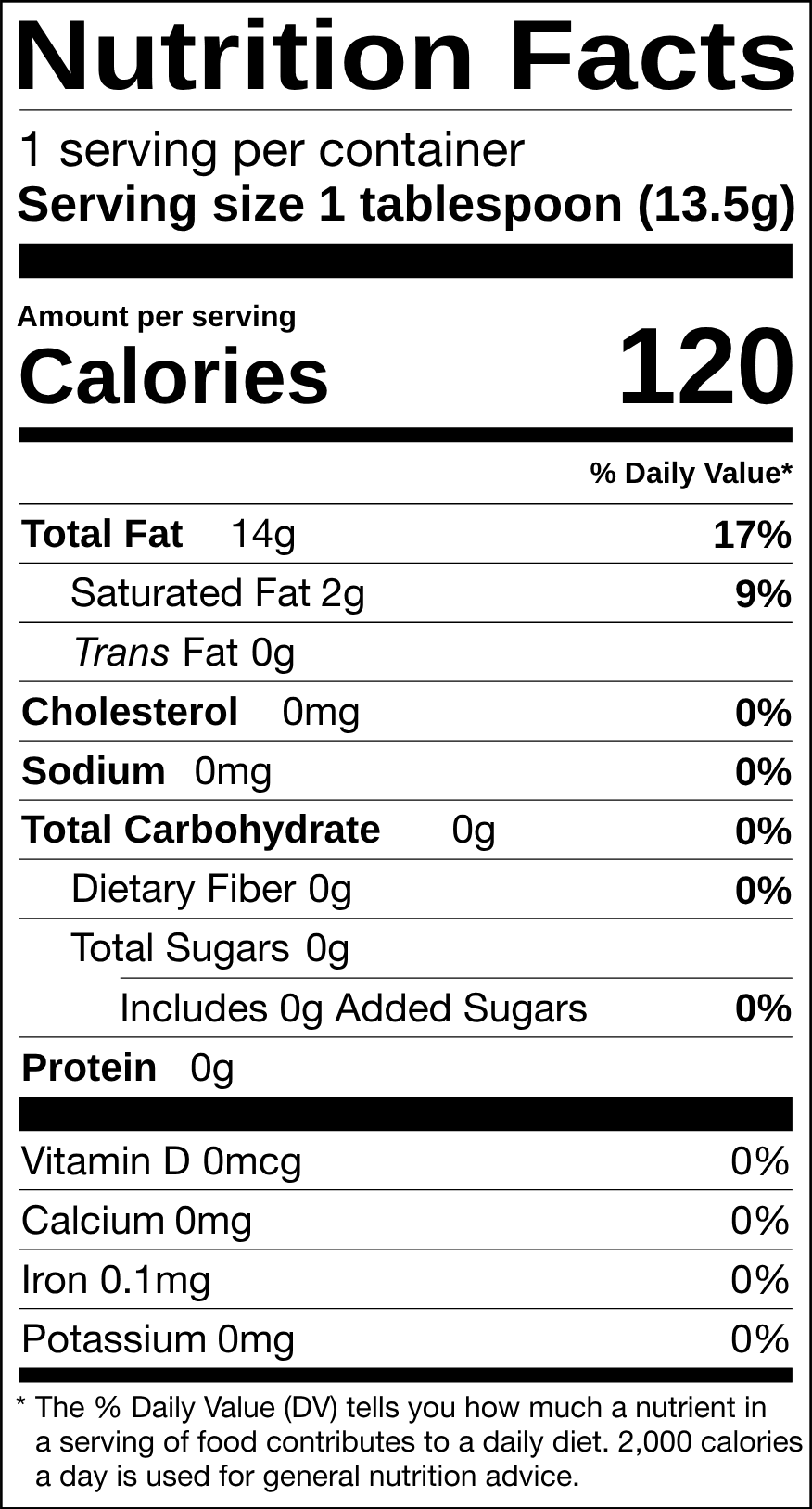
A tablespoon of olive oil (13.5 g) has 119 calories. 100 g has 884 calories. On a Nutrition Facts label, calories are rounded to the nearest 5 or 10, so the panel above may show 120.
A tablespoon of olive oil (13.5 g) has 119 calories and 13.5 g of fat, with no protein, carbohydrate or sugar. Most of that fat is monounsaturated, and extra virgin and regular olive oil have essentially the same calories and fat.
FDA standard format. Values use the FDA rounding rules for the serving you pick. Nutrients USDA does not report for this food print as 0 on the panel and as "not reported" in the table.
Download this label: SVG · PNG Free to use as a reference. A label for a product you sell needs your full recipe and ingredient statement.
1 tablespoon (13.5 g)
Opens the free label generator with this amount of olive oil already added. Add the rest of your ingredients and the label updates as you go.
| Nutrient | Per serving | % DV* | Per 100 g |
|---|---|---|---|
| Calories and macronutrients | |||
| Calories | 119 | 884 | |
| Total fat | 13.5 g | 17% | 100 g |
| Saturated fat | 1.9 g | 9% | 13.8 g |
| Trans fat | not reported | ||
| Monounsaturated fat | 9.8 g | 73 g | |
| Polyunsaturated fat | 1.4 g | 10.5 g | |
| Cholesterol | 0 mg | 0% | 0 mg |
| Sodium | 0.27 mg | 0% | 2 mg |
| Total carbohydrate | 0 g | 0% | 0 g |
| Dietary fiber | 0 g | 0% | 0 g |
| Total sugars | 0 g | 0 g | |
| Added sugars | 0 g | 0% | 0 g |
| Protein | 0 g | 0 g | |
| Vitamins | |||
| Vitamin D | 0 mcg | 0% | 0 mcg |
| Vitamin A | 0 mcg | 0% | 0 mcg |
| Vitamin C | 0 mg | 0% | 0 mg |
| Vitamin E | 1.9 mg | 13% | 14.4 mg |
| Vitamin K | 8.1 mcg | 7% | 60.2 mcg |
| Thiamin (B1) | 0 mg | 0% | 0 mg |
| Riboflavin (B2) | 0 mg | 0% | 0 mg |
| Niacin (B3) | 0 mg | 0% | 0 mg |
| Vitamin B6 | 0 mg | 0% | 0 mg |
| Folate (DFE) | 0 mcg | 0% | 0 mcg |
| Vitamin B12 | 0 mcg | 0% | 0 mcg |
| Choline | <0.1 mg | 0% | 0.3 mg |
| Minerals | |||
| Calcium | 0.14 mg | 0% | 1 mg |
| Iron | 0.08 mg | 0% | 0.56 mg |
| Potassium | 0.14 mg | 0% | 1 mg |
| Magnesium | 0 mg | 0% | 0 mg |
| Phosphorus | 0 mg | 0% | 0 mg |
| Zinc | 0 mg | 0% | 0 mg |
| Copper | 0 mg | 0% | 0 mg |
| Manganese | 0 mg | 0% | 0 mg |
| Selenium | 0 mcg | 0% | 0 mcg |
| Other | |||
| Water | 0 g | 0 g | |
| Caffeine | 0 mg | 0 mg | |
| Alcohol | 0 g | 0 g | |
* Percent Daily Values are based on a 2,000 calorie diet (FDA reference values for adults and children 4 years and older). Per-100 g values are USDA figures before label rounding.
Every serving below is a USDA household measure for this food, a fraction of one, or a unit conversion. Amounts are USDA values scaled by weight; only the Nutrition Facts panel applies the coarser FDA label rounding.
| Serving | Weight | Calories | Total carbohydrate | Protein | Total fat | Dietary fiber | Total sugars |
|---|---|---|---|---|---|---|---|
| 1 tablespoon | 13.5 g | 119 | 0 g | 0 g | 13.5 g | 0 g | 0 g |
| 1 cup | 216 g | 1909 | 0 g | 0 g | 216 g | 0 g | 0 g |
| 1 tsp | 4.5 g | 40 | 0 g | 0 g | 4.5 g | 0 g | 0 g |
| 100 g | 100 g | 884 | 0 g | 0 g | 100 g | 0 g | 0 g |
A tablespoon of olive oil (13.5 g) has 119 calories. 100 g has 884 calories. On a Nutrition Facts label, calories are rounded to the nearest 5 or 10, so the panel above may show 120.
A tablespoon of olive oil (13.5 g) has 13.5 g total fat: 1.9 g saturated, 9.8 g monounsaturated and 1.4 g polyunsaturated.
A tablespoon of olive oil (13.5 g) has 8.1 mcg of vitamin K, 7% of the Daily Value. 100 g has 60.2 mcg. That is below the 10% DV a serving needs for a "good source" claim.
100 g of olive oil has 884 calories, 0 g protein, 0 g carbohydrate, 0 g fiber, 0 g sugars and 100 g fat.
About 0% of the calories in olive oil come from carbohydrate, 100% from fat and 0% from protein (Atwater factors of 4, 9 and 4 calories per gram).
Olive oil is the fat pressed from olives. USDA's record, "Oil, olive, salad or cooking", is a general figure for olive oil rather than one grade. Because oil is pure fat with no water, every grade has the same calories and fat per tablespoon; what differs between them is flavor, aroma, color and how much of the olive's natural compounds survive processing.
Most of its fat is monounsaturated, mainly oleic acid, with smaller amounts of saturated and polyunsaturated fat. The only vitamins present in measurable amounts are vitamins E and K, both of which dissolve in fat: a tablespoon has 1.9 mg of vitamin E, 13% of the Daily Value.
The US uses voluntary grade standards for olive oil that follow the international grades:
Heat does not remove calories from oil. When you saute or roast with olive oil, the calories you eat depend on how much oil ends up in the food rather than left in the pan. Breaded and fried foods absorb a lot; a quick saute in a nonstick pan leaves some behind. Extra virgin olive oil works for everyday sauteing and roasting, while refined and light olive oils tolerate higher heat before smoking, which makes them better for high-heat searing and frying.
Extra virgin olive oil is the one to taste: in vinaigrettes, drizzled over soups, grilled bread and finished pasta, or as a dip with bread. Any grade works for sauteing vegetables, roasting potatoes and marinating meat and fish. Olive oil also replaces butter in some cakes and quick breads, and it emulsifies with egg yolk and garlic into aioli. In food manufacturing it is used in salad dressings, hummus, pesto, canned fish packed in oil and jarred vegetables.
Whisk olive oil with lemon juice, minced garlic, salt and pepper; shake in a jar to re-mix before using.
Toss cubed potatoes with olive oil, salt and garlic, spread on a sheet pan and roast until browned.
Toast bread, rub it with garlic, and top with chopped tomato dressed in olive oil and salt.
Olive Oil · White Bread · Tomato · Garlic
Light, heat and air make olive oil go stale and eventually rancid. Keep it tightly capped in a dark bottle or tin, in a cupboard away from the stove, and use an opened bottle within a few months for the best flavor. Refrigeration is not needed; chilled olive oil turns cloudy and thick, then clears again at room temperature.
Oil is the easiest ingredient to under-count in a recipe, so weigh it rather than estimating spoonfuls; a tablespoon weighs 13.5 g. For dressings, sauces and baked goods, all of the oil stays in the product. For fried foods, only the oil the food absorbs counts, so weigh the oil before and after frying and enter the difference. In the ingredient list, name the oil as you buy it, for example extra virgin olive oil, or list each oil in a blend. Build the recipe in the label generator or the recipe nutrition calculator, and check the reference amount for your category in the RACC lookup.
The same serving of olive oil, drawn by the label formats other markets require: the Canadian bilingual Nutrition Facts table, the EU nutrition declaration (per 100 g, energy in kJ and kcal, salt instead of sodium) and the UK nutrition information table with reference intakes. The generator switches between these and many more from one recipe.
| Fat / Lipides | 14 g | 18 % |
| Saturated / Saturés | 1.9 g + Trans 0 g | 9 % |
| Cholesterol / Cholestérol | 0 mg | 0 % |
| Sodium | 0 mg | 0 % |
| Carbohydrate / Glucides | 0 g | 0 % |
| Fibre / Fibres | 0 g | 0 % |
| Sugars / Sucres | 0 g | 0 % |
| Protein / Protéines | 0 g | |
| Vitamin D / Vitamine D | 0 mcg | 0 % |
| Calcium | 0 mg | 0 % |
| Iron / Fer | 0 mg | 0 % |
| Potassium | 0 mg | 0 % |
| Per 100g | |
|---|---|
| Energy | 3699 kJ / 884 kcal |
| Fat | 100 g |
| of which saturates | 14 g |
| Carbohydrate | 0.0 g |
| of which sugars | 0.0 g |
| Protein | 0.0 g |
| Salt | 0.0 g |
| Per 100g | Per 13.5g | %RI* | |
|---|---|---|---|
| Energy | 3699 kJ 884 kcal |
499 kJ 119 kcal |
6% |
| Fat | 100g | 14g | 19% |
| of which saturates | 14g | 1.9g | 9.3% |
| Carbohydrate | 0 gg | 0 gg | <1% |
| of which sugars | 0 gg | 0 gg | <1% |
| Fibre | 0 gg | 0 gg | - |
| Protein | 0 gg | 0 gg | <1% |
| Salt | 0 gg | 0 gg | <1% |
If you make and sell a product that contains olive oil, these free tools cover the next steps.
Nutrient values are from USDA FoodData Central, SR Legacy (April 2018 release, public domain), record 171413: "Oil, olive, salad or cooking". Values are stored per 100 g exactly as USDA reports them and scaled to each serving by weight. The Nutrition Facts panel applies the FDA rounding rules in 21 CFR 101.9; tables and text show the scaled amounts at reading precision, so a figure can differ slightly from the panel. A nutrient USDA does not report for this food is shown as not reported, never as a guessed value.
SR Legacy predates the added sugars field. This is a whole or unsweetened food, so added sugars are shown as 0 g. View the USDA record ↗