How many calories are in an avocado?
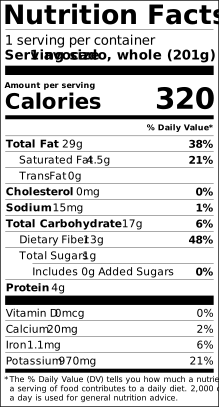
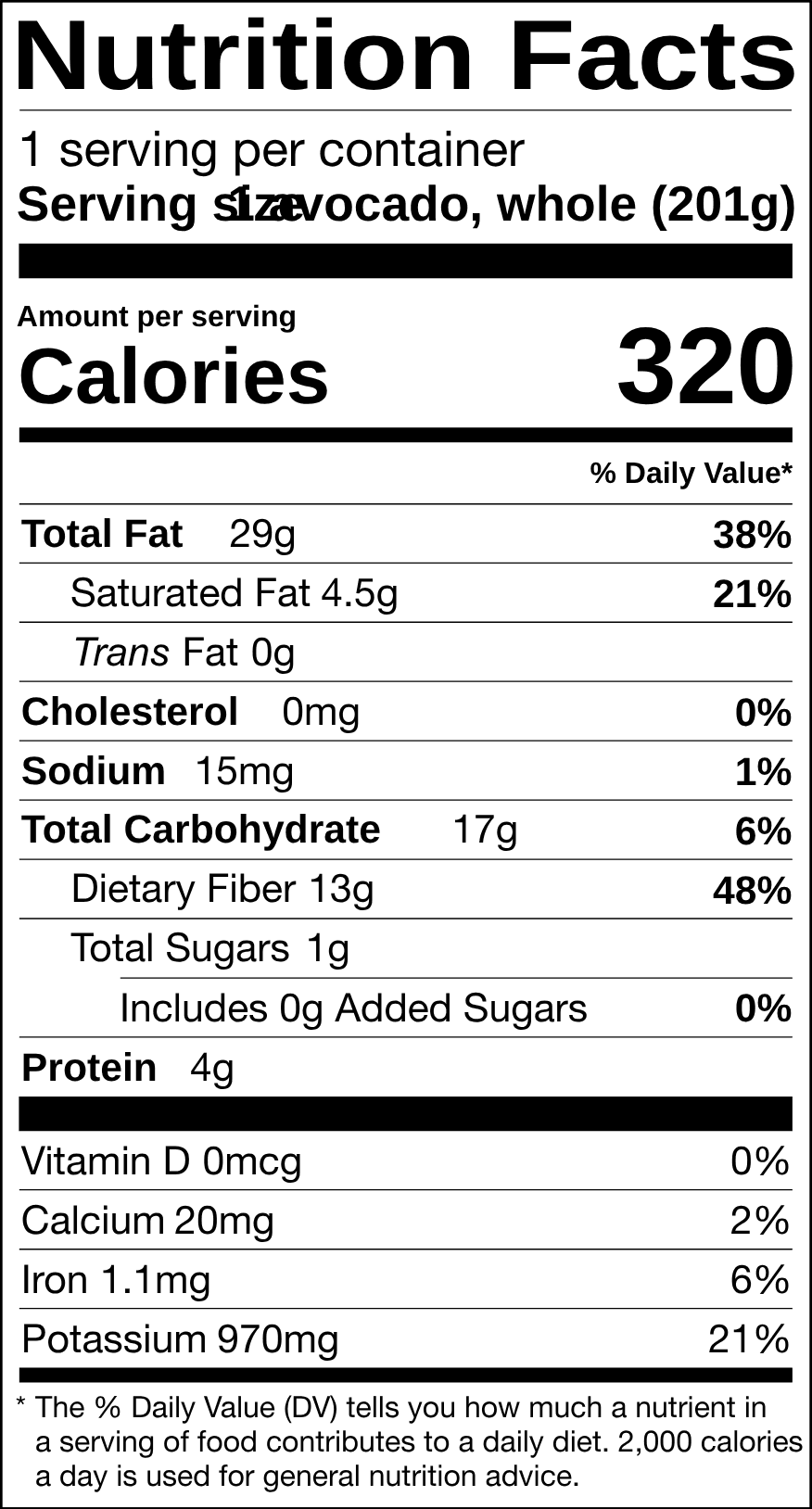
A whole avocado (201 g) has 322 calories. 100 g has 160 calories. On a Nutrition Facts label, calories are rounded to the nearest 5 or 10, so the panel above may show 320.
A whole avocado (201 g of flesh, without skin or pit) has 322 calories, 29.5 g of fat and 13.5 g of fiber. The figures are USDA's average for raw avocados of all commercial varieties, and they scale to any serving you pick below.
FDA standard format. Values use the FDA rounding rules for the serving you pick. Nutrients USDA does not report for this food print as 0 on the panel and as "not reported" in the table.
Download this label: SVG · PNG Free to use as a reference. A label for a product you sell needs your full recipe and ingredient statement.
1 avocado, whole (201 g)
Opens the free label generator with this amount of avocado already added. Add the rest of your ingredients and the label updates as you go.
| Nutrient | Per serving | % DV* | Per 100 g |
|---|---|---|---|
| Calories and macronutrients | |||
| Calories | 322 | 160 | |
| Total fat | 29.5 g | 38% | 14.7 g |
| Saturated fat | 4.3 g | 21% | 2.13 g |
| Trans fat | 0 g | 0 g | |
| Monounsaturated fat | 19.7 g | 9.8 g | |
| Polyunsaturated fat | 3.7 g | 1.82 g | |
| Cholesterol | 0 mg | 0% | 0 mg |
| Sodium | 14 mg | 1% | 7 mg |
| Total carbohydrate | 17.1 g | 6% | 8.53 g |
| Dietary fiber | 13.5 g | 48% | 6.7 g |
| Total sugars | 1.3 g | 0.66 g | |
| Added sugars | 0 g | 0% | 0 g |
| Protein | 4 g | 2 g | |
| Vitamins | |||
| Vitamin D | 0 mcg | 0% | 0 mcg |
| Vitamin A | 14 mcg | 2% | 7 mcg |
| Vitamin C | 20 mg | 22% | 10 mg |
| Vitamin E | 4.2 mg | 28% | 2.07 mg |
| Vitamin K | 42 mcg | 35% | 21 mcg |
| Thiamin (B1) | 0.13 mg | 11% | 0.07 mg |
| Riboflavin (B2) | 0.26 mg | 20% | 0.13 mg |
| Niacin (B3) | 3.5 mg | 22% | 1.74 mg |
| Vitamin B6 | 0.52 mg | 30% | 0.26 mg |
| Folate (DFE) | 163 mcg | 41% | 81 mcg |
| Vitamin B12 | 0 mcg | 0% | 0 mcg |
| Choline | 29 mg | 5% | 14.2 mg |
| Minerals | |||
| Calcium | 24 mg | 2% | 12 mg |
| Iron | 1.1 mg | 6% | 0.55 mg |
| Potassium | 975 mg | 21% | 485 mg |
| Magnesium | 58 mg | 14% | 29 mg |
| Phosphorus | 105 mg | 8% | 52 mg |
| Zinc | 1.3 mg | 12% | 0.64 mg |
| Copper | 0.38 mg | 42% | 0.19 mg |
| Manganese | 0.29 mg | 12% | 0.14 mg |
| Selenium | 0.8 mcg | 1% | 0.4 mcg |
| Other | |||
| Water | 147.2 g | 73.2 g | |
| Caffeine | 0 mg | 0 mg | |
| Alcohol | 0 g | 0 g | |
* Percent Daily Values are based on a 2,000 calorie diet (FDA reference values for adults and children 4 years and older). Per-100 g values are USDA figures before label rounding.
Every serving below is a USDA household measure for this food, a fraction of one, or a unit conversion. Amounts are USDA values scaled by weight; only the Nutrition Facts panel applies the coarser FDA label rounding.
| Serving | Weight | Calories | Total carbohydrate | Protein | Total fat | Dietary fiber | Total sugars |
|---|---|---|---|---|---|---|---|
| 1 cup, cubes | 150 g | 240 | 12.8 g | 3 g | 22 g | 10.1 g | 1 g |
| 1 cup, pureed | 230 g | 368 | 19.6 g | 4.6 g | 33.7 g | 15.4 g | 1.5 g |
| 1 cup, sliced | 146 g | 234 | 12.5 g | 2.9 g | 21.4 g | 9.8 g | 1 g |
| 1 avocado, whole | 201 g | 322 | 17.1 g | 4 g | 29.5 g | 13.5 g | 1.3 g |
| 1 NLEA serving | 50 g | 80 | 4.3 g | 1 g | 7.3 g | 3.4 g | 0.3 g |
| 100 g | 100 g | 160 | 8.5 g | 2 g | 14.7 g | 6.7 g | 0.7 g |
A whole avocado (201 g) has 322 calories. 100 g has 160 calories. On a Nutrition Facts label, calories are rounded to the nearest 5 or 10, so the panel above may show 320.
A whole avocado (201 g) has 29.5 g total fat: 4.3 g saturated, 19.7 g monounsaturated and 3.7 g polyunsaturated.
A whole avocado (201 g) has 13.5 g of fiber, 48% of the Daily Value. 100 g has 6.7 g. At 20% DV or more per serving, that meets the FDA threshold for an "excellent source" claim.
A whole avocado (201 g) has 4 g protein, 8% of the 50 g Daily Value. 100 g has 2 g. That is below the 10% DV a serving needs for a "good source" claim.
A whole avocado (201 g) has 17.1 g total carbohydrate, including 13.5 g dietary fiber and 1.3 g total sugars. Carbohydrate minus fiber is 3.7 g.
A whole avocado (201 g) has 975 mg of potassium, 21% of the Daily Value. 100 g has 485 mg. At 20% DV or more per serving, that meets the FDA threshold for an "excellent source" claim.
100 g of avocado has 160 calories, 2 g protein, 8.53 g carbohydrate, 6.7 g fiber, 0.66 g sugars and 14.7 g fat.
About 20% of the calories in avocado come from carbohydrate, 76% from fat and 5% from protein (Atwater factors of 4, 9 and 4 calories per gram).
This page uses USDA's average for raw avocados of all commercial varieties, weighed as edible flesh without the skin and pit. Unlike most fruit, an avocado is mostly fat rather than sugar, with only 1.3 g of sugars in a whole fruit, and much of its carbohydrate is fiber.
Avocados vary a lot in size, so the "whole avocado" here is USDA's average fruit; a small Hass avocado can weigh much less. The amounts people actually eat are usually smaller still:
Most avocados sold in the US are Hass, the variety with pebbly skin that darkens from green to nearly black as it ripens. Florida avocados, often sold as green-skin avocados, are larger and smoother, with more water and less fat per gram, so they have fewer calories gram for gram. USDA keeps separate records for California (mostly Hass) and Florida avocados; the all-varieties average on this page sits between them.
Avocados are eaten raw almost every time, because heat turns their flavor bitter. Ripe avocado is mashed into guacamole and onto toast, sliced into salads, sandwiches, tacos and grain bowls, and rolled into sushi. Its creamy texture also makes it a base for dressings, smoothies and dairy-free chocolate mousse, and some bakers use mashed avocado in place of part of the butter. Commercially, avocados become packaged guacamole, frozen chunks and pulp, and avocado oil.
Mash ripe avocado with lime juice and salt, then fold in diced tomato, onion and a little garlic.
Spread mashed avocado on toast and top with a fried or sliced boiled egg.
Avocado · White Bread · Egg
Top rice with flaked cooked salmon, sliced avocado and cucumber, and finish with soy sauce.
Avocado · Atlantic Salmon · White Rice · Cucumber · Soy Sauce
Avocados do not ripen on the tree; they soften only after they are picked. Leave firm ones on the counter, or put them in a paper bag with a banana or apple to speed things up. A ripe avocado yields to gentle pressure; once ripe, move it to the refrigerator to hold it a few more days. Cut avocado browns as the flesh meets air. Brushing it with lemon or lime juice and pressing plastic wrap onto the surface slows browning; leaving the pit in only protects the part it covers.
For guacamole, avocado toast, salads or smoothies, weigh the avocado flesh you use, without the skin and pit, which is the basis of USDA's figures. Skin and pit make up a sizable share of a whole fruit, so weighing whole avocados would overstate every nutrient. Lime juice, salt and other ingredients change the numbers per gram, so enter them all in the label generator. Check the reference amount for your product category, such as a dip or a sandwich, in the RACC lookup, and set servings from the finished product weight.
The same serving of avocado, drawn by the label formats other markets require: the Canadian bilingual Nutrition Facts table, the EU nutrition declaration (per 100 g, energy in kJ and kcal, salt instead of sodium) and the UK nutrition information table with reference intakes. The generator switches between these and many more from one recipe.
| Fat / Lipides | 29 g | 39 % |
| Saturated / Saturés | 4.3 g + Trans 0 g | 21 % |
| Cholesterol / Cholestérol | 0 mg | 0 % |
| Sodium | 15 mg | 1 % |
| Carbohydrate / Glucides | 17 g | 6 % |
| Fibre / Fibres | 13 g | 48 % |
| Sugars / Sucres | 1 g | 1 % |
| Protein / Protéines | 4 g | |
| Vitamin D / Vitamine D | 0 mcg | 0 % |
| Calcium | 24 mg | 2 % |
| Iron / Fer | 1 mg | 6 % |
| Potassium | 975 mg | 29 % |
| Per 100g | |
|---|---|
| Energy | 669 kJ / 160 kcal |
| Fat | 15 g |
| of which saturates | 2.1 g |
| Carbohydrate | 8.5 g |
| of which sugars | 0.7 g |
| Protein | 2.0 g |
| Salt | 0.0 g |
| Per 100g | Per 201g | %RI* | |
|---|---|---|---|
| Energy | 669 kJ 160 kcal |
1346 kJ 322 kcal |
16% |
| Fat | 15g | 29g | 42% |
| of which saturates | 2.1g | 4.3g | 21% |
| Carbohydrate | 8.5g | 17g | 6.6% |
| of which sugars | 0.7g | 1.3g | 1.5% |
| Fibre | 6.7g | 13g | - |
| Protein | 2.0g | 4.0g | 8% |
| Salt | 0.02g | 0.04g | <1% |
If you make and sell a product that contains avocado, these free tools cover the next steps.
Nutrient values are from USDA FoodData Central, SR Legacy (April 2018 release, public domain), record 171705: "Avocados, raw, all commercial varieties". Values are stored per 100 g exactly as USDA reports them and scaled to each serving by weight. The Nutrition Facts panel applies the FDA rounding rules in 21 CFR 101.9; tables and text show the scaled amounts at reading precision, so a figure can differ slightly from the panel. A nutrient USDA does not report for this food is shown as not reported, never as a guessed value.
SR Legacy predates the added sugars field. This is a whole or unsweetened food, so added sugars are shown as 0 g. View the USDA record ↗