How many calories are in salmon?
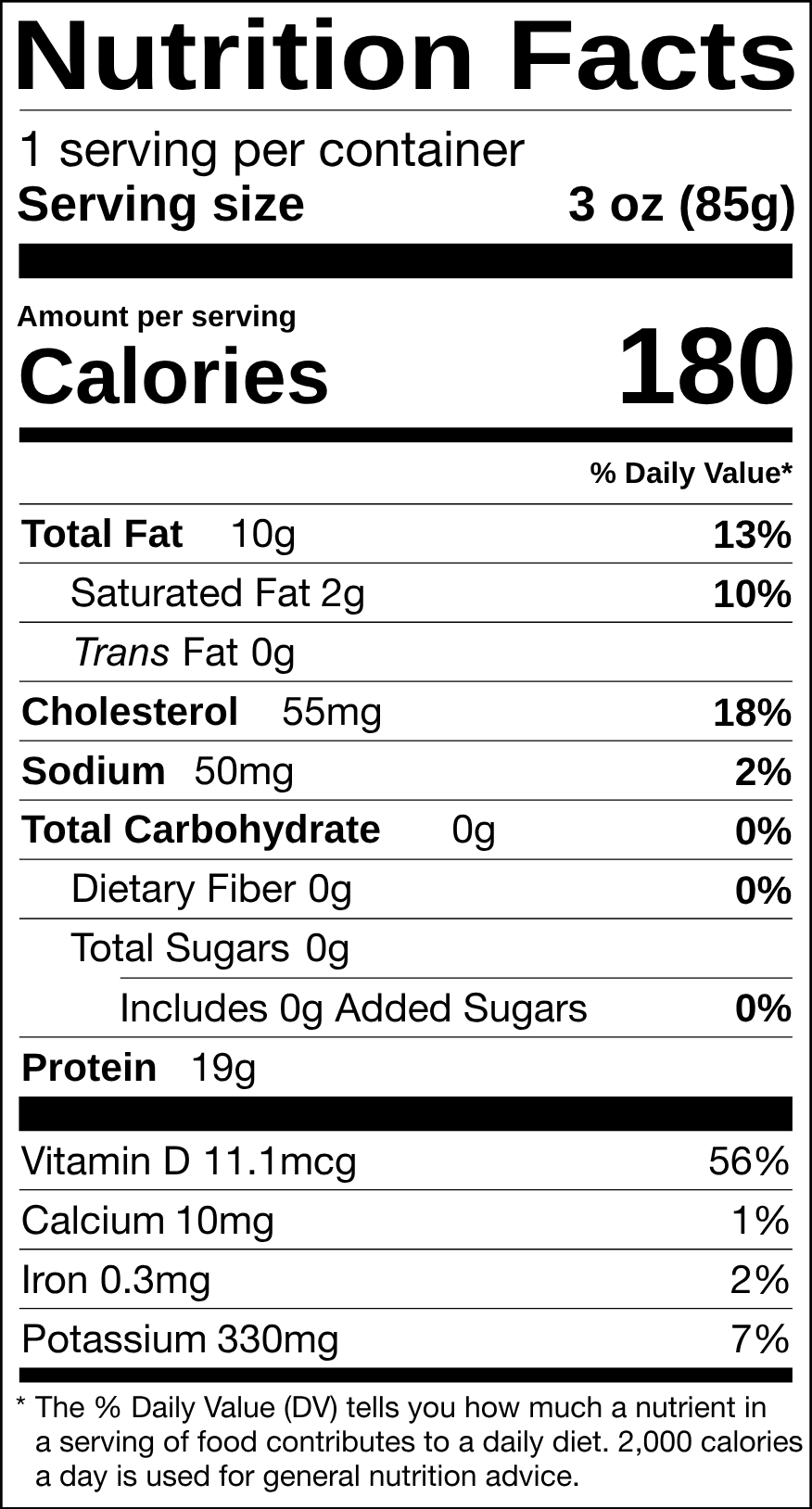
3 oz of cooked salmon (85 g) has 175 calories. 100 g has 206 calories. On a Nutrition Facts label, calories are rounded to the nearest 5 or 10, so the panel above may show 180.
Three ounces of cooked Atlantic salmon (85 g) has 175 calories, 18.8 g of protein and 10.5 g of fat, with no carbohydrate. The figures are USDA's for farmed Atlantic salmon cooked with dry heat, such as baking, broiling or grilling.
FDA standard format. Values use the FDA rounding rules for the serving you pick. Nutrients USDA does not report for this food print as 0 on the panel and as "not reported" in the table.
Download this label: SVG · PNG Free to use as a reference. A label for a product you sell needs your full recipe and ingredient statement.
3 oz (85 g)
Opens the free label generator with this amount of Atlantic salmon already added. Add the rest of your ingredients and the label updates as you go.
| Nutrient | Per serving | % DV* | Per 100 g |
|---|---|---|---|
| Calories and macronutrients | |||
| Calories | 175 | 206 | |
| Total fat | 10.5 g | 13% | 12.4 g |
| Saturated fat | 2 g | 10% | 2.4 g |
| Trans fat | not reported | ||
| Monounsaturated fat | 3.6 g | 4.18 g | |
| Polyunsaturated fat | 3.9 g | 4.55 g | |
| Cholesterol | 54 mg | 18% | 63 mg |
| Sodium | 52 mg | 2% | 61 mg |
| Total carbohydrate | 0 g | 0% | 0 g |
| Dietary fiber | 0 g | 0% | 0 g |
| Total sugars | 0 g | 0 g | |
| Added sugars | 0 g | 0% | 0 g |
| Protein | 18.8 g | 22.1 g | |
| Vitamins | |||
| Vitamin D | 11 mcg | 56% | 13.1 mcg |
| Vitamin A | 59 mcg | 7% | 69 mcg |
| Vitamin C | 3.1 mg | 3% | 3.7 mg |
| Vitamin E | 0.97 mg | 6% | 1.14 mg |
| Vitamin K | 0.09 mcg | 0% | 0.1 mcg |
| Thiamin (B1) | 0.29 mg | 24% | 0.34 mg |
| Riboflavin (B2) | 0.11 mg | 9% | 0.14 mg |
| Niacin (B3) | 6.8 mg | 43% | 8.05 mg |
| Vitamin B6 | 0.55 mg | 32% | 0.65 mg |
| Folate (DFE) | 29 mcg | 7% | 34 mcg |
| Vitamin B12 | 2.4 mcg | 99% | 2.8 mcg |
| Choline | 77 mg | 14% | 90.5 mg |
| Minerals | |||
| Calcium | 13 mg | 1% | 15 mg |
| Iron | 0.29 mg | 2% | 0.34 mg |
| Potassium | 326 mg | 7% | 384 mg |
| Magnesium | 26 mg | 6% | 30 mg |
| Phosphorus | 214 mg | 17% | 252 mg |
| Zinc | 0.37 mg | 3% | 0.43 mg |
| Copper | <0.1 mg | 5% | 0.05 mg |
| Manganese | <0.1 mg | 1% | 0.02 mg |
| Selenium | 35 mcg | 64% | 41.4 mcg |
| Other | |||
| Water | 55 g | 64.8 g | |
| Caffeine | 0 mg | 0 mg | |
| Alcohol | 0 g | 0 g | |
* Percent Daily Values are based on a 2,000 calorie diet (FDA reference values for adults and children 4 years and older). Per-100 g values are USDA figures before label rounding.
Every serving below is a USDA household measure for this food, a fraction of one, or a unit conversion. Amounts are USDA values scaled by weight; only the Nutrition Facts panel applies the coarser FDA label rounding.
| Serving | Weight | Calories | Total carbohydrate | Protein | Total fat | Dietary fiber | Total sugars |
|---|---|---|---|---|---|---|---|
| 3 oz | 85 g | 175 | 0 g | 18.8 g | 10.5 g | 0 g | 0 g |
| 1/2 fillet | 178 g | 367 | 0 g | 39.3 g | 22 g | 0 g | 0 g |
| 4 oz | 113.4 g | 234 | 0 g | 25.1 g | 14 g | 0 g | 0 g |
| 100 g | 100 g | 206 | 0 g | 22.1 g | 12.4 g | 0 g | 0 g |
3 oz of cooked salmon (85 g) has 175 calories. 100 g has 206 calories. On a Nutrition Facts label, calories are rounded to the nearest 5 or 10, so the panel above may show 180.
3 oz of cooked salmon (85 g) has 18.8 g protein, 38% of the 50 g Daily Value. 100 g has 22.1 g. At 20% DV or more per serving, that meets the FDA threshold for an "excellent source" claim.
3 oz of cooked salmon (85 g) has 10.5 g total fat: 2 g saturated, 3.6 g monounsaturated and 3.9 g polyunsaturated.
3 oz of cooked salmon (85 g) has 11 mcg of vitamin D, 56% of the Daily Value. 100 g has 13.1 mcg. At 20% DV or more per serving, that meets the FDA threshold for an "excellent source" claim.
3 oz of cooked salmon (85 g) has 2.4 mcg of vitamin B12, 99% of the Daily Value. 100 g has 2.8 mcg. At 20% DV or more per serving, that meets the FDA threshold for an "excellent source" claim.
3 oz of cooked salmon (85 g) has 54 mg of cholesterol, 18% of the Daily Value. 100 g has 63 mg.
100 g of Atlantic salmon has 206 calories, 22.1 g protein, 0 g carbohydrate, 0 g fiber, 0 g sugars and 12.4 g fat.
About 0% of the calories in Atlantic salmon come from carbohydrate, 56% from fat and 44% from protein (Atwater factors of 4, 9 and 4 calories per gram).
The salmon on this page is farmed Atlantic salmon, cooked. That is the salmon most people buy: commercial fishing for wild Atlantic salmon is prohibited in the US, so the Atlantic salmon in US stores and restaurants is farm-raised. The numbers describe the fish after cooking, when it has lost some water, so they fit a fillet weighed on the plate rather than raw from the package.
Salmon stands out in the database for two nutrients that few foods supply in quantity: vitamin D and vitamin B12. It is also one of the fattiest common fish, and much of that fat is unsaturated.
Wild salmon in US markets comes from the Pacific, in five main species:
Farmed Atlantic salmon usually has more fat, and so more calories per ounce, than most wild Pacific salmon. Its exact fat content depends on the fish's feed, which is why packaged farmed salmon labels can differ from this USDA average.
The omega-3 fats EPA and DHA that salmon is known for are part of its polyunsaturated fat, 3.9 g in a 3-ounce serving. USDA measures them individually, and fatty fish such as salmon are among the richest food sources of both.
Much of a fillet's fat sits in and just under the skin, so salmon eaten without the skin has somewhat less fat and fewer calories. Cooking with dry heat removes water, not nutrients, so a cooked fillet weighs less than it did raw but carries the same protein and fat. Oil, butter and glazes used in cooking add their own calories.
Fresh fillets are baked, broiled, grilled, pan-seared skin side down until crisp, or poached. Salmon is also sold hot-smoked (fully cooked and flaky) and cold-smoked or cured as lox, which is sliced thin for bagels; both are salted, so their sodium is far higher than fresh salmon. Canned salmon goes into patties, salads and spreads. In food manufacturing it appears in frozen portions, burgers, sushi and prepared meals.
Brush salmon and broccoli with olive oil and garlic and roast together on one pan until the salmon flakes.
Whisk soy sauce, honey and minced garlic, brush over salmon fillets, and bake or broil until glazed.
Atlantic Salmon · Soy Sauce · Honey · Garlic
Flake cooked salmon over brown rice and top with avocado, cucumber and a squeeze of lemon.
Keep raw salmon in the coldest part of the refrigerator and cook it within one to two days, or freeze it. Cooked salmon keeps three to four days refrigerated. Thaw frozen fillets overnight in the refrigerator rather than on the counter. Smoked salmon keeps longer unopened; follow the date on the package.
Fish is a major food allergen, and US allergen rules require the species to be named, so a product containing salmon must declare "salmon", not just "fish". For the nutrition panel, use cooked data like this page when you weigh cooked salmon, and raw data when you portion raw fillets, since cooking removes water. Include glazes, oils and brines as ingredients; smoked and cured salmon need their own data because curing adds a lot of sodium. Build your recipe in the label generator, prepare the allergen statement with the ingredient formatter, and check the reference amount in the RACC lookup.
The same serving of Atlantic salmon, drawn by the label formats other markets require: the Canadian bilingual Nutrition Facts table, the EU nutrition declaration (per 100 g, energy in kJ and kcal, salt instead of sodium) and the UK nutrition information table with reference intakes. The generator switches between these and many more from one recipe.
| Fat / Lipides | 10 g | 14 % |
| Saturated / Saturés | 2.0 g + Trans 0 g | 10 % |
| Cholesterol / Cholestérol | 54 mg | 18 % |
| Sodium | 50 mg | 2 % |
| Carbohydrate / Glucides | 0 g | 0 % |
| Fibre / Fibres | 0 g | 0 % |
| Sugars / Sucres | 0 g | 0 % |
| Protein / Protéines | 19 g | |
| Vitamin D / Vitamine D | 11 mcg | 56 % |
| Calcium | 13 mg | 1 % |
| Iron / Fer | 0 mg | 2 % |
| Potassium | 326 mg | 10 % |
| Per 100g | |
|---|---|
| Energy | 862 kJ / 206 kcal |
| Fat | 12 g |
| of which saturates | 2.4 g |
| Carbohydrate | 0.0 g |
| of which sugars | 0.0 g |
| Protein | 22 g |
| Salt | 0.2 g |
| Per 100g | Per 85g | %RI* | |
|---|---|---|---|
| Energy | 862 kJ 206 kcal |
733 kJ 175 kcal |
8.8% |
| Fat | 12g | 10g | 15% |
| of which saturates | 2.4g | 2.0g | 10% |
| Carbohydrate | 0 gg | 0 gg | <1% |
| of which sugars | 0 gg | 0 gg | <1% |
| Fibre | 0 gg | 0 gg | - |
| Protein | 22g | 19g | 38% |
| Salt | 0.15g | 0.13g | 2.2% |
Different forms of the same food are separate USDA records, so each has its own page. Per 100 g:
| Form | Calories | Protein | Total fat | Total carbohydrate |
|---|---|---|---|---|
| Atlantic SalmonFish, salmon, Atlantic, farmed, cooked, dry heat | 206 | 22.1 g | 12.4 g | 0 g |
| Raw SalmonFish, salmon, Atlantic, farmed, raw | 208 | 20.4 g | 13.4 g | 0 g |
| Smoked SalmonFish, salmon, chinook, smoked, (lox), regular | 117 | 18.3 g | 4.32 g | 0 g |
| Wild Atlantic SalmonFish, salmon, Atlantic, wild, cooked, dry heat | 182 | 25.4 g | 8.13 g | 0 g |
If you make and sell a product that contains Atlantic salmon, these free tools cover the next steps.
Nutrient values are from USDA FoodData Central, SR Legacy (April 2018 release, public domain), record 175168: "Fish, salmon, Atlantic, farmed, cooked, dry heat". Values are stored per 100 g exactly as USDA reports them and scaled to each serving by weight. The Nutrition Facts panel applies the FDA rounding rules in 21 CFR 101.9; tables and text show the scaled amounts at reading precision, so a figure can differ slightly from the panel. A nutrient USDA does not report for this food is shown as not reported, never as a guessed value.
SR Legacy predates the added sugars field. This is a whole or unsweetened food, so added sugars are shown as 0 g. View the USDA record ↗