How many calories are in brown rice?
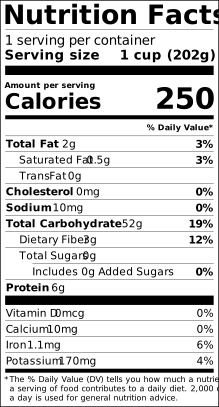
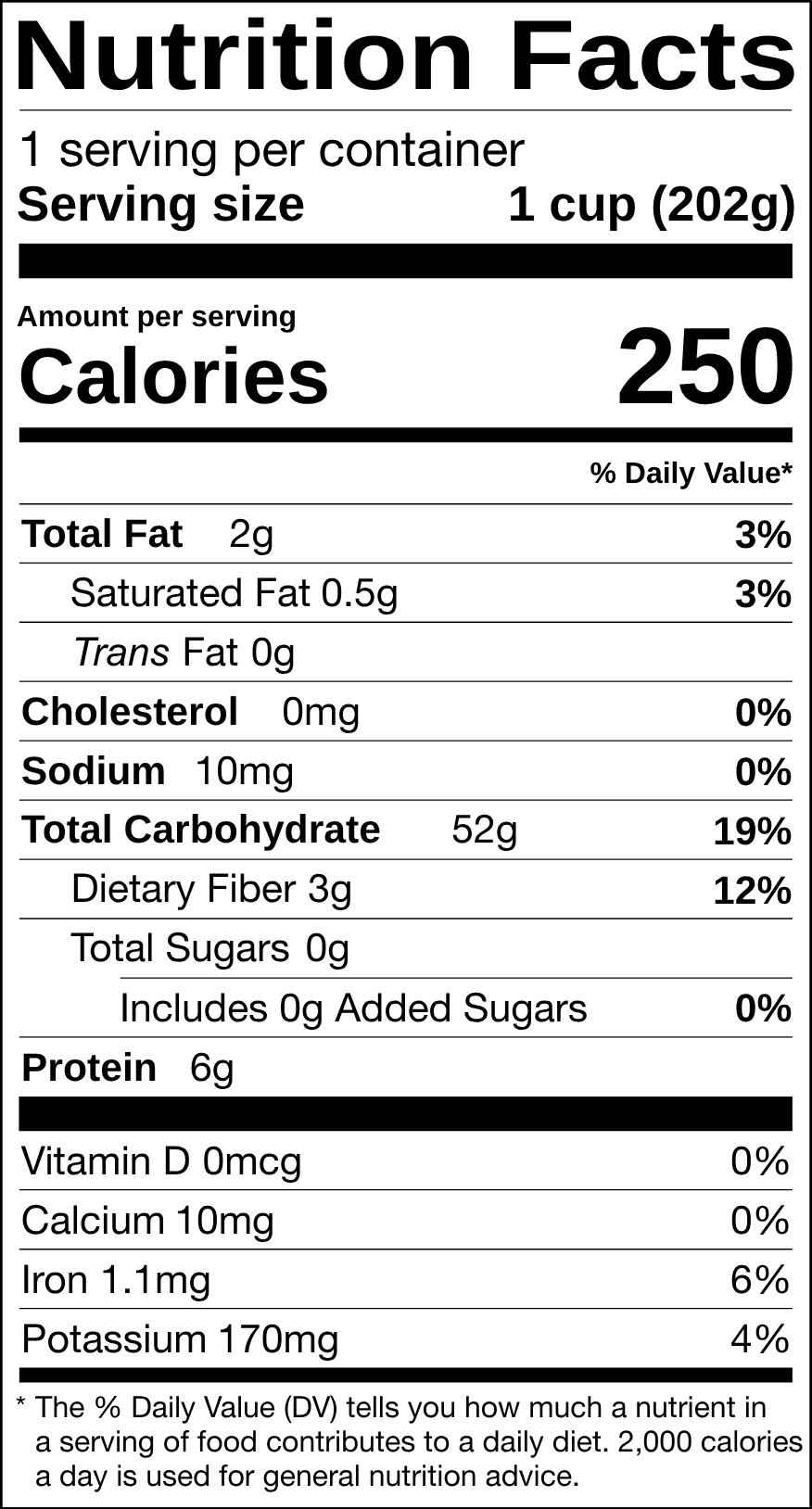
A cup of cooked brown rice (202 g) has 248 calories. 100 g has 123 calories. On a Nutrition Facts label, calories are rounded to the nearest 5 or 10, so the panel above may show 250.
A cup of cooked long-grain brown rice (202 g) has 248 calories, 51.7 g of carbohydrate, 3.2 g of fiber and 5.5 g of protein. The numbers are USDA's for brown rice after cooking, so they apply to rice measured on the plate, not dry from the bag.
FDA standard format. Values use the FDA rounding rules for the serving you pick. Nutrients USDA does not report for this food print as 0 on the panel and as "not reported" in the table.
Download this label: SVG · PNG Free to use as a reference. A label for a product you sell needs your full recipe and ingredient statement.
1 cup (202 g)
Opens the free label generator with this amount of brown rice already added. Add the rest of your ingredients and the label updates as you go.
| Nutrient | Per serving | % DV* | Per 100 g |
|---|---|---|---|
| Calories and macronutrients | |||
| Calories | 248 | 123 | |
| Total fat | 2 g | 3% | 0.97 g |
| Saturated fat | 0.5 g | 3% | 0.26 g |
| Trans fat | 0 g | 0 g | |
| Monounsaturated fat | 0.7 g | 0.37 g | |
| Polyunsaturated fat | 0.7 g | 0.37 g | |
| Cholesterol | 0 mg | 0% | 0 mg |
| Sodium | 8.1 mg | 0% | 4 mg |
| Total carbohydrate | 51.7 g | 19% | 25.6 g |
| Dietary fiber | 3.2 g | 12% | 1.6 g |
| Total sugars | 0.5 g | 0.24 g | |
| Added sugars | 0 g | 0% | 0 g |
| Protein | 5.5 g | 2.74 g | |
| Vitamins | |||
| Vitamin D | 0 mcg | 0% | 0 mcg |
| Vitamin A | 0 mcg | 0% | 0 mcg |
| Vitamin C | 0 mg | 0% | 0 mg |
| Vitamin E | 0.34 mg | 2% | 0.17 mg |
| Vitamin K | 0.4 mcg | 0% | 0.2 mcg |
| Thiamin (B1) | 0.36 mg | 30% | 0.18 mg |
| Riboflavin (B2) | 0.14 mg | 11% | 0.07 mg |
| Niacin (B3) | 5.2 mg | 32% | 2.56 mg |
| Vitamin B6 | 0.25 mg | 15% | 0.12 mg |
| Folate (DFE) | 18 mcg | 5% | 9 mcg |
| Vitamin B12 | 0 mcg | 0% | 0 mcg |
| Choline | 19 mg | 3% | 9.2 mg |
| Minerals | |||
| Calcium | 6.1 mg | 0% | 3 mg |
| Iron | 1.1 mg | 6% | 0.56 mg |
| Potassium | 174 mg | 4% | 86 mg |
| Magnesium | 79 mg | 19% | 39 mg |
| Phosphorus | 208 mg | 17% | 103 mg |
| Zinc | 1.4 mg | 13% | 0.71 mg |
| Copper | 0.21 mg | 24% | 0.11 mg |
| Manganese | 2 mg | 86% | 0.97 mg |
| Selenium | 12 mcg | 21% | 5.8 mcg |
| Other | |||
| Water | 141.9 g | 70.3 g | |
| Caffeine | 0 mg | 0 mg | |
| Alcohol | 0 g | 0 g | |
* Percent Daily Values are based on a 2,000 calorie diet (FDA reference values for adults and children 4 years and older). Per-100 g values are USDA figures before label rounding.
Every serving below is a USDA household measure for this food, a fraction of one, or a unit conversion. Amounts are USDA values scaled by weight; only the Nutrition Facts panel applies the coarser FDA label rounding.
| Serving | Weight | Calories | Total carbohydrate | Protein | Total fat | Dietary fiber | Total sugars |
|---|---|---|---|---|---|---|---|
| 1 cup | 202 g | 248 | 51.7 g | 5.5 g | 2 g | 3.2 g | 0.5 g |
| 1/2 cup | 101 g | 124 | 25.8 g | 2.8 g | 1 g | 1.6 g | 0.2 g |
| 100 g | 100 g | 123 | 25.6 g | 2.7 g | 1 g | 1.6 g | 0.2 g |
A cup of cooked brown rice (202 g) has 248 calories. 100 g has 123 calories. On a Nutrition Facts label, calories are rounded to the nearest 5 or 10, so the panel above may show 250.
A cup of cooked brown rice (202 g) has 51.7 g total carbohydrate, including 3.2 g dietary fiber and 0.5 g total sugars. Carbohydrate minus fiber is 48.4 g.
A cup of cooked brown rice (202 g) has 3.2 g of fiber, 12% of the Daily Value. 100 g has 1.6 g. At 10 to 19% DV per serving, that meets the FDA threshold for a "good source" claim.
A cup of cooked brown rice (202 g) has 5.5 g protein, 11% of the 50 g Daily Value. 100 g has 2.74 g. At 10 to 19% DV per serving, that meets the FDA threshold for a "good source" claim.
A cup of cooked brown rice (202 g) has 2 mg of manganese, 86% of the Daily Value. 100 g has 0.97 mg. At 20% DV or more per serving, that meets the FDA threshold for an "excellent source" claim.
A cup of cooked brown rice (202 g) has 79 mg of magnesium, 19% of the Daily Value. 100 g has 39 mg. At 10 to 19% DV per serving, that meets the FDA threshold for a "good source" claim.
100 g of brown rice has 123 calories, 2.74 g protein, 25.6 g carbohydrate, 1.6 g fiber, 0.24 g sugars and 0.97 g fat.
About 84% of the calories in brown rice come from carbohydrate, 7% from fat and 9% from protein (Atwater factors of 4, 9 and 4 calories per gram).
Brown rice is whole-grain rice: only the inedible outer hull is removed, so the bran layer and the germ stay on the grain. Those layers give it its tan color, nutty flavor and chewy bite, and they hold most of the grain's fiber, magnesium, manganese and B vitamins. White rice is the same grain milled further to remove them.
Brown rice is usually sold unenriched, because the nutrients that enrichment adds back to white rice were never taken out. The trade-offs are a longer cooking time and a shorter shelf life, both caused by the bran.
Compared with enriched white rice, cooked brown rice has:
Jasmine and basmati are names for aromatic rice varieties, and both are sold as brown rice too. Brown jasmine and brown basmati are whole grains like the long-grain brown rice on this page and are close to it in nutrition; the white versions are milled and belong with white rice. Short-grain brown rice is stickier but similar per gram, and quick-cooking or parboiled brown rice has been partly cooked so it is ready faster.
The bran layer slows the movement of water into the grain, which is why brown rice needs more water and roughly twice as long on the stove as white rice. As it cooks, it absorbs water and expands to roughly three times its dry volume or a little more. Water adds weight without calories, so dry brown rice has roughly three times the calories per gram of cooked brown rice. Use this page when you measure rice after cooking, and the uncooked values on the package when you measure it dry.
Brown rice holds its shape better than white rice, which suits grain bowls, rice salads, pilafs, stuffed peppers and burritos. Day-old brown rice makes good fried rice, and leftovers can be simmered with milk and fruit as a breakfast porridge. Food makers mill it into brown rice flour for gluten-free baking, and use it in rice cakes, brown rice pasta, cereals and brown rice syrup.
Top brown rice with sliced cooked chicken and steamed broccoli, then drizzle with soy sauce.
Layer brown rice, warm black beans, chopped tomato and avocado.
Brown Rice · Black Beans · Tomato · Avocado
Simmer leftover brown rice in milk until creamy and top with sliced banana.
The bran layer contains natural oils that can turn rancid, so uncooked brown rice keeps only about six months in the pantry, far less than white rice. For longer storage, keep it in the refrigerator or freezer in a sealed container. Cooked brown rice follows the same rules as any cooked rice: cool it quickly, refrigerate it within two hours, and use it within three to five days or freeze it.
For rice bowls, burritos, salads and prepared sides, choose one basis and stick to it: weigh the cooked rice that goes into each portion and use cooked data like this page, or weigh the dry rice and give the generator the finished batch weight so it can account for the water absorbed. Brown rice absorbs more water than white rice, so a white-rice yield will not carry over. Enter the recipe in the label generator or the recipe nutrition calculator, and check the reference amount for your product in the RACC lookup.
The same serving of brown rice, drawn by the label formats other markets require: the Canadian bilingual Nutrition Facts table, the EU nutrition declaration (per 100 g, energy in kJ and kcal, salt instead of sodium) and the UK nutrition information table with reference intakes. The generator switches between these and many more from one recipe.
| Fat / Lipides | 2.0 g | 3 % |
| Saturated / Saturés | 0.5 g + Trans 0 g | 3 % |
| Cholesterol / Cholestérol | 0 mg | 0 % |
| Sodium | 10 mg | 0 % |
| Carbohydrate / Glucides | 52 g | 19 % |
| Fibre / Fibres | 3 g | 12 % |
| Sugars / Sucres | 0 g | 0 % |
| Protein / Protéines | 6 g | |
| Vitamin D / Vitamine D | 0 mcg | 0 % |
| Calcium | 6 mg | 0 % |
| Iron / Fer | 1 mg | 6 % |
| Potassium | 174 mg | 5 % |
| Per 100g | |
|---|---|
| Energy | 515 kJ / 123 kcal |
| Fat | 1.0 g |
| of which saturates | 0.3 g |
| Carbohydrate | 26 g |
| of which sugars | 0.2 g |
| Protein | 2.7 g |
| Salt | 0.0 g |
| Per 100g | Per 202g | %RI* | |
|---|---|---|---|
| Energy | 515 kJ 123 kcal |
1040 kJ 248 kcal |
12% |
| Fat | 1.0g | 2.0g | 2.8% |
| of which saturates | 0.3g | 0.5g | 2.6% |
| Carbohydrate | 26g | 52g | 20% |
| of which sugars | 0 gg | 0 gg | <1% |
| Fibre | 1.6g | 3.2g | - |
| Protein | 2.7g | 5.5g | 11% |
| Salt | 0 gg | 0.02g | <1% |
Different forms of the same food are separate USDA records, so each has its own page. Per 100 g:
| Form | Calories | Protein | Total fat | Total carbohydrate |
|---|---|---|---|---|
| Brown RiceRice, brown, long-grain, cooked (Includes foods for USDA's Food Distribution Program) | 123 | 2.74 g | 0.97 g | 25.6 g |
| Dry Brown RiceRice, brown, long-grain, raw (Includes foods for USDA's Food Distribution Program) | 367 | 7.54 g | 3.2 g | 76.3 g |
If you make and sell a product that contains brown rice, these free tools cover the next steps.
Nutrient values are from USDA FoodData Central, SR Legacy (April 2018 release, public domain), record 169704: "Rice, brown, long-grain, cooked (Includes foods for USDA's Food Distribution Program)". Values are stored per 100 g exactly as USDA reports them and scaled to each serving by weight. The Nutrition Facts panel applies the FDA rounding rules in 21 CFR 101.9; tables and text show the scaled amounts at reading precision, so a figure can differ slightly from the panel. A nutrient USDA does not report for this food is shown as not reported, never as a guessed value.
SR Legacy predates the added sugars field. This is a whole or unsweetened food, so added sugars are shown as 0 g. View the USDA record ↗