How many calories are in spinach?
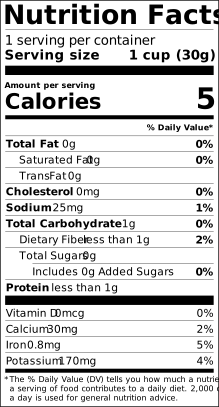
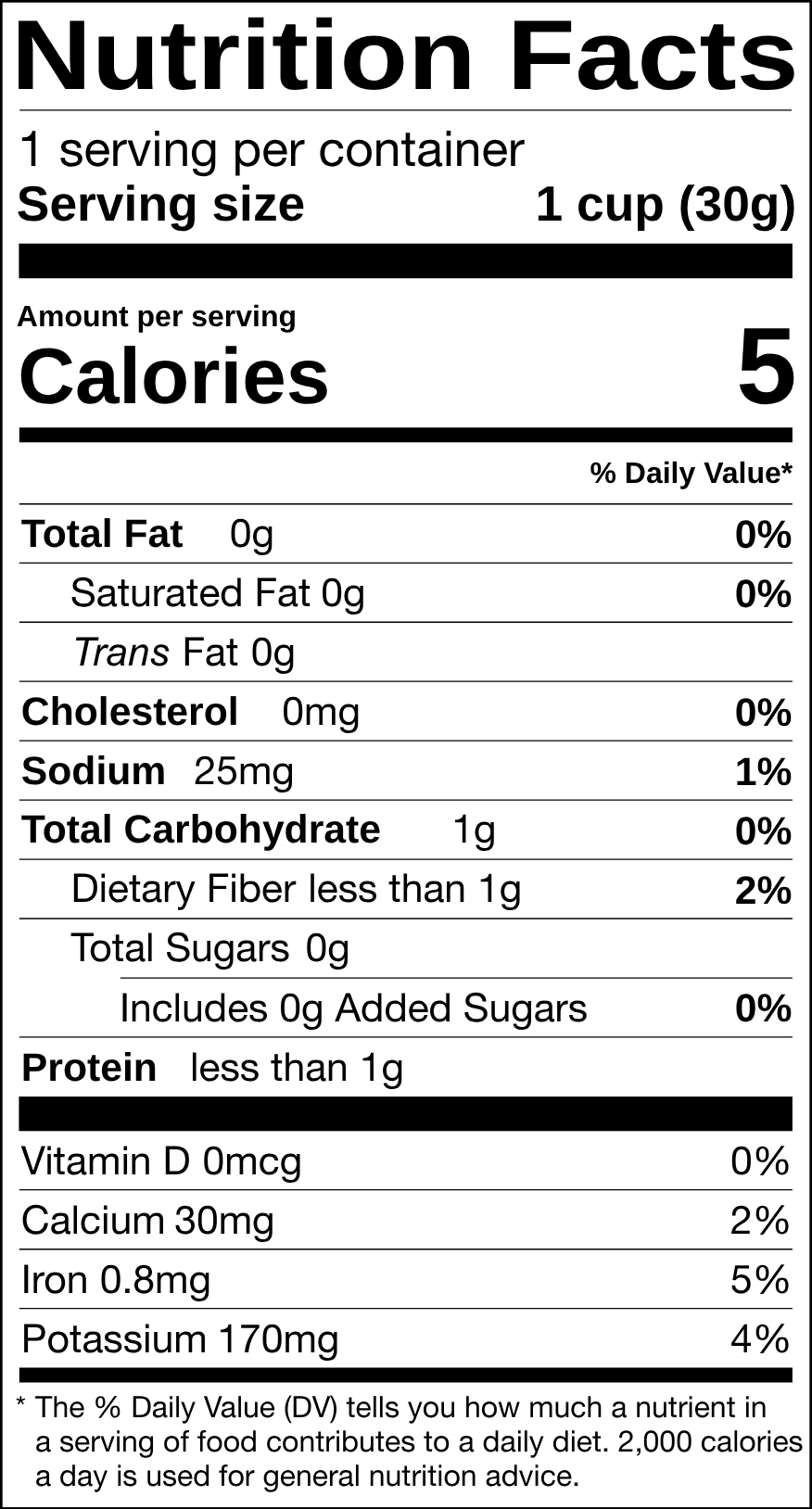
A cup of raw spinach (30 g) has 7 calories. 100 g has 23 calories. On a Nutrition Facts label, calories are rounded to the nearest 5 or 10, so the panel above may show 5.
A cup of raw spinach leaves weighs just 30 g and has 7 calories, 0.9 g of protein and 145 mcg of vitamin K, 121% of the Daily Value. Because the leaves are so light, 100 g (about three loosely packed cups) is often the more useful unit, and it has 23 calories.
FDA standard format. Values use the FDA rounding rules for the serving you pick. Nutrients USDA does not report for this food print as 0 on the panel and as "not reported" in the table.
Download this label: SVG · PNG Free to use as a reference. A label for a product you sell needs your full recipe and ingredient statement.
1 cup (30 g)
Opens the free label generator with this amount of spinach already added. Add the rest of your ingredients and the label updates as you go.
| Nutrient | Per serving | % DV* | Per 100 g |
|---|---|---|---|
| Calories and macronutrients | |||
| Calories | 7 | 23 | |
| Total fat | 0.1 g | 0% | 0.39 g |
| Saturated fat | <0.1 g | 0% | 0.06 g |
| Trans fat | 0 g | 0 g | |
| Monounsaturated fat | <0.1 g | 0.01 g | |
| Polyunsaturated fat | <0.1 g | 0.17 g | |
| Cholesterol | 0 mg | 0% | 0 mg |
| Sodium | 24 mg | 1% | 79 mg |
| Total carbohydrate | 1.1 g | 0% | 3.63 g |
| Dietary fiber | 0.7 g | 2% | 2.2 g |
| Total sugars | 0.1 g | 0.42 g | |
| Added sugars | 0 g | 0% | 0 g |
| Protein | 0.9 g | 2.86 g | |
| Vitamins | |||
| Vitamin D | 0 mcg | 0% | 0 mcg |
| Vitamin A | 141 mcg | 16% | 469 mcg |
| Vitamin C | 8.4 mg | 9% | 28.1 mg |
| Vitamin E | 0.61 mg | 4% | 2.03 mg |
| Vitamin K | 145 mcg | 121% | 483 mcg |
| Thiamin (B1) | <0.1 mg | 2% | 0.08 mg |
| Riboflavin (B2) | 0.06 mg | 4% | 0.19 mg |
| Niacin (B3) | 0.22 mg | 1% | 0.72 mg |
| Vitamin B6 | 0.06 mg | 3% | 0.2 mg |
| Folate (DFE) | 58 mcg | 15% | 194 mcg |
| Vitamin B12 | 0 mcg | 0% | 0 mcg |
| Choline | 5.8 mg | 1% | 19.3 mg |
| Minerals | |||
| Calcium | 30 mg | 2% | 99 mg |
| Iron | 0.81 mg | 5% | 2.71 mg |
| Potassium | 167 mg | 4% | 558 mg |
| Magnesium | 24 mg | 6% | 79 mg |
| Phosphorus | 15 mg | 1% | 49 mg |
| Zinc | 0.16 mg | 1% | 0.53 mg |
| Copper | <0.1 mg | 4% | 0.13 mg |
| Manganese | 0.27 mg | 12% | 0.9 mg |
| Selenium | 0.3 mcg | 1% | 1 mcg |
| Other | |||
| Water | 27.4 g | 91.4 g | |
| Caffeine | 0 mg | 0 mg | |
| Alcohol | 0 g | 0 g | |
* Percent Daily Values are based on a 2,000 calorie diet (FDA reference values for adults and children 4 years and older). Per-100 g values are USDA figures before label rounding.
Every serving below is a USDA household measure for this food, a fraction of one, or a unit conversion. Amounts are USDA values scaled by weight; only the Nutrition Facts panel applies the coarser FDA label rounding.
| Serving | Weight | Calories | Total carbohydrate | Protein | Total fat | Dietary fiber | Total sugars |
|---|---|---|---|---|---|---|---|
| 1 cup | 30 g | 7 | 1.1 g | 0.9 g | 0.1 g | 0.7 g | 0.1 g |
| 1 bunch | 340 g | 78 | 12.3 g | 9.7 g | 1.3 g | 7.5 g | 1.4 g |
| 1 leaf | 10 g | 2 | 0.4 g | 0.3 g | <0.1 g | 0.2 g | <0.1 g |
| 1 package (10 oz) | 284 g | 65 | 10.3 g | 8.1 g | 1.1 g | 6.2 g | 1.2 g |
| 100 g | 100 g | 23 | 3.6 g | 2.9 g | 0.4 g | 2.2 g | 0.4 g |
A cup of raw spinach (30 g) has 7 calories. 100 g has 23 calories. On a Nutrition Facts label, calories are rounded to the nearest 5 or 10, so the panel above may show 5.
A cup of raw spinach (30 g) has 145 mcg of vitamin K, 121% of the Daily Value. 100 g has 483 mcg. At 20% DV or more per serving, that meets the FDA threshold for an "excellent source" claim.
A cup of raw spinach (30 g) has 0.81 mg of iron, 5% of the Daily Value. 100 g has 2.71 mg. That is below the 10% DV a serving needs for a "good source" claim.
A cup of raw spinach (30 g) has 58 mcg of folate, 15% of the Daily Value. 100 g has 194 mcg. At 10 to 19% DV per serving, that meets the FDA threshold for a "good source" claim.
A cup of raw spinach (30 g) has 167 mg of potassium, 4% of the Daily Value. 100 g has 558 mg. That is below the 10% DV a serving needs for a "good source" claim.
A cup of raw spinach (30 g) has 0.7 g of fiber, 2% of the Daily Value. 100 g has 2.2 g. That is below the 10% DV a serving needs for a "good source" claim.
A cup of raw spinach (30 g) has 0.9 g protein, 2% of the 50 g Daily Value. 100 g has 2.86 g. That is below the 10% DV a serving needs for a "good source" claim.
100 g of spinach has 23 calories, 2.86 g protein, 3.63 g carbohydrate, 2.2 g fiber, 0.42 g sugars and 0.39 g fat.
Spinach is sold two main ways: as bunches of mature leaves, either flat-leaf or crinkly savoy types, and as baby spinach, the same plant harvested young, when the leaves are small, tender and mild. Baby spinach is usually sold washed in bags or clamshells, while bunched spinach often carries grit and needs a thorough rinse.
The numbers here come from USDA's general record for raw spinach leaves. It is the record most nutrition databases use for both bunched and baby spinach, since the two are the same vegetable at different ages.
Spinach shrinks dramatically when cooked. Heat collapses the leaves and drives out water, so a full 284 g package of raw spinach cooks down to a cup or two. Per 100 g, raw and cooked spinach are close in calories, but a cup of cooked spinach contains several cups' worth of raw leaves, and with them several times the calories, iron, vitamin K and folate.
Spinach also contains oxalic acid, which binds part of its calcium and iron into forms the body absorbs poorly. Boiling and draining removes some of the oxalate along with the water, but it also washes out part of the folate and vitamin C. Quick wilting in a pan with little or no added water keeps more of those.
In food manufacturing, frozen chopped spinach is the usual form for dips, fillings and prepared meals, and dried spinach powder colors green pasta and wraps.
Moisture is what turns spinach slimy. Store it in the refrigerator dry, in its bag or in a container lined with a paper towel to absorb condensation, and wash it just before use. Remove any wet or darkened leaves as soon as you see them, because they spoil the leaves around them. For longer storage, blanch and freeze it; frozen spinach is best for cooked dishes, not salads.
Raw and cooked spinach weigh so differently that the state you weigh it in matters more than for most vegetables. If fresh spinach goes into a dish that is then cooked, enter the raw weight in the label generator and set the final batch weight so the water loss is counted. Frozen spinach is packed with water; weigh it the way you use it, and if you squeeze it dry, weigh it after squeezing and use a cooked spinach value. The recipe nutrition calculator handles batch yields, and the RACC lookup gives the FDA reference amount for your product category.
The same serving of spinach, drawn by the label formats other markets require: the Canadian bilingual Nutrition Facts table, the EU nutrition declaration (per 100 g, energy in kJ and kcal, salt instead of sodium) and the UK nutrition information table with reference intakes. The generator switches between these and many more from one recipe.
| Fat / Lipides | 0 g | 0 % |
| Saturated / Saturés | 0 g + Trans 0 g | 0 % |
| Cholesterol / Cholestérol | 0 mg | 0 % |
| Sodium | 25 mg | 1 % |
| Carbohydrate / Glucides | 1 g | 0 % |
| Fibre / Fibres | 1 g | 2 % |
| Sugars / Sucres | 0 g | 0 % |
| Protein / Protéines | 1 g | |
| Vitamin D / Vitamine D | 0 mcg | 0 % |
| Calcium | 30 mg | 2 % |
| Iron / Fer | 1 mg | 5 % |
| Potassium | 167 mg | 5 % |
| Per 100g | |
|---|---|
| Energy | 96 kJ / 23 kcal |
| Fat | 0.4 g |
| of which saturates | 0.1 g |
| Carbohydrate | 3.6 g |
| of which sugars | 0.4 g |
| Protein | 2.9 g |
| Salt | 0.2 g |
| Per 100g | Per 30g | %RI* | |
|---|---|---|---|
| Energy | 96 kJ 23 kcal |
29 kJ 7 kcal |
<1% |
| Fat | 0 gg | 0 gg | <1% |
| of which saturates | 0 gg | 0 gg | <1% |
| Carbohydrate | 3.6g | 1.1g | <1% |
| of which sugars | 0 gg | 0 gg | <1% |
| Fibre | 2.2g | 0.7g | - |
| Protein | 2.9g | 0.9g | 1.7% |
| Salt | 0.20g | 0.06g | <1% |
Different forms of the same food are separate USDA records, so each has its own page. Per 100 g:
| Form | Calories | Protein | Total fat | Total carbohydrate |
|---|---|---|---|---|
| SpinachSpinach, raw | 23 | 2.86 g | 0.39 g | 3.63 g |
| Cooked SpinachSpinach, cooked, boiled, drained, without salt | 23 | 2.97 g | 0.26 g | 3.75 g |
| Frozen SpinachSpinach, frozen, chopped or leaf, unprepared (Includes foods for USDA's Food Distribution Program) | 29 | 3.63 g | 0.57 g | 4.21 g |
If you make and sell a product that contains spinach, these free tools cover the next steps.
Nutrient values are from USDA FoodData Central, SR Legacy (April 2018 release, public domain), record 168462: "Spinach, raw". Values are stored per 100 g exactly as USDA reports them and scaled to each serving by weight. The Nutrition Facts panel applies the FDA rounding rules in 21 CFR 101.9; tables and text show the scaled amounts at reading precision, so a figure can differ slightly from the panel. A nutrient USDA does not report for this food is shown as not reported, never as a guessed value.
SR Legacy predates the added sugars field. This is a whole or unsweetened food, so added sugars are shown as 0 g. View the USDA record ↗