How many calories are in coconut oil?
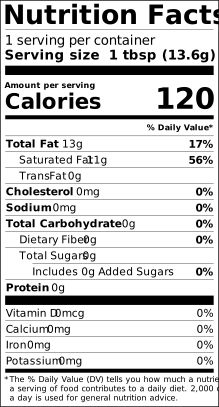
A tablespoon of coconut oil (13.6 g) has 121 calories. 100 g has 892 calories. On a Nutrition Facts label, calories are rounded to the nearest 5 or 10, so the panel above may show 120.
A tablespoon of coconut oil (13.6 g) has 121 calories and 13.5 g of fat, of which 11.2 g is saturated (56% of the Daily Value). Like other oils it has no protein, carbohydrate or cholesterol.
FDA standard format. Values use the FDA rounding rules for the serving you pick. Nutrients USDA does not report for this food print as 0 on the panel and as "not reported" in the table.
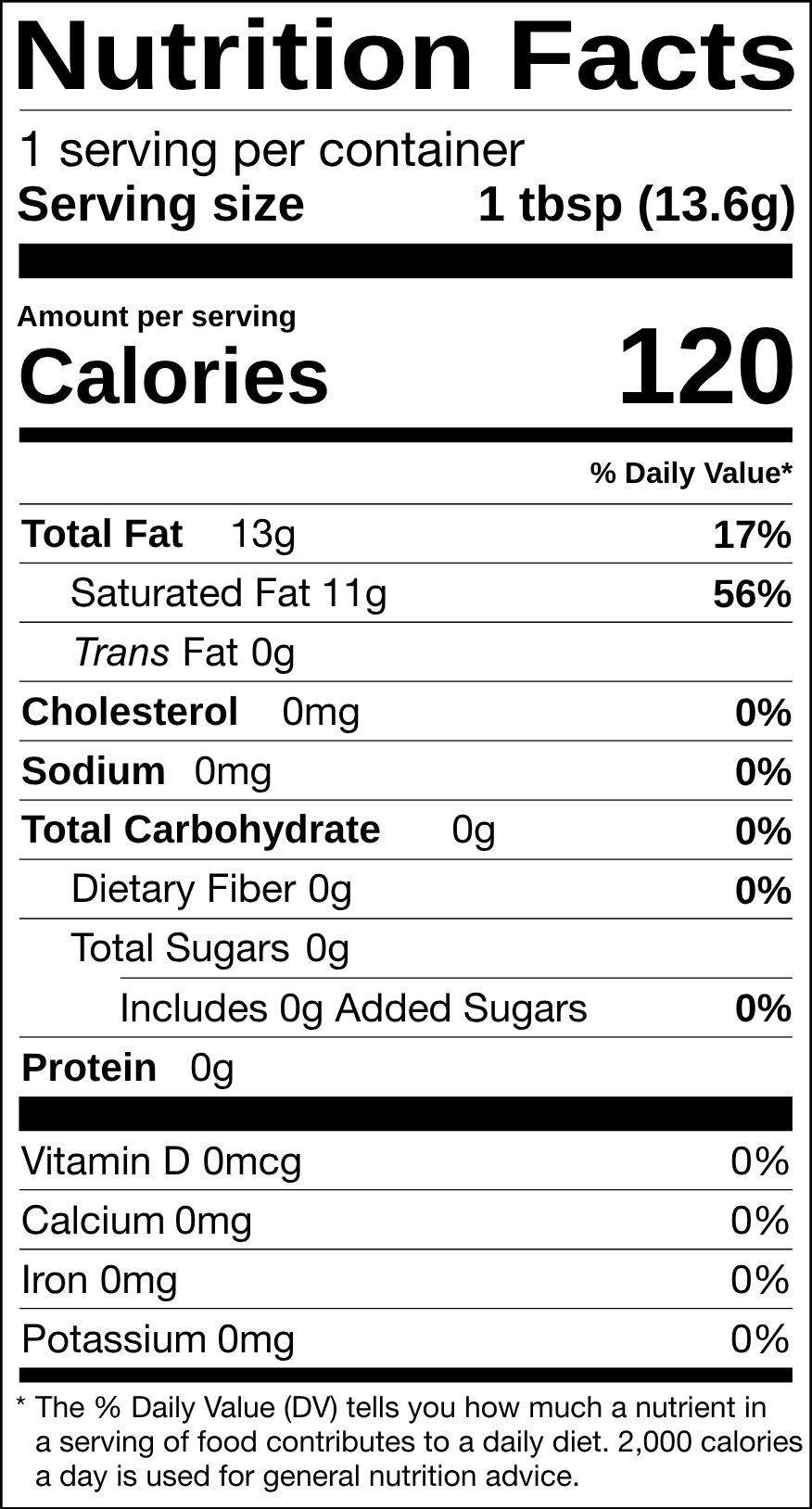
Download this label: SVG · PNG Free to use as a reference. A label for a product you sell needs your full recipe and ingredient statement.
1 tbsp (13.6 g)
Opens the free label generator with this amount of coconut oil already added. Add the rest of your ingredients and the label updates as you go.
| Nutrient | Per serving | % DV* | Per 100 g |
|---|---|---|---|
| Calories and macronutrients | |||
| Calories | 121 | 892 | |
| Total fat | 13.5 g | 17% | 99.1 g |
| Saturated fat | 11.2 g | 56% | 82.5 g |
| Trans fat | <0.1 g | 0.03 g | |
| Monounsaturated fat | 0.9 g | 6.33 g | |
| Polyunsaturated fat | 0.2 g | 1.7 g | |
| Cholesterol | 0 mg | 0% | 0 mg |
| Sodium | 0 mg | 0% | 0 mg |
| Total carbohydrate | 0 g | 0% | 0 g |
| Dietary fiber | 0 g | 0% | 0 g |
| Total sugars | 0 g | 0 g | |
| Added sugars | 0 g | 0% | 0 g |
| Protein | 0 g | 0 g | |
| Vitamins | |||
| Vitamin D | 0 mcg | 0% | 0 mcg |
| Vitamin A | 0 mcg | 0% | 0 mcg |
| Vitamin C | 0 mg | 0% | 0 mg |
| Vitamin E | <0.1 mg | 0% | 0.11 mg |
| Vitamin K | 0.08 mcg | 0% | 0.6 mcg |
| Thiamin (B1) | 0 mg | 0% | 0 mg |
| Riboflavin (B2) | 0 mg | 0% | 0 mg |
| Niacin (B3) | 0 mg | 0% | 0 mg |
| Vitamin B6 | 0 mg | 0% | 0 mg |
| Folate (DFE) | 0 mcg | 0% | 0 mcg |
| Vitamin B12 | 0 mcg | 0% | 0 mcg |
| Choline | <0.1 mg | 0% | 0.3 mg |
| Minerals | |||
| Calcium | 0.14 mg | 0% | 1 mg |
| Iron | <0.1 mg | 0% | 0.05 mg |
| Potassium | 0 mg | 0% | 0 mg |
| Magnesium | 0 mg | 0% | 0 mg |
| Phosphorus | 0 mg | 0% | 0 mg |
| Zinc | <0.1 mg | 0% | 0.02 mg |
| Copper | 0 mg | 0% | 0 mg |
| Manganese | 0 mg | 0% | 0 mg |
| Selenium | 0 mcg | 0% | 0 mcg |
| Other | |||
| Water | <0.1 g | 0.03 g | |
| Caffeine | 0 mg | 0 mg | |
| Alcohol | 0 g | 0 g | |
* Percent Daily Values are based on a 2,000 calorie diet (FDA reference values for adults and children 4 years and older). Per-100 g values are USDA figures before label rounding.
Every serving below is a USDA household measure for this food, a fraction of one, or a unit conversion. Amounts are USDA values scaled by weight; only the Nutrition Facts panel applies the coarser FDA label rounding.
| Serving | Weight | Calories | Total carbohydrate | Protein | Total fat | Dietary fiber | Total sugars |
|---|---|---|---|---|---|---|---|
| 1 tbsp | 13.6 g | 121 | 0 g | 0 g | 13.5 g | 0 g | 0 g |
| 1 cup | 218 g | 1945 | 0 g | 0 g | 216 g | 0 g | 0 g |
| 1 tsp | 4.5 g | 40 | 0 g | 0 g | 4.5 g | 0 g | 0 g |
| 100 g | 100 g | 892 | 0 g | 0 g | 99.1 g | 0 g | 0 g |
A tablespoon of coconut oil (13.6 g) has 121 calories. 100 g has 892 calories. On a Nutrition Facts label, calories are rounded to the nearest 5 or 10, so the panel above may show 120.
A tablespoon of coconut oil (13.6 g) has 13.5 g total fat: 11.2 g saturated, 0.9 g monounsaturated and 0.2 g polyunsaturated.
A tablespoon of coconut oil (13.6 g) has 11.2 g of saturated fat, 56% of the Daily Value. 100 g has 82.5 g. That is 20% DV or more per serving, which the FDA treats as high.
A tablespoon of coconut oil (13.6 g) has 0 mg of cholesterol, 0% of the Daily Value. 100 g has 0 mg.
100 g of coconut oil has 892 calories, 0 g protein, 0 g carbohydrate, 0 g fiber, 0 g sugars and 99.1 g fat.
Coconut oil is pressed from the white meat of mature coconuts. It is unusual among plant oils because most of its fat is saturated, which is why it is solid at cool room temperature and melts at about 75°F (24°C). About half of that saturated fat is lauric acid.
Both are essentially pure fat with the same calories, so USDA's single coconut oil record, used here, covers either. Fractionated or "MCT" coconut oil is a different product: part of the fat has been removed, so it stays liquid and its fat profile differs from this record.
Coconut oil keeps well in a closed jar in the pantry, because saturated fat oxidizes slowly. Switching between solid and liquid as the kitchen warms and cools does not hurt it. To measure solid oil by the spoon, soften it first, or weigh it, which is more accurate either way.
Coconut oil raises saturated fat on a Nutrition Facts panel quickly: one tablespoon is already 56% of the Daily Value. Weigh the oil in grams, enter it in the label generator with your other ingredients and check the saturated fat line. In January 2025 the FDA removed coconut from its list of tree nuts that count as major food allergens, so a "Contains" statement is no longer required for it, but coconut oil must still be listed by its common name in the ingredient statement; the ingredient formatter helps there. Oils have their own reference amount in the RACC lookup.
The same serving of coconut oil, drawn by the label formats other markets require: the Canadian bilingual Nutrition Facts table, the EU nutrition declaration (per 100 g, energy in kJ and kcal, salt instead of sodium) and the UK nutrition information table with reference intakes. The generator switches between these and many more from one recipe.
| Fat / Lipides | 13 g | 18 % |
| Saturated / Saturés | 11 g + Trans 0 g | 56 % |
| Cholesterol / Cholestérol | 0 mg | 0 % |
| Sodium | 0 mg | 0 % |
| Carbohydrate / Glucides | 0 g | 0 % |
| Fibre / Fibres | 0 g | 0 % |
| Sugars / Sucres | 0 g | 0 % |
| Protein / Protéines | 0 g | |
| Vitamin D / Vitamine D | 0 mcg | 0 % |
| Calcium | 0 mg | 0 % |
| Iron / Fer | 0 mg | 0 % |
| Potassium | 0 mg | 0 % |
| Per 100g | |
|---|---|
| Energy | 3732 kJ / 892 kcal |
| Fat | 99 g |
| of which saturates | 82 g |
| Carbohydrate | 0.0 g |
| of which sugars | 0.0 g |
| Protein | 0.0 g |
| Salt | 0.0 g |
| Per 100g | Per 13.6g | %RI* | |
|---|---|---|---|
| Energy | 3732 kJ 892 kcal |
508 kJ 121 kcal |
6.1% |
| Fat | 99g | 13g | 19% |
| of which saturates | 82g | 11g | 56% |
| Carbohydrate | 0 gg | 0 gg | <1% |
| of which sugars | 0 gg | 0 gg | <1% |
| Fibre | 0 gg | 0 gg | - |
| Protein | 0 gg | 0 gg | <1% |
| Salt | 0 gg | 0 gg | <1% |
If you make and sell a product that contains coconut oil, these free tools cover the next steps.
Nutrient values are from USDA FoodData Central, SR Legacy (April 2018 release, public domain), record 171412: "Oil, coconut". Values are stored per 100 g exactly as USDA reports them and scaled to each serving by weight. The Nutrition Facts panel applies the FDA rounding rules in 21 CFR 101.9; tables and text show the scaled amounts at reading precision, so a figure can differ slightly from the panel. A nutrient USDA does not report for this food is shown as not reported, never as a guessed value.
SR Legacy predates the added sugars field. This is a whole or unsweetened food, so added sugars are shown as 0 g. View the USDA record ↗