A medium apple (182 g, about 3 inches across) has 95 calories, 25.1 g of carbohydrate and 4.4 g of fiber, with almost no fat or protein. The figures come from USDA's record for raw apple eaten with the skin and change with the size you choose, from an extra small apple to a cup of slices.
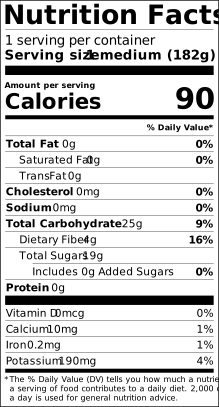
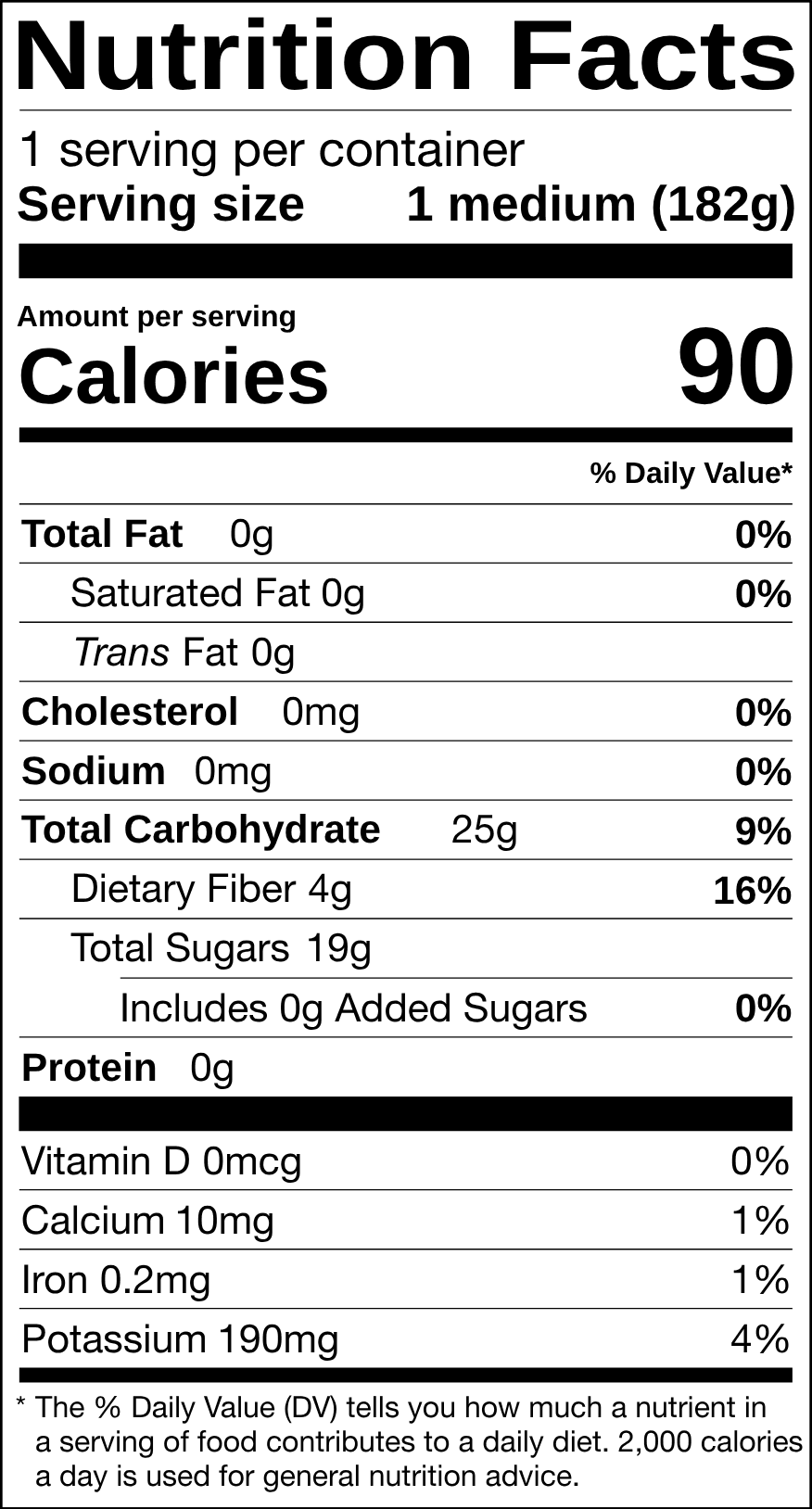
FDA standard format. Values use the FDA rounding rules for the serving you pick. Nutrients USDA does not report for this food print as 0 on the panel and as "not reported" in the table.
Download this label:SVG · PNG Free to use as a reference. A label for a product you sell needs your full recipe and ingredient statement.
Opens the free label generator with this amount of apple already added. Add the rest of your ingredients and the label updates as you go.
All nutrients for this serving
1 medium (3" dia) (182 g)
Nutrient
Per serving
% DV*
Per 100 g
Calories and macronutrients
Calories
95
52
Total fat
0.3 g
0%
0.17 g
Saturated fat
0.1 g
0%
0.03 g
Trans fat
0 g
0 g
Monounsaturated fat
<0.1 g
0.01 g
Polyunsaturated fat
0.1 g
0.05 g
Cholesterol
0 mg
0%
0 mg
Sodium
1.8 mg
0%
1 mg
Total carbohydrate
25.1 g
9%
13.8 g
Dietary fiber
4.4 g
16%
2.4 g
Total sugars
18.9 g
10.4 g
Added sugars
0 g
0%
0 g
Protein
0.5 g
0.26 g
Vitamins
Vitamin D
0 mcg
0%
0 mcg
Vitamin A
5.5 mcg
1%
3 mcg
Vitamin C
8.4 mg
9%
4.6 mg
Vitamin E
0.33 mg
2%
0.18 mg
Vitamin K
4 mcg
3%
2.2 mcg
Thiamin (B1)
<0.1 mg
3%
0.02 mg
Riboflavin (B2)
<0.1 mg
4%
0.03 mg
Niacin (B3)
0.17 mg
1%
0.09 mg
Vitamin B6
0.07 mg
4%
0.04 mg
Folate (DFE)
5.5 mcg
1%
3 mcg
Vitamin B12
0 mcg
0%
0 mcg
Choline
6.2 mg
1%
3.4 mg
Minerals
Calcium
11 mg
1%
6 mg
Iron
0.22 mg
1%
0.12 mg
Potassium
195 mg
4%
107 mg
Magnesium
9.1 mg
2%
5 mg
Phosphorus
20 mg
2%
11 mg
Zinc
0.07 mg
1%
0.04 mg
Copper
<0.1 mg
5%
0.03 mg
Manganese
0.06 mg
3%
0.04 mg
Selenium
0 mcg
0%
0 mcg
Other
Water
155.7 g
85.6 g
Caffeine
0 mg
0 mg
Alcohol
0 g
0 g
* Percent Daily Values are based on a 2,000 calorie diet (FDA reference values for adults and children 4 years and older). Per-100 g values are USDA figures before label rounding.
Apple nutrition by serving size
Every serving below is a USDA household measure for this food, a fraction of one, or a unit conversion. Amounts are USDA values scaled by weight; only the Nutrition Facts panel applies the coarser FDA label rounding.
Serving
Weight
Calories
Total carbohydrate
Protein
Total fat
Dietary fiber
Total sugars
1 cup, quartered or chopped
125 g
65
17.3 g
0.3 g
0.2 g
3 g
13 g
1 cup slices
109 g
57
15.1 g
0.3 g
0.2 g
2.6 g
11.3 g
1 large (3-1/4" dia)
223 g
116
30.8 g
0.6 g
0.4 g
5.4 g
23.2 g
1 medium (3" dia)
182 g
95
25.1 g
0.5 g
0.3 g
4.4 g
18.9 g
1 small (2-3/4" dia)
149 g
77
20.6 g
0.4 g
0.3 g
3.6 g
15.5 g
1 extra small (2-1/2" dia)
101 g
53
13.9 g
0.3 g
0.2 g
2.4 g
10.5 g
1 NLEA serving
242 g
126
33.4 g
0.6 g
0.4 g
5.8 g
25.1 g
100 g
100 g
52
13.8 g
0.3 g
0.2 g
2.4 g
10.4 g
Apple calories by size
USDA weighs apple in several sizes. Calories rise with weight:
Serving
Weight
Calories
Total carbohydrate
1 extra small (2-1/2" dia)
101 g
53
13.9 g
1 small (2-3/4" dia)
149 g
77
20.6 g
1 medium (3" dia)
182 g
95
25.1 g
1 large (3-1/4" dia)
223 g
116
30.8 g
How many carbs are in an apple?
A medium apple (182 g) has 25.1 g total carbohydrate, including 4.4 g dietary fiber and 18.9 g total sugars. Carbohydrate minus fiber is 20.8 g.
How much sugar is in an apple?
A medium apple (182 g) has 18.9 g total sugars. None of it is added sugar.
How much fiber is in an apple?
A medium apple (182 g) has 4.4 g of fiber, 16% of the Daily Value. 100 g has 2.4 g. At 10 to 19% DV per serving, that meets the FDA threshold for a "good source" claim.
How much vitamin C is in an apple?
A medium apple (182 g) has 8.4 mg of vitamin C, 9% of the Daily Value. 100 g has 4.6 mg. That is below the 10% DV a serving needs for a "good source" claim.
Apple nutrition per 100 grams
100 g of apple has 52 calories, 0.26 g protein, 13.8 g carbohydrate, 2.4 g fiber, 10.4 g sugars and 0.17 g fat.
Where the calories in apple come from
About 96% of the calories in apple come from carbohydrate, 3% from fat and 2% from protein (Atwater factors of 4, 9 and 4 calories per gram).
What USDA's apple record covers
The record behind this page, "Apples, raw, with skin", is a general figure for fresh eating apples rather than one named variety. It assumes you eat the peel, which matters: much of an apple's fiber sits in and just under the skin. Sizes are defined by diameter, so a "medium" apple here is about 3 inches across and a large one about 3 and a quarter inches.
Roughly six parts in seven of a raw apple's weight is water (155.7 g in a medium apple). Almost all of the rest is carbohydrate, mainly natural fruit sugars plus fiber, which is why calories track weight so closely from one size to the next.
Honeycrisp, Gala, Granny Smith and other apple varieties
People often search calories for a specific variety. USDA does publish separate records for several common ones, including Fuji, Gala, Granny Smith, Honeycrisp and Red Delicious. Per gram, these records sit close to the general apple figure used here; tart Granny Smith apples run a little lower in sugar than sweet varieties such as Fuji.
In practice, the size of the apple changes the calories far more than the variety does. A large Honeycrisp and a small Gala are not comparable, so weigh the fruit or pick the matching size above. For tart green apples, see green apple (Granny Smith) nutrition.
How apples are used in cooking
Different apples suit different jobs:
Raw: sliced for snacks and lunch boxes, grated into slaws, or diced into salads, where crisp varieties hold their texture.
Baking: firm, tart apples such as Granny Smith keep their shape in pies, crisps and galettes; softer varieties break down.
Sauce and butter: apples that collapse when cooked make smooth applesauce and apple butter.
Savory dishes: roasted with pork or root vegetables, or sliced onto grilled cheese.
Food manufacturing: apple juice concentrate is a common sweetener in fruit snacks and juices, and apple pectin is used to set jams and jellies.
Foods made with apples
Apple pie. Sliced apples baked with sugar and spice in a flour and butter crust. All-Purpose Flour · Butter · Sugar
Apple crisp. Like pie without the bottom crust, topped with a crumble of oats, butter and brown sugar. Oats · Butter · Brown Sugar
Applesauce. Apples cooked down until soft, sold sweetened or unsweetened. Unsweetened applesauce is often used to replace some of the oil in baking.
Apples with peanut butter. A common snack pairing of apple slices and nut butter. Peanut Butter
Waldorf-style salad. Diced apple with celery, walnuts and a mayonnaise or yogurt dressing. Walnuts · Mayonnaise · Greek Yogurt
Caramel apples. Whole apples dipped in caramel, which adds far more sugar than the fruit itself contains.
Simple apple recipes
Apple and peanut butter slices
Core and slice an apple, then spread or dip the slices in peanut butter. A squeeze of lemon keeps cut slices from browning if you pack them ahead.
Apples keep longest in the refrigerator crisper drawer; at room temperature they soften within days. They give off ethylene, the ripening gas, so store them away from produce that ripens quickly, such as bananas and leafy greens. Cut apple turns brown when an enzyme in the flesh reacts with air. A little lemon juice on the cut surface slows it, and so does keeping slices covered and cold. Browning changes color and flavor, not the calories.
Labeling a product made with apples
For pies, crisps, applesauce or dried apple snacks, the label is calculated from your recipe, not from a whole apple. Weigh apples after coring, and after peeling if your recipe peels them, because USDA's record used here includes the skin. Cooking and drying drive off water, so base the serving size on the finished product weight. Enter each ingredient in the label generator, or build the formula first in the recipe nutrition calculator, and check the FDA reference amount for your product category in the RACC lookup.
Apple nutrition label for Canada, the EU and the UK
The same serving of apple, drawn by the label formats other markets require: the Canadian bilingual Nutrition Facts table, the EU nutrition declaration (per 100 g, energy in kJ and kcal, salt instead of sodium) and the UK nutrition information table with reference intakes. The generator switches between these and many more from one recipe.
Nutrition Facts
Valeur nutritive
Per 1 medium (182g) / pour 1 medium (182g)
Calories
90
% Daily Value* / % valeur quotidienne*
Fat / Lipides
0 g
0 %
Saturated / Saturés
0 g + Trans 0 g
0 %
Cholesterol / Cholestérol
0 mg
0 %
Sodium
0 mg
0 %
Carbohydrate / Glucides
25 g
9 %
Fibre / Fibres
4 g
16 %
Sugars / Sucres
19 g
19 %
Protein / Protéines
0 g
Vitamin D / Vitamine D
0 mcg
0 %
Calcium
11 mg
1 %
Iron / Fer
0 mg
1 %
Potassium
195 mg
6 %
*5% or less is a little, 15% or more is a lot
*5 % ou moins c'est peu, 15 % ou plus c'est beaucoup
Canada: bilingual table
Nutrition Declaration
Per 100g
Energy
218 kJ / 52 kcal
Fat
0.2 g
of which saturates
0.0 g
Carbohydrate
14 g
of which sugars
10 g
Protein
0.3 g
Salt
0.0 g
EU 1169/2011: per 100 g, kJ and kcal, salt
Nutrition Information
Typical values (1 servings per pack)
Per 100g
Per 182g
%RI*
Energy
218 kJ 52 kcal
396 kJ 95 kcal
4.7%
Fat
0 gg
0 gg
<1%
of which saturates
0 gg
0 gg
<1%
Carbohydrate
14g
25g
9.7%
of which sugars
10g
19g
21%
Fibre
2.4g
4.4g
-
Protein
0 gg
0 gg
<1%
Salt
0 gg
0 gg
<1%
*Reference Intake of an average adult (8400 kJ / 2000 kcal).
This pack contains approximately 1 servings.
UK FIR 2014: per 100 g and per serving, %RI
Frequently asked questions about apple
Does an apple have fewer calories without the skin?+
A little fewer, and noticeably less fiber. USDA's record for peeled raw apple has slightly fewer calories per gram than the with-skin record used here and only a little more than half the fiber. Peeling also removes weight, so a peeled apple has fewer calories in total.
How many calories are in a cup of apple slices?+
A cup of apple slices (109 g) has 57 calories. A cup of chopped or quartered apple packs more fruit into the cup (125 g), so it has 65 calories.
How many calories are in an apple with peanut butter?+
Add the two together: a medium apple has 95 calories, and the usual two tablespoons of peanut butter add more calories than the apple itself. Use the label generator with both ingredients to get the total for your portions.
Which has more calories, an apple or a banana?+
Size for size, a medium banana has slightly more calories and carbohydrate than a medium apple (95 calories). A large apple (116 calories) has more than a medium banana, so the size you eat matters more than the fruit.
Is an apple high in sugar?+
A medium apple has 18.9 g of sugar, all of it naturally present in the fruit. On a Nutrition Facts label none of it counts as added sugars, so the added sugars line for a fresh apple is zero.
Does cooking an apple change its nutrition?+
Baking or stewing an apple does not remove its calories or fiber, but heat lowers the vitamin C. Cooked apple dishes usually differ more because of what is added, such as sugar and butter, than because of the cooking itself.
What is the best apple for nutrition?+
No common variety stands far apart: USDA's records for Fuji, Gala, Granny Smith, Honeycrisp and Red Delicious are close per gram. Eating the skin and choosing the size you want make a bigger difference than the variety.
How many calories are in 100 g of apple?+
100 g of apple has 52 calories, 0.26 g protein, 13.8 g carbohydrate and 0.17 g fat.
How much protein is in an apple?+
A medium apple (182 g) has 0.5 g protein, 1% of the 50 g Daily Value. 100 g has 0.26 g.
What is a serving of apple?+
This page defaults to 1 medium (3" dia) (182 g), a USDA household measure. The serving size on a packaged food label is set by the FDA reference amount (RACC) for its category, so a product label can use a different amount. The selector above shows every USDA measure for apple.
Can I use apple in a Nutrition Facts label calculation?+
Yes. Open the generator with apple added, enter the weight you use, add your other ingredients and the label is calculated from the same USDA record shown here. A label for a product you sell must reflect your actual recipe and finished serving.
Apple compared with other forms
Different forms of the same food are separate USDA records, so each has its own page. Per 100 g:
Form
Calories
Protein
Total fat
Total carbohydrate
AppleApples, raw, with skin (Includes foods for USDA's Food Distribution Program)
52
0.26 g
0.17 g
13.8 g
Green AppleApples, raw, granny smith, with skin (Includes foods for USDA's Food Distribution Program)
58
0.44 g
0.19 g
13.6 g
Fuji AppleApples, raw, fuji, with skin (Includes foods for USDA's Food Distribution Program)
63
0.2 g
0.18 g
15.2 g
Gala AppleApples, raw, gala, with skin (Includes foods for USDA's Food Distribution Program)
Nutrient values are from USDA FoodData Central, SR Legacy (April 2018 release, public domain), record 171688: "Apples, raw, with skin (Includes foods for USDA's Food Distribution Program)". Values are stored per 100 g exactly as USDA reports them and scaled to each serving by weight. The Nutrition Facts panel applies the FDA rounding rules in 21 CFR 101.9; tables and text show the scaled amounts at reading precision, so a figure can differ slightly from the panel. A nutrient USDA does not report for this food is shown as not reported, never as a guessed value.
SR Legacy predates the added sugars field. This is a whole or unsweetened food, so added sugars are shown as 0 g. View the USDA record ↗
Make a Nutrition Facts label with apple
Add apple and the rest of your recipe. The label, %DV and serving math are done for you. Free to start.