Carrot calories by size
USDA weighs carrot in several sizes. Calories rise with weight:
| Serving | Weight | Calories | Total carbohydrate |
|---|---|---|---|
| 1 small (5-1/2" long) | 50 g | 21 | 4.8 g |
| 1 medium | 61 g | 25 | 5.8 g |
| 1 large (7-1/4" to 8-/1/2" long) | 72 g | 30 | 6.9 g |
A medium raw carrot (61 g) has 25 calories, 5.8 g of carbohydrate and 509 mcg of vitamin A, which is 57% of the Daily Value. A large carrot has 30 calories.
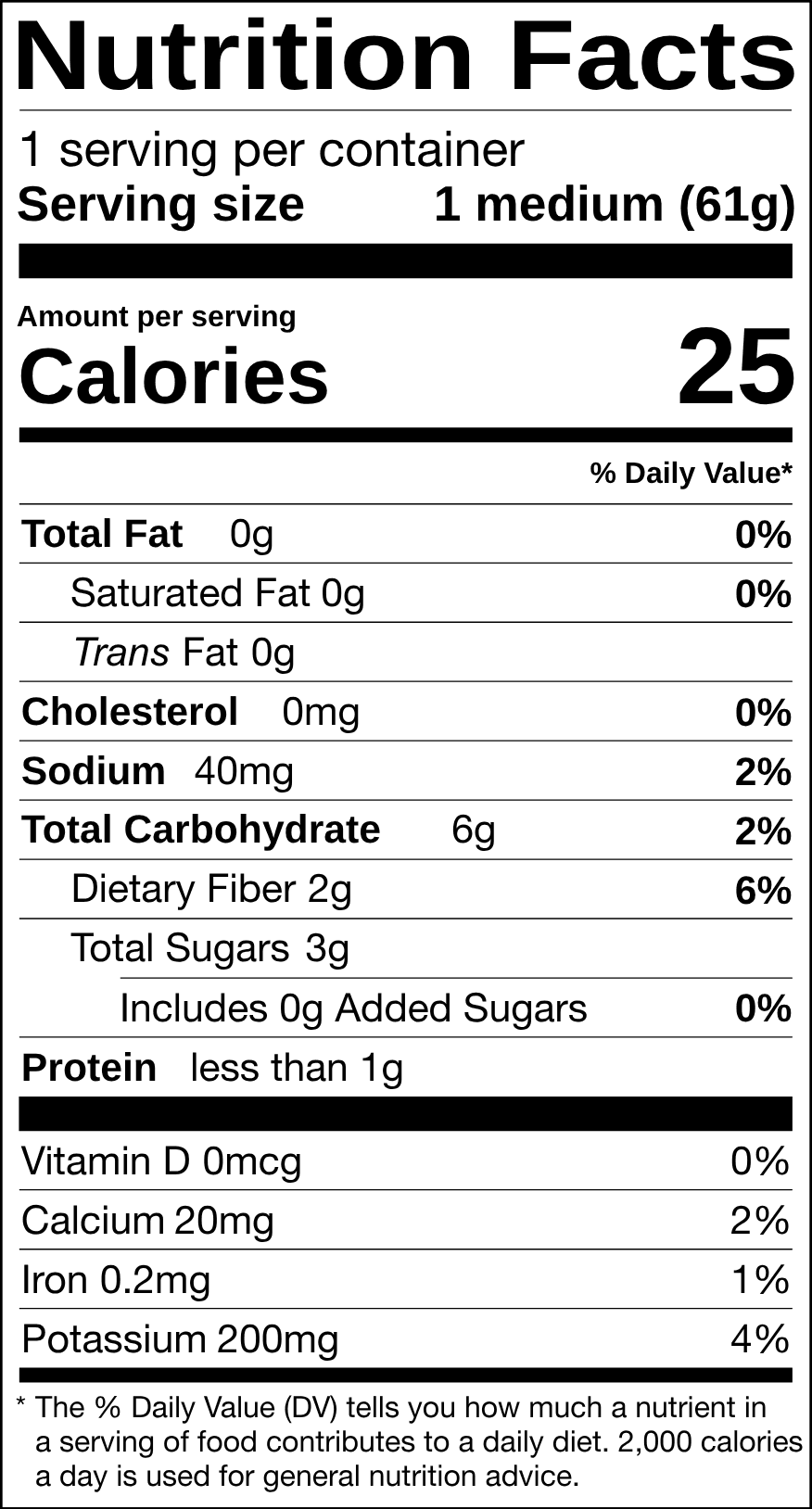
FDA standard format. Values use the FDA rounding rules for the serving you pick. Nutrients USDA does not report for this food print as 0 on the panel and as "not reported" in the table.
Download this label: SVG · PNG Free to use as a reference. A label for a product you sell needs your full recipe and ingredient statement.
1 medium (61 g)
Opens the free label generator with this amount of carrot already added. Add the rest of your ingredients and the label updates as you go.
| Nutrient | Per serving | % DV* | Per 100 g |
|---|---|---|---|
| Calories and macronutrients | |||
| Calories | 25 | 41 | |
| Total fat | 0.1 g | 0% | 0.24 g |
| Saturated fat | <0.1 g | 0% | 0.03 g |
| Trans fat | 0 g | 0 g | |
| Monounsaturated fat | <0.1 g | 0.01 g | |
| Polyunsaturated fat | 0.1 g | 0.1 g | |
| Cholesterol | 0 mg | 0% | 0 mg |
| Sodium | 42 mg | 2% | 69 mg |
| Total carbohydrate | 5.8 g | 2% | 9.58 g |
| Dietary fiber | 1.7 g | 6% | 2.8 g |
| Total sugars | 2.9 g | 4.74 g | |
| Added sugars | 0 g | 0% | 0 g |
| Protein | 0.6 g | 0.93 g | |
| Vitamins | |||
| Vitamin D | 0 mcg | 0% | 0 mcg |
| Vitamin A | 509 mcg | 57% | 835 mcg |
| Vitamin C | 3.6 mg | 4% | 5.9 mg |
| Vitamin E | 0.4 mg | 3% | 0.66 mg |
| Vitamin K | 8.1 mcg | 7% | 13.2 mcg |
| Thiamin (B1) | <0.1 mg | 3% | 0.07 mg |
| Riboflavin (B2) | <0.1 mg | 3% | 0.06 mg |
| Niacin (B3) | 0.6 mg | 4% | 0.98 mg |
| Vitamin B6 | 0.08 mg | 5% | 0.14 mg |
| Folate (DFE) | 12 mcg | 3% | 19 mcg |
| Vitamin B12 | 0 mcg | 0% | 0 mcg |
| Choline | 5.4 mg | 1% | 8.8 mg |
| Minerals | |||
| Calcium | 20 mg | 2% | 33 mg |
| Iron | 0.18 mg | 1% | 0.3 mg |
| Potassium | 195 mg | 4% | 320 mg |
| Magnesium | 7.3 mg | 2% | 12 mg |
| Phosphorus | 21 mg | 2% | 35 mg |
| Zinc | 0.15 mg | 1% | 0.24 mg |
| Copper | <0.1 mg | 3% | 0.05 mg |
| Manganese | 0.09 mg | 4% | 0.14 mg |
| Selenium | 0.06 mcg | 0% | 0.1 mcg |
| Other | |||
| Water | 53.9 g | 88.3 g | |
| Caffeine | 0 mg | 0 mg | |
| Alcohol | 0 g | 0 g | |
* Percent Daily Values are based on a 2,000 calorie diet (FDA reference values for adults and children 4 years and older). Per-100 g values are USDA figures before label rounding.
Every serving below is a USDA household measure for this food, a fraction of one, or a unit conversion. Amounts are USDA values scaled by weight; only the Nutrition Facts panel applies the coarser FDA label rounding.
| Serving | Weight | Calories | Total carbohydrate | Protein | Total fat | Dietary fiber | Total sugars |
|---|---|---|---|---|---|---|---|
| 1 cup chopped | 128 g | 52 | 12.3 g | 1.2 g | 0.3 g | 3.6 g | 6.1 g |
| 1 cup grated | 110 g | 45 | 10.5 g | 1 g | 0.3 g | 3.1 g | 5.2 g |
| 1 cup strips or slices | 122 g | 50 | 11.7 g | 1.1 g | 0.3 g | 3.4 g | 5.8 g |
| 1 large (7-1/4" to 8-/1/2" long) | 72 g | 30 | 6.9 g | 0.7 g | 0.2 g | 2 g | 3.4 g |
| 1 medium | 61 g | 25 | 5.8 g | 0.6 g | 0.1 g | 1.7 g | 2.9 g |
| 1 small (5-1/2" long) | 50 g | 21 | 4.8 g | 0.5 g | 0.1 g | 1.4 g | 2.4 g |
| 1 slice | 3 g | 1 | 0.3 g | <0.1 g | <0.1 g | 0.1 g | 0.1 g |
| 1 strip large (3" long) | 7 g | 3 | 0.7 g | 0.1 g | <0.1 g | 0.2 g | 0.3 g |
| 1 strip medium | 4 g | 2 | 0.4 g | <0.1 g | <0.1 g | 0.1 g | 0.2 g |
| 100 g | 100 g | 41 | 9.6 g | 0.9 g | 0.2 g | 2.8 g | 4.7 g |
USDA weighs carrot in several sizes. Calories rise with weight:
| Serving | Weight | Calories | Total carbohydrate |
|---|---|---|---|
| 1 small (5-1/2" long) | 50 g | 21 | 4.8 g |
| 1 medium | 61 g | 25 | 5.8 g |
| 1 large (7-1/4" to 8-/1/2" long) | 72 g | 30 | 6.9 g |
A medium carrot (61 g) has 509 mcg of vitamin A, 57% of the Daily Value. 100 g has 835 mcg. At 20% DV or more per serving, that meets the FDA threshold for an "excellent source" claim.
A medium carrot (61 g) has 5.8 g total carbohydrate, including 1.7 g dietary fiber and 2.9 g total sugars. Carbohydrate minus fiber is 4.1 g.
A medium carrot (61 g) has 2.9 g total sugars. None of it is added sugar.
A medium carrot (61 g) has 1.7 g of fiber, 6% of the Daily Value. 100 g has 2.8 g. That is below the 10% DV a serving needs for a "good source" claim.
A medium carrot (61 g) has 195 mg of potassium, 4% of the Daily Value. 100 g has 320 mg. That is below the 10% DV a serving needs for a "good source" claim.
100 g of carrot has 41 calories, 0.93 g protein, 9.58 g carbohydrate, 2.8 g fiber, 4.74 g sugars and 0.24 g fat.
Orange carrots get their color from beta-carotene and related carotenoids, which the body converts to vitamin A. USDA reports vitamin A as retinol activity equivalents (RAE), the unit used on Nutrition Facts labels, calculated from those carotenoids. Purple, red, yellow and white carrots exist too; their pigments differ, so their vitamin A content can too, and this record is for ordinary orange carrots eaten raw.
Most "baby carrots" sold in bags are baby-cut: full-size carrots cut into short pieces and peeled smooth, a method developed in California in the 1980s. USDA has a separate baby carrot record, but they are the same vegetable as the whole carrots on this page.
Raw carrots are crunchy because of their firm cell walls; cooking softens them, and carrots turn noticeably sweeter as they roast and brown. Boiled carrots have their own USDA record, since cooking changes weight and some nutrients; the numbers on this page are for raw carrots. Carrot skin is thin and edible, so peeling is a matter of texture and appearance; scrubbing well is enough for most dishes.
Cut off the green tops before storing, because the leaves keep drawing moisture from the root and the carrots go limp sooner. Refrigerate carrots in a bag or container, unwashed until you use them. Baby-cut carrots sometimes develop a white film as their cut surface dries out; it is harmless dehydration and disappears with a rinse.
Weigh trimmed carrots in the form you use them: a cup of grated carrot is 110 g, while a cup chopped is 128 g, so cups are not interchangeable. Enter the weight in the label generator along with the rest of the recipe. For carrot cake and muffins, the oven drives off water, so set servings from the baked weight; for soups, from the finished batch. Use the cooked carrot record only if you buy carrots already cooked. Serving sizes for cakes, soups and fresh-cut vegetables are in the RACC lookup.
The same serving of carrot, drawn by the label formats other markets require: the Canadian bilingual Nutrition Facts table, the EU nutrition declaration (per 100 g, energy in kJ and kcal, salt instead of sodium) and the UK nutrition information table with reference intakes. The generator switches between these and many more from one recipe.
| Fat / Lipides | 0 g | 0 % |
| Saturated / Saturés | 0 g + Trans 0 g | 0 % |
| Cholesterol / Cholestérol | 0 mg | 0 % |
| Sodium | 40 mg | 2 % |
| Carbohydrate / Glucides | 6 g | 2 % |
| Fibre / Fibres | 2 g | 6 % |
| Sugars / Sucres | 3 g | 3 % |
| Protein / Protéines | 1 g | |
| Vitamin D / Vitamine D | 0 mcg | 0 % |
| Calcium | 20 mg | 2 % |
| Iron / Fer | 0 mg | 1 % |
| Potassium | 195 mg | 6 % |
| Per 100g | |
|---|---|
| Energy | 172 kJ / 41 kcal |
| Fat | 0.2 g |
| of which saturates | 0.0 g |
| Carbohydrate | 9.6 g |
| of which sugars | 4.7 g |
| Protein | 0.9 g |
| Salt | 0.2 g |
| Per 100g | Per 61g | %RI* | |
|---|---|---|---|
| Energy | 172 kJ 41 kcal |
105 kJ 25 kcal |
1.3% |
| Fat | 0 gg | 0 gg | <1% |
| of which saturates | 0 gg | 0 gg | <1% |
| Carbohydrate | 9.6g | 5.8g | 2.2% |
| of which sugars | 4.7g | 2.9g | 3.2% |
| Fibre | 2.8g | 1.7g | - |
| Protein | 0.9g | 0.6g | 1.1% |
| Salt | 0.17g | 0.11g | 1.8% |
Different forms of the same food are separate USDA records, so each has its own page. Per 100 g:
| Form | Calories | Protein | Total fat | Total carbohydrate |
|---|---|---|---|---|
| CarrotCarrots, raw | 41 | 0.93 g | 0.24 g | 9.58 g |
| Baby CarrotsCarrots, baby, raw | 35 | 0.64 g | 0.13 g | 8.24 g |
| Cooked CarrotsCarrots, cooked, boiled, drained, without salt | 35 | 0.76 g | 0.18 g | 8.22 g |
If you make and sell a product that contains carrot, these free tools cover the next steps.
Nutrient values are from USDA FoodData Central, SR Legacy (April 2018 release, public domain), record 170393: "Carrots, raw". Values are stored per 100 g exactly as USDA reports them and scaled to each serving by weight. The Nutrition Facts panel applies the FDA rounding rules in 21 CFR 101.9; tables and text show the scaled amounts at reading precision, so a figure can differ slightly from the panel. A nutrient USDA does not report for this food is shown as not reported, never as a guessed value.
SR Legacy predates the added sugars field. This is a whole or unsweetened food, so added sugars are shown as 0 g. View the USDA record ↗