How many calories are in grapes?
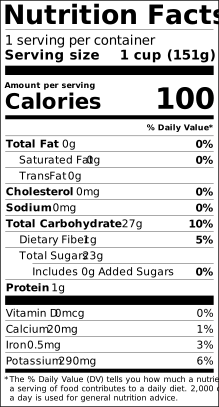
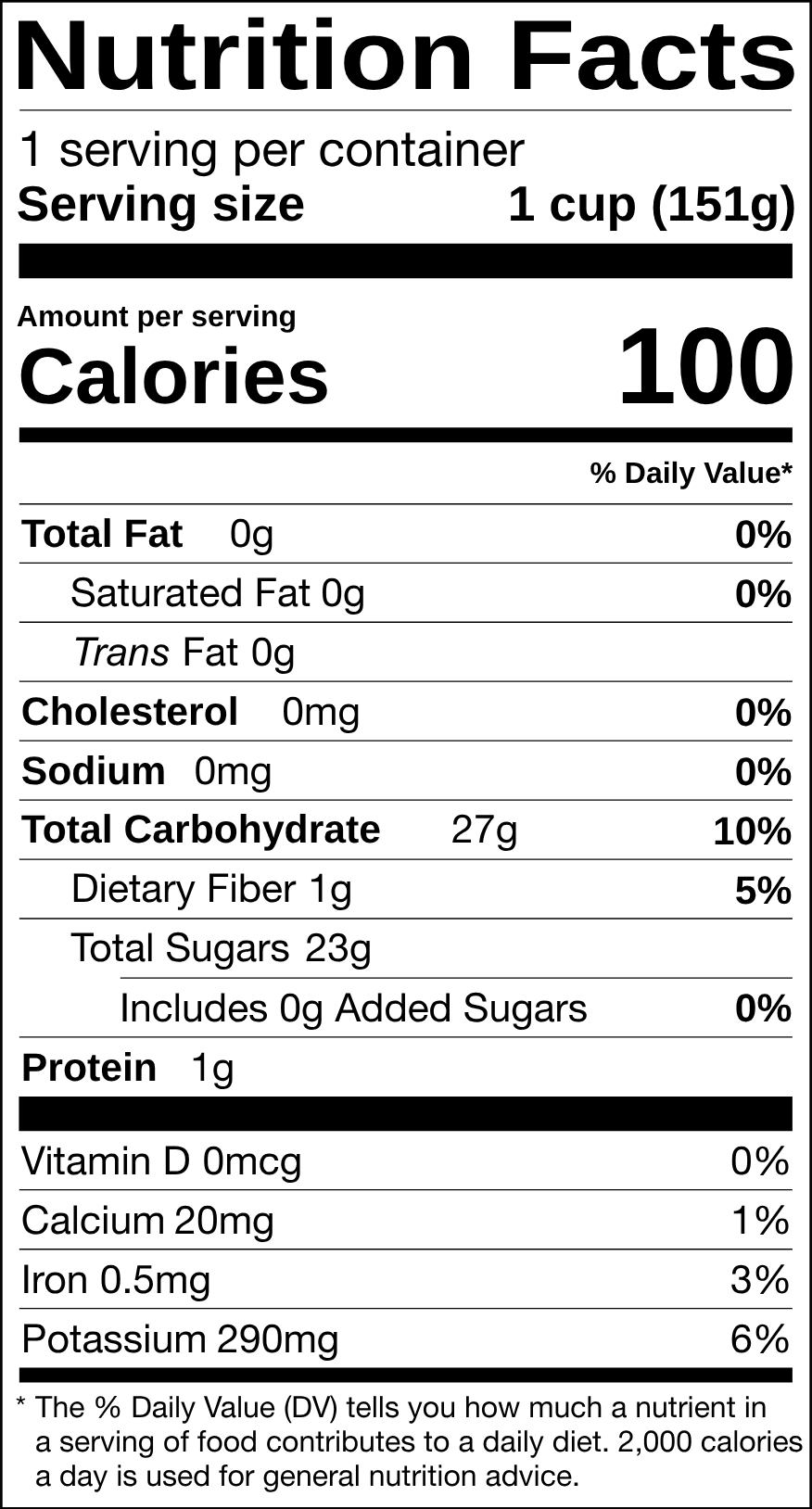
A cup of grapes (151 g) has 104 calories. 100 g has 69 calories. On a Nutrition Facts label, calories are rounded to the nearest 5 or 10, so the panel above may show 100.
A cup of red or green grapes (151 g) has 104 calories, 27.3 g of carbohydrate and 23.4 g of natural sugars, with almost no fat. Ten grapes (49 g) have 34 calories.
FDA standard format. Values use the FDA rounding rules for the serving you pick. Nutrients USDA does not report for this food print as 0 on the panel and as "not reported" in the table.
Download this label: SVG · PNG Free to use as a reference. A label for a product you sell needs your full recipe and ingredient statement.
1 cup (151 g)
Opens the free label generator with this amount of grapes already added. Add the rest of your ingredients and the label updates as you go.
| Nutrient | Per serving | % DV* | Per 100 g |
|---|---|---|---|
| Calories and macronutrients | |||
| Calories | 104 | 69 | |
| Total fat | 0.2 g | 0% | 0.16 g |
| Saturated fat | 0.1 g | 0% | 0.05 g |
| Trans fat | 0 g | 0 g | |
| Monounsaturated fat | <0.1 g | 0.01 g | |
| Polyunsaturated fat | 0.1 g | 0.05 g | |
| Cholesterol | 0 mg | 0% | 0 mg |
| Sodium | 3 mg | 0% | 2 mg |
| Total carbohydrate | 27.3 g | 10% | 18.1 g |
| Dietary fiber | 1.4 g | 5% | 0.9 g |
| Total sugars | 23.4 g | 15.5 g | |
| Added sugars | 0 g | 0% | 0 g |
| Protein | 1.1 g | 0.72 g | |
| Vitamins | |||
| Vitamin D | 0 mcg | 0% | 0 mcg |
| Vitamin A | 4.5 mcg | 1% | 3 mcg |
| Vitamin C | 4.8 mg | 5% | 3.2 mg |
| Vitamin E | 0.29 mg | 2% | 0.19 mg |
| Vitamin K | 22 mcg | 18% | 14.6 mcg |
| Thiamin (B1) | 0.1 mg | 9% | 0.07 mg |
| Riboflavin (B2) | 0.11 mg | 8% | 0.07 mg |
| Niacin (B3) | 0.28 mg | 2% | 0.19 mg |
| Vitamin B6 | 0.13 mg | 8% | 0.09 mg |
| Folate (DFE) | 3 mcg | 1% | 2 mcg |
| Vitamin B12 | 0 mcg | 0% | 0 mcg |
| Choline | 8.5 mg | 2% | 5.6 mg |
| Minerals | |||
| Calcium | 15 mg | 1% | 10 mg |
| Iron | 0.54 mg | 3% | 0.36 mg |
| Potassium | 288 mg | 6% | 191 mg |
| Magnesium | 11 mg | 3% | 7 mg |
| Phosphorus | 30 mg | 2% | 20 mg |
| Zinc | 0.11 mg | 1% | 0.07 mg |
| Copper | 0.19 mg | 21% | 0.13 mg |
| Manganese | 0.11 mg | 5% | 0.07 mg |
| Selenium | 0.15 mcg | 0% | 0.1 mcg |
| Other | |||
| Water | 121.6 g | 80.5 g | |
| Caffeine | 0 mg | 0 mg | |
| Alcohol | 0 g | 0 g | |
* Percent Daily Values are based on a 2,000 calorie diet (FDA reference values for adults and children 4 years and older). Per-100 g values are USDA figures before label rounding.
Every serving below is a USDA household measure for this food, a fraction of one, or a unit conversion. Amounts are USDA values scaled by weight; only the Nutrition Facts panel applies the coarser FDA label rounding.
| Serving | Weight | Calories | Total carbohydrate | Protein | Total fat | Dietary fiber | Total sugars |
|---|---|---|---|---|---|---|---|
| 1 cup | 151 g | 104 | 27.3 g | 1.1 g | 0.2 g | 1.4 g | 23.4 g |
| 10 grapes | 49 g | 34 | 8.9 g | 0.4 g | 0.1 g | 0.4 g | 7.6 g |
| 1 NLEA serving | 126 g | 87 | 22.8 g | 0.9 g | 0.2 g | 1.1 g | 19.5 g |
| 100 g | 100 g | 69 | 18.1 g | 0.7 g | 0.2 g | 0.9 g | 15.5 g |
A cup of grapes (151 g) has 104 calories. 100 g has 69 calories. On a Nutrition Facts label, calories are rounded to the nearest 5 or 10, so the panel above may show 100.
A cup of grapes (151 g) has 23.4 g total sugars. None of it is added sugar.
A cup of grapes (151 g) has 27.3 g total carbohydrate, including 1.4 g dietary fiber and 23.4 g total sugars. Carbohydrate minus fiber is 26 g.
A cup of grapes (151 g) has 1.4 g of fiber, 5% of the Daily Value. 100 g has 0.9 g. That is below the 10% DV a serving needs for a "good source" claim.
A cup of grapes (151 g) has 22 mcg of vitamin K, 18% of the Daily Value. 100 g has 14.6 mcg. At 10 to 19% DV per serving, that meets the FDA threshold for a "good source" claim.
A cup of grapes (151 g) has 288 mg of potassium, 6% of the Daily Value. 100 g has 191 mg. That is below the 10% DV a serving needs for a "good source" claim.
100 g of grapes has 69 calories, 0.72 g protein, 18.1 g carbohydrate, 0.9 g fiber, 15.5 g sugars and 0.16 g fat.
About 94% of the calories in grapes come from carbohydrate, 2% from fat and 4% from protein (Atwater factors of 4, 9 and 4 calories per gram).
USDA's record is for European-type table grapes, the kind with skin that stays attached to the flesh, such as Thompson seedless. It covers red and green grapes together, and this page applies to black seedless table grapes too. The differences between colors are mostly in the skin pigments, not in calories or sugar.
Concord and other American-type grapes are different. Their skin slips off the pulp, they usually have seeds, and USDA lists them in a separate record. They are the classic grape for purple juice and grape jelly.
Grapes do not ripen or get sweeter after they are picked, so taste one before buying if you can. Look for plump fruit firmly attached to green, flexible stems. Store grapes unwashed in the refrigerator and rinse them just before eating. For young children, grapes should be cut lengthwise into quarters, because whole grapes are a choking hazard.
Weigh the grapes you use, off the stem, and add them in the label generator. For a chicken salad or fruit cup, enter every ingredient by weight and set the serving from the finished batch. Raisins, grape juice and Concord grapes each need their own data, because drying or pressing changes the numbers per gram. The FDA reference amount for your category is in the RACC lookup.
The same serving of grapes, drawn by the label formats other markets require: the Canadian bilingual Nutrition Facts table, the EU nutrition declaration (per 100 g, energy in kJ and kcal, salt instead of sodium) and the UK nutrition information table with reference intakes. The generator switches between these and many more from one recipe.
| Fat / Lipides | 0 g | 0 % |
| Saturated / Saturés | 0 g + Trans 0 g | 0 % |
| Cholesterol / Cholestérol | 0 mg | 0 % |
| Sodium | 0 mg | 0 % |
| Carbohydrate / Glucides | 27 g | 10 % |
| Fibre / Fibres | 1 g | 5 % |
| Sugars / Sucres | 23 g | 23 % |
| Protein / Protéines | 1 g | |
| Vitamin D / Vitamine D | 0 mcg | 0 % |
| Calcium | 15 mg | 1 % |
| Iron / Fer | 1 mg | 3 % |
| Potassium | 288 mg | 8 % |
| Per 100g | |
|---|---|
| Energy | 289 kJ / 69 kcal |
| Fat | 0.2 g |
| of which saturates | 0.1 g |
| Carbohydrate | 18 g |
| of which sugars | 15 g |
| Protein | 0.7 g |
| Salt | 0.0 g |
| Per 100g | Per 151g | %RI* | |
|---|---|---|---|
| Energy | 289 kJ 69 kcal |
436 kJ 104 kcal |
5.2% |
| Fat | 0 gg | 0 gg | <1% |
| of which saturates | 0 gg | 0 gg | <1% |
| Carbohydrate | 18g | 27g | 11% |
| of which sugars | 15g | 23g | 26% |
| Fibre | 0.9g | 1.4g | - |
| Protein | 0.7g | 1.1g | 2.2% |
| Salt | 0 gg | 0 gg | <1% |
Different forms of the same food are separate USDA records, so each has its own page. Per 100 g:
| Form | Calories | Protein | Total fat | Total carbohydrate |
|---|---|---|---|---|
| GrapesGrapes, red or green (European type, such as Thompson seedless), raw | 69 | 0.72 g | 0.16 g | 18.1 g |
| Concord GrapesGrapes, american type (slip skin), raw | 67 | 0.63 g | 0.35 g | 17.2 g |
| Dried CurrantsCurrants, zante, dried | 290 | 3.43 g | 0.22 g | 77 g |
| Golden RaisinsRaisins, golden, seedless | 301 | 3.28 g | 0.2 g | 80 g |
| RaisinsRaisins, dark, seedless (Includes foods for USDA's Food Distribution Program) | 299 | 3.3 g | 0.25 g | 79.3 g |
If you make and sell a product that contains grapes, these free tools cover the next steps.
Nutrient values are from USDA FoodData Central, SR Legacy (April 2018 release, public domain), record 174683: "Grapes, red or green (European type, such as Thompson seedless), raw". Values are stored per 100 g exactly as USDA reports them and scaled to each serving by weight. The Nutrition Facts panel applies the FDA rounding rules in 21 CFR 101.9; tables and text show the scaled amounts at reading precision, so a figure can differ slightly from the panel. A nutrient USDA does not report for this food is shown as not reported, never as a guessed value.
SR Legacy predates the added sugars field. This is a whole or unsweetened food, so added sugars are shown as 0 g. View the USDA record ↗