Nutrition Facts Daily Values: The Complete Guide
What a Daily Value is, the full DRV and RDI tables from 21 CFR 101.9, how %DV is calculated on two different rounding ladders, and the 5 and 20 percent rule explained.
Every number in the right-hand column of a Nutrition Facts label is a percent Daily Value, and almost every question about that column comes down to two things: which reference number is the denominator, and how the result is rounded. This guide covers what a Nutrition Facts Daily Value is, where the values come from, the complete tables for adults, children and infants, the two different rounding ladders FDA uses, and the nutrients with no Daily Value at all. It is written for people who have to ship a compliant label, not for people reading one in a grocery aisle.
This is the hub article for Daily Values on the Nutrition Facts label. It does not cover mandatory label elements, type sizes and formats, which are in Nutrition Facts label requirements, or the gram and milligram rounding that happens before a %DV is ever calculated, which is in FDA rounding rules explained. Read those if your question is about the left column.
What a Nutrition Facts Daily Value actually is
A Daily Value is a single reference amount of a nutrient, fixed in regulation, that FDA uses as the denominator for the percentage on the label. It is not a personal recommendation. It is a benchmark chosen so every package divides by the same number, which is the only way a shopper can compare two products.
The Daily Values live in two places in 21 CFR 101.9. Macronutrients and other food components are in 101.9(c)(9); vitamins, minerals and protein for certain populations are in 101.9(c)(8)(iv). Most adult values are built on a 2,000 calorie reference intake, which is why the footnote says what it says. Children 1 through 3 get a separate column built on 1,000 calories, and infants through 12 months a third column with several entries deliberately left blank.
The practical consequence is that %DV is never a judgment call. Given an amount per serving and the correct column for your product's population, the answer is arithmetic. People get into trouble by picking the wrong column, using a pre-2016 value, or applying the wrong rounding ladder.
DV, DRV, RDI and RDA are not interchangeable
These four abbreviations get used as synonyms constantly, including by suppliers sending spec sheets. They mean four different things, and only three are label terms.
- DRV (Daily Reference Value) is the label reference value for macronutrients and other food components: total fat, saturated fat, cholesterol, total carbohydrate, sodium, dietary fiber, protein and added sugars. DRVs are established in 21 CFR 101.9(c)(9).
- RDI (Reference Daily Intake) is the label reference value for vitamins and minerals, plus protein for infants, children 1 through 3, and pregnant and lactating women. RDIs are established in 21 CFR 101.9(c)(8)(iv) and are based on the Dietary Reference Intakes from the Institute of Medicine, now the National Academies.
- DV (Daily Value) is the umbrella term that appears on the label itself. The column heading says "% Daily Value" whether the row underneath is a DRV nutrient like sodium or an RDI nutrient like calcium. There is no label that ever says "%DRV" or "%RDI."
- RDA (Recommended Dietary Allowance) is a nutrition science value set by the National Academies: the intake that meets the needs of 97 to 98 percent of healthy individuals in a given life stage and sex group. RDAs inform the RDIs, but an RDA is not a label value and you must never compute a %DV against one.
The RDA distinction causes real compliance problems. RDAs vary by age and sex, so a database may hand you "percent RDA for adult males," which will not match the label figure. Always compute against the RDI or DRV column for your product's population, never against an RDA.
The complete DRV table
This is the full table from 21 CFR 101.9(c)(9). N/A means no Daily Value is established for that population, and no %DV is shown on that label.
| Component | Unit | Adults and children 4+ (2,000 kcal) | Infants through 12 months | Children 1 through 3 (1,000 kcal) | Pregnant and lactating women |
|---|---|---|---|---|---|
| Total fat | g | 78 | 30 | 39 | 78 |
| Saturated fat | g | 20 | N/A | 10 | 20 |
| Cholesterol | mg | 300 | N/A | 300 | 300 |
| Total carbohydrate | g | 275 | 95 | 150 | 275 |
| Sodium | mg | 2,300 | N/A | 1,500 | 2,300 |
| Dietary fiber | g | 28 | N/A | 14 | 28 |
| Protein | g | 50 | N/A | 13 | N/A |
| Added sugars | g | 50 | N/A | 25 | 50 |
Two rows deserve attention. The added sugars DRV of 50 g is 10 percent of a 2,000 calorie intake, or 200 calories; see added sugars on the Nutrition Facts label. Sodium at 2,300 mg is the value most often quoted wrong, because the pre-2016 figure of 2,400 mg is still printed in old reference material. The FDA Daily Value chart collects the current figures on one page.
Notice how much of the infant column is N/A. Under 101.9(j)(5), labels for infants through 12 months show no %DV for saturated fat, trans fat, cholesterol, sodium, dietary fiber, total sugars or added sugars, and no footnote at all. Labels for children 1 through 3 carry a footnote, but it says 1,000 calories.
The mandatory micronutrients and the full RDI table
Four vitamins and minerals are mandatory on a standard label, and for these you must declare the actual amount in micrograms or milligrams as well as the %DV. Their adult RDIs are vitamin D 20 mcg, calcium 1,300 mg, iron 18 mg and potassium 4,700 mg. Everything else below is voluntary, unless you claim it or add it as a nutrient supplement, in which case it becomes mandatory.
| Nutrient | Unit | Adults and children 4+ | Infants 1 through 12 months | Children 1 through 3 | Pregnant and lactating women |
|---|---|---|---|---|---|
| Vitamin D | mcg | 20 | 10 | 15 | 15 |
| Calcium | mg | 1,300 | 260 | 700 | 1,300 |
| Iron | mg | 18 | 11 | 7 | 27 |
| Potassium | mg | 4,700 | 700 | 3,000 | 5,100 |
| Vitamin A | mcg RAE | 900 | 500 | 300 | 1,300 |
| Vitamin C | mg | 90 | 50 | 15 | 120 |
| Vitamin E | mg alpha-tocopherol | 15 | 5 | 6 | 19 |
| Vitamin K | mcg | 120 | 2.5 | 30 | 90 |
| Thiamin | mg | 1.2 | 0.3 | 0.5 | 1.4 |
| Riboflavin | mg | 1.3 | 0.4 | 0.5 | 1.6 |
| Niacin | mg NE | 16 | 4 | 6 | 18 |
| Vitamin B6 | mg | 1.7 | 0.3 | 0.5 | 2.0 |
| Folate | mcg DFE | 400 | 80 | 150 | 600 |
| Vitamin B12 | mcg | 2.4 | 0.5 | 0.9 | 2.8 |
| Biotin | mcg | 30 | 6 | 8 | 35 |
| Pantothenic acid | mg | 5 | 1.8 | 2 | 7 |
| Phosphorus | mg | 1,250 | 275 | 460 | 1,250 |
| Iodine | mcg | 150 | 130 | 90 | 290 |
| Magnesium | mg | 420 | 75 | 80 | 400 |
| Zinc | mg | 11 | 3 | 3 | 13 |
| Selenium | mcg | 55 | 20 | 20 | 70 |
| Copper | mg | 0.9 | 0.2 | 0.3 | 1.3 |
| Manganese | mg | 2.3 | 0.6 | 1.2 | 2.6 |
| Chromium | mcg | 35 | 5.5 | 11 | 45 |
| Molybdenum | mcg | 45 | 3 | 17 | 50 |
| Chloride | mg | 2,300 | 570 | 1,500 | 2,300 |
| Choline | mg | 550 | 150 | 200 | 550 |
| Protein (RDI) | g | N/A, the 50 g DRV applies | 11 | N/A, the 13 g DRV applies | 71 |
The units are part of the regulation. Vitamin A is in mcg RAE, where 1 mcg RAE equals 1 mcg retinol, 2 mcg supplemental beta-carotene, 12 mcg dietary beta-carotene, or 24 mcg dietary alpha-carotene or beta-cryptoxanthin. Niacin is in mg NE, where 1 mg NE equals 1 mg niacin or 60 mg tryptophan. Folate is in mcg DFE, where 1 mcg DFE equals 1 mcg natural folate or 0.6 mcg folic acid, and folic acid is shown in parentheses in mcg when added or claimed. Vitamin D may additionally show IU in parentheses.
How %DV is calculated, and the two rounding ladders
The nutrition label percent Daily Value calculation is amount per serving divided by the Daily Value, times 100. For DRV nutrients, 101.9(d)(7)(ii) lets you compute from either the declared rounded amount or the actual unrounded amount, then express the result to the nearest whole percent. So 12 g of added sugars is 12 divided by 50, or 24 percent DV; 460 mg of sodium is 460 divided by 2,300, or 20 percent DV.
Vitamins and minerals do not use whole percents. Under 101.9(c)(8)(iii) the %DV is rounded to the nearest 2 percent increment up to and including 10 percent, the nearest 5 percent increment above 10 percent through 50 percent, and the nearest 10 percent increment above 50 percent. So a calcium result of 7 percent is declared as 8 percent, 23 percent becomes 25 percent, and 64 percent becomes 60 percent. This is the most common defect in labels built by hand, because people apply the macronutrient rule down the whole column.
Below 2 percent of the RDI, declaring a vitamin or mineral is not required. You may show 0, an asterisk pointing to "Contains less than 2 percent of the Daily Value of this (these) nutrient(s)," or, for vitamin D, calcium, iron and potassium, the statement "Not a significant source of ..." instead. Both ladders are built into our Daily Value calculator, which applies the correct one per nutrient automatically.
The 5 percent and 20 percent rule
FDA's consumer guidance says 5 percent DV or less per serving is a low amount of a nutrient, and 20 percent DV or more is a high amount. That is the whole rule. It is not a labeling requirement, it does not permit any claim on your package, and it does not change what you print. It is an interpretation aid for shoppers.
It matters for two reasons. First, it tells you how a buyer reads your label: high is good for dietary fiber, vitamin D, calcium, iron and potassium, bad for saturated fat, sodium and added sugars. Second, people confuse it with nutrient content claim thresholds, which are separate and legally binding. "Low sodium" means 140 mg or less per serving, not "5 percent DV." Crossing those two up is how an unapproved claim ends up on a package; the claim validator checks a proposed claim against the actual regulatory threshold rather than the 5 and 20 percent rule of thumb.
Nutrients with no Daily Value, and the protein exception
Some rows never carry a percentage, and leaving that cell blank is correct, not an omission.
- Trans fat has no Daily Value. There is no established reference intake for it, so the label declares grams only.
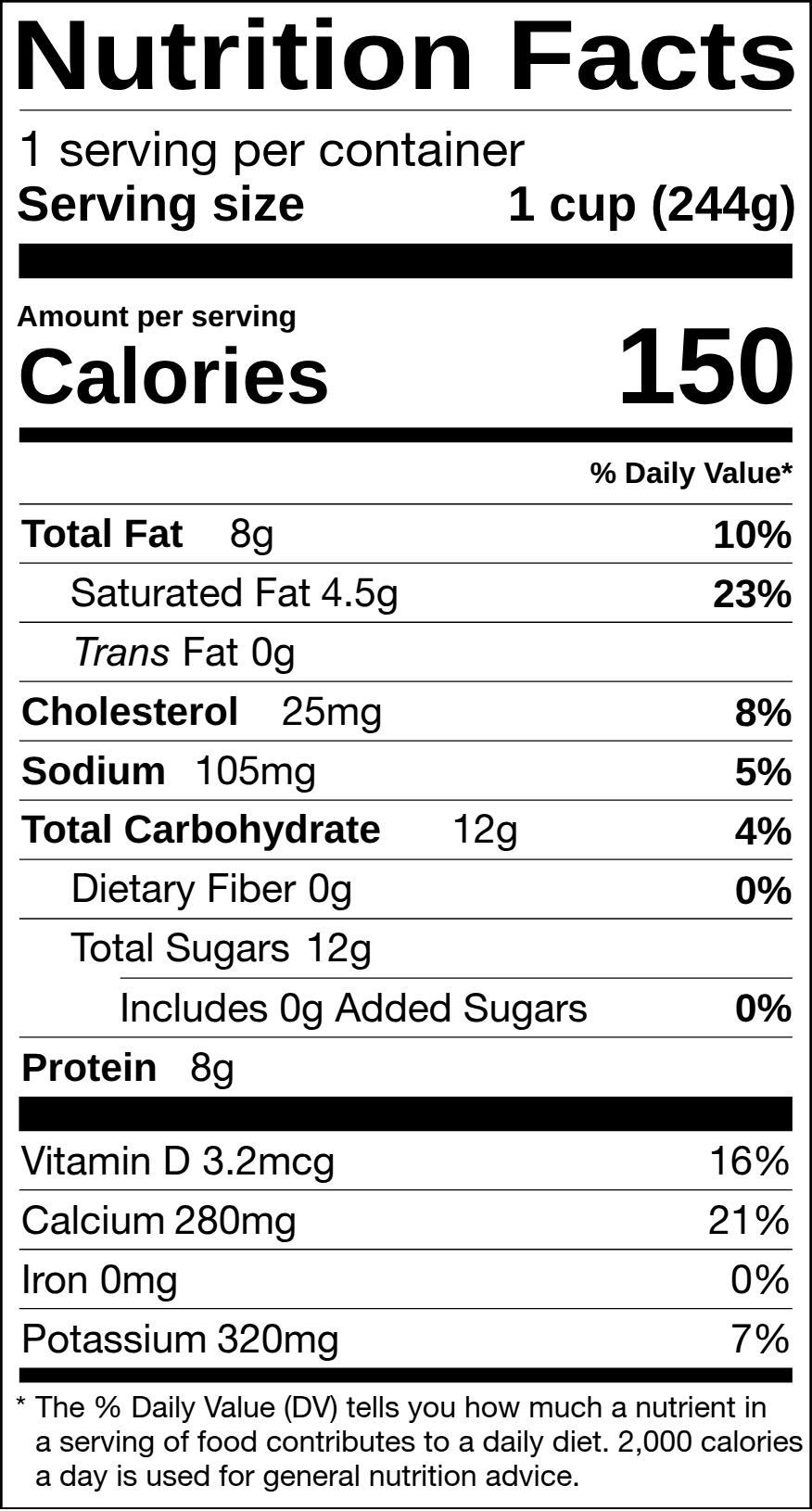
- Total sugars has no Daily Value. Only added sugars carries a DRV, at 50 g. This one confuses shoppers, because the Total Sugars row sits directly above an indented row that does show a percentage. The milk label is the clearest example: the sugars are lactose, so Total Sugars has grams but no %DV and Added Sugars sits at 0 g, 0%.
- Calories from fat is gone from the label entirely; the 2016 rule removed it.
- Protein has a DRV of 50 g for adults and children 4 and older, but a %DV is not required for that population unless you make a protein claim.
The protein rule is a trap. If you declare a protein %DV or make a protein claim on a food for adults and children 4 and older, the value must be corrected for protein quality using PDCAAS, the protein digestibility corrected amino acid score. That means an amino acid analysis and a digestibility figure, not dividing grams by 50. A plant protein bar showing 20 g of protein can land at a materially lower corrected percentage than the arithmetic suggests. Protein %DV is required on foods for infants and children under 4, and the correction applies there too.
The footnote and what the 2016 rule changed
The footnote is fixed text under 101.9(d)(9): "*The % Daily Value tells you how much a nutrient in a serving of food contributes to a daily diet. 2,000 calories a day is used for general nutrition advice." Foods for children 1 through 3 substitute 1,000 calories, infant labels carry no footnote, and calorie-free foods may omit it. The old two-column 2,000 and 2,500 calorie reference table was removed in 2016 and must not be reinstated.
The 2016 final rule, 81 FR 33742, published 27 May 2016, is the source of every current Daily Value; compliance dates landed at 1 January 2020 for firms with $10 million or more in annual food sales and 1 January 2021 for smaller firms. Its Daily Value changes were substantial: vitamins A and C became voluntary while vitamin D and potassium became mandatory; sodium moved from 2,400 to 2,300 mg; dietary fiber moved from 25 to 28 g; total fat from 65 to 78 g; total carbohydrate from 300 to 275 g; calcium from 1,000 to 1,300 mg; potassium from 3,500 to 4,700 mg; vitamin D moved from 400 IU to 20 mcg; and the added sugars DRV of 50 g was created. It also required actual amounts for vitamin D, calcium, iron and potassium alongside the %DV.
If you are working from a supplier document or template that predates 2020, assume its Daily Values are wrong until you check them against the tables above. A label using 2,400 mg sodium or 25 g fiber as the denominator is printing incorrect percentages on every unit shipped.
Frequently asked questions
Is the Daily Value the same as what I should eat in a day?
No. A Daily Value is a labeling denominator fixed in 21 CFR 101.9 so all packages are comparable. It is anchored to a 2,000 calorie reference intake, which is a convention, not a personal target. Individual needs come from the Dietary Reference Intakes, including RDAs, which vary by age, sex and life stage and are not label values.
Why does Total Sugars have no percentage but Added Sugars does?
Because FDA established a DRV only for added sugars, at 50 g, based on 10 percent of a 2,000 calorie intake. There is no reference intake for total sugars, which includes lactose in milk and the sugars in whole fruit, so no denominator exists and the cell stays blank.
My calcium works out to 23 percent. What do I print?
25 percent. Calcium follows the 101.9(c)(8)(iii) ladder, and above 10 percent through 50 percent you round to the nearest 5 percent increment. Had it worked out to 7 percent you would print 8 percent, because at or below 10 percent the step is 2 percent. Only DRV nutrients such as fat, sodium, fiber and added sugars use whole percents.
Do I have to show a %DV for protein?
Not for a food aimed at adults and children 4 and older, unless you make a protein claim. If you show or claim it, the figure must be corrected for protein quality by PDCAAS, which requires amino acid data. Foods for infants and children under 4 must declare protein %DV.
Which Daily Value column applies to a toddler snack?
If the food is represented or purported for children 1 through 3, use those columns: 1,500 mg sodium, 14 g fiber, 25 g added sugars, 700 mg calcium, 7 mg iron, 3,000 mg potassium, 15 mcg vitamin D, and the 1,000 calorie footnote. Foods for infants through 12 months use the infant columns and show no %DV for several nutrients at all.
Once you know which column applies and which ladder each nutrient uses, building the label is mechanical. Our Nutrition Facts label generator holds the current 101.9 tables and applies the right ladder per nutrient, and the Daily Value calculator will check any figure you are unsure about before it goes to print.