Added Sugars on the Nutrition Facts Label
The 50 g Daily Value, the full 101.9(c)(6)(iii) definition of what counts as an added sugar, the Includes line format, rounding, and the honey and maple syrup exception.
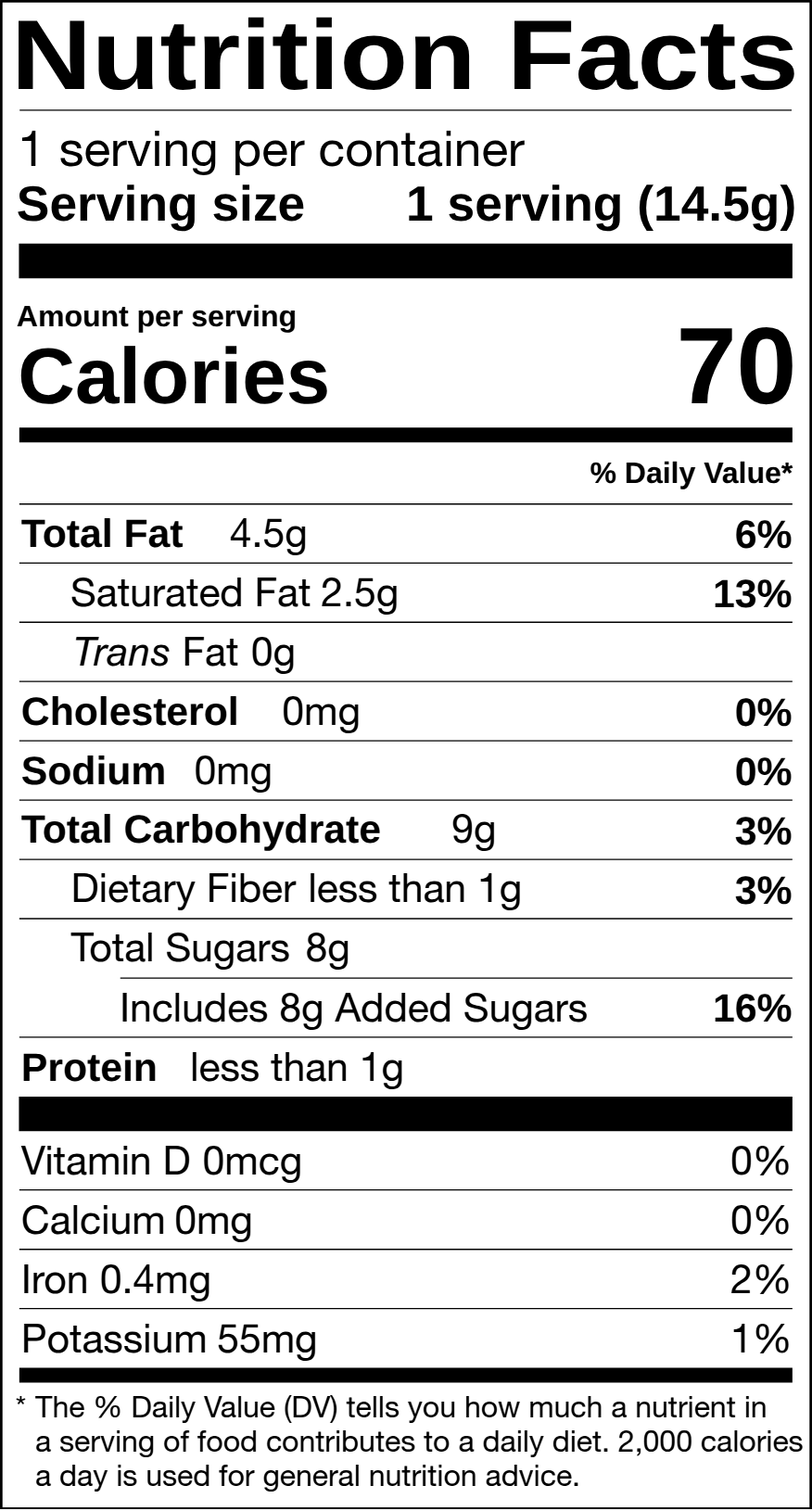
The added sugar nutrition label line is the most misread row on the panel. It is not a measurement you can take with an instrument, it is a figure you calculate from your own formulation, so two products with identical total sugars can legitimately declare very different added sugars. This is the hub piece: where the requirement comes from, what the regulation counts, how to round the grams and compute the percent Daily Value, when you may omit the line, and what is only proposed.
It is written for someone shipping a compliant panel. For the reference number itself see the added sugars Daily Value, for the distinction that trips up most first labels see total sugars versus added sugars, and for the syrup carve-out see is honey an added sugar. It does not walk through the full panel layout.
Why the line exists and when it became mandatory
Added sugars came from the 2016 Nutrition Facts final rule, "Food Labeling: Revision of the Nutrition and Supplement Facts Labels," published at 81 FR 33742 on 27 May 2016. That rule renamed the old "Sugars" row to "Total Sugars" and added the indented "Includes X g Added Sugars" line beneath it. The requirement is codified at 21 CFR 101.9(c)(6)(iii): binding regulation, not guidance and not a proposal.
Firms with $10 million or more in annual food sales had to comply by 1 January 2020. Firms below that threshold had until 1 January 2021. Both dates extended the original 2018 and 2019 deadlines, and both are long past, so any panel printed today needs the line regardless of company size.
The row exists because total sugars alone cannot distinguish plain milk from a sweetened milk drink. Lactose and fruit sugars arrive with water, fibre and micronutrients; sucrose stirred into a batch does not.
The 50 g Daily Value and where the number comes from
The Daily Reference Value for added sugars is 50 g per day for adults and children 4 and older, set in the table at 21 CFR 101.9(c)(9). It is 10 percent of a 2,000 calorie reference intake: 200 calories, and at 4 calories per gram of carbohydrate, 50 g. Every added sugars percent Daily Value on a general-audience label is a fraction of that number. It changes for younger age groups, which matters if you label toddler food.
| Population group | Added sugars DV | Calorie basis |
|---|---|---|
| Adults and children 4 and older | 50 g | 2,000 calories |
| Children 1 through 3 years | 25 g | 1,000 calories |
| Infants through 12 months | None (N/A) | n/a |
| Pregnant and lactating women | 50 g | 2,000 calories |
Foods for infants through 12 months declare grams but show no percent Daily Value and carry no footnote. On a two-age-group label the 25 g and 50 g bases run separately; our Daily Value calculator handles both.
What the regulation actually says
The operative definition, quoted from 21 CFR 101.9(c)(6)(iii):
"Added sugars are either added during the processing of foods, or are packaged as such, and include sugars (free, mono and disaccharides), sugars from syrups and honey, and sugars from concentrated fruit or vegetable juices that are in excess of what would be expected from the same volume of 100 percent fruit or vegetable juice of the same type, except that fruit or vegetable juice concentrated from 100 percent juices sold to consumers, fruit or vegetable juice concentrates used towards the total juice percentage label declaration under 101.30 or for Brix standardization under 102.33(g)(2), fruit juice concentrates which are used to formulate the fruit component of jellies, jams, or preserves in accordance with the standards of identity in 150.140 and 150.160, or the fruit component of fruit spreads shall not be labeled as added sugars."
Four exemptions in one sentence. Applied to a bill of materials:
| Counts as added sugars | Does not count as added sugars |
|---|---|
| Sucrose, dextrose, glucose, fructose, high fructose corn syrup, corn syrup, invert sugar | Lactose naturally present in milk and dairy ingredients |
| Brown sugar, cane sugar, evaporated cane juice, coconut sugar, molasses | Sugars in whole fruit and vegetables, including dried and canned |
| Malt syrup, rice syrup, agave | Sugars in 100 percent fruit or vegetable juice |
| Honey and maple syrup used as ingredients, or packaged as such | Concentrate reconstituted to 100 percent juice, or used for the juice percentage declaration under 101.30 or Brix standardization under 102.33(g)(2) |
| Juice concentrate used as a sweetener, to the extent it exceeds what the same volume of 100 percent juice of that type would give | Concentrate forming the fruit component of jams, jellies and preserves under 150.140 and 150.160, or of fruit spreads |
| A single-ingredient package such as table sugar or a jar of honey, being "packaged as such" | Sugar alcohols and non-nutritive sweeteners, because they are not sugars |
The juice concentrate rule generates the most argument. Concentrate poured in to sweeten is added sugar for the portion above what plain 100 percent juice of that type would have given; concentrate diluted back to single strength, or used to hit a Brix target or a juice percentage claim, is not. The jam and jelly carve-out is tied to specific standards of identity, so do not stretch it to a generic fruit filling.
How the added sugar nutrition label line appears
The added sugar Nutrition Facts label entry sits directly under Total Sugars, double-indented, prefaced with "Includes." The standard rendering is "Includes 10g Added Sugars" with the percent Daily Value in the right-hand column on the same line. The nutrient name must appear as "Added Sugars," not "added sugar" or "sugars added."
On small package and dual column formats the abbreviation "Incl." is permitted in place of "Includes," under 21 CFR 101.9(j)(13)(ii)(B). That is the only sanctioned shortening; "Added Sugars" itself cannot be compressed because space is tight.
Rounding the grams and calculating the percent Daily Value
Added sugar grams on the nutrition label are expressed to the nearest gram. Below 1 g you may state "Contains less than 1 gram" or "less than 1 gram." Below 0.5 g you may express the amount as 0 g. These sit inside the wider pattern in FDA rounding rules, separate from the percent Daily Value step.
| Analytical or calculated amount | Declared grams | Percent Daily Value against 50 g |
|---|---|---|
| 0.3 g | May be declared 0 g | 0 percent |
| 0.7 g | Less than 1 gram | 1.4 percent, declared as 1 percent |
| 2.4 g | 2 g | 4 percent from 2 g, or 5 percent from 2.4 g |
| 9.4 g | 9 g | 18 percent from 9 g, or 19 percent from 9.4 g |
| 12 g | 12 g | 24 percent |
The rule at 21 CFR 101.9(d)(7)(ii) lets you divide either the declared, rounded amount or the actual unrounded amount by 50 g, to the nearest whole percent. The two routes do not always agree: the 9.4 g row gives 18 percent one way and 19 percent the other. Both are defensible. Pick one basis, document it, and apply it across the portfolio.
A worked example from ingredient list to declared grams
Take a strawberry yogurt cup, 170 g labelled serving. Ingredients: cultured nonfat milk, strawberries, cane sugar, water, food starch, natural flavor, pectin. The figures are illustrative, not FDA data, but the method is what you would run against supplier specifications.
| Ingredient | Sugars contributed per serving | Added or naturally occurring |
|---|---|---|
| Cultured nonfat milk (lactose) | 8.0 g | Naturally occurring |
| Strawberries (whole fruit) | 1.5 g | Naturally occurring |
| Cane sugar | 9.4 g | Added |
| Total | 18.9 g | 9.4 g of it added |
Total Sugars is 18.9 g, rounding to 19 g. Added sugars is 9.4 g, rounding to 9 g. Dividing the declared 9 g by 50 g gives 18 percent, so the panel reads "Total Sugars 19g" with "Includes 9g Added Sugars 18%" indented beneath. The naturally occurring 9.5 g never appears as its own number; the reader infers it by subtraction.
A 40 g granola bar of oats, honey, brown rice syrup and raisins works the same way. Assume honey gives 4 g of sugars, rice syrup 3 g, raisins 5 g. Honey and rice syrup are added sugars as ingredients; raisins are whole dried fruit, so their sugars are naturally occurring. Total Sugars is 12 g, added sugars 7 g, and 7 divided by 50 is 14 percent.
When the line may be omitted, and the footnote you then owe
The declaration is not required if the product has less than 1 g of added sugars per serving and no claims are made about sweeteners, sugars, added sugars or sugar alcohols. Both must hold: a savoury cracker with 0.4 g of added sugars can drop the line, but the same cracker with "no sugar added" on the front cannot.
If you omit it, the footnote "Not a significant source of added sugars" must appear at the bottom of the Nutrition Facts table. The obligation is not waived, it moves. Foods on the simplified format under 21 CFR 101.9(f), available when 8 or more of the 15 listed nutrients are present in insignificant amounts, are handled under that section instead.
Total Sugars follows a parallel rule, with the footnote "Not a significant source of total sugars." Most manufacturers keep both lines and declare 0 g, because the footnote costs as much space as the row. The added sugars labeling requirements walkthrough covers the decision case by case.
Honey, maple syrup, table sugar and cranberries
A jar of pure honey is entirely added sugars under the "packaged as such" clause, which created a problem: an "Includes 17g Added Sugars" line on a single-ingredient product implied someone had added something. FDA answered with final guidance issued 18 June 2019, "The Declaration of Added Sugars on Honey, Maple Syrup, Other Single-Ingredient Sugars and Syrups, and Certain Cranberry Products."
Under it, pure honey, pure maple syrup and other single-ingredient sugars and syrups such as table sugar and agave are not required to declare the gram amount on the "Includes ... Added Sugars" line, but the percent Daily Value is still required. That asymmetry is the part people miss: dropping the grams does not drop the row.
FDA also permits, and encourages, an optional dagger symbol immediately after that percent Daily Value, pointing to a footnote explaining how much added sugar one serving contributes and what share of the Daily Value that is. Certain cranberry products, such as dried cranberries and cranberry juice cocktail, with sugars added for palatability at total sugar levels comparable to similar products, must still declare grams and percent Daily Value, but may add a footnote saying the sugars improve the palatability of naturally tart cranberries.
Two caveats. This is guidance: nonbinding, reflecting enforcement discretion, and not codified in 101.9. And the transitional enforcement discretion for these products ran only to 1 July 2021, so that window is closed even though the guidance still applies.
Recordkeeping, and what is still only proposed
Added sugars carries an explicit recordkeeping obligation, because it cannot be verified analytically: a laboratory measuring sugars in your yogurt cannot tell which molecules came from milk and which from cane sugar. Under 21 CFR 101.9(g)(10) and (11) you must keep records substantiating the declared amount when a food contains both naturally occurring and added sugars, or when added sugars are subject to fermentation or non-enzymatic browning, the Maillard reaction. Bread, yogurt and anything with a browning step are in scope; recipes, formulations and batch records are the usual evidence.
Two things about added sugars are frequently written about as though they were law. They are not.
- There is currently no "low added sugars" and no "reduced added sugars" nutrient content claim. FDA's Unified Agenda carries RIN 0910-AJ20, "Nutrient Content Claims for Added Sugars," at the Proposed Rule Stage, which would update the claim provisions and create a voluntary "low added sugar" claim. The projected date for that proposed rule is December 2026. Nothing has been published, so neither phrase is a permitted claim today; the claim validator lists the sugar claims that are defined.
- Added sugars is one of the three nutrients in FDA's proposed front-of-package "Nutrition Info" box, with saturated fat and sodium. As proposed, 20 percent Daily Value or more would read "High," which for added sugars is 10 g or more per serving. That rule is proposed, not final, and no packaged food is required to carry the box. See the front-of-package proposal for where it stands.
Applied to the worked example: the yogurt at 18 percent would sit in the proposed "Med" band, and a gram more cane sugar would reach the 20 percent "High" threshold. If that rule is ever finalised, reformulation pressure will cluster at 10 g per serving.
To have the grams, the rounding and the percent Daily Value handled rather than checked by hand, build the panel in the Nutrition Facts label generator. It applies the 50 g and 25 g Daily Values by age group, blocks added sugars exceeding total sugars, and formats the "Includes" and "Incl." variants for standard, small package and dual column layouts.
Frequently asked questions
Can added sugars ever be higher than total sugars?
No. Added sugars is a subset of total sugars, so the declared figure must be less than or equal to declared total sugars. The usual causes of an inversion are double counting a syrup already captured in the total sugars analysis, or rounding the two lines from different source data. Rounding both from one analysis fixes most cases.
Do sugar alcohols or stevia count toward added sugars?
No. Sugar alcohols such as erythritol, maltitol and sorbitol are not sugars, and neither are non-nutritive sweeteners. Both are excluded from the total sugars and added sugars declarations. Sugar alcohols have their own line, which becomes mandatory when a claim is made about them.
My product has 0.4 g of added sugars. What do I print?
Two compliant options. Declare 0 g on the Includes line, since amounts below 0.5 g may be expressed as 0 g. Or, absent any claim about sweeteners, sugars, added sugars or sugar alcohols, omit the line and add "Not a significant source of added sugars" at the bottom of the table. Most print 0 g, because it removes any question about a later front-panel claim invalidating the omission.
Is fruit juice concentrate in my bar an added sugar?
It depends what it is doing. If the concentrate functions as a sweetener, the sugars beyond what the same volume of 100 percent juice of that type would give are added sugars. If it is reconstituted to 100 percent juice, used toward the juice percentage declaration under 101.30, or used for Brix standardization under 102.33(g)(2), it is not. Keep the calculation showing which portion you treated as excess: that is the record 101.9(g)(10) contemplates.
Can I say "no added sugar" instead of declaring the line?
They are different things, and one triggers the other. Any claim about sweeteners, sugars, added sugars or sugar alcohols removes your ability to omit the declaration under the less-than-1-gram provision. Separately, "low added sugars" and "reduced added sugars" are not defined claims right now, so neither can be used regardless of formulation.