Nutrition Facts Label Requirements (21 CFR 101.9)
Everything 21 CFR 101.9 requires inside the Nutrition Facts panel: who must carry one, the mandatory nutrients in order, the seven approved formats, type-size rules and every exemption.

A Nutrition Facts panel is not a design choice. It is a legally prescribed block of information whose contents, order, wording, type sizes and rule weights are all set out in 21 CFR 101.9. Get the arithmetic right and the layout wrong and the label is still misbranded. This guide covers the Nutrition Facts label requirements for the panel itself: who has to carry one, exactly what must appear inside it and in what order, which of the seven approved formats you are allowed to use, and every exemption that might get you out of printing one at all.
Two things this guide deliberately does not repeat. If you want the whole label rather than the panel, our FDA food labeling requirements checklist covers the ingredient statement, allergens, net quantity and claims. If you want the arithmetic, our rounding rules guide works through every increment in 101.9(c).
Who has to carry a Nutrition Facts panel
The default is that every packaged food offered for sale in the United States must bear FDA nutrition labeling. The rule then carves out a long list of exceptions in 101.9(j), and small producers frequently qualify for one without realising it. The exemptions that matter most in practice:
| Exemption | Who it covers | Conditions |
|---|---|---|
| Small business, 101.9(j)(1) | Firms with fewer than 100 full-time equivalent employees | Fewer than 100,000 units of that product sold in the US in a 12-month period, and an annual notice filed with FDA. Lost immediately if any nutrient content or health claim is made. |
| Very small package, 101.9(j)(13) | Packages with less than 12 square inches of surface area available for labeling | Must give an address or phone number for nutrition information. If nutrition labeling is provided voluntarily, abbreviated formats are allowed. |
| Insignificant nutrients, 101.9(j)(4) | Foods containing insignificant amounts of all the nutrients required to be declared | Coffee beans, tea leaves, plain unsweetened instant coffee and tea, most spices and flavour extracts. A statement of calories and any nutrient present in a significant amount is still required. |
| Restaurant and ready-to-eat food, 101.9(j)(2) | Food served or sold for immediate consumption | Separate menu labeling rules apply to chains with 20 or more locations. |
| Bulk and shipping containers, 101.9(j)(9) | Product shipped for further processing or repackaging | Not for sale to consumers in that form. |
| Raw produce and seafood, 101.9(j)(10) | The 20 most-consumed raw fruits, vegetables and fish | Covered by a voluntary point-of-purchase programme rather than package labeling. |
| Dietary supplements, 101.9(j)(6) | Anything marketed as a dietary supplement | Uses a Supplement Facts panel under 101.36 instead. See our side-by-side comparison. |
The small business exemption is the one people misread most often. It is not automatic and it is not permanent: the notice has to be filed with FDA every year, both thresholds have to be met, and the moment the package says anything like "low sodium" or "good source of fiber" the exemption evaporates for that product. Most producers who intend to sell into retail end up labeling voluntarily anyway, because buyers ask for it.
FDA Nutrition Facts label requirements: what must appear, in order
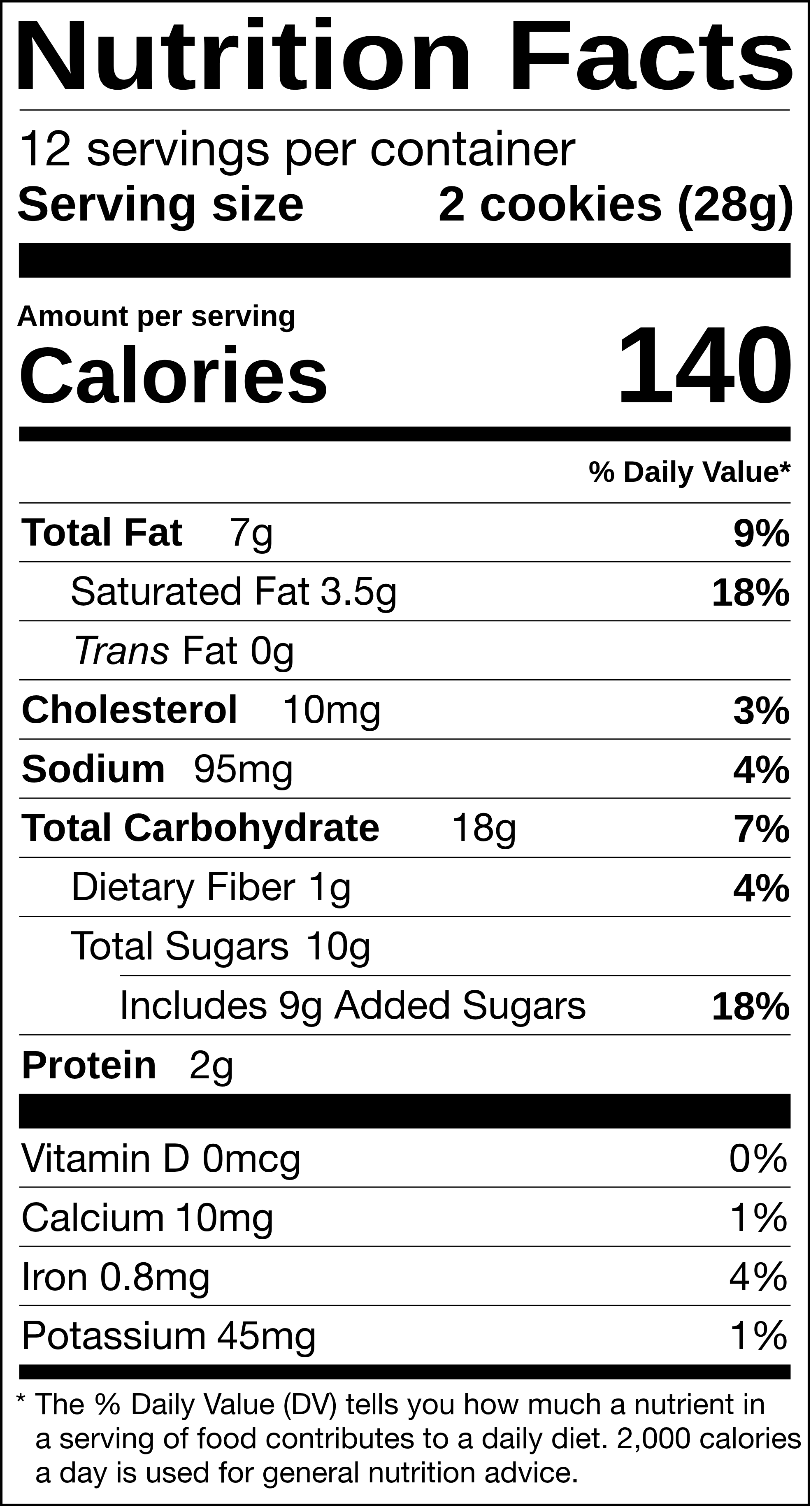
The order is fixed by 101.9(c). You cannot reorder lines for aesthetic reasons, and you cannot omit a mandatory line because the value is zero. Reading top to bottom:
| Line | Notes | %DV shown? |
|---|---|---|
| Servings per container | Above the serving size, in bold | No |
| Serving size | Household measure followed by metric weight in parentheses, in bold | No |
| Calories | The largest type on the panel after the heading | No |
| Total Fat | Bold nutrient name | Yes |
| Saturated Fat | Indented | Yes |
| Trans Fat | Indented, italicised "Trans" | No DV exists |
| Cholesterol | Bold nutrient name | Yes |
| Sodium | Bold nutrient name | Yes |
| Total Carbohydrate | Bold nutrient name | Yes |
| Dietary Fiber | Indented | Yes |
| Total Sugars | Indented, no DV | No DV exists |
| Includes Xg Added Sugars | Double-indented under Total Sugars | Yes |
| Protein | Bold nutrient name | Only if a protein claim is made, or the food is for children under 4 |
| Vitamin D, Calcium, Iron, Potassium | Below a thick rule, with absolute amounts and %DV | Yes |
The four mandatory micronutrients changed in the 2016 rule. Vitamins A and C came off the mandatory list, and vitamin D and potassium went on, because national intake data showed shortfalls in the latter pair and not the former. Any other vitamin or mineral is voluntary unless it is added to the food or the subject of a claim, in which case declaring it becomes mandatory.
Protein deserves a note. For general foods aimed at adults, the gram amount is mandatory but the %DV is not. The moment you say "high in protein" on the front of the pack, the %DV becomes mandatory and it must be corrected for protein quality using PDCAAS, which for many plant proteins produces a markedly lower figure than the raw gram count suggests.
Serving size and the %DV column
Two inputs drive everything else in the panel. The serving size comes from the Reference Amount Customarily Consumed for your product category in 21 CFR 101.12 (look yours up in the RACC lookup), not from what you would like a portion to be. The %DV column comes from the Daily Value table in 101.9(c)(8)(iv) and (c)(9), with 2,000 calories as the reference diet for anyone aged 4 and over.
Both are large enough subjects to have their own guides. See FDA serving size requirements for how the RACC translates into a printed serving, and Nutrition Facts Daily Values for the complete reference table. The short version: sodium is 2,300 mg, total carbohydrate 275 g, dietary fiber 28 g, added sugars 50 g, saturated fat 20 g and total fat 78 g. The DV calculator applies the correct rounding ladder for each nutrient, which is not the same ladder for macronutrients and micronutrients.
Below the micronutrients sits the footnote, whose wording is prescribed: "The % Daily Value (DV) tells you how much a nutrient in a serving of food contributes to a daily diet. 2,000 calories a day is used for general nutrition advice." The old footnote table listing values for 2,000 and 2,500 calorie diets was removed in 2016 and must not be reinstated.
Format rules that fail labels
Of all the Nutrition Facts label rules, the typography in 101.9(d) is the most prescriptive, and this is where otherwise correct labels get rejected by retail buyers and FDA reviewers alike.
- The heading. "Nutrition Facts" in a bold type no smaller than the largest type on the panel, set flush left and right within the box.
- Minimum type sizes. Eight point or larger for most of the panel; six point is permitted only for the footnote and for the panel on small packages.
- Rule weights. A hairline rule between nutrient lines, a bar of at least seven point after the serving-size block, a bar of at least seven point after the added-sugars block, and a hairline above the footnote. These are not decorative. The bars are what visually separate the calorie block, the nutrient block and the micronutrient block.
- Type and background. Black type on white or a neutral contrasting background, in a single easy-to-read typeface. No reversed-out panels, no coloured type, no condensed novelty faces.
- Leading. At least one point of leading, and at least four points between the heading and the rest of the panel.
- Placement. On the information panel immediately to the right of the principal display panel, or on the PDP itself. Not on the bottom of a can where a shopper has to pick it up and turn it over unless the pack shape leaves no alternative.
Which format you are allowed to use
There are several approved layouts, and the one you may use is determined by package geometry and product type rather than preference.
| Format | When you may use it |
|---|---|
| Standard vertical | The default. Always acceptable. |
| Tabular | Packages with 40 square inches or less of labeling space where the standard panel will not fit. |
| Linear | Packages with less than 12 square inches, or under 40 square inches where neither vertical nor tabular fits. |
| Simplified | Foods containing insignificant amounts of eight or more of the fifteen listed nutrients. Requires the "Not a significant source of ..." statement. |
| Dual column | Mandatory for packages containing between 200% and 300% of the RACC. Also used for as-packaged and as-prepared products. |
| Aggregate | Variety packs and assortments where several distinct foods share one outer package. |
The dual column rule catches people out constantly. A 20 ounce bottle of soda is not three servings any more: it is between 200% and 300% of the 12 fluid ounce RACC, so it needs a dual column panel showing both per serving and per container. A container below 200% of the RACC is a single serving and everything in the panel must reflect the entire package. You can preview any of these layouts in the label template library, or start from the standard vertical template.
Compliance dates, records and enforcement
The 2016 rule's compliance dates have long passed: 1 January 2020 for manufacturers with 10 million dollars or more in annual food sales, and 1 January 2021 for everyone else. Every label in the market today should already be in the current format. If you are working from an old artwork file that still shows "Calories from Fat" or lists vitamins A and C as mandatory, that artwork is nine years out of date.
Two record-keeping obligations sit behind the panel and are easy to miss. Under 101.9(g), where a nutrient value depends on a calculation rather than direct analysis, you must be able to show your work. Specifically, added sugars declarations require records when a food contains both naturally occurring and added sugars, or when added sugars are consumed during fermentation or non-enzymatic browning, since the analytical result will not match the amount added.
On enforcement, FDA compares your declared values against laboratory analysis of market samples with defined tolerances. Class I nutrients, meaning added vitamins and minerals, must be present at 100% or more of the declared amount. Class II naturally occurring nutrients must reach at least 80% of the declared amount. For calories, sugars, total fat, saturated fat and sodium, the measured value must not exceed 120% of the declared value. Declaring conservatively in the right direction for each class is a legitimate and widely used strategy.
The failures that actually get flagged
- Invented serving sizes. Choosing 15 g for a snack because it produces a nicer calorie number, when the RACC for that category is 30 g.
- A missing dual column on a package between 200% and 300% of the RACC.
- Omitting a zero line. Trans fat at 0 g still gets a line. Only the specific omissions permitted in 101.9(c) are allowed, and each one carries a required footnote.
- Wrong rule weights, usually a hairline where a seven point bar belongs, which flattens the panel's visual hierarchy.
- Rounding each ingredient before summing. Roll up the recipe at full precision and round once, at the end.
- Claiming an exemption while making a claim. The small business exemption dies the moment the front panel says "good source of fiber".
- Leaving the old footnote table with 2,000 and 2,500 calorie columns on the artwork.
- Declaring protein %DV without the PDCAAS correction after making a protein claim.
Build a compliant panel without hand-setting any of this: enter your recipe in the free label generator and it applies the 101.9 order, rounding, rule weights and type minimums for every approved format, or check an existing label against the rules with the FDA label checklist.
Frequently asked questions
Do I need a Nutrition Facts panel if I only sell at farmers markets?
Possibly not. Food sold directly to consumers for immediate consumption is exempt, and a producer under both small business thresholds who makes no nutrient content or health claims can file for the small business exemption. But the exemption is per product, requires an annual notice to FDA, and disappears the moment you make a claim. Many state cottage food laws impose their own labeling rules regardless, so check your state as well.
Can I put the panel anywhere on the package?
No. It belongs on the information panel, which is the panel immediately to the right of the principal display panel as the consumer faces the product, or on the PDP itself. It may only move elsewhere when the package shape makes those locations genuinely unusable.
Does the panel have to be black and white?
Effectively yes. The regulation requires black type on a white or neutral contrasting background. You may print the panel over a light background colour if contrast is preserved, but coloured type and reversed-out panels are not compliant.
Is a laboratory analysis required?
Not by regulation. You may derive values from a validated nutrient database using your actual formulation. What matters is that the declared values survive FDA's compliance tolerances when a market sample is tested. Database values are entirely defensible for stable formulations; lab analysis becomes worth the cost for products with variable raw materials or where a nutrient sits close to a claim threshold.
Will the front of the package have to change too?
Not yet. FDA proposed a front-of-package "Nutrition Info" box in January 2025 that would rate saturated fat, sodium and added sugars as Low, Med or High. It has not been finalised, and in March 2026 FDA leadership said the proposal was under reassessment. Nothing on the front of your package is required to change today. Our front-of-package guide tracks the current status.