FDA Daily Value Chart (21 CFR 101.9)
The complete DRV and RDI tables from 21 CFR 101.9 for adults, infants, children 1 to 3 and pregnant and lactating women, with units, rounding rules and conversions.

This is a complete FDA daily value chart: every one of the Daily Values in 21 CFR 101.9, in the units the regulation actually uses, for all four population groups the regulation defines. It is written for anyone who has to put a real number in the % Daily Value column of a Nutrition Facts panel and needs the reference value to be right the first time. The tables below reproduce the Daily Reference Values from 101.9(c)(9) and the full Reference Daily Intake table from 101.9(c)(8)(iv), plus the rounding rules that turn a raw percentage into a printable one.
This page is the reference, not the tutorial. If you want the concepts explained rather than tabulated, read how Daily Values work on the Nutrition Facts label, and for the arithmetic done for you, the % Daily Value calculator. If the terminology is what is tripping you up, the same guide's section on Daily Value vs RDI vs RDA untangles the three.
The two kinds of Daily Value
"Daily Value" is an umbrella term. Underneath it sit two separate sets of numbers, established in two separate parts of the regulation, and they behave differently.
Daily Reference Values (DRVs) are the label reference values for macronutrients and other food components: total fat, saturated fat, cholesterol, total carbohydrate, sodium, dietary fiber, protein and added sugars. They live in 21 CFR 101.9(c)(9). For adults and children 4 and older they are anchored to a 2,000 calorie reference intake.
Reference Daily Intakes (RDIs) are the label reference values for vitamins and minerals, plus protein for infants, children 1 through 3, and pregnant and lactating women. They live in 21 CFR 101.9(c)(8)(iv) and are derived from the Institute of Medicine and National Academies Dietary Reference Intakes.
On the label neither term appears. Everything is simply a "% Daily Value." But the rounding rules differ between the two sets, so you do need to know which side of the line a nutrient falls on before you round.
Daily Reference Values (DRVs), 21 CFR 101.9(c)(9)
These are the eight food components with DRVs, with all four population columns. N/A means the regulation itself does not establish a value for that group, not that the value is zero. Where a nutrient is marked N/A for a population, no %DV is declared for it on a label aimed at that population.
| Food component | Unit | Adults and children 4+ (2,000 kcal) | Infants through 12 months | Children 1 through 3 (1,000 kcal) | Pregnant and lactating women |
|---|---|---|---|---|---|
| Total fat | g | 78 | 30 | 39 | 78 |
| Saturated fat | g | 20 | N/A | 10 | 20 |
| Cholesterol | mg | 300 | N/A | 300 | 300 |
| Total carbohydrate | g | 275 | 95 | 150 | 275 |
| Sodium | mg | 2,300 | N/A | 1,500 | 2,300 |
| Dietary fiber | g | 28 | N/A | 14 | 28 |
| Protein | g | 50 | N/A | 13 | N/A |
| Added sugars | g | 50 | N/A | 25 | 50 |
Protein catches people out twice. Its %DV is not required for adults and children 4 and older unless a protein claim is made, and if you declare it after making a claim, the figure must be corrected for protein quality using PDCAAS rather than computed straight from grams. It is required for foods intended for infants and children under 4. Protein also appears in both tables: the DRV of 50 g covers adults and children 4 and older, the DRV of 13 g covers children 1 through 3, and the RDI table supplies infants (11 g) and pregnant and lactating women (71 g).
Complete RDI table for vitamins and minerals, 21 CFR 101.9(c)(8)(iv)
This is the full nutrition daily value chart for micronutrients. Every nutrient with an RDI is listed, not a selection, and the unit column matters as much as the number: vitamin A is in mcg RAE, niacin in mg NE, folate in mcg DFE and vitamin E in mg alpha-tocopherol, and using the wrong unit is the single most common way a label gets a micronutrient %DV badly wrong.
| Nutrient | Unit | Adults and children 4+ | Infants 1 through 12 months | Children 1 through 3 | Pregnant and lactating women |
|---|---|---|---|---|---|
| Vitamin D | mcg | 20 | 10 | 15 | 15 |
| Calcium | mg | 1,300 | 260 | 700 | 1,300 |
| Iron | mg | 18 | 11 | 7 | 27 |
| Potassium | mg | 4,700 | 700 | 3,000 | 5,100 |
| Vitamin A | mcg RAE | 900 | 500 | 300 | 1,300 |
| Vitamin C | mg | 90 | 50 | 15 | 120 |
| Vitamin E | mg alpha-tocopherol | 15 | 5 | 6 | 19 |
| Vitamin K | mcg | 120 | 2.5 | 30 | 90 |
| Thiamin | mg | 1.2 | 0.3 | 0.5 | 1.4 |
| Riboflavin | mg | 1.3 | 0.4 | 0.5 | 1.6 |
| Niacin | mg NE | 16 | 4 | 6 | 18 |
| Vitamin B6 | mg | 1.7 | 0.3 | 0.5 | 2.0 |
| Folate | mcg DFE | 400 | 80 | 150 | 600 |
| Vitamin B12 | mcg | 2.4 | 0.5 | 0.9 | 2.8 |
| Biotin | mcg | 30 | 6 | 8 | 35 |
| Pantothenic acid | mg | 5 | 1.8 | 2 | 7 |
| Phosphorus | mg | 1,250 | 275 | 460 | 1,250 |
| Iodine | mcg | 150 | 130 | 90 | 290 |
| Magnesium | mg | 420 | 75 | 80 | 400 |
| Zinc | mg | 11 | 3 | 3 | 13 |
| Selenium | mcg | 55 | 20 | 20 | 70 |
| Copper | mg | 0.9 | 0.2 | 0.3 | 1.3 |
| Manganese | mg | 2.3 | 0.6 | 1.2 | 2.6 |
| Chromium | mcg | 35 | 5.5 | 11 | 45 |
| Molybdenum | mcg | 45 | 3 | 17 | 50 |
| Chloride | mg | 2,300 | 570 | 1,500 | 2,300 |
| Choline | mg | 550 | 150 | 200 | 550 |
| Protein (RDI) | g | N/A (DRV 50 g applies) | 11 | N/A (DRV 13 g applies) | 71 |
Several values cut against intuition. Iron is higher for pregnant and lactating women (27 mg) than for adults generally (18 mg), and lower for children 1 through 3 (7 mg) than for infants (11 mg). Vitamin D is highest for adults and children 4 and older (20 mcg), not for pregnant and lactating women (15 mcg). Magnesium is lower for pregnant and lactating women (400 mg) than for adults (420 mg). Do not assume the columns rise from left to right.
Unit conversions written into the regulation
The regulation defines its own units of account for three nutrients, and the conversions are part of the rule, not a convention you can vary. For vitamin A, 1 mcg RAE equals 1 mcg retinol, equals 2 mcg supplemental beta-carotene, equals 12 mcg dietary beta-carotene, equals 24 mcg dietary alpha-carotene or beta-cryptoxanthin. The factor of six between supplemental and dietary beta-carotene is the one that most often gets dropped in a formulation spreadsheet.
For niacin, 1 mg NE equals 1 mg niacin, equals 60 mg tryptophan. For folate, 1 mcg DFE equals 1 mcg naturally occurring folate, equals 0.6 mcg folic acid. That last conversion runs the direction people expect least: folic acid is more bioavailable, so a smaller quantity of folic acid delivers the same DFE. When folic acid is added to a food or is the subject of a claim, it is listed in parentheses in mcg alongside the folate declaration.
Vitamin D may additionally be shown in IU in parentheses. The mcg figure is the required one and the IU figure is optional supplementary information, which is the reverse of pre-2016 practice, when IU was the declared unit.
The four mandatory micronutrients
Of the twenty-eight vitamins and minerals with RDIs, exactly four must appear on a standard Nutrition Facts panel, and for each of them the actual quantity has to be declared as well as the %DV.
| Nutrient | Daily Value (adults and children 4+) | Declared as |
|---|---|---|
| Vitamin D | 20 mcg | mcg plus %DV; IU may be added in parentheses |
| Calcium | 1,300 mg | mg plus %DV |
| Iron | 18 mg | mg plus %DV |
| Potassium | 4,700 mg | mg plus %DV |
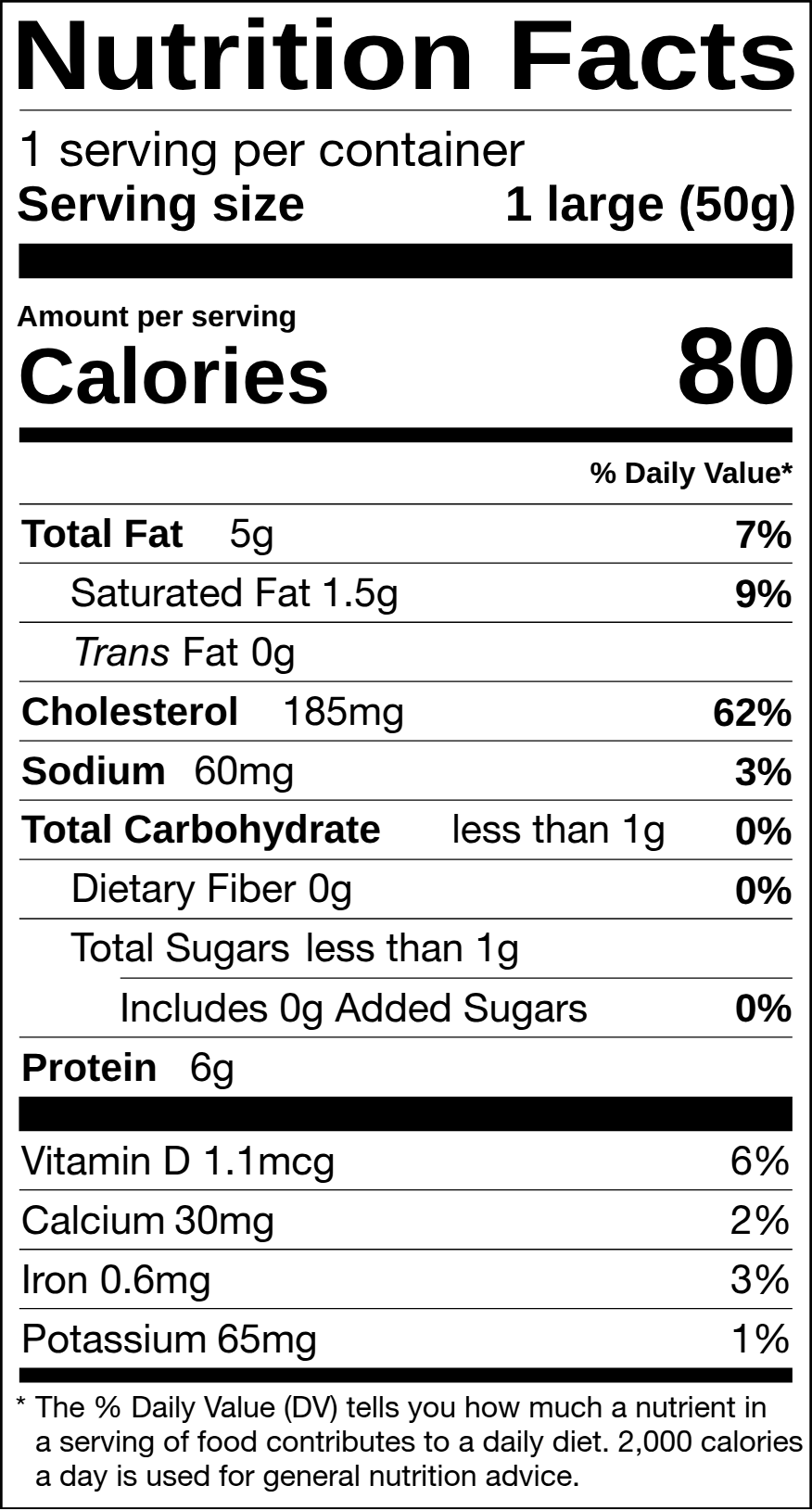
Everything else in the RDI table is voluntary. Voluntary does not mean permanently optional: a voluntary nutrient becomes mandatory as soon as you make a claim about it, or add it to the food as a nutrient supplement. Fortify a cereal with zinc and zinc has to be declared. Put "excellent source of vitamin C" on the front and vitamin C has to be declared. Vitamins A and C are the classic example of the shift, since both were mandatory before 2016 and are voluntary now, which is why older label templates still list them by default.
Rounding the % Daily Value
The two nutrient families round differently, and nothing on the finished label tells you which rule was applied.
| Nutrient family | Calculated %DV range | Round to | Example |
|---|---|---|---|
| Macronutrients with DRVs (fat, saturated fat, cholesterol, carbohydrate, sodium, fiber, protein, added sugars) | All values | Nearest whole percent | 12 g added sugars divided by 50 g equals 24%, printed as 24% |
| Vitamins and minerals with RDIs | Up to and including 10% | Nearest 2% increment | A calculated 7% is printed as 8%; 5% is printed as 6% or 4% by nearest-increment rounding |
| Vitamins and minerals with RDIs | Above 10% through 50% | Nearest 5% increment | A calculated 23% is printed as 25% |
| Vitamins and minerals with RDIs | Above 50% | Nearest 10% increment | A calculated 72% is printed as 70% |
For the macronutrients, the %DV may be computed from either the rounded declared amount or the actual unrounded amount, and either approach is acceptable so long as you apply it consistently. The milk label example shows the RDI ladder on a real panel, with calcium's %DV against 1,300 mg landing on a 5% increment. Our Daily Value calculator applies both rounding families automatically, and nutrient targets works the other direction, telling you what gram or milligram amount you need in a serving to hit a given %DV.
Nutrients with no Daily Value, and the below-2-percent options
Three items on or near the label have no Daily Value at all. Trans fat has none, so the grams are declared with a blank %DV column. Total sugars has none either, which is why the label shows a gram figure for Total Sugars and a %DV only on the indented "Includes X g Added Sugars" line beneath it. Calories from fat also had no Daily Value, and it was removed from the label entirely in the 2016 rule.
When a vitamin or mineral is present at less than 2 percent of its RDI, declaration is not required at all. If you choose to address it, the regulation gives you three options. You can show 0. You can use an asterisk keyed to the statement "Contains less than 2 percent of the Daily Value of this (these) nutrient(s)." Or, for the four mandatory micronutrients specifically, you can use the "Not a significant source of ..." statement. The same "not a significant source" mechanism covers omitted added sugars and total sugars lines when a product has less than 1 g of either and makes no sweetener or sugar claim.
How the FDA daily value chart changed in 2016
The values in the tables above are the 2016 values, which became mandatory on 1 January 2020 for firms with $10 million or more in annual food sales and 1 January 2021 for smaller firms. They remain in force. The 2016 rule moved sodium from 2,400 mg to 2,300 mg, fiber from 25 g to 28 g, total fat from 65 g to 78 g, total carbohydrate from 300 g to 275 g, calcium from 1,000 mg to 1,300 mg, and potassium from 3,500 mg to 4,700 mg. Vitamin D moved from 400 IU to 20 mcg, a change of unit as well as value.
The same rule introduced Added Sugars with its 50 g Daily Value, renamed Sugars to Total Sugars, made vitamin D and potassium mandatory while making vitamins A and C voluntary, removed Calories from Fat, required the actual gram or milligram amounts of the four mandatory micronutrients rather than %DV alone, and switched vitamin A to mcg RAE and folate to mcg DFE. It also deleted the old two-column 2,000 and 2,500 calorie reference table from the footnote. If you are looking at a chart that still shows sodium at 2,400 mg or vitamin D in IU, it predates this rule and should not be used.
If you would rather not hand-apply thirty-odd reference values and two rounding schemes to every SKU, the Nutrition Facts label generator holds the full 101.9 table above and produces a compliant panel from your recipe data, with the right population column and the right rounding already applied.
Frequently asked questions
What is a Daily Value?
A Daily Value is the single reference amount of a nutrient that FDA sets for labeling purposes, so that the % Daily Value on a Nutrition Facts panel can tell a shopper how much one serving contributes to a day's diet. FDA's consumer shorthand for reading those percentages is that 5% DV or less per serving is low and 20% DV or more per serving is high, applied to saturated fat, sodium and added sugars as nutrients to limit, and to dietary fiber, vitamin D, calcium, iron and potassium as nutrients to get more of.
Are Daily Values the same as RDAs?
No. An RDA, or Recommended Dietary Allowance, is a Dietary Reference Intake set by the National Academies for nutrition science: the intake that meets the needs of 97 to 98 percent of healthy individuals in a specific life-stage and sex group. There are many RDAs for a single nutrient, one per group. A label needs one number per nutrient, so FDA established RDIs, which are informed by the RDAs but are separate regulatory values codified in 21 CFR 101.9(c)(8)(iv). The practical consequence is that an RDI can differ from any particular RDA, and quoting an RDA as if it were the label value will give you a wrong %DV. RDAs also cover only vitamins, minerals and a few other nutrients, whereas the macronutrient side of the label runs on DRVs, which have no RDA counterpart at all.
Did the 2025-2030 Dietary Guidelines change any Daily Values?
No. The 2025-2030 Dietary Guidelines for Americans were released on 7 January 2026, and they contain new dietary advice, including a limit of no more than 10 g added sugars per meal and a recommendation to avoid added sugars for children until age 10. None of that touches the Daily Values in 21 CFR 101.9, which are unchanged. Changing a Daily Value requires notice-and-comment rulemaking, and no such rulemaking has been proposed. FDA has said only that it will assess whether the criteria for the "healthy" nutrient content claim need aligning with the new Guidelines. Keep using the values in the tables above.
Which Daily Values apply to a food marketed to both adults and toddlers?
A product aimed at two population groups needs nutrition information for both, which in practice means a side-by-side or aggregate display carrying one column of %DV figures against the adult and children 4 and older values and another against the children 1 through 3 values. The toddler column is a different label, not just a different denominator: foods for children 1 through 3 must declare calories, total fat, saturated fat, trans fat, cholesterol, sodium, total carbohydrate, dietary fiber, total sugars, added sugars, protein, vitamin D, calcium, iron and potassium, and they carry the footnote "The % Daily Value tells you how much a nutrient in a serving of food contributes to a daily diet. 1,000 calories a day is used for general nutrition advice" rather than the 2,000 calorie version. Foods for infants through 12 months go further still and show no %DV for saturated fat, trans fat, cholesterol, sodium, dietary fiber, total sugars or added sugars, and no footnote at all.