FDA Labeling Requirements: 2026 Food Label Checklist
FDA labeling requirements for packaged foods in 2026. Check Nutrition Facts, ingredients, allergens, claims, serving sizes and required package details.
FDA labeling requirements for packaged foods in the US cover the same core obligations, and FDA warning letters cite the same handful of failures year after year. This is the complete 2026 checklist: what must appear on the package, where each element goes, the rule behind it, and the traps that actually catch small producers. Work through it top to bottom and you have covered what a reviewer will look for.
The two panels behind FDA food labeling requirements
FDA labeling is organized around two zones. The principal display panel (PDP), the front the shopper sees, must carry the statement of identity (what the food is) and the net quantity of contents (21 CFR 101.7: weight or volume, in both US customary and metric, in the bottom 30% of the panel, at a type size tied to panel area).
The information panel, immediately to the PDP's right, carries the Nutrition Facts label, ingredient statement, allergen declaration, and the name and address of the manufacturer, packer or distributor (21 CFR 101.5). Scattering these elements elsewhere on the package is itself a violation, even when every element is individually correct.

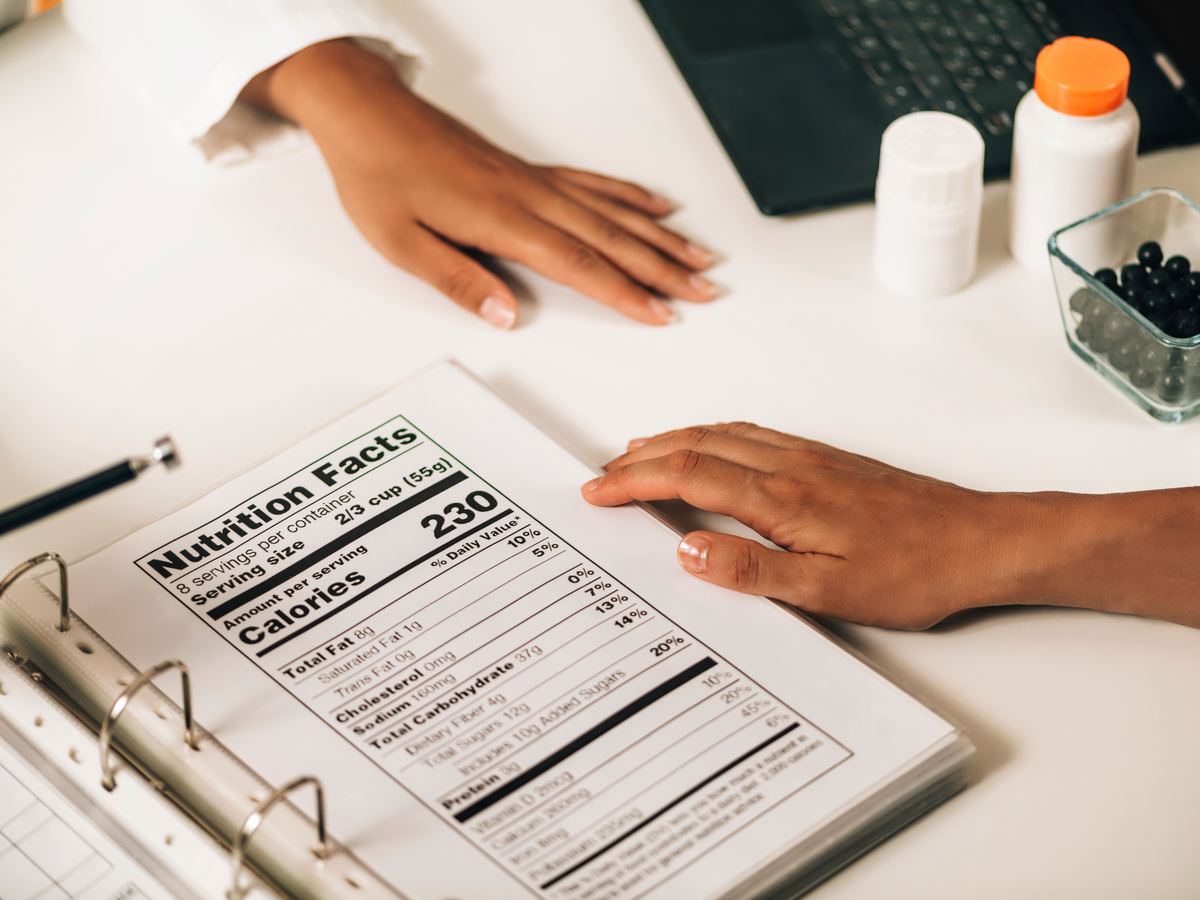
1. The Nutrition Facts label (21 CFR 101.9)
- Serving size comes from the FDA's RACC table, not from your preference. Look yours up in the free RACC lookup. Packages containing 200%–300% of the RACC may need dual-column labeling, per serving and per container.
- Mandatory nutrients, in order: calories, total fat, saturated fat, trans fat, cholesterol, sodium, total carbohydrate, dietary fiber, total sugars, added sugars, protein, vitamin D, calcium, iron, potassium.
- Rounding is prescribed per nutrient. Declaring 97 calories instead of 100 is a format violation. The full increments are in our rounding rules guide.
- Format follows package geometry: standard vertical by default; tabular and linear formats only where space qualifies; simplified format when enough nutrients are zero. Every recognized variant is in the template library.
- Type rules matter: minimum sizes, the hairline hierarchy, and bold on the right lines. A visually "close enough" panel drawn in a design tool is the single most common DIY failure. The generator renders the geometry to spec.
2. The ingredient statement (21 CFR 101.4)
All ingredients must appear by common or usual name, in descending order of predominance by weight. Compound ingredients either declare their own sub-ingredients in parentheses or are broken out entirely.
Water is an ingredient. Chemical preservatives must state their function ("citric acid to preserve freshness"). Spices, natural flavors and artificial colors have specific naming allowances, but certified colors (Red 40, Yellow 5…) must be named individually.
3. Allergen declarations (FALCPA + FASTER Act)
Nine major allergens, milk, eggs, fish, crustacean shellfish, tree nuts, peanuts, wheat, soybeans and, since 2023, sesame, must be declared either in parentheses within the ingredient list or in a "Contains" statement immediately after it.
Fish, crustacean species and tree nut types must be named specifically. "May contain" advisory statements are voluntary and unregulated in wording, but they never substitute for a required declaration.
Details and edge cases are in the allergen labeling guide. The free allergen detector scans a pasted ingredient list for all nine.
4. Claims: the part of food labeling requirements that triggers letters
Nutrient content claims ("low sodium", "high in protein", "sugar free") have numeric definitions in 21 CFR 101.13 and Subpart D. Each is checkable, and the free claim validator checks them.
Health claims are limited to authorized or qualified wordings. "Healthy" has a new 2024 definition with food-group and nutrient conditions. Anything implying disease treatment moves the product into drug territory. The safe rule: no front-of-pack adjective you can't tie to a CFR section.
5. The rest of the FDA labeling requirements checklist
- Name and address of manufacturer, packer or distributor, with "manufactured for" or "distributed by" when it isn't you (21 CFR 101.5).
- Country of origin where customs rules require it.
- Small-business exemption: nutrition labeling, not ingredients or allergens, can be exempt for low-volume businesses under the general exemption thresholds, with an annual FDA notice for the larger tier. Allergen and ingredient rules apply to everyone.
- Cottage food: state law adds its own label lines ("made in a home kitchen…") on top of, not instead of, the applicable federal rules when you sell across state lines.
- Watch item for 2026: FDA's proposed front-of-package "Nutrition Info" box is not final. Nothing needs to be printed yet, but packaging designed this year should leave front-panel room for it.
The five food labeling failures reviewers actually find
- Serving size that ignores the RACC table.
- Rounding done freehand (97 calories, 3.7 g fat).
- Sesame missing from products with tahini, hummus bases or bakery blends.
- Ingredient lists ordered by recipe convenience rather than weight.
- Unqualified claims, including "healthy", "immune boosting" and "low sugar" (a claim the FDA has never defined).
All five disappear when the label is generated from the recipe instead of drawn. The food label maker pulls serving sizes from the RACC table, applies § 101.9 rounding, orders the ingredient statement by weight and declares the nine allergens automatically.
FDA labeling requirements frequently asked questions
Do I need FDA approval before selling a food product?
No. Food labels are not pre-approved. The FDA regulates by inspection and enforcement after the fact, which is precisely why the checklist above is your responsibility, not a submission form.
Does this apply to meat and poultry products?
Mostly-meat products fall under USDA/FSIS labeling, which does require pre-approval in some cases and has its own format rules. Mixed products follow whichever agency governs the product's jurisdictional recipe share.
I only sell at farmers' markets in my state. Does any of this apply?
Purely intrastate cottage-food sales are governed by your state's cottage food law, which sets its own label requirements, usually simpler but always mandatory. The moment you ship across state lines or sell wholesale, the federal checklist applies.
Run your own label against the checklist. Build it in the free generator, and the compliance checker flags what a reviewer would.