Nutrition Facts label: what it is and what must be on it
A Nutrition Facts label is the standardized panel on packaged food in the United States that states the serving size, calories and nutrients, in a format the FDA prescribes down to the typeface. It is required on most packaged foods under the Nutrition Labeling and Education Act of 1990, and the rules are in 21 CFR 101.9. Almost nothing on the panel is your choice: the nutrients, their order, the rounding, the serving size and the layout are all set by the regulation.
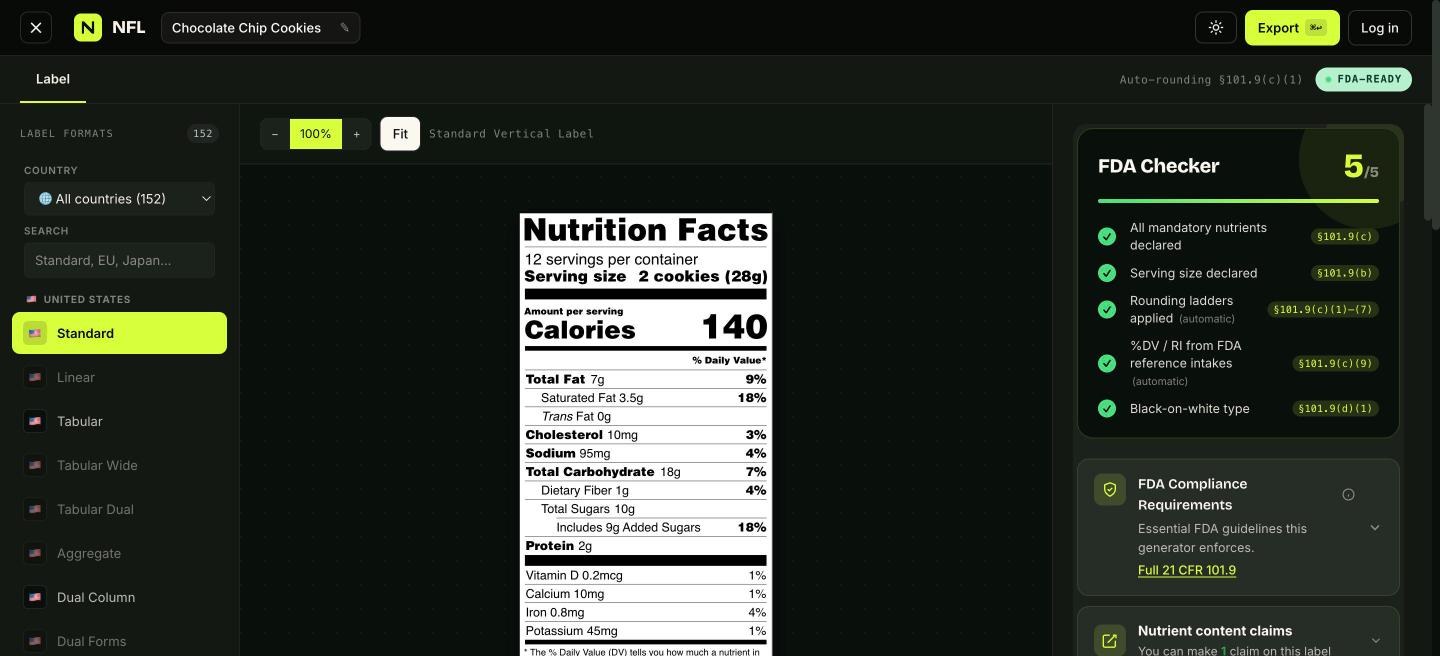
What must be on a Nutrition Facts label
The current panel comes from the FDA's 2016 final rule. Manufacturers with $10 million or more in annual food sales had to comply by January 1, 2020, and smaller ones by January 1, 2021. It requires:
At the top: servings per container; the serving size, as a household measure with the metric amount in parentheses; and calories, in large bold type.
Nutrients, in this order: Total Fat, with Saturated Fat and Trans Fat; Cholesterol; Sodium; Total Carbohydrate, with Dietary Fiber, Total Sugars and "Includes X g Added Sugars"; and Protein.
Vitamins and minerals: Vitamin D, Calcium, Iron and Potassium, in that order. All four are mandatory, each with its amount and its % Daily Value.
At the bottom: the footnote that explains % Daily Value.
The full rule, paragraph by paragraph, is on the FDA Nutrition Facts label requirements page.
What changed in 2016
Three changes explain most of the old templates still in circulation:
Added Sugars became mandatory. It is declared separately from Total Sugars, and it is one of the harder numbers to work out from a recipe. See added sugars on the Nutrition Facts label.
Vitamin D and Potassium replaced Vitamins A and C as mandatory nutrients.
"Calories from Fat" was removed.
A template that shows Calories from Fat, or lists Vitamin A and Vitamin C as its required vitamins, follows the old format and does not meet the current rule.
The panel is not the whole label
A Nutrition Facts panel alone does not make a compliant package. US food labeling rules require five elements:
Statement of identity (what the product is), on the principal display panel: 21 CFR 101.3.
Net quantity of contents, in the bottom 30 percent of the principal display panel: 21 CFR 101.7. See the net quantity rules.
Nutrition Facts panel: 21 CFR 101.9.
Ingredient statement, in descending order by weight, with the allergen declaration: 21 CFR 101.4. See ingredient list order and allergen labeling.
Name and place of business of the manufacturer, packer or distributor: 21 CFR 101.5.
Each has its own placement and minimum type size. Correct nutrition numbers with the net quantity statement in the wrong place still make a non-compliant pack.
| Per 100g | |
|---|---|
| Energy | 2092 kJ / 500 kcal |
| Fat | 25 g |
| of which saturates | 13 g |
| Carbohydrate | 64 g |
| of which sugars | 36 g |
| Protein | 7.1 g |
| Salt | 0.85 g |
| Fat / Lipides | 7 g | 9 % |
| Saturated / Saturés | 3.5 g + Trans / trans 0 g | 18 % |
| Cholesterol / Cholestérol | 10 mg | 3 % |
| Sodium | 95 mg | 4 % |
| Carbohydrate / Glucides | 18 g | 7 % |
| Fibre / Fibres | 1 g | 4 % |
| Sugars / Sucres | 10 g | 10 % |
| Protein / Protéines | 2 g | |
| Vitamin D / Vitamine D | 0 mcg | 0 % |
| Calcium | 10 mg | 1 % |
| Iron / Fer | 1 mg | 4 % |
| Potassium | 50 mg | 1 % |
*5 % ou moins c'est peu, 15 % ou plus c'est beaucoup
Which Nutrition Facts format to use
There is more than one Nutrition Facts label. Which one applies depends on the package and the product:
Standard vertical: the familiar one, and the default where space allows.
Tabular and linear: for packages with limited label space.
Dual column: required when a package holds at least 200 percent and up to and including 300 percent of the reference amount, so it shows values per serving and per package. See dual-column labeling.
Simplified: allowed when the food has insignificant amounts of eight or more of the fifteen core nutrients.
Aggregate: for variety packs.
Bilingual: when a second language appears on the label.
Infants and young children: a different set of nutrients and Daily Values.
Blank versions of each are on the nutrition label templates page.
Who needs a Nutrition Facts label
Not every packaged food does. 21 CFR 101.9(j) lists the exemptions. The ones small producers ask about most:
Small business: fewer than 100 full-time equivalent employees and fewer than 100,000 units of the product sold in the US in a year. A notice has to be filed with the FDA, except for a non-importer with fewer than 10 employees selling fewer than 10,000 units. See the small business exemption.
Small packages: less than 12 square inches of label space, if the label gives an address or phone number where the nutrition information can be requested.
Insignificant amounts of every nutrient: coffee beans, tea leaves, flavor extracts and food colors are the regulation's examples.
Restaurant and food-service items served for immediate consumption.
These exemptions end if the label makes a nutrition claim. Put "high in fiber" or "low sodium" on the pack and a full Nutrition Facts panel is required. The free Do I need a Nutrition Facts label? tool walks through the questions.
Where the numbers come from
The FDA accepts two routes.
Database analysis calculates the values from your ingredients, using USDA FoodData Central or supplier specification sheets, summed across the recipe and adjusted for the water lost in cooking. Most packaged food in the US is labeled this way.
Laboratory analysis measures the finished product. It is worth the cost when an ingredient is in no database, when a nutrient claim sits close to its limit, or when a customer asks for it.
Either way the values are then rounded under 21 CFR 101.9(c), with a different rule for each nutrient, before they go on the panel. See the FDA rounding rules. The serving size comes from the reference amounts in 21 CFR 101.12, not from your own idea of a portion: see how to determine serving size.
Nutrition labels outside the United States
The US panel is one national format among many, and they are not interchangeable:
Canada requires a bilingual Nutrition Facts table, and from January 1, 2026 a front-of-package symbol on foods high in saturated fat, sugars or sodium.
The EU requires a nutrition declaration under Regulation 1169/2011, with energy in kilojoules and kilocalories and values per 100 g or 100 ml.
The UK keeps the same framework, and many products add the voluntary traffic light label.
Australia and New Zealand use the FSANZ nutrition information panel.
Mexico requires NOM-051 front-of-pack warning seals.
A product sold in three markets needs three labels, each calculated to its own rules.
Common mistakes on a first label
1. Choosing your own serving size. It comes from the reference amount for the food category.
2. Ignoring cooking loss. Water evaporates and nutrients do not, so values per gram are understated if you skip the adjustment.
3. Rounding by eye. The rounding steps are fixed for each nutrient.
4. Leaving out Added Sugars.
5. Using a pre-2016 template.
6. Forgetting sesame. It became the ninth major US allergen on January 1, 2023.
7. Treating the panel as the whole job. Four other elements are required beside it.
What the generator is not
It is not a laboratory: the values come from the database you build the recipe from, or from the figures you type, and their accuracy is yours. It is not legal advice: each format page cites the regulation it follows so you can check the source. And it produces the nutrition panel, not your whole pack design.