How to Determine Your Serving Size
A lookup followed by a short chain of arithmetic, with the regulation supplying the answer at every step. Find your category in the reference amount tables, convert to a household measure, round the metric weight, and count the servings per container.
Figuring out how to determine serving size for a nutrition label is not a judgment call. It is a lookup followed by a short chain of arithmetic, and the regulation gives the answer at every step. You find your product category in the reference amount tables at 21 CFR 101.12(b), read the reference amount customarily consumed per eating occasion (the RACC), then apply the conversion procedures in 21 CFR 101.9(b) to turn that reference amount into the serving size you print.
What follows is that sequence in the order a producer hits it, ending with the cases that do not fit the pattern. For the wider set of serving size obligations, see FDA serving size requirements. For the tables themselves and how the amounts were derived, see FDA RACC reference amounts.
Step one: find your category and read the reference amount
Everything downstream depends on getting the right row out of 101.12(b). The reference amount is the amount customarily consumed per eating occasion by people 4 years of age or older. Table 1 covers foods for infants and children 1 through 3 years of age, and 101.12(a)(2) limits those amounts to foods specially formulated or processed for that group. Table 2 covers everything else, and its rows are specific: cookies 30 g, grain-based bars including granola bars 40 g, bagels and muffins excluding English muffins 110 g, snacks of all varieties 30 g, carbonated and noncarbonated beverages 360 mL, soups 245 g.
Three principles in 101.12(a) can change which number you read. The reference amount covers only the edible portion, not bone, seed or shell (101.12(a)(6)); it follows the major intended use, which is why milk is referenced as a beverage and not as an addition to cereal (101.12(a)(7)); and a food usually used as an ingredient but also eaten as purchased, butter being the example, is referenced as purchased (101.12(a)(8)).
The general rules for products not specifically listed. Most categories carry a catch-all row phrased as "all others except those listed as separate categories," and that is your first stop. Beyond it, 101.12 gives three general rules.
- Unprepared forms, 101.12(c). If 101.12(b) gives a reference amount for the prepared form but not the unprepared form, the reference amount for the unprepared product is the amount required to make the reference amount of the prepared one. Dry mixes, concentrates, dough, batter and fresh or frozen pasta are the named examples, and footnote 2 to the tables repeats the rule. Dry soup mixes and bouillon are listed exactly this way: the amount needed to make 245 g.
- Imitation and substitute foods, 101.12(d). The reference amount for an imitation, a substitute or an altered food such as a low calorie version is the same as for the food it substitutes for. Making a lighter product does not buy you a smaller reference amount.
- Combination products, 101.12(f). Where neither form of a two-or-more-food package is listed, the reference amount is that of the ingredient represented as the main ingredient plus proportioned amounts of all minor ingredients. Compatible units are summed: the regulation's example gives 4 tablespoons for equal volumes of peanut butter and jelly, 2 tbsp of each, with peanut butter as the main ingredient. Incompatible units convert to weight first, so pancakes and syrup is 110 g for the pancakes plus the weight of the proportioned syrup.
If none of that reaches your product, 101.12(h) allows a petition to establish a new reference amount, but the catch-all row almost always answers it first. Our RACC lookup tool searches the 101.12(b) categories by product description.
How to determine serving size for a nutrition label when the product is in discrete units
101.9(b)(2) requires the declared serving size to be determined from the 101.12(b) reference amounts, with exceptions at 101.9(b)(3), (b)(4) and (b)(6) and for weight-control products sold only through a weight-control programme. For products in discrete units, meaning muffins, sliced bread, individually packaged products inside a multiserving package and the like, 101.9(b)(2)(i) sets four gates on the ratio of one unit's weight to the reference amount.
| Unit weight as a share of the reference amount | Serving size, per 101.9(b)(2)(i) | Worked case |
|---|---|---|
| 50 percent or less | The number of whole units that most closely approximates the reference amount | A 13 g cookie is 43.3 percent of the 30 g amount. Two cookies is 26 g, three is 39 g, so the serving is 2 cookies (26 g) |
| More than 50 percent but less than 67 percent | The manufacturer may declare one unit or two units | A 60 g muffin is 54.5 percent of the 110 g amount, so either 1 muffin (60 g) or 2 muffins (120 g) is compliant |
| 67 percent or more but less than 200 percent | One unit. No discretion | A 45 g granola bar is 112.5 percent of the 40 g grain-based bar amount, so the serving is 1 bar (45 g) |
| At least 200 percent and up to and including 300 percent | The amount approximating the reference amount, plus a second column of amounts and percent Daily Values per individual unit | A 90 g twin bar is 225 percent of 40 g, so the serving is half a bar (45 g) with a second column for the whole bar |
Read the boundaries exactly as written, because they are not symmetrical. The first gate closes at 50 percent inclusive, the second opens above 50 and closes below 67, the third takes 67 inclusive up to but not including 200, and the fourth runs from 200 inclusive to 300 inclusive. A unit at exactly 67 percent is one serving, not a choice. The dual column in the fourth gate carries the exemptions at 101.9(b)(12)(i)(A), (B) and (C), which cover tabular and linear format products, raw fruits, vegetables and seafood with voluntary labeling, and products already carrying a second column.
Large divided units, bulk products and single-serving containers
Under 101.9(b)(2)(ii), for large discrete units usually divided before eating such as cake, pie, pizza, melon and cabbage, the serving is the fractional slice of the ready-to-eat product that most closely approximates the reference amount. The permitted fractions are 1/2, 1/3, 1/4, 1/5, 1/6, or smaller fractions generated by dividing those by 2 or 3. Where the whole package makes one large divided unit, cake mix and pizza kit being the examples, the fraction of the package used to make the 101.12(c) reference amount may be used instead.
Under 101.9(b)(2)(iii), for nondiscrete bulk products such as breakfast cereal, flour, sugar, dry mixes and concentrates, the serving is the amount in household measure that most closely approximates the reference amount. There are no percentage gates here because there is no unit to compare.
101.9(b)(6) decides whether a package is a single serving at all. A product packaged and sold individually containing less than 200 percent of the applicable reference amount must be treated as a single-serving container, with the entire contents labeled as one serving. A 20 fl oz bottle of a carbonated beverage is 600 mL at the 30 mL per fluid ounce conversion in 101.9(b)(5)(viii), or 166.7 percent of the 360 mL reference amount, so the whole bottle is one serving. Falling above 150 percent and below 200 percent, it may also carry a voluntary extra column per the household measure closest to the reference amount, here 12 fl oz.
The household measure and the metric equivalent
101.9(b)(5) defines common household measure as cup, tablespoon, teaspoon, piece, slice, fraction, ounce, fluid ounce, or other household equipment used to package food such as a jar or a tray, then sets a hierarchy: cups, tablespoons or teaspoons wherever possible and appropriate, except for beverages where fluid ounces may be used; failing that, units such as piece, slice, tray, jar and fraction; failing that, ounces with a visual unit of measure in 0.5 oz increments, the regulation's example being 1 oz (28 g/about 1/2 pickle).
The increments are fixed: cups in 1/4 or 1/3 cup increments, tablespoons as 1, 1 1/3, 1 1/2, 1 2/3, 2, or 3, teaspoons as 1/8, 1/4, 1/2, 3/4, 1, or 2. So are the conversions, in 101.9(b)(5)(viii): a teaspoon is 5 mL, a tablespoon is 15 mL, a cup is 240 mL, 1 fl oz is 30 mL, 1 oz in weight is 28 g. Use those rather than exact physical conversions or your gram figures will drift from a reviewer's.
A worked bulk case: a ready-to-eat cereal weighing 30 g per cup falls in the 20 g or more but less than 43 g per cup category, which carries a 40 g reference amount. Dividing 40 g by 30 g per cup gives 1.333 cups, and one third is an allowed increment, so the serving is 1 1/3 cups (40 g). When the arithmetic lands exactly between two permitted sizes, 101.9(b)(5)(ix) rounds up to the next incremental size; the regulation's example is 2.5 tbsp becoming 3 tablespoons.
The metric equivalent follows in parentheses under 101.9(b)(7), fluids in millilitres and everything else in grams. Its rounding, at 101.9(b)(7)(ii), is to the nearest whole number, except that a quantity between 2 and 5 g or mL rounds to the nearest 0.5 and one below 2 g or mL is expressed in 0.1 increments. A single-serving container does not need the parenthetical metric quantity, because it already appears in the net quantity of contents statement required by 21 CFR 101.7; give it voluntarily and 101.9(b)(7)(i) requires it to match that declaration exactly.
Servings per container and the rounding in 101.9(b)(8)
101.9(b)(8) bases the number of servings per container on the serving size you just determined, not on the reference amount. Its rounding has one break point: round to the nearest whole number, except that a result between 2 and 5 servings rounds to the nearest 0.5 serving. Random weight products are excluded. Where rounding occurred, the declaration uses the word "about".
| Package | Serving size | Raw division | Declared |
|---|---|---|---|
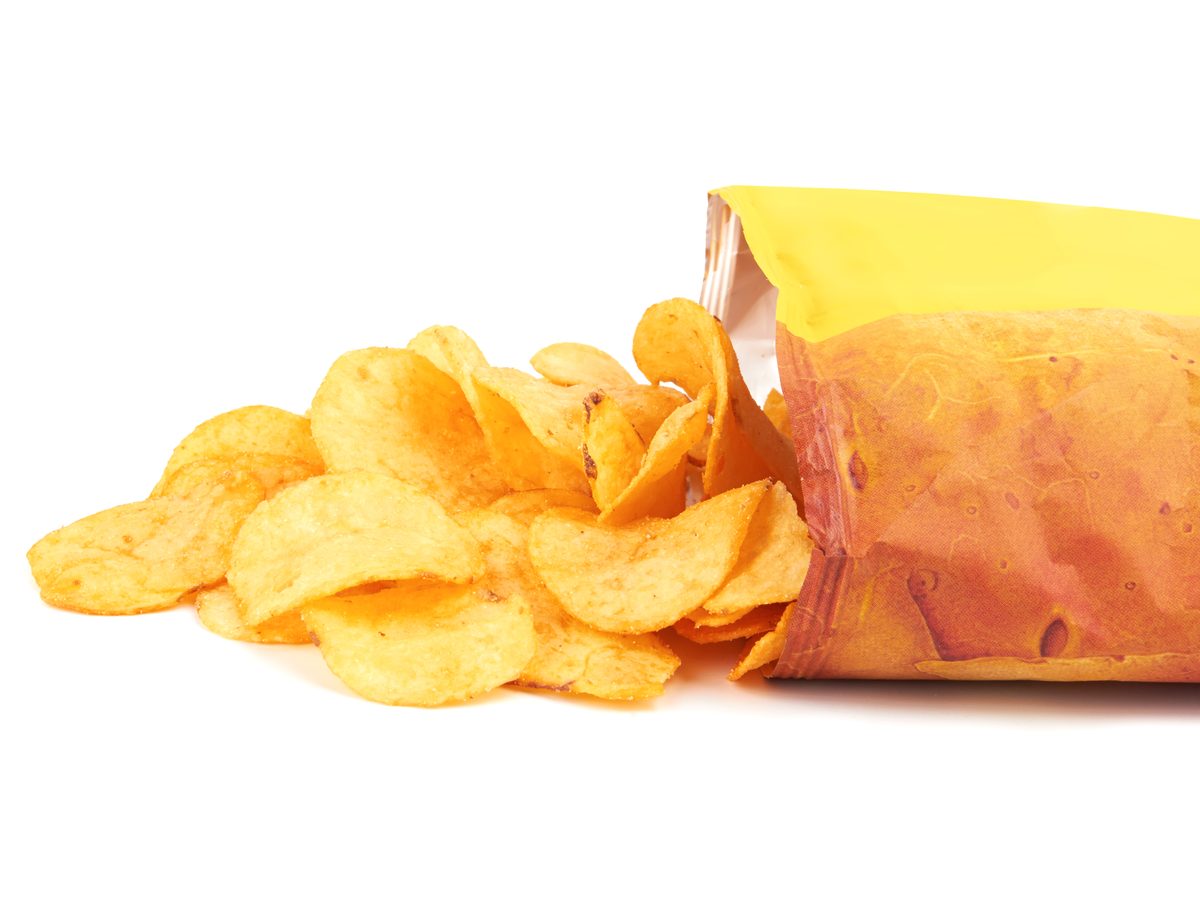
| 99 g bag of chips | 1 oz (28 g) | 3.54 | about 3.5 servings |
| 170 g bag of chips | 1 oz (28 g) | 6.07 | about 6 servings |
| 350 g box of cereal | 1 1/3 cups (40 g) | 8.75 | about 9 servings |
| 16 cookies at 13 g | 2 cookies (26 g) | 8.00 | 8 servings, with no "about" |
The last row matters: "about" signals that rounding happened, so if the division comes out exactly, leave it off. Two multipack rules follow. Under 101.9(b)(8)(iv), for a package of several individual single-serving containers each labeled for individual sale, the servings count is the number of packages inside, and each of those units is itself one serving under 101.9(b)(2)(i)(H). Under 101.9(b)(8)(v), for a package of several individually packaged multiserving units, multiply the number of units by the servings in each.
Aggregate packages and variable-weight products
Variety packs and compartment trays. Under 101.9(b)(4), a variety pack of several single-serving varieties, and a product with two or more compartments each holding a different food, must give nutrition information for each variety, per a serving size derived from that variety's own 101.12(b) reference amount. One averaged panel across the varieties is not what the rule asks for.
Meal and main dish products. Under 101.9(b)(3), those defined in 101.13(l) and (m) are declared, in single-serving containers, as the entire content of the package, edible portion only; in multiserving containers they use the 101.12(b) reference amount if listed and the 101.12(f) combination rules if not.
Components eaten together. Under 101.9(b)(5)(vii), nutrition information may be declared per component or as a composite, and the serving size may follow the discrete, divided or bulk procedures or be given in ounces with a visual unit of measure, as in "3 oz dry macaroni (84 g/about 2/3 cup)" plus "1 oz dry cheese mix (28 g/about 2 tbsp)".
Products that naturally vary in size. Under 101.9(b)(2)(i)(F), pickles, shellfish, whole fish and fillet of fish may be declared in ounces closest to the reference amount, in 0.5 oz increments with a visual unit of measure per 101.9(b)(5)(vi) and (b)(5)(iii). Pickles carry a 30 g reference amount and a label statement of 1 oz (28 g/visual unit of measure), and because they are packed in a liquid not customarily consumed, 101.9(b)(9) puts the declaration on the drained solids. Where the serving is on a drained solids basis and the servings vary with unit size, 101.9(b)(8)(ii) permits a typical number, as in "usually 5 servings".
Random weight products. Under 101.9(b)(8)(iii), foods such as cheeses sold at random weights, where net contents differ container to container, may declare "varied" for servings per container, provided the nutrition information is based on the reference amount in the appropriate household measure from the 101.9(b)(5) hierarchy. Cheese other than the separately listed types carries a 30 g reference amount. The typical number of servings may follow in parentheses.
One thing holds throughout: under 101.12(g) it is the reference amount, not your declared serving size, that decides whether a product qualifies for a nutrient content or health claim, and where the two differ the claim must carry a statement of that basis, for example "Very low sodium, 35 mg or less per 240 mL (8 fl oz)". Once the reference amount, the unit ratio and the household measure are settled, the nutrition label generator applies the gates and all three rounding rules and builds the panel from those inputs.
Frequently asked questions
Can I choose my own serving size to make the numbers look better?
No. 101.9(b)(2) requires the serving size to be determined from the reference amounts in 101.12(b). The only real discretion is the second gate, where a unit weighing more than 50 percent but less than 67 percent of the reference amount may be declared as one unit or two. The narrow exception is a product both intended for weight control and sold only through a weight-control programme, which may use a serving consistent with that meal plan and must bear a "for sale only through the ______ program" statement on the principal display panel.
My product category is not in the tables. What do I use?
Work the general rules in order. Look first for the catch-all row in the closest category, phrased as all others except those listed as separate categories. An unprepared form of something listed prepared takes 101.12(c): the amount needed to make the prepared reference amount. An imitation or substitute takes 101.12(d): the reference amount of the food it replaces. Two or more foods packaged to be eaten together take 101.12(f): the main ingredient's reference amount plus proportioned minor ingredients. Only if none of those reaches your product does a 101.12(h) petition come into it.
When do I have to print two columns?
Three situations in 101.9(b). A discrete unit at 200 to 300 percent of the reference amount needs a per-unit column, under 101.9(b)(2)(i)(D). A product packaged and sold individually at 200 to 300 percent of the reference amount needs a whole-package column, under 101.9(b)(12)(i), subject to the exemptions at (A) through (C). And under 101.9(b)(11), promoting a use that differs in quantity by twofold or more from the use the reference amount was based on needs a column for that use, though flour, oils and other bulk ingredients, eggs, butter and multipurpose baking mixes are exempt. Separately, a product sold individually at more than 150 percent and less than 200 percent may voluntarily add a column per the household measure closest to the reference amount.
Does the whole bottle count as one serving?
If it is packaged and sold individually and contains less than 200 percent of the applicable reference amount, yes. 101.9(b)(6) requires it to be treated as a single-serving container with the entire contents labeled as one serving, so a 600 mL bottle of a carbonated beverage, being 166.7 percent of the 360 mL reference amount, is one serving. At 200 percent or more the dual-column rules start to apply.
Do infant and toddler products use different reference amounts?
Only when they qualify. 101.12(a)(2) says the reference amounts for infants up to 12 months and for children 1 through 3 years are used only when the food is specially formulated or processed for that group, and those sit in Table 1 of 101.12(b). A general-market product that toddlers happen to eat stays on the Table 2 amounts.