AB 660: California Food Date Label Rules for 2026
AB 660 explained for California food date labels, including BEST if Used by, USE by, banned Sell by dates, exemptions and compliance steps.
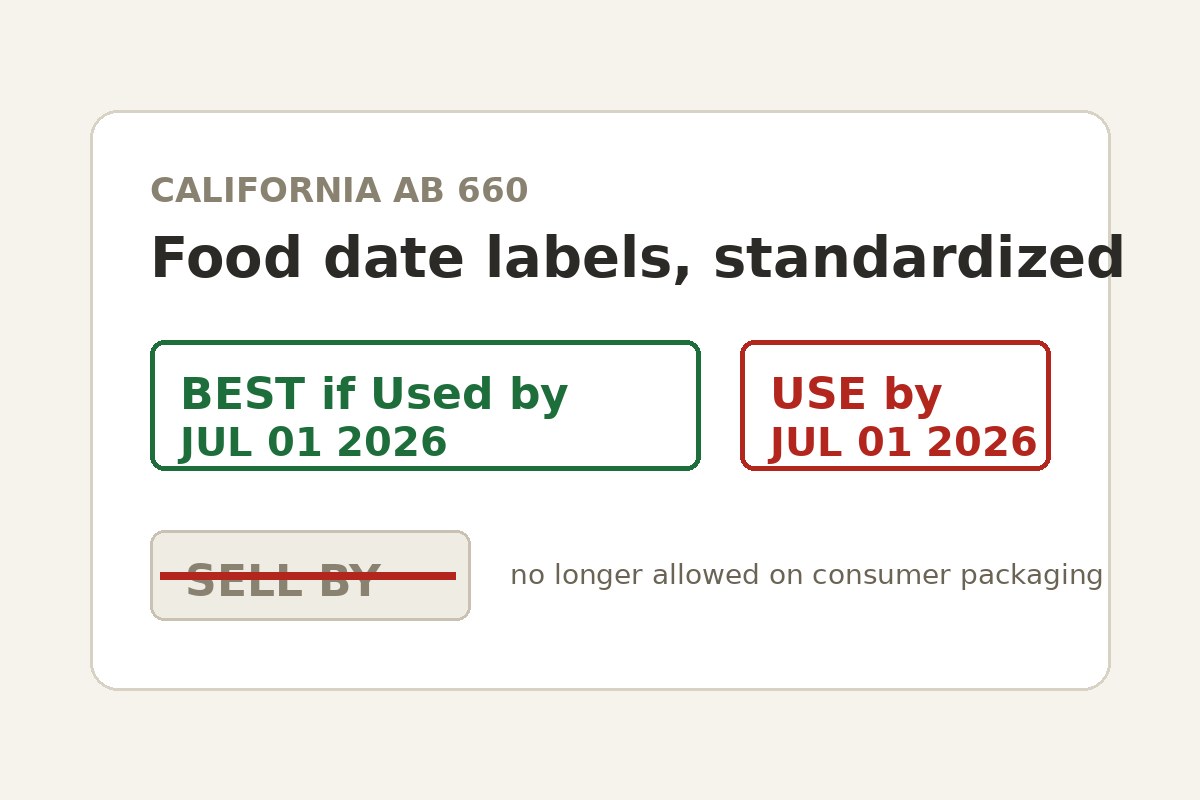
AB 660 standardizes date labels on packaged foods sold in California beginning July 1, 2026. Food manufactured on or after that date may use only two types of consumer-facing date label: a quality date beginning “BEST if Used by” or a safety date beginning “USE by”. Consumer-facing “Sell by” dates are prohibited.
The requirements are established in Food and Agricultural Code §§ 82000–82001. If you sell packaged food in California, your date wording needs to follow the statute. In practice, many brands selling nationally will use the same wording across the United States rather than maintain a separate California SKU.
This guide explains the California date labeling law, the permitted phrases, what is prohibited, which products are exempt, and how to choose the appropriate date for your food.
AB 660's two permitted food date labels
AB 660 replaces the fifty-plus date phrases previously used on food, including “enjoy by,” “freshest before,” “expires on,” and “best when purchased by,” with a two-track system.
Which track you use depends on whether the date communicates quality or safety.
| Date type | Required phrase | Small-package abbreviation | Use it when |
|---|---|---|---|
| Quality | “BEST if Used by” or “BEST if Used or Frozen by” | BB | The food remains safe after the date but peak flavor or texture has passed - crackers, cereal, canned goods, most shelf-stable products |
| Safety | “USE by” or “USE by or Freeze by” | UB | Consuming the product after the date carries an elevated safety risk - deli salads, fresh dairy, ready-to-eat perishables |
The capitalization specified by the statute is deliberate. BEST begins the quality phrase and USE begins the safety phrase.
The manufacturer decides which track applies based on the product's risk profile.
If you have not formally determined how long the product remains safe and palatable, use our shelf life calculator to develop a defensible initial estimate, then confirm it through testing where the product's risk warrants it.
What AB 660 bans: consumer-facing “Sell by” dates
“Sell by” was designed as an inventory-management instruction for retailers rather than a message to consumers. However, consumers frequently interpret it as an expiration date and discard food that may still be usable.
AB 660 therefore prohibits consumer-facing “Sell by” dates.
Retailers and manufacturers can still use dates for stock rotation, but the information must be presented as a coded date.
The code cannot use the phrase “sell by” and cannot be easily readable by consumers as a calendar date. A Julian date or lot-style code can satisfy that purpose.
Who and what is exempt from California's date labeling law
Several categories fall outside the standard AB 660 requirements:
- Food manufactured before July 1, 2026. The law applies to food manufactured on or after the effective date. Existing inventory does not have to be relabeled or removed from sale.
- Infant formula. Its “Use by” date is already required federally by FDA and remains unchanged.
- Eggs. These are covered by separate federal and California dating requirements.
- Food prepared for immediate consumption. Restaurant and food-service items are outside the scope.
Other packaged foods are generally within the scope of the law.
Importantly, a date label itself remains voluntary under AB 660. The statute does not require every packaged food to carry a date. Instead, it controls the wording manufacturers must use when they choose to provide one.
AB 660 enforcement and non-compliance costs
The California Department of Food and Agriculture oversees the program in consultation with the Department of Public Health.
Violations can be charged as misdemeanors with fines of up to $1,000.
Retailers selling non-compliant products face the same exposure as manufacturers. That is why grocery buyers have been requesting AB 660 compliance attestations from suppliers since spring 2026.
For a small food brand, the most immediate enforcement problem may therefore not be a state inspection. It may be a distributor or retailer refusing a purchase order because the package uses non-compliant date wording.
Five steps to comply with AB 660
- Inventory your SKUs' current date wording. Identify every package using wording other than the four permitted phrases or the BB/UB abbreviations. Those products need date-label artwork changes.
- Classify each product as quality-dated or safety-dated. The distinction is whether the food can create a safety concern after the date, rather than simply losing desirable taste, texture or other quality characteristics.
- Set the date itself defensibly. Use the shelf life calculator for an initial estimate based on product category, storage and packaging, then document how you established the final date.
- Move stock-rotation information into a code. If your co-packer currently prints a consumer-readable sell-by date for logistics, replace it with a lot or Julian-style code.
- Consider adopting the California wording nationwide. Nothing in federal law conflicts with “BEST if Used by”, and FDA and USDA already recommend that wording. A single national label can therefore be less expensive than maintaining a separate California version, while other states are also drafting similar legislation.
AB 660 and “BEST if Used by” California requirements: frequently asked questions
Does AB 660 apply to products made before July 1, 2026?
No. AB 660 applies to food manufactured on or after July 1, 2026 and sold in California. Products manufactured before the effective date can continue to sell through using their existing date labels rather than being relabeled or removed solely because of the new standardized wording.
Do I have to put a date label on my product at all?
Generally, no. Date labeling remains voluntary for most foods. AB 660 standardizes the wording if you choose to place a date on the product. Infant formula and certain other products remain subject to their own mandatory federal dating requirements, so the voluntary nature of AB 660 does not override those separate rules.
Is “Expires on” or “Enjoy by” still allowed?
No, not for food manufactured after the effective date and sold in California. Quality dates must use “BEST if Used by” or “BEST if Used or Frozen by.” Safety dates must use “USE by” or “USE by or Freeze by.” The standardized phrases replace alternatives such as “Expires on” and “Enjoy by.”
Does the date label appear on the Nutrition Facts panel?
No. The date is separate from the Nutrition Facts panel and is commonly printed near the lid, seam or base of the package. Retailers reviewing AB 660 compliance may still review the complete package, so an artwork update is a useful time to check the rest of the label with the free label generator and FDA labeling requirements checklist.
Setting your first date? Use the free shelf life calculator to estimate it, then create the rest of your compliant food label in the NFL label generator.