Étiquetez votre produit sans embaucher une équipe réglementaire
Petites marques CPG, dark kitchens et entreprises alimentaires à domicile utilisent NFL pour livrer des étiquettes conformes à la FDA dès le premier jour.
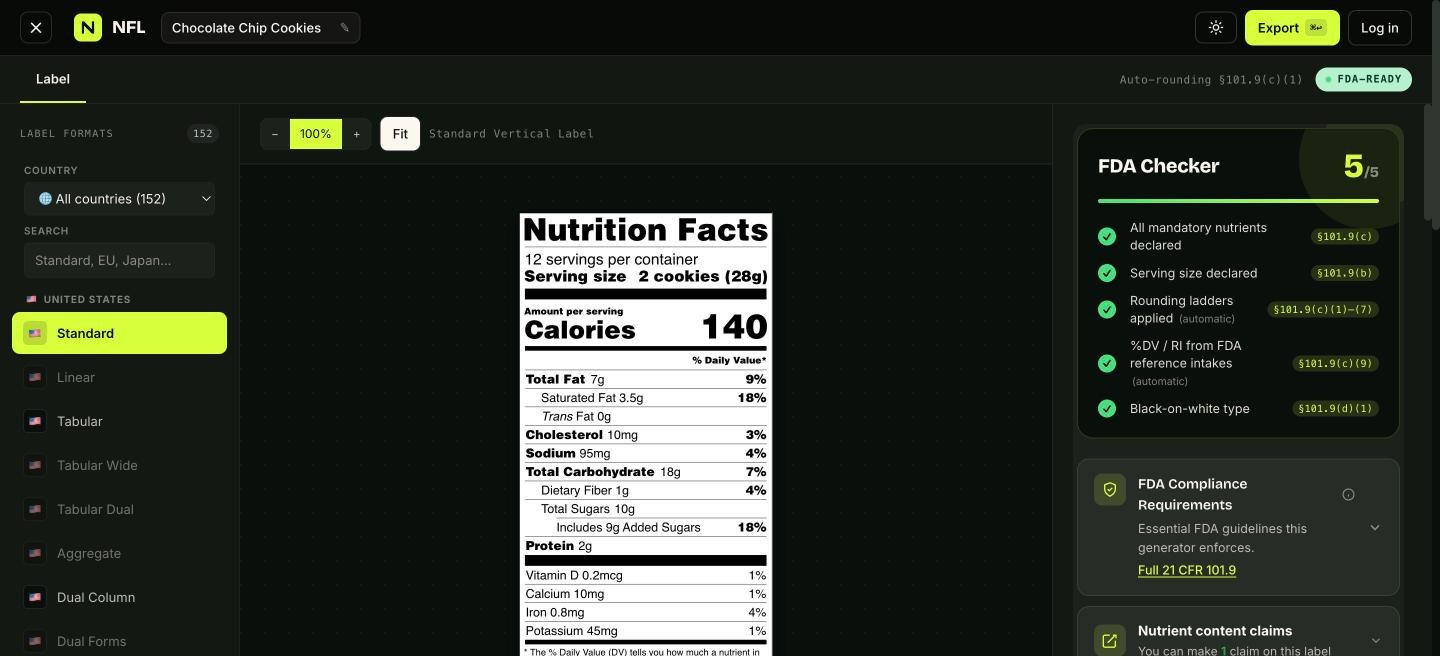
Le problème
Vous avez un produit, un designer d'étiquettes et une date de mise en rayon. Ce que vous n'avez pas, c'est un spécialiste réglementaire pour vous dire si votre bloc Nutrition Facts arrondit totalFat à 4 g ou 4,5 g. En embaucher un pour une seule référence n'est pas rentable.
Ce que fait NFL
- Calcule automatiquement chaque nutriment à partir de votre liste d'ingrédients grâce aux données USDA FoodData Central
- Applique les règles d'arrondi et d'insignifiance du 21 CFR 101.9 de la FDA pour que vous n'ayez pas à les chercher
- Génère la ligne d'allergènes « Contains: » à partir des cases à cocher FALCPA + FASTER Act
- Exporte en PDF, PNG, SVG, JPG, EPS ou AI prêt à imprimer - le fichier dont votre designer a besoin
À qui cela s'adresse
Sauces artisanales, pâtisseries, viande séchée, granola, beurres de fruits à coque, plats surgelés, alternatives végétales aux produits laitiers - tous ceux qui vendent sur les marchés, en épicerie locale ou en e-commerce direct et qui ont besoin d'étiquettes légales sur leurs emballages sans budget d'entreprise.
The five things every packaged food label has to carry
Nutrition Facts is one element of a compliant label, not the whole of it. A packaged food sold in the US generally needs all five of these, and missing any one of them is a labeling violation on its own:
1. Statement of identity. What the product actually is, in the product's common or usual name, on the principal display panel - the face the customer sees on shelf. "Aunt May's" is a brand, not an identity. "Aunt May's Blueberry Preserve" is.
2. Net quantity of contents. In both metric and US customary units, positioned in the bottom 30% of the principal display panel under § 101.7. This placement rule surprises people constantly - a correct weight in the wrong third of the panel is still wrong.
3. Ingredient statement. Every ingredient by common name, in descending order of predominance by weight, with sub-ingredients in parentheses per § 101.4.
4. Name and place of business of the manufacturer, packer, or distributor, per § 101.5 - qualified with "Manufactured for" or "Distributed by" if the named firm did not make it.
5. Nutrition Facts and allergen declaration, unless a specific exemption applies to you.
If you are cooking from home, read this part first
Home-based food businesses usually operate under a state cottage food law rather than the federal packaged-food regime, and those are genuinely different rules with a different shape.
Cottage food laws are state-level and vary substantially - in which foods they permit, what sales ceiling they impose, and whether they require a permit or inspection. Most restrict you to shelf-stable, non-potentially-hazardous products: baked goods, jams, dry mixes, candies. Most require a specific disclosure on the label along the lines of "Made in a home kitchen that is not subject to state inspection." And most importantly, most confine you to selling within your own state.
That last constraint is the one that ends the arrangement. The day you ship to a customer in another state, you are in interstate commerce, your cottage food licence stops covering you, and the full federal labeling rules apply. Plenty of home businesses cross that line the first week they turn on online ordering, without realising the legal basis they were operating under just evaporated.
Check your own state's cottage food statute before you rely on it. They differ enough that no general description is a substitute for reading yours.
Where the exemptions actually apply
Even in interstate commerce, small operations may not need a Nutrition Facts panel. Two federal provisions matter: § 101.9(j)(1), a turnover-based exemption for very low gross sales, and § 101.9(j)(18), covering businesses selling fewer than 100,000 units into the US in twelve months with fewer than 100 full-time-equivalent employees.
The second requires filing FDA Form 3570, annually. It is not automatic and a business that qualifies but never files is not exempt.
And both vanish the moment you make a nutrient content or health claim. "Low sugar," "high protein," "keto-friendly," "only 100 calories" - any of these on the package opts you into full nutrition labeling for that product. If you are leaning on an exemption, keep claim language off the pack.