FDA Front-of-Package Nutrition Label: 2026 Status and Rules
FDA proposed a front-of-package Nutrition Info box in January 2025. It is still not final. What it would require, where the rulemaking stands, and what to do now.

This article covers the FDA front of package nutrition label, the "Nutrition Info" box FDA proposed on 16 January 2025. Start with the fact most coverage gets wrong: the rule is proposed and has not been finalised. As of today, no packaged food in the United States is required to carry a front-of-package nutrition box, and no compliance clock is running. Below is what the box would show if the rule were finalised as written, where the rulemaking stands, and what a manufacturer can usefully do meanwhile.
This is the hub piece for the cluster. For nutrient-by-nutrient detail on sodium, added sugars and saturated fat in the proposed box, see the walkthrough in front of package label requirements. It does not cover the Nutrition Facts panel itself, which is a separate and long-binding rule.
Where the FDA front of package nutrition label rule stands, with dates
FDA published "Food Labeling: Front-of-Package Nutrition Information" in the Federal Register on 16 January 2025 at 90 FR 5426, under Docket No. FDA-2024-N-2910 and RIN 0910-AI80. It would create a new 21 CFR 101.6, "Front-of-package Nutrition Info box." Everything below comes from that document, and none of it is in force.
| Date | What happened |
|---|---|
| 16 Jan 2025 | Proposed rule published, 90 FR 5426, docket FDA-2024-N-2910. FDA had announced it on 14 January 2025. |
| 20 Jan 2025 | Presidential "Regulatory Freeze Pending Review" memo; the proposal became subject to review by the incoming administration. |
| 9 May 2025 | Comment period extension published, moving the 16 May 2025 deadline to 15 July 2025. |
| 15 Jul 2025 | Comments closed. Trade press reported more than 11,000 comments; FDA itself later described "tens of thousands of public comments" showing broad support but varying views on the label's content and design. |
| 2025 and 2026 Unified Agendas | RIN 0910-AI80 listed at Final Rule Stage with a projected final rule date of May 2026. That date passed with no final rule. |
| 23 Jan 2026 | FDA's Human Foods Program 2026 priority deliverables listed "enhanced food labeling, such as front-of-package nutrition labeling," with FDA to analyse comments and prepare options for a final rule. |
| March 2026 | Then-Commissioner Makary said leadership "did not like the front-of-package plan that we inherited." Deputy Commissioner Diamantas told Bloomberg Law "everything is on the table," and that meaningful changes could require re-proposing the rule for another comment round. |
| 12 May 2026 | Makary resigned; Kyle Diamantas, previously Deputy Commissioner for Human Foods, became Acting FDA Commissioner. |
| July 2026 | The 2026 Unified Regulatory Agenda again listed it as a priority final rule "anticipated for remainder of 2026," with no date commitment. |
| Today | No final rule. A Federal Register search for FDA "front-of-package" documents from 2025 forward returns only the January 2025 proposal and the May 2025 extension. |
That leaves three futures, not one: FDA finalises broadly as proposed, re-proposes with changes and opens another comment round, or the rule goes nowhere. Anyone telling you the design is settled is guessing.
What the Nutrition Info box FDA proposed would show
The proposed box is narrow. Under proposed 21 CFR 101.6(a)(2) it would contain:
- The heading "Nutrition Info" across the top, in larger type than anything else in the box.
- Two column subheadings: "Per serving," with the serving size in household measure ("Per serving (1/2 cup)" or "Per serving (whole package)"), and "% Daily Value."
- Three nutrients only, listed vertically in a fixed order: Saturated Fat, then Sodium, then Added Sugars.
- For each nutrient, the quantitative %DV in its own column and, to its right, one interpretive word: Low, Med or High.
- A banner at the bottom carrying an "FDA.gov" attribution.
Proposed 101.6(a)(4) would bar anything else from the box. Two omissions surprise people. First, calories are not in the box, though they could still be declared elsewhere on the front panel under existing rules. Second, there is no fibre, protein or vitamin line. The box is a three-nutrient summary, not a nutrition profile.
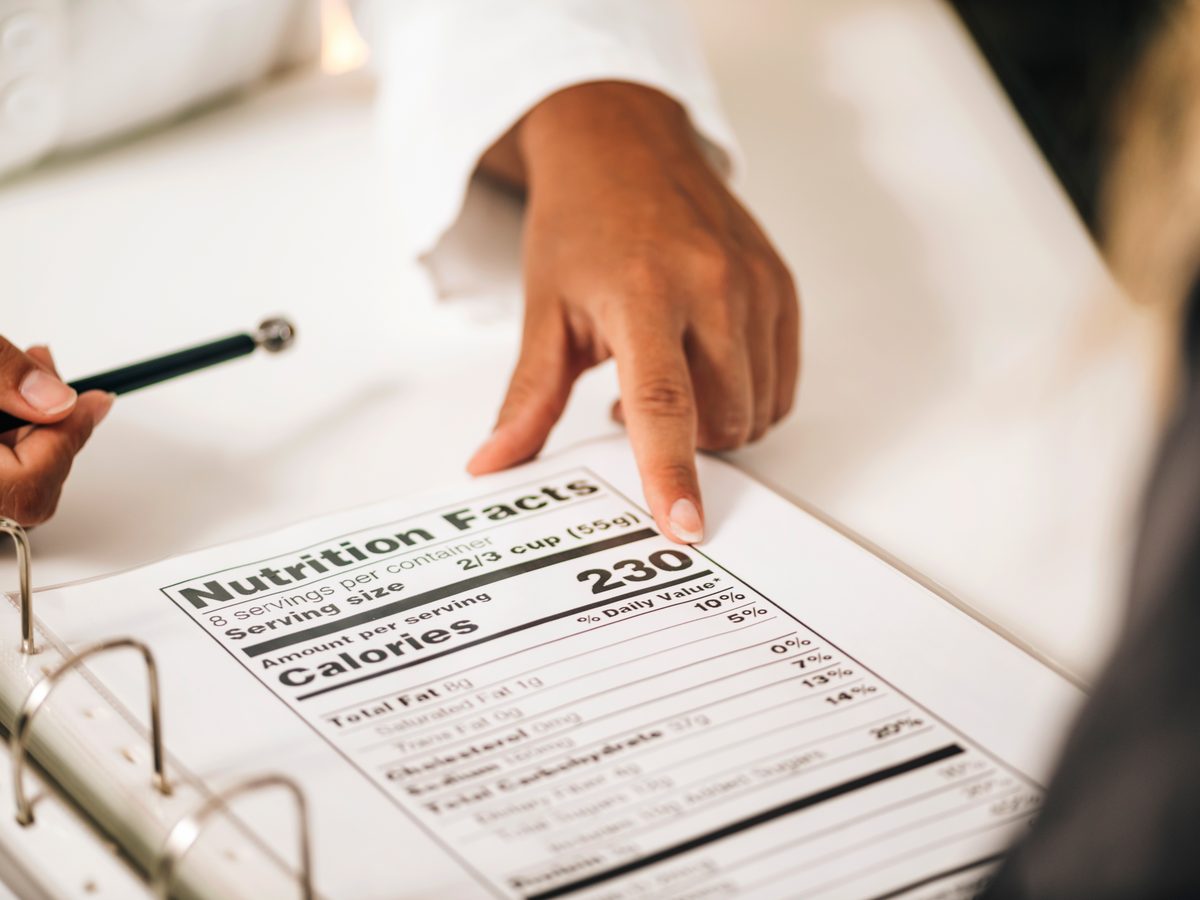
The %DV values are not new numbers. They are the %DVs already calculated and rounded for the Nutrition Facts panel under 21 CFR 101.9(c)(9) and (d)(7)(ii), for ages 4 and older; FDA said it does not address calculation or rounding in the proposal. If your panel is right, your box inputs are already right.
The Low, Med and High bands, in grams and milligrams
Proposed 101.6(a)(2)(iv) sets three bands, defined only in %DV: Low is 5% DV or less, Med is 6% to 19% DV, High is 20% DV or more. Those cut-offs are the 5/20 rule FDA already uses in consumer education.
Because the adult Daily Values are 20 g saturated fat, 2,300 mg sodium and 50 g added sugars, the bands translate into absolute amounts per serving. The regulation does not state these gram and milligram figures; they are arithmetic from the DVs, and they are the numbers formulators actually think in.
| Nutrient (adult DV) | Low (5% DV or less) | Med (6% to 19% DV) | High (20% DV or more) |
|---|---|---|---|
| Saturated Fat (20 g) | 1 g or less per serving | Above 1 g and below 4 g | 4 g or more per serving |
| Sodium (2,300 mg) | 115 mg or less per serving | Above 115 mg and below 460 mg | 460 mg or more per serving |
| Added Sugars (50 g) | 2.5 g or less per serving | Above 2.5 g and below 10 g | 10 g or more per serving |
Worked example: a 1/2 cup of pasta sauce with 1 g saturated fat, 480 mg sodium and 7 g added sugars computes to 5%, 21% and 14% DV, which reads Low, High, Med. Cutting sodium to 450 mg still gives 20% DV and still prints High; you need under 460 mg to reach 19% and print Med. That narrow step is the kind of reformulation decision the box would drive.
Format, type size and placement
Proposed 101.6(a)(3) is specific about how the box would look, and it is not the colour-coded traffic light used in front of pack labelling schemes in some other countries.
- Placement: the upper third of the principal display panel. FDA did not propose an exact spot within it.
- Type size: at least 8 point, and no smaller than the required net quantity of contents declaration under 21 CFR 101.7(h) and (i). A single, easy-to-read type style.
- Colour: all text and hairlines in black or one colour, on a white or other neutral contrasting background. FDA's testing found monochrome versions performed well, so the proposal is a black-and-white box.
- Rules and weights: a hairline outer box, a thick horizontal rule under the heading and subheadings, and hairline rules between nutrient rows.
- Emphasis: "Nutrition Info" extra-bold and centred; "% Daily Value" extra-bold and right-justified; nutrient names bold and left-justified; Low, Med and High extra-bold and right-justified; %DV numbers right-justified in their own column.
- FDA.gov banner: background in the same colour as the text, "FDA.gov" right-justified in bold or extra-bold in the same colour as the box background, so it reads as a reversed-out strip.
For most brands the practical problem is not the drawing. It is the upper third requirement, which competes with brand marks, flag callouts and net weight statements. That is where the redesign cost sits.
Scope, exemptions and the small-package version
The proposal would apply to all food covered by 21 CFR 101.9 marketed for people ages 4 and older. Foods marketed for infants and children under 4 would not be covered, though FDA asked for comment on future policy for ages 1 to 3. Most dietary supplements are outside it too, because they are labelled under 21 CFR 101.36 and exempt from 101.9 via 101.9(j)(6).
Proposed 101.6(c) would exempt any food already exempt from 101.9 under 101.9(j) unless stated otherwise, small packages with less than 12 square inches of total surface area available to bear labelling, packages marketed as gifts containing an assortment of foods, and unit containers inside a multiunit retail package where the units are exempt under 101.9(j)(15) and the outer package carries the box.
Several special cases matter to real product lines:
- Intermediate packages, 40 square inches or less of labelling area: a reduced box that drops the "Per serving" and "% Daily Value" subheadings and the numeric %DVs, showing only the interpretive words, with the abbreviations "Sat. Fat" and "Add. Sugar."
- Aggregate displays such as variety packs: one box per product, arranged in a horizontal or vertical line in the upper third, each with the food name right-justified above it.
- Dual-column per serving / per unit products: the box would reflect "per serving."
- As-packaged versus as-prepared: the box would reflect the product as packaged, and would have to carry a statement such as "Represents product as packaged" or "See Nutrition Facts for As Prepared information."
- Two population groups: the box would reflect ages 4 and older only.
- Bulk foods: the box would appear on bulk container labelling visible at point of purchase.
- State law: proposed 101.6(d) would preempt non-identical state front-of-package requirements, a quiet but consequential provision.
The proposed change to the "low sodium" claim
The same proposal amends the nutrient content claim rules, and this is the part most likely to catch a manufacturer out. FDA proposed tightening "low sodium" from 140 mg to 115 mg or less per RACC (115 mg or less per 50 g where the RACC is 30 g or less or 2 tablespoons or less), and 115 mg or less per 100 g for meals and main dishes. The rationale is alignment: 115 mg is 5% of the 2,300 mg DV, so the claim would match the "Low" band.
The binding definition today is still 140 mg under 21 CFR 101.61. Nothing has changed. If a product sits between 116 mg and 140 mg per RACC, it qualifies for "low sodium" now and would stop qualifying if this proposal were finalised as written. That is an identifiable exposure you can measure today from a formulation sheet, or by running the product through the claim validator against the current 140 mg definition.
"Low saturated fat" would keep its current thresholds, 1 g or less per RACC and not more than 15% of calories from saturated fat (1 g or less per 100 g and under 10% of calories for meals and main dishes). The change there is procedural: a food bearing "low saturated fat" would also have to display "Low" for saturated fat in the box, and a "low sodium" food would have to display "Low" for sodium. Claim and box would have to agree.
Proposed compliance timeline, cost, and what industry said
FDA proposed a compliance date of 3 years after the final rule's effective date for businesses with $10 million or more in annual food sales, and 4 years for smaller firms. Those clocks start only when and if a final rule is published. Nothing has started. Any article giving you a firm front-of-package deadline is inventing it; the deadlines that do exist are collected in FDA nutrition label changes.
FDA's primary estimate of annualised costs was $333 million, range $191 million to $530 million, over 10 years at a 2% discount rate in 2023 dollars. That figure drives most of the industry argument.
The two loudest industry positions pull in opposite directions. The Consumer Brands Association promoted its voluntary "Facts up Front" scheme instead, arguing a mandatory box is unnecessary. FMI asked FDA to add calories, cover more nutrients, drop or reconsider "Med," and allow placement in the bottom third. The SBA Office of Advocacy argued FDA understated the burden on small firms. Those disagreements are what make a re-proposal plausible rather than a straightforward finalisation.
For contrast, look north. Canada's front-of-package nutrition symbol is not a proposal; it is mandatory, with a real compliance date, covered in the Canada front-of-package deadline article. If you sell into both markets, one of those obligations is real today and the other is not.
What a manufacturer should actually do now
Nothing is mandatory. There is no box to add, no artwork to change, no deadline to hit. FDA has not authorised a voluntary format, so a home-made "Nutrition Info" box risks a misbranding problem rather than a head start.
What you can do costs almost nothing, because you already have the inputs. Every %DV the box would print is one you already declare. For each SKU write down saturated fat %DV, sodium %DV and added sugars %DV, then apply the bands: 5% or less is Low, 6% to 19% is Med, 20% or more is High. That is the whole calculation.
The result is a portfolio map: how many SKUs would print "High," which sit within a gram or 20 milligrams of a better band, and which "low sodium" claims are exposed to the proposed 115 mg threshold. None of that is wasted if the rule changes shape, because it is an inventory against the same 5/20 thresholds.
Frequently asked questions
Is the FDA front of package nutrition label required now?
No. The rule was proposed on 16 January 2025 and has not been finalised. No packaged food in the United States is required to carry a front-of-package nutrition box, and no compliance date exists, because the clocks would only start after a final rule takes effect.
Why is there no calorie count in the FDA nutrition info box?
FDA proposed a three-nutrient box covering saturated fat, sodium and added sugars only, and proposed 101.6(a)(4) would prohibit anything else inside it. Calories could still be declared elsewhere on the front panel under existing rules. FMI asked FDA to add calories; FDA has not said whether it will.
Could the new front of package food labels look different from the proposal?
Yes. In March 2026 FDA leadership said they "did not like the front-of-package plan that we inherited" and that "everything is on the table," including changes big enough to require re-proposing the rule for another comment round. Treat the heading, the three nutrients, the Low/Med/High wording and the upper-third placement as proposed design, not settled design.
Does the proposal change what counts as "low sodium"?
It would, if finalised. The proposal would lower the threshold from 140 mg to 115 mg or less per RACC so that the claim lines up with the 5% DV "Low" band. Until then the binding definition in 21 CFR 101.61 remains 140 mg per RACC, and a product at 130 mg per RACC may still be labelled "low sodium" today.
Are small packages exempt from the proposed box?
Packages with less than 12 square inches available to bear labelling would be exempt outright. Packages of 40 square inches or less could use a reduced box that omits the column subheadings and numeric %DVs, showing only Low, Med or High next to "Sat. Fat," "Sodium" and "Add. Sugar." Gift assortments and certain unit containers in multiunit retail packages would also be exempt.
While the front-of-package rule waits, the Nutrition Facts panel it would sit beside is binding and enforceable today. Build a compliant panel, with correct %DVs for saturated fat, sodium and added sugars, in the nutrition label generator, then check where each product falls against the proposed Low, Med and High bands with the %DV calculator.