How many calories are in canned sockeye salmon?
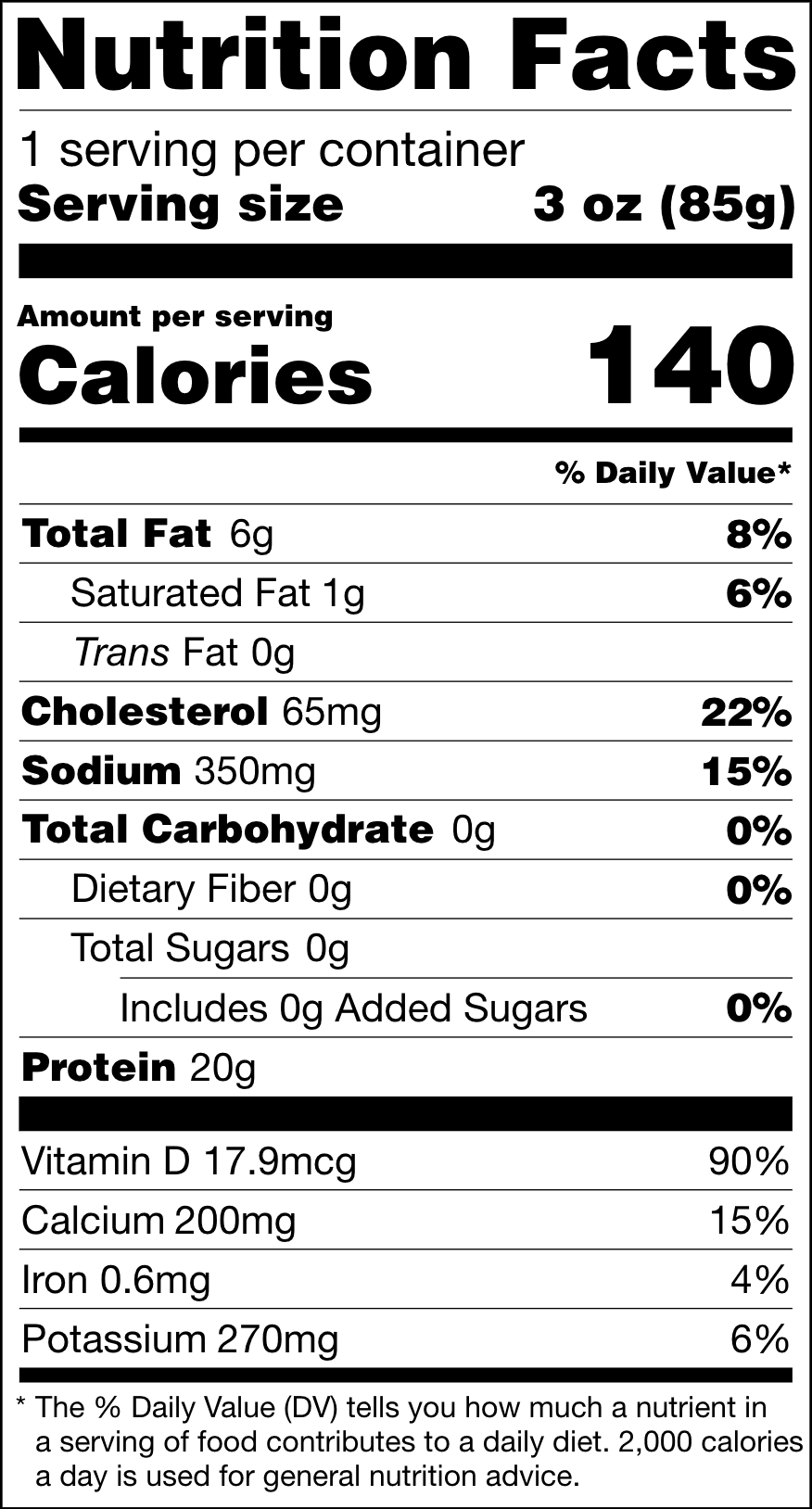
Canned sockeye salmon (3 oz, 85 g) has 142 calories. 100 g has 167 calories. On a Nutrition Facts label, calories are rounded to the nearest 5 or 10, so the panel above may show 140.
Canned sockeye salmon (3 oz, 85 g) has 142 calories, 20.1 g protein, 0 g carbohydrate and 6.3 g fat, according to USDA FoodData Central. 100 g has 167 calories. Change the serving below and the label, the summary and the full nutrient table update together.
This page covers canned sockeye salmon, a separate USDA record. For the main form, see sockeye salmon nutrition facts.
FDA standard format. Values use the FDA rounding rules for the serving you pick. Nutrients USDA does not report for this food print as 0 on the panel and as "not reported" in the table.
Download this label: · PNG Free to use as a reference. A label for a product you sell needs your full recipe and ingredient statement.
3 oz (85 g)
Opens the free label generator with this amount of canned sockeye salmon already added. Add the rest of your ingredients and the label updates as you go.
| Nutrient | Per serving | % DV* | Per 100 g |
|---|---|---|---|
| Calories and macronutrients | |||
| Calories | 142 | 167 | |
| Total fat | 6.3 g | 8% | 7.39 g |
| Saturated fat | 1.2 g | 6% | 1.44 g |
| Trans fat | <0.1 g | 0.04 g | |
| Monounsaturated fat | 2.1 g | 2.49 g | |
| Polyunsaturated fat | 1.5 g | 1.78 g | |
| Cholesterol | 67 mg | 22% | 79 mg |
| Sodium | 347 mg | 15% | 408 mg |
| Total carbohydrate | 0 g | 0% | 0 g |
| Dietary fiber | 0 g | 0% | 0 g |
| Total sugars | 0 g | 0 g | |
| Added sugars | 0 g | 0% | 0 g |
| Protein | 20.1 g | 23.6 g | |
| Vitamins | |||
| Vitamin D | 18 mcg | 90% | 21 mcg |
| Vitamin A | 47 mcg | 6% | 55 mcg |
| Vitamin C | 0 mg | 0% | 0 mg |
| Vitamin E | 1.8 mg | 10% | 2.07 mg |
| Vitamin K | 0.09 mcg | 0% | 0.1 mcg |
| Thiamin (B1) | <0.1 mg | 2% | 0.03 mg |
| Riboflavin (B2) | 0.18 mg | 15% | 0.21 mg |
| Niacin (B3) | 6.5 mg | 40% | 7.62 mg |
| Vitamin B6 | 0.1 mg | 6% | 0.12 mg |
| Folate (DFE) | 3.4 mcg | 0% | 4 mcg |
| Vitamin B12 | 4.7 mcg | 190% | 5.5 mcg |
| Choline | 70 mg | 15% | 82.6 mg |
| Minerals | |||
| Calcium | 197 mg | 15% | 232 mg |
| Iron | 0.55 mg | 4% | 0.65 mg |
| Potassium | 267 mg | 6% | 314 mg |
| Magnesium | 26 mg | 6% | 31 mg |
| Phosphorus | 287 mg | 25% | 338 mg |
| Zinc | 0.71 mg | 6% | 0.84 mg |
| Copper | 0.06 mg | 6% | 0.07 mg |
| Manganese | <0.1 mg | 0% | 0.03 mg |
| Selenium | 29 mcg | 50% | 34.3 mcg |
| Other | |||
| Water | 57.9 g | 68.1 g | |
| Caffeine | 0 mg | 0 mg | |
| Alcohol | 0 g | 0 g | |
* Percent Daily Values are based on a 2,000 calorie diet (FDA reference values for adults and children 4 years and older). Per-100 g values are USDA figures before label rounding.
Making a label for your own product? Use our free nutrition facts label generator.
Every serving below is a USDA household measure for this food, a fraction of one, or a unit conversion. Amounts are USDA values scaled by weight; only the Nutrition Facts panel applies the coarser FDA label rounding.
| Serving | Weight | Calories | Total carbohydrate | Protein | Total fat | Dietary fiber | Total sugars |
|---|---|---|---|---|---|---|---|
| 3 oz | 85 g | 142 | 0 g | 20.1 g | 6.3 g | 0 g | 0 g |
| 1 can | 337 g | 563 | 0 g | 79.5 g | 24.9 g | 0 g | 0 g |
| 100 g | 100 g | 167 | 0 g | 23.6 g | 7.4 g | 0 g | 0 g |
Canned sockeye salmon (3 oz, 85 g) has 142 calories. 100 g has 167 calories. On a Nutrition Facts label, calories are rounded to the nearest 5 or 10, so the panel above may show 140.
Canned sockeye salmon (3 oz, 85 g) has 4.7 mcg of vitamin B12, 190% of the Daily Value. 100 g has 5.5 mcg. At 20% DV or more per serving, that meets the FDA threshold for an "excellent source" claim.
Canned sockeye salmon (3 oz, 85 g) has 18 mcg of vitamin D, 90% of the Daily Value. 100 g has 21 mcg. At 20% DV or more per serving, that meets the FDA threshold for an "excellent source" claim.
100 g of canned sockeye salmon has 167 calories, 23.6 g protein, 0 g carbohydrate, 0 g fiber, 0 g sugars and 7.39 g fat.
About 0% of the calories in canned sockeye salmon come from carbohydrate, 41% from fat and 59% from protein (Atwater factors of 4, 9 and 4 calories per gram).
Per 100 g, compared with the other 202 fish in this database, canned sockeye salmon has more calories than 74% of them and more protein than 71%.
The same serving of canned sockeye salmon, drawn by the label formats other markets require: the Canadian bilingual Nutrition Facts table, the EU nutrition declaration (per 100 g, energy in kJ and kcal, salt instead of sodium) and the UK nutrition information table with reference intakes. The generator switches between these and many more from one recipe.
| Fat / Lipides | 6 g | 8 % |
| Saturated / Saturés | 1 g + Trans / trans 0 g | 6 % |
| Cholesterol / Cholestérol | 65 mg | 22 % |
| Sodium | 350 mg | 15 % |
| Carbohydrate / Glucides | 0 g | 0 % |
| Fibre / Fibres | 0 g | 0 % |
| Sugars / Sucres | 0 g | 0 % |
| Protein / Protéines | 20 g | |
| Vitamin D / Vitamine D | 18 mcg | 89 % |
| Calcium | 197 mg | 15 % |
| Iron / Fer | 1 mg | 3 % |
| Potassium | 250 mg | 8 % |
| Per 100g | |
|---|---|
| Energy | 699 kJ / 167 kcal |
| Fat | 7.4 g |
| of which saturates | 1.4 g |
| Carbohydrate | 0 g |
| of which sugars | 0 g |
| Protein | 24 g |
| Salt | 1.0 g |
| Per 100g | Per 85g | %RI* | |
|---|---|---|---|
| Energy | 699 kJ 167 kcal |
594 kJ 142 kcal |
7.1% |
| Fat | 7.4g | 6.3g | 9% |
| of which saturates | 1.4g | 1.2g | 6.1% |
| Carbohydrate | 0 gg | 0 gg | <1% |
| of which sugars | 0 gg | 0 gg | <1% |
| Fibre | 0 gg | 0 gg | - |
| Protein | 24g | 20g | 40% |
| Salt | 1.0g | 0.87g | 14% |
Different forms of the same food are separate USDA records, so each has its own page. Per 100 g:
| Form | Calories | Protein | Total fat | Total carbohydrate |
|---|---|---|---|---|
| Canned Sockeye SalmonFish, salmon, sockeye, canned, drained solids | 167 | 23.6 g | 7.39 g | 0 g |
| Sockeye SalmonFish, salmon, sockeye, cooked, dry heat | 156 | 26.5 g | 5.57 g | 0 g |
| Raw Sockeye SalmonFish, salmon, sockeye, raw | 131 | 22.3 g | 4.69 g | 0 g |
If you make and sell a product that contains canned sockeye salmon, these free tools cover the next steps.
Nutrient values are from USDA FoodData Central, SR Legacy (April 2018 release, public domain), record 173693: "Fish, salmon, sockeye, canned, drained solids". Values are stored per 100 g exactly as USDA reports them and scaled to each serving by weight. The Nutrition Facts panel applies the FDA rounding rules in 21 CFR 101.9; tables and text show the scaled amounts at reading precision, so a figure can differ slightly from the panel. A nutrient USDA does not report for this food is shown as not reported, never as a guessed value.
SR Legacy predates the added sugars field. This is a whole or unsweetened food, so added sugars are shown as 0 g. View the USDA record ↗
Or make a canned sockeye salmon nutrition label from values you already have