Labels for the products you distribute, import and private-label
Distributors end up responsible for labels they did not design: an imported product that needs a US panel, a private-label line made by a co-packer, a range relabeled for a new market. NutritionFactLabel builds them from the product's recipe or nutrient data.
Your name on the label means your responsibility
A packaged food has to name its manufacturer, packer or distributor under 21 CFR § 101.5. When the name on the label is yours but you did not make the food, it has to say so, with "Distributed by", "Manufactured for" or a similar phrase.
Once your name is on the front, buyers and regulators come to you about the label. The manufacturer may have done the formulation, but a missing allergen or a panel in the wrong format is a problem for the business named on the package.
| Per 100g | |
|---|---|
| Energy | 2092 kJ / 500 kcal |
| Fat | 25 g |
| of which saturates | 13 g |
| Carbohydrate | 64 g |
| of which sugars | 36 g |
| Protein | 7.1 g |
| Salt | 0.85 g |
| Fat / Lipides | 7 g | 9 % |
| Saturated / Saturés | 3.5 g + Trans / trans 0 g | 18 % |
| Cholesterol / Cholestérol | 10 mg | 3 % |
| Sodium | 95 mg | 4 % |
| Carbohydrate / Glucides | 18 g | 7 % |
| Fibre / Fibres | 1 g | 4 % |
| Sugars / Sucres | 10 g | 10 % |
| Protein / Protéines | 2 g | |
| Vitamin D / Vitamine D | 0 mcg | 0 % |
| Calcium | 10 mg | 1 % |
| Iron / Fer | 1 mg | 4 % |
| Potassium | 50 mg | 1 % |
*5 % ou moins c'est peu, 15 % ou plus c'est beaucoup
Imported products need labels for the market they are sold in
A product with a correct EU nutrition declaration still needs a US Nutrition Facts panel, US serving sizes and US allergen declarations before it can be sold in the United States, and the same is true in reverse. Converting a label is more than a translation: serving sizes come from the destination's rules, rounding differs, and some nutrients are mandatory in one market and absent in another.
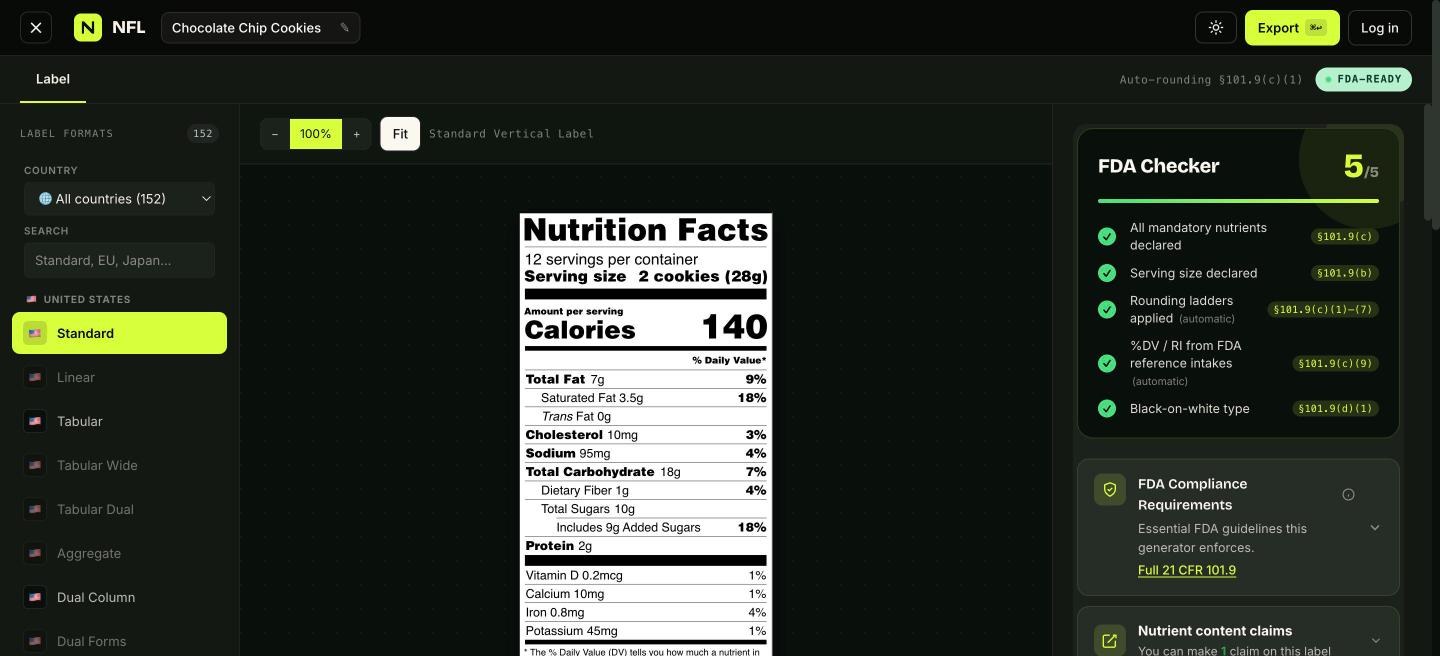
Enter the product's nutrient values or its recipe once, then render it in the format each market needs, from the US panel to Canada's bilingual table. NutritionFactLabel has formats for 114 countries, and the international labels page lists them.
Allergens are where imported labels fail most often
The US recognizes nine major allergens, including sesame since 1 January 2023, and requires the specific tree nut, fish or shellfish to be named. Other countries have different lists. An imported product whose label was correct at home can arrive missing a US declaration, and undeclared allergens are among the most common reasons for food recalls.
The generator detects the major allergens from the ingredient list, and the free allergen detector checks a supplier's ingredient list in seconds before you commit to a shipment.
Private label without the back-and-forth
For a private-label line, you or your co-packer can build each product's recipe in NutritionFactLabel, generate the panel and the ingredient statement, and export print-ready files. Every recipe exports as JSON, so the data can move between your team and the manufacturer, and several files can be downloaded together as a zip for a range launch. The co-packer page covers the manufacturer's side.
Lot records for what you hold in stock
If you repack or relabel, the inventory module records stock by supplier lot, traces a lot forward to the products it went into, and exports a recall report as a PDF. First-expired-first-out alerts flag stock before it goes out of date. It is not a warehouse or order management system: it does not take customer orders or map storage locations, and it works alongside the system you already use for those.