Labels for food made in one kitchen and sold somewhere else
A commissary cooks for many outlets, and a caterer cooks for many events. NutritionFactLabel turns one recipe library into the packaged labels, allergen sheets and nutrition numbers each of them needs.
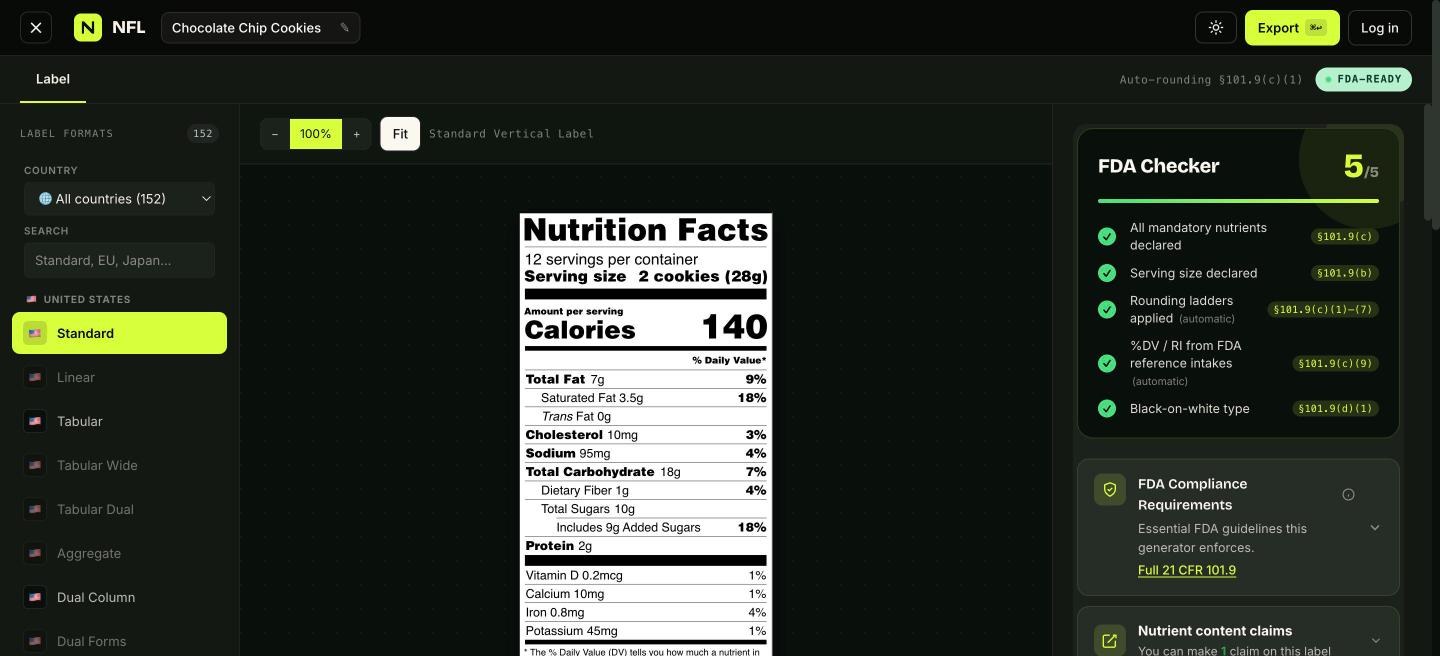
The retail exemption stops at your kitchen door
Here is the rule commissaries most often miss. A deli or bakery that makes ready-to-eat food on site and sells it in the same shop is exempt from Nutrition Facts under 21 CFR § 101.9(j)(3), but only if the food is not offered for sale outside that establishment.
Grab-and-go salads, sandwiches and desserts made in a central kitchen and delivered to cafés, kiosks or a second location do not meet that condition. Once packaged food leaves the kitchen that made it, it generally needs a full label: Nutrition Facts, an ingredient statement in descending order by weight, the major allergens and the name and place of business, unless another exemption such as the small business one in § 101.9(j)(18) applies.
One recipe library for every outlet and event
Build your base components once as sub-recipes, such as a vinaigrette, a braise or a cookie dough, then use them inside every dish that needs them. Change the dressing and every salad that uses it updates its nutrition, its ingredient statement and its allergens at the same time.
Set waste and cooking yield on the recipe, so the per-serving numbers reflect what is on the plate rather than what went into the pot. Paid plans add team seats, so the chef who changes a recipe and the person who prints the labels work from the same data.
Allergen information for food that has no package
The federal allergen labeling law applies to packaged food, so a buffet tray does not carry a "Contains:" statement. Event clients ask anyway, and many state and local food codes now expect written allergen information for unpackaged food. Check the version your health department enforces.
Because allergens are detected from each recipe's ingredients and carried up through every sub-recipe, you can give an event planner an accurate list per dish without rebuilding it from memory the night before. The same data feeds the packaged label when that dish goes into a grab-and-go case.
Nutrition numbers for contracts that ask for them
Corporate dining, schools, hospitals and wellness events often ask for calories and macros per serving in the bid. Nutrition is calculated from USDA FoodData Central for every recipe, per serving, so you can answer a request for proposal without sending every dish to a lab.
If your catering arm belongs to a restaurant chain with 20 or more locations, the menu labeling rule in 21 CFR § 101.11 may also apply to your standard menu items; the restaurant page covers it.
Production records for a central kitchen
A commissary that ships to several outlets needs to know which batch went where. The inventory module logs ingredients by supplier lot, records each production run with a batch-control log of scaled amounts and lots used, and traces a finished batch back to its ingredients or a suspect ingredient forward to every batch. A recall report exports as a PDF, and first-expired-first-out alerts flag stock before it goes out of date.
What it does not do is schedule your prep day or take orders from outlets; keep using your ordering system for that and let NutritionFactLabel handle recipes, labels and lots.
Cost per portion, at the size you actually serve
Enter ingredient prices once and the cost calculator gives the cost per batch and per serving, including the share of each sub-recipe. When a supplier raises the price of one ingredient, every dish that uses it shows the new cost, which is the number you need before you quote the next event.