Front-of-Package Label Requirements (Proposed FDA Rule)
What the proposed FDA Nutrition Info box would require product by product: scope, every exemption, the reduced box for small packs, and the claim changes that ride along.

FDA's front-of-package "Nutrition Info" box is a proposed rule, published in the Federal Register on 16 January 2025 at 90 FR 5426 under Docket No. FDA-2024-N-2910, and it has not been finalised. No packaged food in the United States has to carry a front-of-package box today, and no compliance clock is running. This article takes the proposed front of package nutrition label requirements as written and answers the operational question: which of your products would be caught, which packages would be exempt, and what would have to change on the artwork.
It is the manufacturer-facing companion to the front-of-package nutrition label guide, which covers what the box shows and where the rulemaking stands, and to the front-of-package sodium article. Read those for the design specification and the status history. Stay here for the product-by-product work.
Scope of the front of package nutrition requirements: which products would be caught
The scope line in proposed 21 CFR 101.6(a)(1) is short and does a lot of work. The box would apply to all food covered by 21 CFR 101.9, the Nutrition Facts regulation, that is marketed for people ages 4 and older. That is the whole test. There is no carve-out by category, no exclusion for foods that happen to score well, and no distinction between branded and private label. If a package carries a mandatory Nutrition Facts panel and is aimed at the general population, assume it would be in scope.
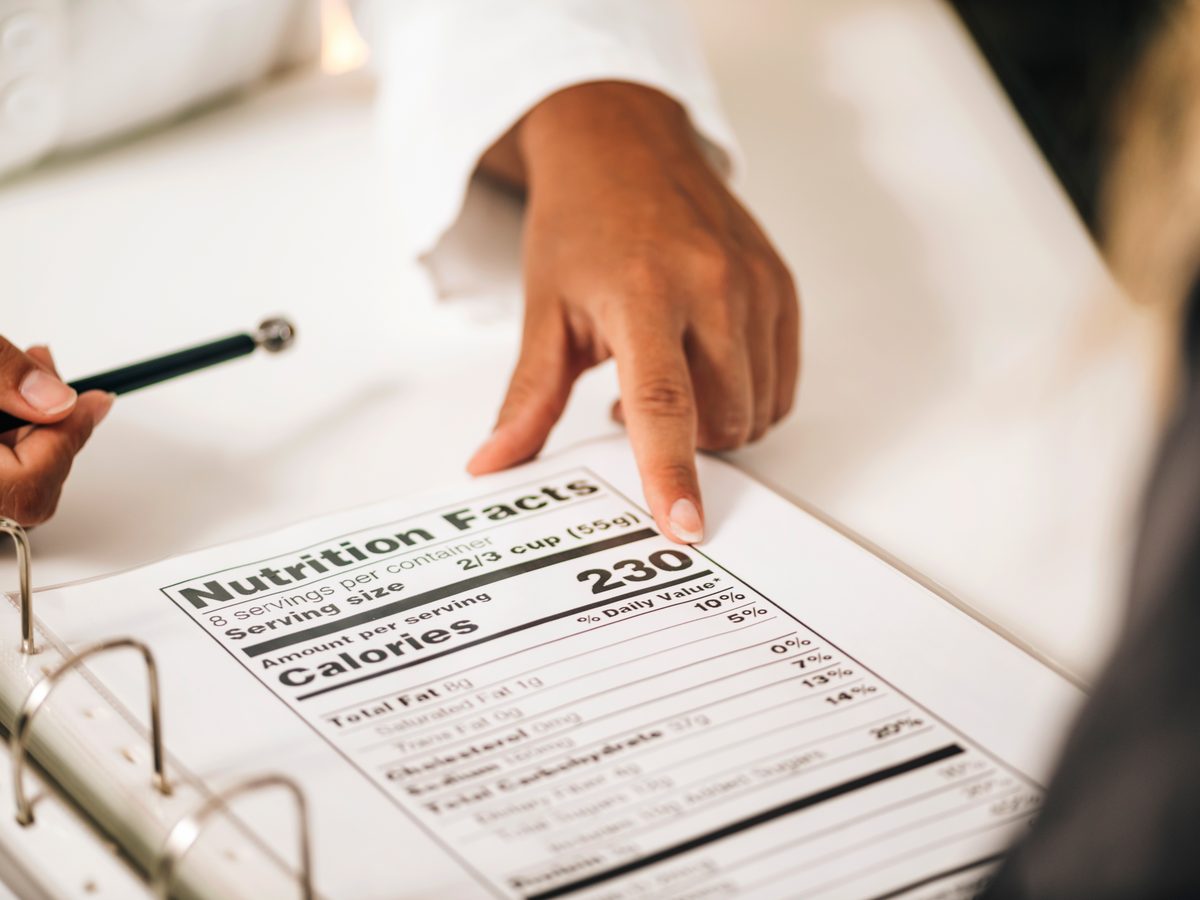
The box adds no new analysis. It republishes three numbers you already declare, so it is entirely derivative of the Nutrition Facts label requirements.
Two populations would sit outside the rule. Foods marketed for infants and children under 4 would not be covered. FDA asked for comment on extending policy to ages 1 to 3 in a future action, a signal rather than a requirement. Most dietary supplements would also be outside it, for a structural reason: supplements are labelled under 21 CFR 101.36 with a Supplement Facts panel and are exempt from 101.9 by way of 101.9(j)(6), so they never reach the scope line.
| Product | Box required? | Why |
|---|---|---|
| Retail snack, cereal, sauce, frozen entree | Yes | Covered by 101.9, marketed to ages 4 and older |
| Toddler pouch marketed for ages 1 to 3 | No | Outside the ages 4 and older scope line |
| Dietary supplement | No | Labelled under 101.36, exempt from 101.9 at (j)(6) |
| Bulk ingredient for further manufacturing | No | Exempt from 101.9 at (j)(9), so exempt at 101.6(c)(1) |
The exemption list in proposed 101.6(c)
Four exemptions, each for a different reason. The reasoning tells you how much you can lean on it.
1. Any food exempt from 101.9 under 101.9(j), unless otherwise stated. This is a pure derivation rule: the box reproduces %DV figures already calculated for the Nutrition Facts label, so a food with no mandatory panel has no figures to reproduce. That one line sweeps in restaurant and ready-to-eat foods prepared and sold on site under (j)(2) and (j)(3), foods with insignificant amounts of all mandatory nutrients under (j)(4) such as coffee beans, tea leaves and spices, medical foods, bulk food for further manufacturing, raw fruits, vegetables and fish under (j)(10), and the small business low-volume exemption at (j)(18) for firms with fewer than an average of 100 full-time equivalent employees selling fewer than 100,000 units. The trap is the familiar one: most 101.9(j) exemptions are void the moment you make a nutrient content claim. Lose the 101.9 exemption and you pick up the front-of-package obligation with it.
2. Small packages with less than 12 square inches of total surface area available to bear labeling. The reasoning is space. Twelve square inches is the same threshold that already exempts a package from mandatory Nutrition Facts under 101.9(j)(13), provided no claims are made and the label gives an address or phone number for nutrition information.
3. Packages marketed as gifts containing an assortment of foods. A gift basket has no single nutrition profile and no meaningful serving, so one box on the outer package would misstate everything inside. This is tied to the gift assortment framing, not a general licence for multi-item packs.
4. Unit containers inside a multiunit retail package, where the units are exempt under 101.9(j)(15) and the outer package bears the box. The reasoning is non-duplication. If the inner units are marked "This Unit Not Labeled For Retail Sale" and the outer carton carries full nutrition labeling, the carton carries the box and the sleeves do not. Confirm SKU by SKU, because plenty of inner units are sold individually and are not exempt at (j)(15) at all.
Small packages: 12 square inches and the 40 square inch reduced box
Two package-size rules in the proposed FDA Nutrition Info box requirements, frequently conflated. Under 12 square inches of available labeling area, the package would be exempt outright. At 40 square inches or less, the package would not be exempt but would be allowed a reduced box.
The reduced box drops both column subheadings, "Per serving" and "% Daily Value," and drops the numeric %DVs. What remains is the "Nutrition Info" heading, the three nutrients and the words Low, Med or High, with the names abbreviated to "Sat. Fat" and "Add. Sugar." Sodium is short enough to stay as is. On a small package the shopper would see the judgement without the arithmetic behind it.
| Element | Standard box | Reduced box (40 sq in or less) |
|---|---|---|
| "Nutrition Info" heading | Yes | Yes |
| "Per serving" with household measure | Yes | Omitted |
| "% Daily Value" subheading | Yes | Omitted |
| Numeric %DV column | Yes | Omitted |
| Nutrient names | Saturated Fat, Sodium, Added Sugars | Sat. Fat, Sodium, Add. Sugar |
| Low / Med / High | Yes | Yes |
The size test is available labeling area, not the footprint of the front panel. Either way the box would sit in the upper third of the principal display panel, in type of at least 8 point that is also no smaller than the net quantity of contents declaration required by 21 CFR 101.7(h) and (i). The PDP calculator will do the geometry for cylinders, boxes and pouches.
Package types that would need special handling
Variety packs and aggregate displays
Where a package holds several different foods and uses an aggregate Nutrition Facts display, the proposal would require one box per product rather than one averaged box. The boxes would run in a horizontal or vertical line in the upper third of the principal display panel, with the name of each food right-justified above its own box. A twelve-count pack of three flavours means three boxes across the top of the carton. This is the provision most likely to break existing artwork, because that row consumes the band of the panel that usually carries the brand block.
Dual column, per serving and per unit
Products carrying dual "per serving" and "per unit" Nutrition Facts would show a box reflecting the per serving column. There would be no second box for the per-unit figures.
As packaged versus as prepared
For products declared both as packaged and as prepared, a dry cake mix or a condensed soup, the box would reflect the as packaged figures and would have to carry a statement such as "Represents product as packaged" or "See Nutrition Facts for As Prepared information." It matters: a dry mix that scores Low as packaged can score very differently once the butter, oil or milk is in it, and the pointer statement is FDA's answer to the gap.
Two population groups, bulk foods, game meats
A product labelled for two population groups, for example one declared both for children 1 through 3 and for the general population, would carry a box reflecting ages 4 and older only. No second box for the younger group. For bulk foods the box would appear on the bulk container labeling so it is visible at the point of purchase. For game meats the box would be presented consistently with however that product's nutrition information is already presented, reflecting the flexible treatment game meats get under 101.9(j)(11) and (j)(12).
The claim changes riding along in the same proposal
The same document proposes amendments to the nutrient content claim rules at 21 CFR 101.61 and 101.62, and they are easy to miss because they sit behind the box.
"Low sodium" would tighten from 140 mg to 115 mg or less per reference amount customarily consumed, with 115 mg or less per 50 g where the RACC is 30 g or less or 2 tablespoons or less, and 115 mg or less per 100 g for meals and main dishes. The rationale is arithmetic: 115 mg is 5 percent of the 2,300 mg Daily Value, exactly the top of the proposed "Low" band. FDA does not want a product saying "low sodium" on the front while a box beside it calls the sodium "Med." A food bearing the claim would also have to display "Low" for sodium in the box.
"Low saturated fat" would keep its existing test, 1 g or less per RACC and not more than 15 percent of calories from saturated fat, but a food bearing the claim would likewise have to display "Low" for saturated fat in the box.
Plainly: the binding definitions today remain 140 mg for low sodium and 1 g plus 15 percent of calories for low saturated fat. Nothing about your current claims is out of compliance. But a product at 130 mg sodium per RACC carrying "low sodium" today would fail the proposed test, and that is worth knowing now rather than mid-sprint. Check eligibility against the rules in force with the claim validator.
| Claim | Binding today | Proposed |
|---|---|---|
| Low sodium, individual food | 140 mg or less per RACC (and per 50 g if the RACC is 30 g or 2 tbsp or less) | 115 mg on the same two tests, plus "Low" shown for sodium in the box |
| Low sodium, meals and main dishes | 140 mg or less per 100 g | 115 mg or less per 100 g |
| Low saturated fat | 1 g or less per RACC and 15 percent or less of calories | Unchanged, plus "Low" shown for saturated fat in the box |
| Very low sodium | 35 mg or less per RACC | Not changed by this proposal |
Preemption and the proposed compliance timeline
Proposed 101.6(d) would preempt state and local front-of-package requirements that are not identical to the federal rule. For a national brand that is valuable, since one federal box is cheaper to run than a patchwork. It is also the part with no present effect, because preemption exists only once a final rule does.
The proposal sets two compliance dates, both measured from the effective date of a final rule: 3 years for businesses with 10 million dollars or more in annual food sales, and 4 years for businesses with less than 10 million dollars. That is the whole schedule. Both clocks start only if and when a final rule publishes. Comments closed on 15 July 2025 and no final rule has appeared, so the earliest possible compliance date is at least three years after a publication date nobody can name. Anyone selling you a front-of-package deadline is selling you a projection. The dates that are real sit on the back of pack, and the FDA nutrition label changes timeline lists them.
How to audit your portfolio against the front of package nutrition label requirements now
The useful work is not artwork, it is a spreadsheet, and you can build it from data you already own. The proposal uses the %DV values you already calculate and round for the Nutrition Facts panel, and FDA said it does not address calculation or rounding, so no new analysis is needed. Pull three columns for every SKU: saturated fat %DV, sodium %DV and added sugars %DV as declared. Then sort each into the three bands.
| Band | %DV | Saturated fat | Sodium | Added sugars |
|---|---|---|---|---|
| Low | 5 percent or less | 1 g or less | 115 mg or less | 2.5 g or less |
| Med | 6 to 19 percent | above 1 g, under 4 g | above 115 mg, under 460 mg | above 2.5 g, under 10 g |
| High | 20 percent or more | 4 g or more | 460 mg or more | 10 g or more |
The gram and milligram figures are derived from the adult Daily Values of 20 g saturated fat, 2,300 mg sodium and 50 g added sugars. The proposal defines the bands only in %DV, so treat the absolute numbers as a sense check rather than the legal test. The Daily Value calculator will give you percentages if you hold grams but not %DVs.
Then answer four questions. Which SKUs would carry at least one "High"? Which sit a point or two from a band edge, where a small reformulation or a serving size correction would move them? Which carry "low sodium" between 115 mg and 140 mg per RACC and would lose the claim? And for every SKU needing a box, does the upper third of the principal display panel have room at 8 point or larger without covering the brand mark, the net quantity statement or a vignette? For variety packs, ask that with two or three boxes in the row. The output is useful whether or not a rule ever finalises.
Frequently asked questions
Do I have to put a Nutrition Info box on my product now?
No. The rule is proposed, not final. It was published 16 January 2025, comments closed 15 July 2025, and no final rule has been published. Nothing requires a front-of-package nutrition box on packaged food in the United States.
My product carries "low sodium" at 130 mg per RACC. Is it non-compliant?
No. The binding definition is still 140 mg or less per RACC under 21 CFR 101.61, and 130 mg meets it. The 115 mg figure is proposed only. Flag the SKU, because if the proposal finalises in this form the claim would fail and you would need a reformulation or a claim change inside the compliance window.
Would a package under 12 square inches ever need the box?
Under the proposal as written, packages with less than 12 square inches of total surface area available to bear labeling would be exempt. Watch the underlying position though: the parallel 101.9(j)(13) exemption is conditional on making no nutrient content claims and giving an address or phone number for nutrition information, and losing the 101.9 exemption would pull in the front-of-package obligation under 101.6(c)(1).
How would a variety pack with three flavours be labelled?
Each product would get its own box, arranged in a horizontal or vertical line in the upper third of the principal display panel with the food name right-justified above each box. Three flavours means three boxes.
Which figures apply to a dry mix prepared with other ingredients?
The as-packaged figures, plus a statement such as "Represents product as packaged" or "See Nutrition Facts for As Prepared information" pointing the shopper to the full panel for the prepared version.
Whatever happens to the proposal, the three numbers it would publish are numbers you have to get right on the back of pack today. Build the panel with the label generator and keep your saturated fat, sodium and added sugars %DVs in a form you can sort, so a portfolio audit is a filter rather than a project.