FDA Healthy Claim Saturated Fat Limits
1 g for most categories, 2 g for dairy, eggs and game meat, and a separate 20 percent of total fat test for oils. Plus the inherent-fat exclusion that lets salmon qualify.
The FDA healthy claim saturated fat limit is the most nuanced of the three nutrient limits in the updated definition of "healthy," and it is the one people most often get wrong. There is no single number. Most individual food categories are held to 5% of the Daily Value, which is 1 g; several are held to 10% DV, or 2 g; the oil categories use a different test based on a percentage of total fat; and saturated fat inherent in seafood, nuts, seeds and soybeans is excluded from the calculation altogether. This article works through all four mechanics.
It is written for a manufacturer who has to decide whether a real formula clears the criterion. The food group equivalent minimums and the rest of the definition are covered in the full requirements article, and the products that skip the nutrient tests entirely are covered in step 2 of the step-by-step qualification article.
Two ceilings, and a third test that is not a ceiling at all
The rule is final. It was published at 89 FR 106064 on 27 December 2024, amending 21 CFR 101.65(d), with the effective date moved from 25 February 2025 to 28 April 2025 under the 2025 regulatory freeze. The compliance date is 25 February 2028 and did not move. The claim is voluntary: you never have to say "healthy," but if you use the word in a nutritional context the food must meet 101.65(d) by that date.
Within that rule, saturated fat is handled three different ways depending on the category:
- 5% DV, currently 1 g, for vegetable, fruit, grain, seafood, bean/pea/lentil and nut/seed/soy products.
- 10% DV, currently 2 g, for dairy products, game meats and eggs.
- 20 percent of total fat, with no gram ceiling at all, for 100% oils, oil-based spreads and oil-based dressings.
The gram figures come from the saturated fat Daily Reference Value of 20 g in 21 CFR 101.9(c)(9). The regulation states the limits as percentages, so the gram equivalents would move if the Daily Value moved. No change has been proposed.
The FDA healthy claim saturated fat limit, category by category
Individual foods are tested per reference amount, or per 50 g where the RACC is 50 g or less or 3 tablespoons or less. Mixed products are tested per RACC; main dishes and meals per labeled serving.
| Category under 101.65(d) | Saturated fat limit | Inherent fat excluded? |
|---|---|---|
| Vegetable product | 5% DV (1 g) | No |
| Fruit product | 5% DV (1 g) | No |
| Grain product | 5% DV (1 g) | No |
| Dairy product | 10% DV (2 g) | No |
| Game meats | 10% DV (2 g) | No |
| Egg | 10% DV (2 g) | No |
| Seafood | 5% DV (1 g) | Yes, inherent in seafood |
| Beans, peas, lentils | 5% DV (1 g) | No |
| Nuts, seeds, soy products | 5% DV (1 g) | Yes, inherent in nuts, seeds, soybeans |
| 100% oil | 20% of total fat | Not applicable |
| Oil-based spread | 20% of total fat | Not applicable |
| Oil-based dressing | 20% of total fat | Not applicable |
| Mixed product | 10% DV (2 g) | Yes, seafood, nuts, seeds, soy |
| Main dish | 15% DV (3 g) | Yes, seafood, nuts, seeds, soy |
| Meal product | 20% DV (4 g) | Yes, seafood, nuts, seeds, soy |
Dairy, game meats and eggs get double the allowance of the plant and seafood categories, because their saturated fat is not separable from the food group the rule is trying to encourage. The exclusion column, not the limit column, is where most of the commercial impact sits.
The inherent saturated fat exclusion, and why it changed the shelf
For seafood the criterion reads 5% DV (1 g), excluding saturated fat inherent in seafood. For nuts, seeds and soy products it reads 5% DV (1 g), excluding saturated fat inherent in nuts, seeds and soybeans. The same inherent fat exclusion carries through the mixed product, main dish and meal tiers.
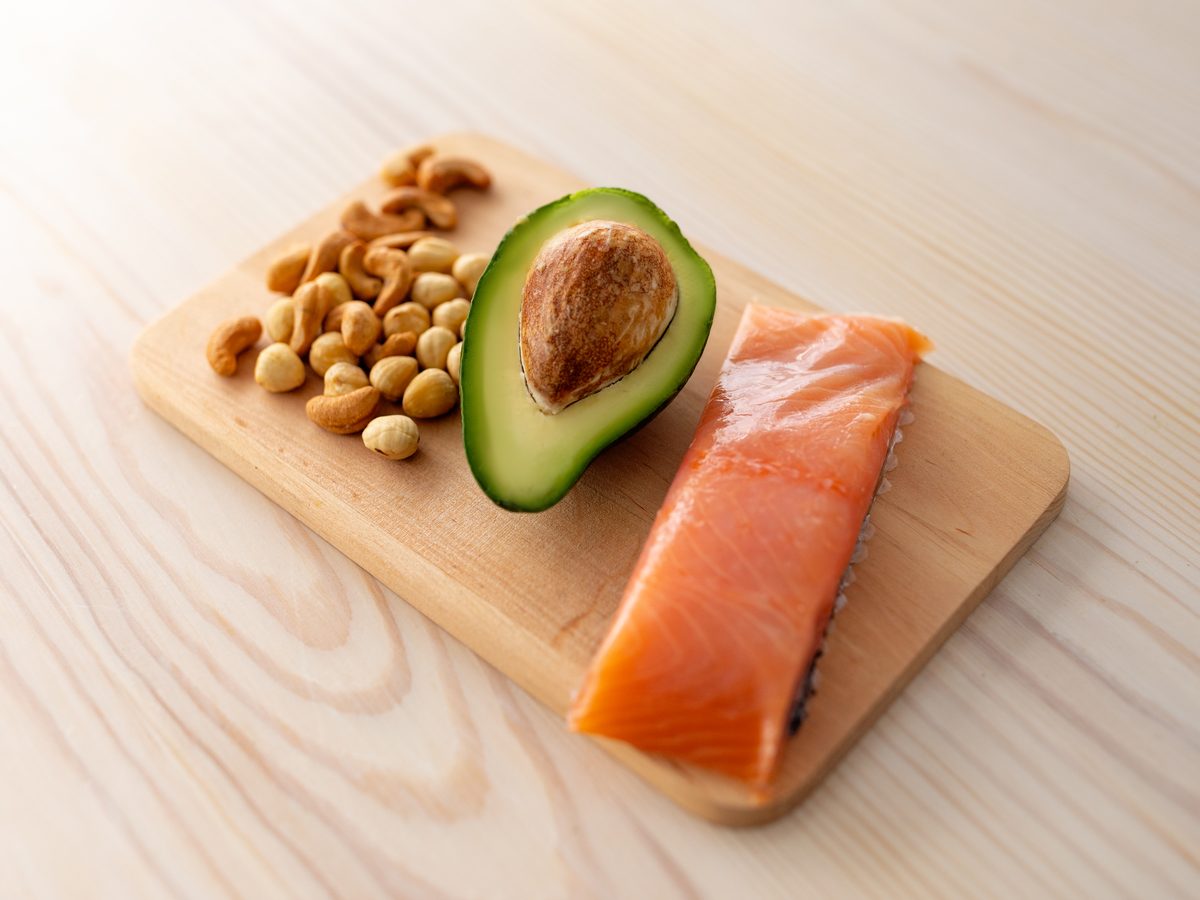
Read that literally, because the literal reading is the point. Saturated fat that comes with the fish, the nut, the seed or the soybean does not count against the limit. What counts is saturated fat from anywhere else: an added oil, butter, cream, a coating, a sauce, a fried batter. Canned salmon packed in water has essentially no countable saturated fat however fatty the fish, and a jar of nothing but almonds has none either. Add palm oil to the roast, or coat the nuts in confectionery, and the added fraction counts in full.
This is the most commercially significant sentence in the rule. Under the 1994 definition, "healthy" had a flat saturated fat cap with no carve-out, so fatty fish and most nuts were shut out of the claim for being high in fat. FDA's list of foods that newly qualify reflects the change directly: water, avocados, nuts and seeds, higher-fat fish such as salmon, olive oil, certain peanut butters and certain canned fruits and vegetables. Categories consumers were already told to eat more of became eligible for the word on the front of the pack.
Three practical consequences follow.
- You need to be able to split total saturated fat into inherent and added fractions, and to defend the split. A database analysis of the raw commodity plus a fat balance across your formula is the usual route.
- The exclusion is limited to those specific commodities. There is no equivalent carve-out for dairy fat, meat fat, coconut, palm or cocoa butter. If your nut butter contains added palm oil for stabilization, that palm fraction is fully countable against 1 g.
- An automatic qualifier is simpler still. Under 101.65(d)(3)(i), a food made only of one or more of vegetables, fruit, whole grains, fat-free or low-fat dairy, or lean meat, seafood, eggs, beans, peas, lentils, nuts or seeds, with nothing added but water, qualifies with no nutrient testing at all. Plain roasted unsalted almonds and water-packed salmon land here. The moment you add oil or salt, you are back in the table.
Oils, spreads and dressings: 20 percent of total fat
The three oil categories have no gram ceiling. Their test is that saturated fat may not exceed 20 percent of total fat. That is a ratio, so the answer depends on the fat itself rather than the serving size, which is why an oil passes or fails at every reference amount alike.
Work an example. An oil declaring 14 g of total fat per reference amount has a saturated fat ceiling of 20 percent of 14 g, which is 2.8 g. A high-oleic or olive-type oil generally sits under that. A coconut or palm kernel oil does not come close, because its saturated fraction is a majority of its total fat, and no serving size arithmetic can rescue it. For an oil-based dressing declaring 12 g total fat per reference amount, the ceiling is 2.4 g.
The category definitions matter as much as the ratio. A 100% oil is also held to 0% DV for sodium and 0% DV for added sugars. An oil-based spread must derive its fats solely from oil and gets 10% DV sodium, or 230 mg. An oil-based dressing must be at least 30 percent oil, its oils must themselves meet the oil criteria, and it gets 10% DV sodium and 2% DV added sugars, or 1 g. Miss the composition definition and you are not in the oil pathway at all.
Worked examples of passing and failing on saturated fat
The figures below are illustrative formulation values chosen to show the arithmetic, not published data on any real branded product. Run your own analysis before relying on any of it.
| Example | Limit | Saturated fat, total and countable | Result |
|---|---|---|---|
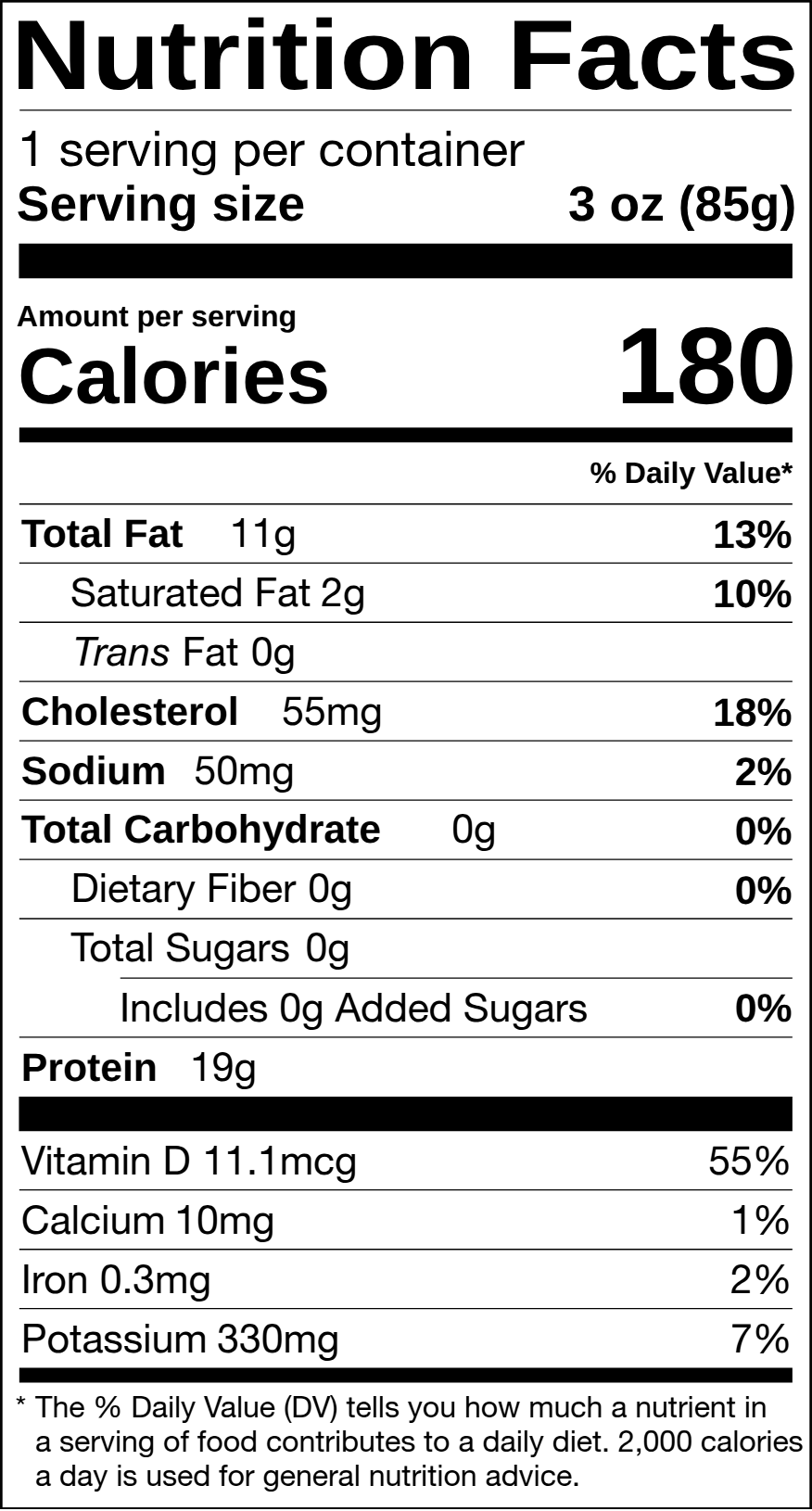
| Canned salmon in water | Seafood, 1 g | 1.5 g total, all inherent, 0 g countable | Passes |
| Salmon in a cream sauce | Mixed or main dish | 4.5 g total, 3 g from cream and countable | Fails as a mixed product at 2 g |
| Almonds, nothing added | Nuts, 1 g | All inherent, 0 g countable | Passes, and is an automatic qualifier |
| Peanut butter with added palm oil | Nuts, 1 g | 3.4 g total, 1.4 g from palm and countable | Fails on the added fraction alone |
| Olive-type 100% oil | 20% of total fat | 2.0 g against a 2.8 g ceiling | Passes |
| Coconut oil | 20% of total fat | Saturated fraction is the majority of total fat | Fails at any serving size |
| Low-fat plain yogurt | Dairy, 2 g | 1.0 g countable | Passes on this criterion |
| Whole-milk yogurt | Dairy, 2 g | 4.5 g countable, no exclusion available | Fails |
| Whole grain bread with butter in the dough | Grain, 1 g | 1.5 g countable per 50 g | Fails; passes if the butter becomes a liquid oil |
FDA's consumer page says 2 g. The CFR tables say 1 g for most categories.
This one is worth stating bluntly, because it has already caused confusion. FDA's consumer-facing page on the use of the term "healthy" summarizes the criteria for individual foods as 2.5 g added sugars, 230 mg sodium and 2 g saturated fat. The tables in 21 CFR 101.65(d) do not say that. They set saturated fat at 5% DV, which is 1 g, for vegetable, fruit, grain, seafood, bean, pea, lentil and nut, seed and soy products, and 10% DV, which is 2 g, only for dairy, game meats and eggs. The consumer page also gives 2.5 g for added sugars, which is the dairy figure, while most individual categories are held to 2% DV, or 1 g.
The consumer page is a plain-language summary, not the regulation. Build a portfolio assessment on the 2 g number and roughly half your categories get assessed against a limit twice as generous as the one that applies, which you then discover during an inspection rather than during development. Where a summary and the codified text disagree, the codified text governs.
What the 1994 rule capped, and what is now gone
The 1994 definition (59 FR 24232, 10 May 1994) was nutrient-centric. It capped total fat, saturated fat, cholesterol and sodium, and required at least 10% DV of one "nutrient to encourage": vitamin A, vitamin C, calcium, iron, protein or dietary fiber. Different criteria applied to seafood, game meat and raw produce.
The 2024 rule dropped the total fat limit and the cholesterol limit entirely. Neither appears anywhere in 101.65(d). It replaced the nutrient minimums with food group equivalent minimums, kept and restructured the saturated fat limit, cut the sodium limit roughly in half, and added an added sugars limit that did not exist before.
Dropping total fat is what makes the inherent-fat exclusion coherent. A food can now be high in fat and still be "healthy," provided the fat is the kind the Dietary Guidelines encourage and the food carries a genuine food group equivalent. That is why avocados, nuts and olive oil moved from excluded to eligible in one rulemaking. It also means the saturated fat criterion is now doing all of the work that three separate fat criteria used to do, which is why it carries so much category-specific detail.
Reformulation levers that move saturated fat
Saturated fat is less forgiving than sodium because it is structural. You usually cannot shave a fraction off; you have to change the fat.
- Replace hard fats with liquid oils. Swapping butter, palm, palm kernel or coconut for a high-oleic liquid oil is the largest single move. It changes texture, so expect work on crumb, snap, plasticity and shelf life rather than a straight substitution.
- Move the fat into the excluded fraction. If your product is in the seafood or nut, seed and soy category, replacing an added fat with more of the commodity itself moves saturated fat out of the countable column entirely. A nut butter stabilized without palm oil is the clearest case.
- Cut the dairy fat rather than the dairy. Dairy products get 2 g, which is workable for low-fat and fat-free bases and impossible for full-fat ones. Note also that the automatic qualifier route only recognizes fat-free and low-fat dairy.
- Watch coatings, inclusions and fried components. Chocolate coatings bring cocoa butter, confectionery coatings bring lauric fats, and fried components bring whatever they were fried in. In a 1 g category these single components frequently decide the outcome on their own.
- Check the category before reformulating. A product that fails as an individual food at 1 g may pass as a mixed product at 2 g, but only if it genuinely delivers one total food group equivalent with at least a quarter equivalent from each of two food groups. Change the composition to earn the tier, not the label copy.
To check a specific formula against the right category limit, including the inherent-fat exclusion and the oil ratio test, run it through our claim validator, then build the finished panel in our nutrition label generator.
Frequently asked questions
Does the exclusion apply to all fish, or only oily fish?
The text excludes saturated fat inherent in seafood, without distinguishing between species or fat levels. That is what allows higher-fat fish such as salmon to qualify, which FDA cites as an example of a food that newly qualifies under the updated definition. The exclusion is about the source of the fat, not the amount.
If a product is already labeled "low saturated fat," does it pass?
Not automatically, and the two tests are different. The binding definition of "low saturated fat" is 1 g or less per reference amount and not more than 15 percent of calories from saturated fat, with meals and main dishes at 1 g or less per 100 g and less than 10 percent of calories. A product meeting that will clear the 1 g "healthy" ceiling in the plant categories, but it still has to meet the food group minimum and the sodium and added sugars limits. The January 2025 front-of-package proposal would keep the 1 g and 15 percent definition and additionally require a food bearing the claim to display "Low" for saturated fat in the proposed box. That proposal has not been finalized.
How does label rounding interact with a 1 g limit?
Saturated fat is declared under 101.9(c) as 0 below 0.5 g, to the nearest 0.5 g below 5 g, and to the nearest 1 g at 5 g and above. A formula at 1.2 g countable saturated fat declares 1 g on the panel but is above the criterion in fact. Treat 1 g as a formulation target supported by analytical data, not as a rounding outcome.
What do I need to keep on file?
Under 101.65(d)(4) you must keep written records verifying food group equivalent content, including recipes, formulations, database analyses and batch records, for at least two years after the food enters interstate commerce, unless the equivalent is evident from the label or the food is an automatic qualifier. If you rely on the inherent-fat exclusion, keep the analysis that separates inherent from added saturated fat in the same file, because that split is the whole basis of your compliance position. FDA's general food labeling compliance program, revised June 2025, instructs investigators on these criteria.