Whole Milk Nutrition Facts Label: Calories & Sat Fat
The FDA Nutrition Facts label for whole milk, drawn for 1 cup: 149 calories, 7.8 g protein, 8.1 g fat, 11.7 g carbs, with %DV. Plus Canada, EU and UK versions and a PNG download.
Whole Milk Nutrition Facts label (FDA standard format)
This is the Nutrition Facts label for whole milk as the FDA specifies it: one serving of 1 cup (244 g), every value rounded exactly as 21 CFR 101.9 requires, the same rounding a compliance reviewer checks. Nutrient data is USDA FoodData Central (SR Legacy, FDC ID 171265: Milk, whole, 3.25% milkfat, with added vitamin D).
Making a product that contains whole milk? The free label generator builds this panel from your full recipe - every ingredient, correct serving size, ingredient statement and allergens included.
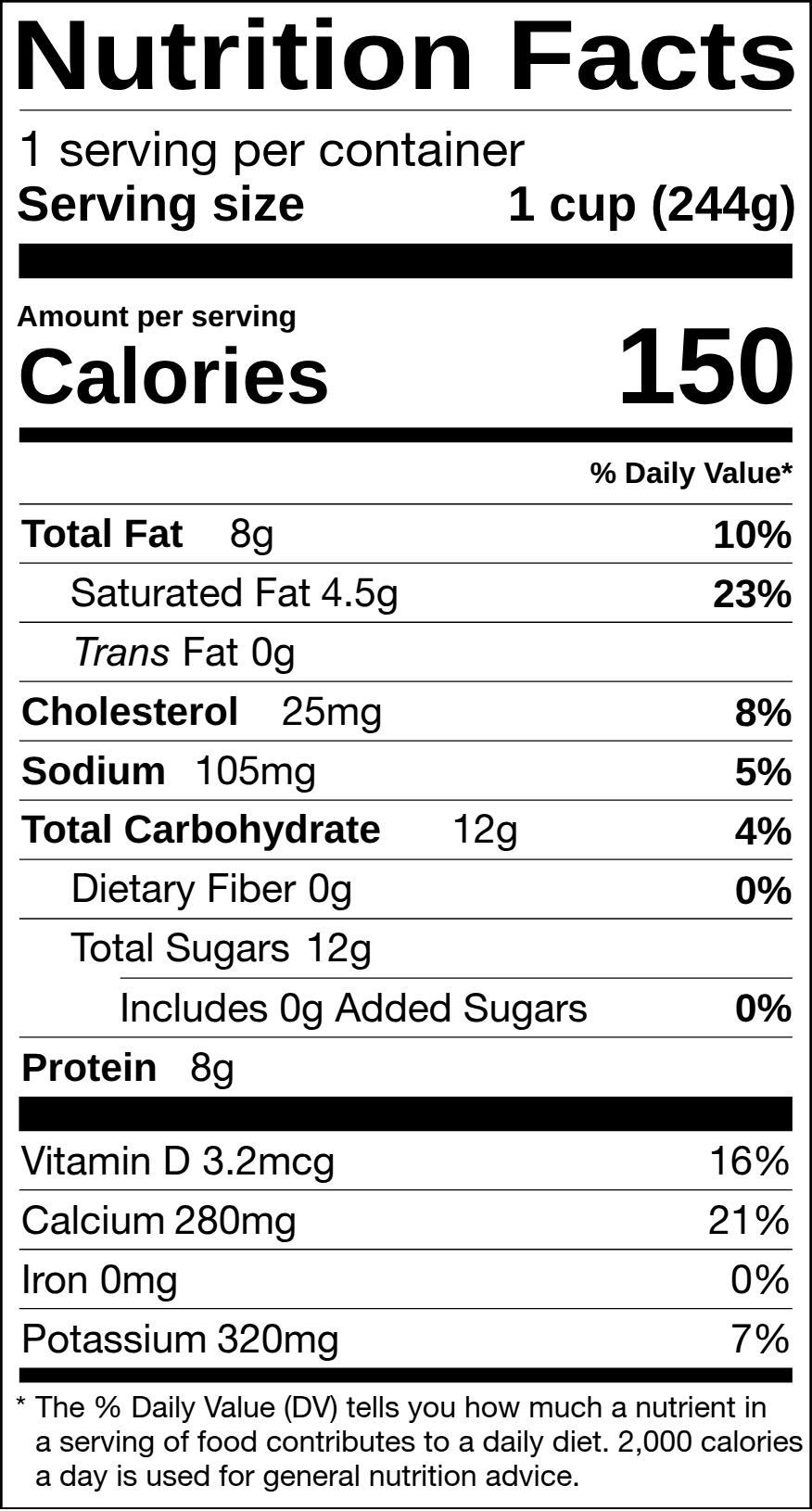
Free to use as a reference for a product made with whole milk. A label for sale needs your full recipe, serving size and ingredient statement, which the generator builds.
Whole Milk nutrition label for Canada, the EU and the UK
The same 1 cup of whole milk, drawn by the site's Canadian, EU and UK renderers. Canada keeps a per-serving panel in English and French with its own Daily Values and folds trans fat into the saturated-fat row. The EU declaration is per 100 g only, states energy in kJ and kcal, and declares salt (sodium × 2.5) rather than sodium. The UK table is the EU layout as retained by the Food Information Regulations 2014, with the optional per-serving column and %RI. One recipe in the generator renders all of them from the same numbers.
| Fat / Lipides | 8 g | 11 % |
| Saturated / Saturés | 4.6 g + Trans 0 g | 23 % |
| Cholesterol / Cholestérol | 24 mg | 8 % |
| Sodium | 105 mg | 5 % |
| Carbohydrate / Glucides | 12 g | 4 % |
| Fibre / Fibres | 0 g | 0 % |
| Sugars / Sucres | 12 g | 12 % |
| Protein / Protéines | 8 g | |
| Vitamin D / Vitamine D | 3 mcg | 16 % |
| Calcium | 276 mg | 21 % |
| Iron / Fer | 0 mg | 0 % |
| Potassium | 322 mg | 9 % |
*5 % ou moins c'est peu, 15 % ou plus c'est beaucoup
| Per 100g | |
|---|---|
| Energy | 255 kJ / 61 kcal |
| Fat | 3.3 g |
| of which saturates | 1.9 g |
| Carbohydrate | 4.8 g |
| of which sugars | 5.1 g |
| Protein | 3.2 g |
| Salt | 0.1 g |
| Per 100g | Per 244g | %RI* | |
|---|---|---|---|
| Energy | 255 kJ 61 kcal |
623 kJ 149 kcal |
7.5% |
| Fat | 3.3g | 8.1g | 12% |
| of which saturates | 1.9g | 4.6g | 23% |
| Carbohydrate | 4.8g | 12g | 4.5% |
| of which sugars | 5.1g | 12g | 14% |
| Fibre | 0 gg | 0 gg | - |
| Protein | 3.2g | 7.8g | 16% |
| Salt | 0.11g | 0.26g | 4.4% |
What stands out in whole milk
Measured against the FDA's nutrient-content claim thresholds (21 CFR 101.54), whole milk is notable for:
- Saturated Fat - 4.5g per 1 cup - 23% DV, at or above the 20% the FDA treats as high.
- Calcium - 280mg per 1 cup - 21% DV, enough to qualify as an excellent source (20% DV or more).
- Protein - 8g per 1 cup - 16% DV, enough to qualify as a good source (10–19% DV).
- Vitamin D - 3.2mcg per 1 cup - 16% DV, enough to qualify as a good source (10–19% DV).
These are the thresholds that decide whether a package may carry a claim like “good source of fiber”. The label generator applies the same rules to your own recipe.
Whole Milk nutrition facts per serving and per 100 g
| Nutrient | Per 1 cup | % DV* | Per 100 g |
|---|---|---|---|
| Calories | 150 | – | 61 |
| Total Fat | 8g | 10% | 3.3g |
| Saturated Fat | 4.5g | 23% | 1.9g |
| Trans Fat | 0g | – | – |
| Cholesterol | 25mg | 8% | 10mg |
| Sodium | 105mg | 5% | 43mg |
| Total Carbohydrate | 12g | 4% | 4.8g |
| Dietary Fiber | 0g | 0% | 0g |
| Total Sugars | 12g | – | 5.1g |
| Added Sugars | 0g | 0% | 0g |
| Protein | 8g | – | 3.2g |
| Vitamin D | 3.2mcg | 16% | 1.3mcg |
| Calcium | 280mg | 21% | 113mg |
| Iron | 0mg | 0% | 0mg |
| Potassium | 320mg | 7% | 132mg |
* Percent Daily Values are based on a 2,000-calorie diet (FDA adult reference values). Per-serving values use the FDA's label rounding rules; per-100 g values are the unrounded USDA amounts.
Macronutrient breakdown
By calories, whole milk is 48% fat, 31% carbohydrate and 21% protein (Atwater 9/4/4 factors, per 1 cup). Of the 11.7 g of carbohydrate, 12.4 g is sugars.
Compare it against other foods with the free food comparison tool, or analyze a whole recipe with the recipe nutrition calculator.
Whole Milk nutrition FAQ
How many calories are in whole milk?
How much saturated fat is in whole milk?
How much calcium is in whole milk?
What is the serving size for whole milk?
Is there a Canadian, EU or UK nutrition label for whole milk?
Related foods
Whole Milk in other forms: Almond Milk nutrition label
Butter · Egg White · Half and Half · Cream Cheese · Greek Yogurt · Cheddar Cheese
Browse all foods → Or look up anything in USDA's database with the nutrition facts search.
Source: USDA FoodData Central, SR Legacy release (public domain). FDC ID 171265 - Milk, whole, 3.25% milkfat, with added vitamin D. Serving: 1 cup = 244 g (USDA household measure).