Foods That Automatically Qualify as Healthy
Under 21 CFR 101.65(d)(3)(i) a short list of foods meets the healthy claim on identity alone, with no food group equivalent arithmetic. Which foods are on it, what an added ingredient costs you, and why olive oil qualifies by a different route.
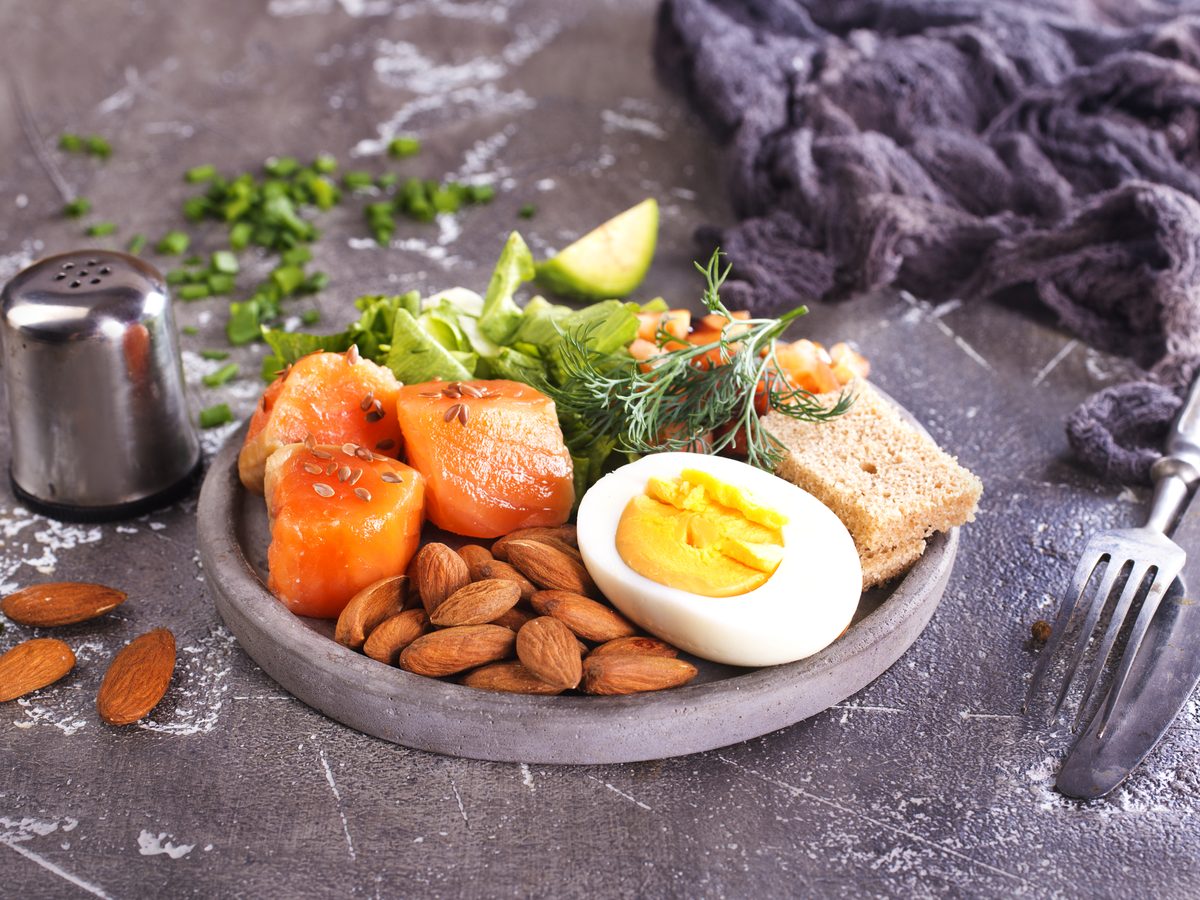
The FDA healthy claim rule has a short list of foods that qualify on identity alone, and nuts are on it. Under 21 CFR 101.65(d)(3)(i), a food made only of vegetables, fruit, whole grains, fat-free or low-fat dairy, or lean meat, seafood, eggs, beans, peas, lentils, nuts or seeds, with no other added ingredients except for water, meets the definition without running a food group equivalent calculation and without being measured against the added sugars, sodium and saturated fat limits. A second automatic route, 101.65(d)(3)(vi), covers water, tea and coffee. Everything else has to be tested.
Status first. The updated definition is a final rule, "Food Labeling: Nutrient Content Claims; Definition of Term 'Healthy'," published 27 December 2024 at 89 FR 106064 and carried in the section's own source note at 89 FR 106162. Its effective date was published as 25 February 2025 and then delayed to 28 April 2025. Using the claim is voluntary: nothing obliges you to put the word on a package, and you may apply the new criteria now. If you do use it, the compliance date is 25 February 2028, unmoved by the delay, after which any product bearing "healthy" or a derivative must meet this definition.
This article covers only the automatic qualifiers, and it names exactly the foods the regulation names. For the full structure of the rule, including the food group equivalents and every category limit, see FDA healthy claim requirements. If your product is not on the automatic list, the decision sequence in can my food be labeled healthy is the faster read.
The two routes, and what the automatic route skips
Paragraph (d)(3) lets you use "healthy" or the derivative terms "health," "healthful," "healthfully," "healthfulness," "healthier," "healthiest," "healthily" and "healthiness" as an implied nutrient content claim if the food meets the criteria of one or more of paragraphs (d)(3)(i) through (vi). One or more: a food has to satisfy only a single one of the six, so a product that fails the table test can still qualify if it is on the automatic list.
Four of the six are tests. Paragraph (d)(3)(ii) covers individual foods, with a food group equivalent minimum plus three nutrient ceilings per category. Paragraphs (d)(3)(iii), (iv) and (v) do the same for mixed products, main dish products as defined in 101.13(m) and meal products as defined in 101.13(l), each asking for more food group equivalents and allowing more added sugars, sodium and saturated fat as the portion grows.
Two are not tests. Paragraph (d)(3)(i) qualifies a food on what it is made of; paragraph (d)(3)(vi) qualifies water, tea and coffee on a calorie ceiling alone. Neither counts food group equivalents and neither imposes an added sugars, sodium or saturated fat limit, which is why a handful of almonds and a salmon fillet, both carrying real saturated fat, can bear the claim while a sweetened yogurt cannot.
Being on the automatic list does not exempt a product from the rest of the claim machinery. Paragraph (a)(3) requires the food bearing the claim to be labeled in accordance with 101.9, 101.10 or 101.36, so putting "healthy" on a bag of plain walnuts brings nutrition labeling with it. Paragraph (a)(2) requires compliance with the general requirements in 101.13, with one carve-out: 101.13(h) does not apply when the claim is made under paragraph (d). That is the provision that would otherwise force a "See nutrition information for ____ content" disclosure on a food carrying more than 13.0 g of fat, 4.0 g of saturated fat, 60 mg of cholesterol or 480 mg of sodium per reference amount customarily consumed. Nuts, salmon and oil clear 13.0 g of fat easily, and carry no disclosure statement.
Nuts and seeds under the FDA healthy claim
Nuts and seeds are named in 101.65(d)(3)(i)(E), in the same clause as lean meat, seafood, eggs, beans, peas and lentils. A product comprised of nuts or seeds with no other added ingredients except for water is a qualifying food. Plain almonds, plain walnuts, plain pumpkin seeds, a plain mixed-nut pack: all of them, at any fat level, with no calculation.
The condition is the ingredient list, and it is strict. "No other added ingredients except for water" means salt, sugar and roasting oil are all added ingredients. A dry-roasted nut with nothing applied stays on route 1. A salted or honey-roasted nut leaves it and has to qualify, if at all, through the nuts, seeds and soy products row of the individual-foods table: at least 1 oz equivalent, added sugars no greater than 2% DV, sodium no greater than 10% DV, saturated fat no greater than 5% DV excluding the saturated fat inherent in nuts, seeds and soybeans.
That inherent-fat exclusion is what keeps salted almonds in play. Saturated fat from the nut itself does not count against the 5% DV ceiling; only saturated fat from something added does. Sodium is the binding constraint instead: against the adult Daily Value of 2,300 mg, 10% DV works out to roughly 230 mg, a modest amount of salt on a 1 oz serving.
Peanut butter sits on the same fault line, and FDA names certain peanut butters among the products that newly qualify. Which ones is decided by the ingredient statement, not the nutrition panel: nothing but peanuts keeps the jar on the (d)(3)(i) route, while added salt, sugar or stabiliser oil moves it to the table.
| Product | Ingredients | Route | What is tested |
|---|---|---|---|
| Raw almonds | Almonds | 101.65(d)(3)(i)(E) | Nothing |
| Salted roasted almonds | Almonds, sea salt | 101.65(d)(3)(ii) | 1 oz equivalent, 2% DV added sugars, 10% DV sodium, 5% DV saturated fat excluding inherent |
| Peanut butter, one ingredient | Peanuts | 101.65(d)(3)(i)(E) | Nothing |
| Peanut butter, sweetened | Peanuts, sugar, salt, palm oil | 101.65(d)(3)(ii) | Same four numbers as above |
Eggs, salmon and other fatty fish
Eggs
Eggs are named in 101.65(d)(3)(i)(E). An egg with nothing added is a qualifying food, and its cholesterol content is irrelevant because the updated definition carries no cholesterol limit at all. The table 1 food group equivalent for eggs is 1 oz equivalent, and the regulation gives 1 large egg as the example of that equivalent, so a single egg clears the minimum on the test route too.
The qualifier is conditional in the same way as nuts. Plain shell eggs and plain liquid or frozen whole egg stay on route 1; a liquid egg product with added salt, gums or oil does not, and has to run the egg row: 1 oz equivalent, added sugars no greater than 2% DV, sodium no greater than 10% DV, saturated fat no greater than 10% DV. That row allows 10% DV saturated fat rather than the 5% DV applied to seafood and nuts, and carries no inherent-fat exclusion.
Salmon and other fatty fish
Seafood is named in 101.65(d)(3)(i)(E) with no leanness qualifier attached to it. The word "lean" in that clause sits in front of "meat"; seafood follows as its own item. That is why a plain salmon fillet is a qualifying food, and why FDA lists higher-fat fish such as salmon among the products that newly qualify. The 1994 criteria, which imposed a total fat limit, kept salmon out.
Plain frozen fillets and fish canned in water are still route 1 foods, because water is the one permitted addition. Fish canned in oil is not, and smoked, cured or brined salmon is not, because salt is an added ingredient. Those fall to the seafood row: 1 oz equivalent seafood, added sugars no greater than 2% DV, sodium no greater than 10% DV, saturated fat no greater than 5% DV excluding the saturated fat inherent in seafood. The exclusion is generous; the sodium ceiling is what decides a smoked fillet.
Whole fruits and vegetables, whole grains, fat-free and low-fat dairy
The first four items in the foundation list are vegetable, fruit, whole grains, and fat-free or low-fat dairy. Whole fruits and vegetables are the clearest case in the rule: an apple, a bag of carrots, a head of broccoli, all qualifying foods with no test. FDA names avocados specifically among the foods that newly qualify, for the same reason as salmon, since the old definition's fat limit excluded them.
Processing form does not break the qualifier as long as the ingredient list does not. Fresh, frozen, canned and dried forms all stay on route 1 if nothing but water has been added, which is why FDA lists certain canned fruits and vegetables among the newly qualifying products. Canned in water, yes; canned in syrup or brine, no, because sugar and salt are added ingredients. Frozen vegetables in a sauce, no. Dried fruit with nothing added, yes; the same fruit sweetened, no.
Two of the four are conditional in the clause itself. It names whole grains, not grains generally, so a refined-flour product is outside (d)(3)(i) before you reach the ingredient list. And it names fat-free or low-fat dairy, so whole milk is not on the foundation list and has to go through the dairy row instead. For every category row side by side, see healthy claim requirements by food category.
Olive oil qualifies, but it is not an automatic qualifier
This is the one people get wrong, because olive oil appears on FDA's list of foods that newly qualify and the list gets read as a list of automatic qualifiers. Read 101.65(d)(3)(i) again: vegetable, fruit, whole grains, fat-free or low-fat dairy, and lean meat, seafood, eggs, beans, peas, lentils, nuts or seeds. Oils are not among the five foundation categories. Olive oil qualifies through the individual-foods tables.
The oils rows are unusual, which is probably the source of the confusion. Every other row of table 2 and table 3 opens with a food group equivalent minimum. The oils rows have none, because oil is not a food group. What they do have is nutrient limits, and they are the tightest in the rule.
| Oils category | Added sugars | Sodium | Saturated fat |
|---|---|---|---|
| 100% oil | 0% DV | 0% DV | No greater than 20% of total fat |
| Oil-based spread whose fats come solely from oil | 0% DV | 10% DV | No greater than 20% of total fat |
| Oil-based dressing, at least 30% oil, oils meeting the 100% oil criteria | 2% DV | 10% DV | No greater than 20% of total fat |
So a bottle of 100% olive oil must carry zero added sugars and zero sodium, and no more than 20% of its total fat as saturated fat. That last one is a ratio inside the product, not a percent Daily Value, which makes it a different calculation from every other saturated fat limit in the rule. Which table applies depends on the reference amount customarily consumed: table 2 on a per-RACC basis above 50 g or 3 tablespoons, table 3 on a per 50 g basis at or below it. Oils sit on the small side of that line. To check the arithmetic against the category you are actually in, the claim validator runs the category test for you.
Water, tea and coffee
The second automatic route is a single sentence. Paragraph 101.65(d)(3)(vi) covers "all water, tea, and coffee with less than 5 calories per RACC and per labeled serving." That is the whole provision: no food group equivalents, no nutrient ceilings.
Two details carry weight. The calorie condition applies to all three beverages, not just tea and coffee, so this qualifier is conditional rather than absolute. And it has to be met on both bases, per reference amount customarily consumed and per labeled serving, so a product whose labeled serving is larger than its RACC must clear 5 calories on the larger number too. Plain bottled water, unsweetened tea and black coffee pass. Anything sweetened past 5 calories on either basis does not.
The records you do not have to keep
Paragraph 101.65(d)(4) requires every manufacturer of a food bearing the "healthy" claim to make and keep written records verifying that it meets the food group equivalent requirements: database analyses, recipes, formulations or batch records. They must be kept at least two years after the food is introduced or delivered for introduction into interstate commerce, produced to FDA on request during an inspection, kept under part 11 if electronic, and kept accurate, indelible and legible.
That obligation has three exceptions written into the same sentence, and two of them are the automatic qualifiers: foods described in paragraph (d)(3)(i), foods described in paragraph (d)(3)(vi), and foods whose required label information, such as the ingredient list, already verifies the food group equivalent. When the ingredient statement reads "almonds," the label is the verification record.
So a plain product on route 1 needs no formulation file for the claim at all. The same product with salt added is on route 2, and now needs both the numbers and two years of records behind them. One ingredient decides it.
Two things that do not yet exist get asserted often enough to be worth stating. There is no official FDA "healthy" symbol: FDA says it is still exploring one and its 2026 deliverables include advancing a potential guidance identifying it, but any symbol would be voluntary guidance, not a rule. FDA's draft guidance "Questions and Answers Regarding Use of the 'Healthy' Claim" went onto its 2026 guidance agenda on 29 June 2026 and had not been issued as of early September 2026.
Once you know which paragraph your product qualifies under, build the panel that has to sit beside the claim: the nutrition label generator produces the 101.9 Nutrition Facts panel that 101.65(a)(3) requires on any food carrying the word.
Frequently asked questions
Do nuts automatically qualify for the FDA healthy claim?
Plain ones do. Nuts and seeds are named in 101.65(d)(3)(i)(E), so a product comprised of nuts or seeds with no other added ingredients except for water meets the definition with no calculation and no nutrient limit. Add salt, sugar or roasting oil and it has to qualify instead through the nuts, seeds and soy products row: 1 oz equivalent, 2% DV added sugars, 10% DV sodium, 5% DV saturated fat excluding the saturated fat inherent in nuts, seeds and soybeans.
Does the high fat content of nuts, salmon or olive oil disqualify them?
No. The updated definition limits added sugars, sodium and saturated fat only; the total fat and cholesterol limits belonged to the 1994 criteria. The seafood row and the nuts, seeds and soy products row also exclude the saturated fat inherent in those foods from their 5% DV ceiling, and foods qualifying under (d)(3)(i) face no saturated fat ceiling at all.
Is olive oil an automatic qualifier?
No, and this is the most common misreading of the rule. Oils are not one of the five foundation categories in 101.65(d)(3)(i). Olive oil qualifies through the 100% oil row of table 2 or table 3, which sets no food group equivalent minimum but does impose 0% DV added sugars, 0% DV sodium and saturated fat no greater than 20% of total fat. FDA does list olive oil among the foods that newly qualify, but it qualifies by meeting conditions, not by identity.
Does a canned vegetable still qualify?
If nothing but water has been added, yes. Paragraph (d)(3)(i) permits water as the only addition, which keeps fresh, frozen, canned and dried forms on the automatic route. Canned in brine or syrup breaks it, and the product must then meet the vegetable or fruit row: 1/2 cup equivalent, 2% DV added sugars, 10% DV sodium, 5% DV saturated fat.
Do I need records for a bag of plain almonds labeled healthy?
No. Paragraph 101.65(d)(4) exempts foods described in paragraphs (d)(3)(i) and (vi) from the two-year recordkeeping requirement, along with foods whose required label information already verifies the food group equivalent. A one-ingredient product on the automatic route verifies itself through its ingredient statement.
Can I use the claim before 25 February 2028?
Yes. The rule is final and has been effective since 28 April 2025, and using the term is voluntary at any point, so you may apply the new criteria now. The 25 February 2028 compliance date is the deadline after which any product bearing "healthy" must meet this definition rather than the 1994 one.
Does a qualifying food still need a Nutrition Facts panel?
If it carries the claim, yes. Paragraph 101.65(a)(3) conditions any implied nutrient content claim on the food being labeled in accordance with 101.9, 101.10 or 101.36. A raw agricultural commodity that would otherwise rely on voluntary nutrition labeling takes on the requirement when you put the word on the package. What it does not take on is the 101.13(h) disclosure statement, which 101.65(a)(2) switches off for claims made under paragraph (d).