How many calories are in basil?
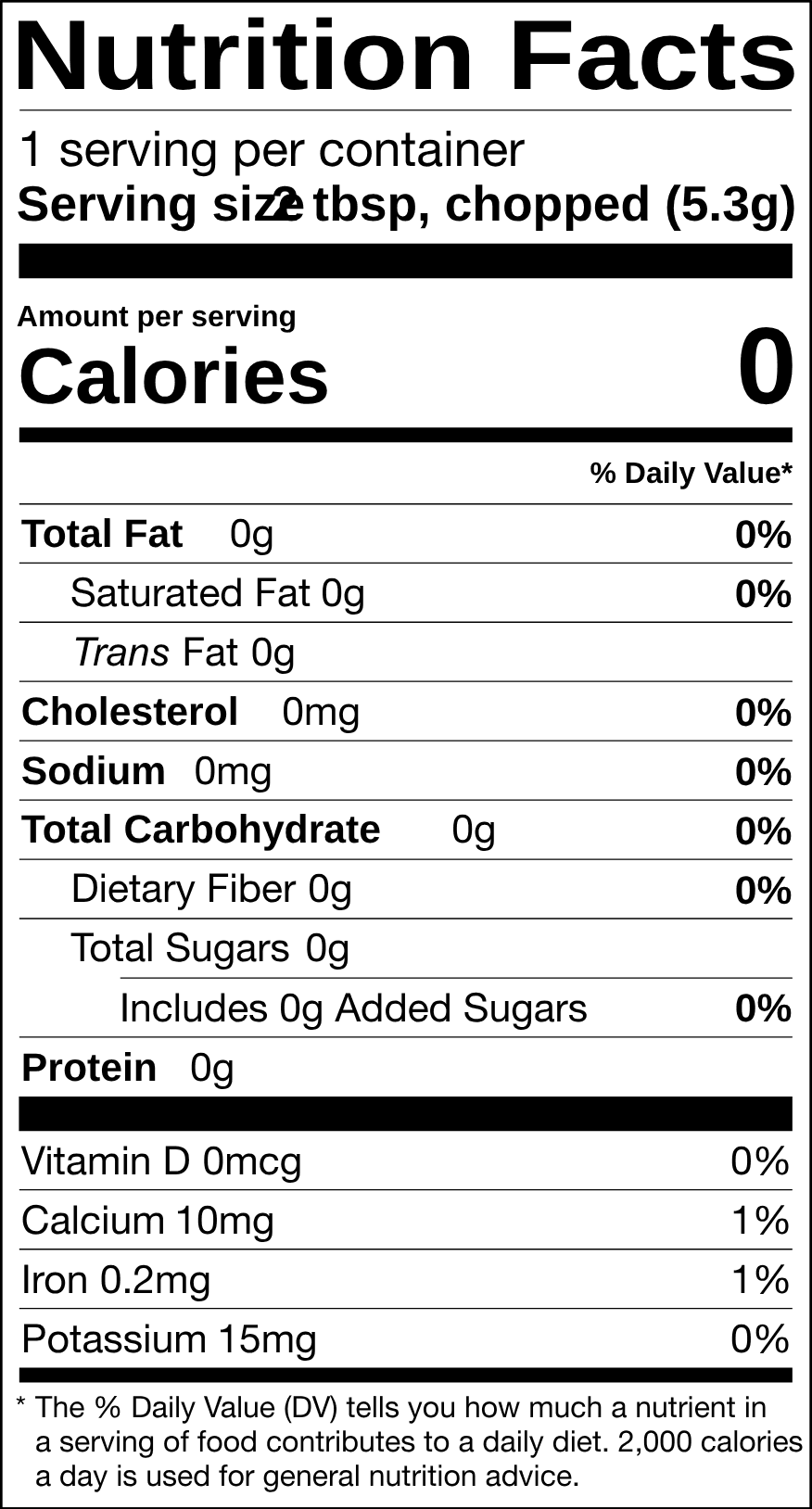
Basil (2 tbsp, chopped, 5.3 g) has 1 calories. 100 g has 23 calories. On a Nutrition Facts label, calories are rounded to the nearest 5 or 10, so the panel above may show 0.
Basil nutrition facts from USDA FoodData Central: 1 calories in 2 tbsp, chopped, with 0.2 g protein, 0.1 g carbohydrate and <0.1 g fat. Change the serving below and the label, the summary and the full nutrient table update together.
FDA standard format. Values use the FDA rounding rules for the serving you pick. Nutrients USDA does not report for this food print as 0 on the panel and as "not reported" in the table.
Download this label: · PNG Free to use as a reference. A label for a product you sell needs your full recipe and ingredient statement.
2 tbsp, chopped (5.3 g)
Opens the free label generator with this amount of basil already added. Add the rest of your ingredients and the label updates as you go.
| Nutrient | Per serving | % DV* | Per 100 g |
|---|---|---|---|
| Calories and macronutrients | |||
| Calories | 1 | 23 | |
| Total fat | <0.1 g | 0% | 0.64 g |
| Saturated fat | <0.1 g | 0% | 0.04 g |
| Trans fat | 0 g | 0 g | |
| Monounsaturated fat | <0.1 g | 0.09 g | |
| Polyunsaturated fat | <0.1 g | 0.39 g | |
| Cholesterol | 0 mg | 0% | 0 mg |
| Sodium | 0.21 mg | 0% | 4 mg |
| Total carbohydrate | 0.1 g | 0% | 2.65 g |
| Dietary fiber | 0.1 g | 0% | 1.6 g |
| Total sugars | <0.1 g | 0.3 g | |
| Added sugars | 0 g | 0% | 0 g |
| Protein | 0.2 g | 3.15 g | |
| Vitamins | |||
| Vitamin D | 0 mcg | 0% | 0 mcg |
| Vitamin A | 14 mcg | 2% | 264 mcg |
| Vitamin C | 0.95 mg | 1% | 18 mg |
| Vitamin E | <0.1 mg | 0% | 0.8 mg |
| Vitamin K | 22 mcg | 18% | 415 mcg |
| Thiamin (B1) | <0.1 mg | 0% | 0.03 mg |
| Riboflavin (B2) | <0.1 mg | 0% | 0.08 mg |
| Niacin (B3) | <0.1 mg | 0% | 0.9 mg |
| Vitamin B6 | <0.1 mg | 0% | 0.16 mg |
| Folate (DFE) | 3.6 mcg | 1% | 68 mcg |
| Vitamin B12 | 0 mcg | 0% | 0 mcg |
| Choline | 0.6 mg | 0% | 11.4 mg |
| Minerals | |||
| Calcium | 9.4 mg | 1% | 177 mg |
| Iron | 0.17 mg | 1% | 3.17 mg |
| Potassium | 16 mg | 0% | 295 mg |
| Magnesium | 3.4 mg | 1% | 64 mg |
| Phosphorus | 3 mg | 0% | 56 mg |
| Zinc | <0.1 mg | 0% | 0.81 mg |
| Copper | <0.1 mg | 2% | 0.39 mg |
| Manganese | 0.06 mg | 3% | 1.15 mg |
| Selenium | <0.1 mcg | 0% | 0.3 mcg |
| Other | |||
| Water | 4.9 g | 92.1 g | |
| Caffeine | 0 mg | 0 mg | |
| Alcohol | 0 g | 0 g | |
* Percent Daily Values are based on a 2,000 calorie diet (FDA reference values for adults and children 4 years and older). Per-100 g values are USDA figures before label rounding.
Every serving below is a USDA household measure for this food, a fraction of one, or a unit conversion. Amounts are USDA values scaled by weight; only the Nutrition Facts panel applies the coarser FDA label rounding.
| Serving | Weight | Calories | Total carbohydrate | Protein | Total fat | Dietary fiber | Total sugars |
|---|---|---|---|---|---|---|---|
| 5 leaves | 2.5 g | 1 | 0.1 g | 0.1 g | <0.1 g | <0.1 g | <0.1 g |
| 2 tbsp, chopped | 5.3 g | 1 | 0.1 g | 0.2 g | <0.1 g | 0.1 g | <0.1 g |
| 1/4 cup leaves, whole | 6 g | 1 | 0.2 g | 0.2 g | <0.1 g | 0.1 g | <0.1 g |
| 100 g | 100 g | 23 | 2.7 g | 3.2 g | 0.6 g | 1.6 g | 0.3 g |
Basil (2 tbsp, chopped, 5.3 g) has 1 calories. 100 g has 23 calories. On a Nutrition Facts label, calories are rounded to the nearest 5 or 10, so the panel above may show 0.
Basil (2 tbsp, chopped, 5.3 g) has 22 mcg of vitamin K, 18% of the Daily Value. 100 g has 415 mcg. At 10 to 19% DV per serving, that meets the FDA threshold for a "good source" claim.
100 g of basil has 23 calories, 3.15 g protein, 2.65 g carbohydrate, 1.6 g fiber, 0.3 g sugars and 0.64 g fat.
About 37% of the calories in basil come from carbohydrate, 20% from fat and 44% from protein (Atwater factors of 4, 9 and 4 calories per gram).
The same serving of basil, drawn by the label formats other markets require: the Canadian bilingual Nutrition Facts table, the EU nutrition declaration (per 100 g, energy in kJ and kcal, salt instead of sodium) and the UK nutrition information table with reference intakes. The generator switches between these and many more from one recipe.
| Fat / Lipides | 0 g | 0 % |
| Saturated / Saturés | 0 g + Trans 0 g | 0 % |
| Cholesterol / Cholestérol | 0 mg | 0 % |
| Sodium | 0 mg | 0 % |
| Carbohydrate / Glucides | 0 g | 0 % |
| Fibre / Fibres | 0 g | 0 % |
| Sugars / Sucres | 0 g | 0 % |
| Protein / Protéines | 0 g | |
| Vitamin D / Vitamine D | 0 mcg | 0 % |
| Calcium | 9 mg | 1 % |
| Iron / Fer | 0 mg | 1 % |
| Potassium | 16 mg | 0 % |
| Per 100g | |
|---|---|
| Energy | 96 kJ / 23 kcal |
| Fat | 0.6 g |
| of which saturates | 0.0 g |
| Carbohydrate | 2.6 g |
| of which sugars | 0.3 g |
| Protein | 3.2 g |
| Salt | 0.0 g |
| Per 100g | Per 5.3g | %RI* | |
|---|---|---|---|
| Energy | 96 kJ 23 kcal |
5 kJ 1 kcal |
<1% |
| Fat | 0.6g | 0 gg | <1% |
| of which saturates | 0 gg | 0 gg | <1% |
| Carbohydrate | 2.6g | 0 gg | <1% |
| of which sugars | 0 gg | 0 gg | <1% |
| Fibre | 1.6g | 0 gg | - |
| Protein | 3.2g | 0 gg | <1% |
| Salt | 0 gg | 0 gg | <1% |
Different forms of the same food are separate USDA records, so each has its own page. Per 100 g:
| Form | Calories | Protein | Total fat | Total carbohydrate |
|---|---|---|---|---|
| BasilBasil, fresh | 23 | 3.15 g | 0.64 g | 2.65 g |
| Dried BasilSpices, basil, dried | 233 | 23 g | 4.07 g | 47.8 g |
If you make and sell a product that contains basil, these free tools cover the next steps.
Nutrient values are from USDA FoodData Central, SR Legacy (April 2018 release, public domain), record 172232: "Basil, fresh". Values are stored per 100 g exactly as USDA reports them and scaled to each serving by weight. The Nutrition Facts panel applies the FDA rounding rules in 21 CFR 101.9; tables and text show the scaled amounts at reading precision, so a figure can differ slightly from the panel. A nutrient USDA does not report for this food is shown as not reported, never as a guessed value.
SR Legacy predates the added sugars field. This is a whole or unsweetened food, so added sugars are shown as 0 g. View the USDA record ↗