Converting Serving Sizes to Grams
The serving size line carries a household measure and the weight of that exact amount in metric units, and the two halves have to agree for your product. Which measures are permitted, how the gram figure rounds, and why a cup-to-gram chart cannot give you the number.
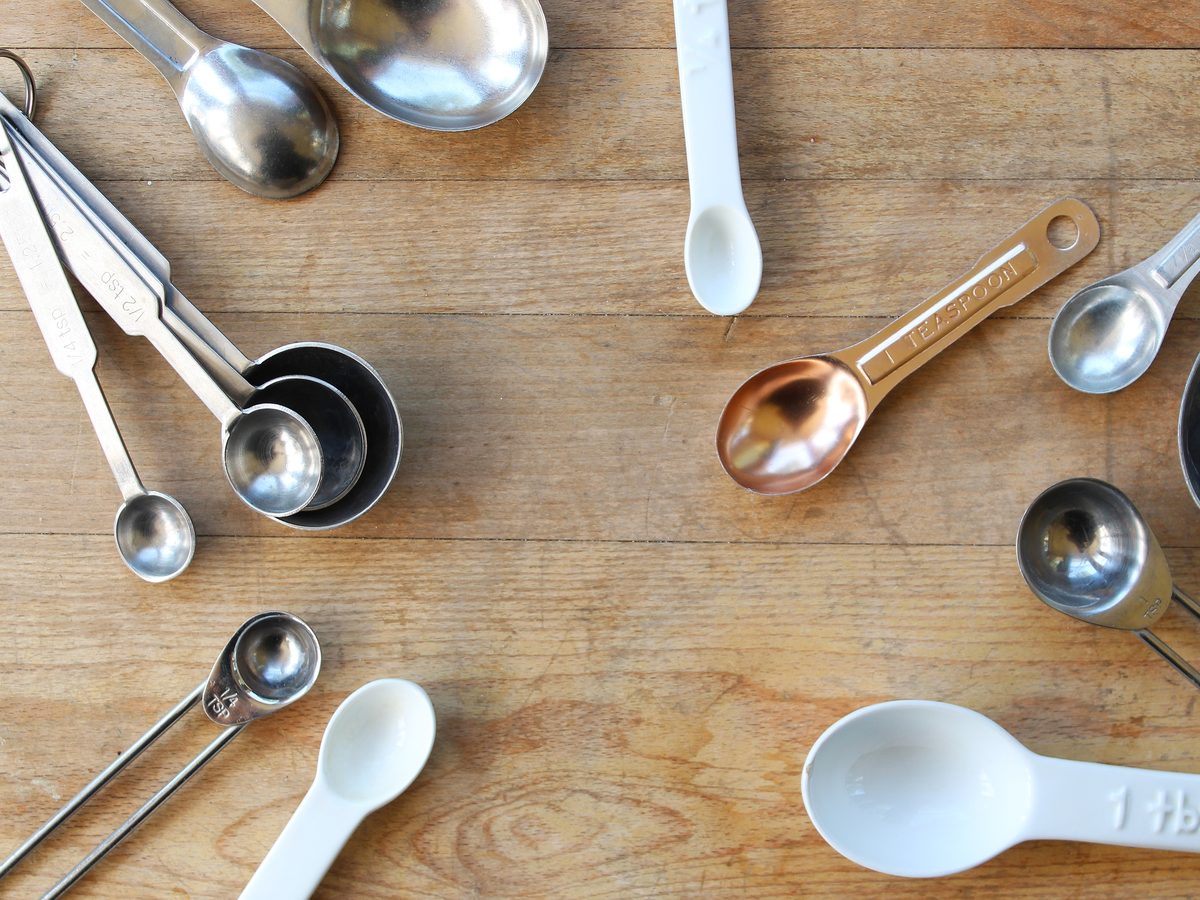
A formula is written in cups and tablespoons. The panel needs two things on one line: a household measure a shopper recognises, and the weight of that exact amount in metric units. Getting the serving size grams nutrition label line right means making those two halves agree for your product specifically. 21 CFR 101.9(b)(7) sets the form of the line. 21 CFR 101.12 supplies the amount the line has to approximate. Neither gives you a cup-to-gram conversion factor, because no fixed one exists.
A cup is a fixed volume here. It is not a fixed weight. One cup of puffed rice cereal and one cup of a dense biscuit cereal are both one cup, and nowhere near the same number of grams. The regulation knows this so well that it sorts ready-to-eat cereals into separate categories by how much a cup of them weighs. For the upstream question of where the target amount comes from, see FDA RACC and reference amounts explained.
What the serving size grams nutrition label line has to contain
The rule is 21 CFR 101.9(b)(7). A label statement regarding a serving is the serving size expressed in common household measures, followed by the equivalent metric quantity in parenthesis, fluids in milliliters and all other foods in grams. The ordering is not cosmetic. The household measure is the declaration and the metric quantity is its equivalent, which means the gram figure is derived from the household measure, not the reverse.
One carve-out: 101.9(b)(7)(i) does not require the parenthetical on a single-serving container, because the metric quantity already appears in the net weight statement on the principal display panel. It is required where nutrition information must be on a drained weight basis under 101.9(b)(9). Show it voluntarily and it must be identical to the metric quantity in the net quantity of contents statement.
Two extras are optional. Under 101.9(b)(7)(iii) you may add ounces or fluid ounces in parenthesis after the metric measure, separated by a slash, producing a line like 1 slice (28 g/1 oz) for sliced bread. Under 101.9(b)(7)(v), for products needing only water or another ingredient with insignificant nutrients, you may state the finished amount at the end, as in 1/2 cup (120 mL) concentrated soup (makes 1 cup prepared).
If you abbreviate, 101.9(b)(7)(iv) fixes the forms: tbsp, tsp, g, mL, oz and fl oz. So gm, ml and TBS are all wrong.
Which household measures are permitted, and in what order
101.9(b)(5) defines the term. A common household measure means cup, tablespoon, teaspoon, piece, slice, fraction such as 1/4 pizza, ounce (oz), fluid ounce (fl oz), or other common household equipment used to package food, such as a jar or tray. That list is closed: scoops and handfuls are not on it. The paragraph then sets a hierarchy you work down in order.
- 101.9(b)(5)(i). Cups, tablespoons or teaspoons shall be used wherever possible and appropriate, except for beverages, where fluid ounces may be used. Cups are expressed in 1/4-cup or 1/3-cup increments. Tablespoons are expressed as 1, 1 1/3, 1 1/2, 1 2/3, 2 or 3. Teaspoons are expressed as 1/8, 1/4, 1/2, 3/4, 1 or 2.
- 101.9(b)(5)(ii). If those are not applicable, use piece, slice, tray, jar or fraction.
- 101.9(b)(5)(iii). If neither works, ounces may be used with an appropriate visual unit of measure, such as 1 oz (28 g/about 1/2 pickle), in 0.5 oz increments most closely approximating the reference amount.
- 101.9(b)(5)(iv). Single-serving containers use a description of the container, such as can, box or package. Other discrete units use a description of the unit, such as piece, slice, cracker or bar.
Those increment lists constrain the arithmetic. You cannot declare 1.2 cups or 2 1/2 tablespoons. When a calculated serving size lands exactly between two permitted sizes, 101.9(b)(5)(ix) says to round up to the next incremental size, giving 2.5 tbsp as its own example.
The one set of fixed conversions is 101.9(b)(5)(viii), and it is worth reading for what it omits. For nutrition labeling purposes a teaspoon means 5 mL, a tablespoon 15 mL, a cup 240 mL, 1 fl oz 30 mL, and 1 oz in weight 28 g. Every entry is volume to volume except the last, which is weight to weight. Nothing converts a volume into a weight, and that gap is the whole problem.
Rounding the metric quantity
Once you have the gram or milliliter figure, 101.9(b)(7)(ii) tells you how to express it. The ladder is the reverse of what people expect: the smaller the number, the more decimal places you keep.
| Metric quantity | How it is expressed | Worked example |
|---|---|---|
| 5 g or 5 mL and above | Nearest whole number | 39.6 g declares as 40 g |
| Between 2 and 5 g or mL | Nearest 0.5 | 3.4 g declares as 3.5 g |
| Less than 2 g or mL | 0.1 increments | 0.63 g declares as 0.6 g |
The bottom rung is not a curiosity. Baking powder, baking soda and pectin have a reference amount of 0.6 g in 101.12(b) with a label statement of the form "__ tsp (__ g)", so the parenthetical lands below 2 g and carries a tenth of a gram. The optional ounce figure goes in 0.1 oz increments. Both rounding provisions are written with "should" rather than the "shall" used for the household-measure increments in 101.9(b)(5)(i), so treat the ladder as expected practice.
Why a cup-to-gram chart cannot give you the number
A chart gives one gram weight per cup for a named ingredient. Your parenthetical is the weight of a cup of your finished product. Those are different quantities unless your product is that ingredient, at that particle size and moisture content, packed the way your filler packs it. Granulation, aeration, flake thickness, coating and fat content all move the number, and none are in the chart.
The regulation is built on the assumption that density varies inside a single category. Ready-to-eat breakfast cereal in 101.12(b) is not one category. It is three, and the dividing line is density:
- Weighing less than 20 g per cup, for example plain puffed cereal grains: reference amount 15 g.
- Weighing 20 g or more but less than 43 g per cup, and high fiber cereals containing 28 g or more of fiber per 100 g: reference amount 40 g.
- Weighing 43 g or more per cup, and biscuit types: reference amount 60 g.
To know which band your cereal is in, you must already have weighed a cup of it. The reference amount is downstream of a density measurement on your own product, so a chart cannot even tell you which row to read.
The same reasoning reappears in 101.12(h)(10), on petitioning FDA for a new reference amount. Amounts for fluids are expressed in milliliters and other foods in grams, except where common household units are more appropriate, and the reason given is density: household measures would be more appropriate if products within the same category differ substantially in density, such as frozen desserts.
101.12(e) goes further. Where aeration lowers a food's density by 25 percent or more in weight relative to an appropriate reference regular food whose reference amount is in grams, the manufacturer may adjust for the difference, rounded to the nearest 5 g increment, provided FDA is shown the detailed protocol and all data and the product bears a term such as whipped or aerated. Density is treated throughout as a measured property backed by records, never a looked-up constant.
Establishing the gram weight by weighing your own product
FDA anticipated this step. 101.9(b)(7)(vi) says that to promote uniformity in label serving sizes declared by different manufacturers, FDA has provided a guidance document entitled "Guidelines for Determining the Gram Weight of the Household Measure", available from the Office of Nutrition and Food Labeling at CFSAN. Its existence is the clearest signal that the gram weight is determined, not retrieved.
For a nondiscrete bulk product, which 101.9(b)(2)(iii) defines to include breakfast cereal, flour, sugar, dry mixes and concentrates, the sequence runs like this.
- Find your category and its reference amount in 101.12(b). Our RACC lookup tool searches the table by product description.
- Weigh one household measure of your own product, filled the way a consumer would fill it, replicated enough times that the average is representative.
- Under 101.9(b)(2)(iii) the serving size is the amount in household measure that most closely approximates the reference amount. Divide the reference amount by your measured weight per household measure, then snap the result to the permitted increments in 101.9(b)(5)(i).
- Multiply the declared household measure back by your measured weight to get the parenthetical, and round it with the 101.9(b)(7)(ii) ladder.
Take the middle cereal in the figure. Suppose your measurement gives 32 g per cup, which is your own data, not a figure from the regulation. That puts you in the 20 g up to 43 g per cup band, so the reference amount is 40 g. Dividing 40 by 32 gives 1.25 cups, which is arithmetic, and 1.25 is already a permitted 1/4-cup increment, so the declared measure is 1 1/4 cup. Multiplying back returns 40 g. The line reads 1 1/4 cup (40 g).
Run the same procedure on a puffed cereal at 12 g per cup and 15 divided by 12 is again 1.25 cups, giving 1 1/4 cup (15 g). On a biscuit type at 48 g per cup, 60 divided by 48 is once more 1.25 cups, giving 1 1/4 cup (60 g). Three products, one household measure, gram figures of 15, 40 and 60. Any chart mapping 1 1/4 cup of cereal to a single gram number is wrong for at least two of them.
Keep the records. The conditions 101.12(e) sets for a density-adjusted reference amount are a fair model for any density work: the same trained operator using the same methodology, equipment and procedures under the same conditions, replicated enough times to be representative, with sample selection following 101.9(g).
Where the regulation prescribes weight and where it prescribes volume
Three provisions decide this, and they answer different questions.
The parenthetical. 101.9(b)(7) is the simple one: fluids in milliliters, all other foods in grams.
The reference amount you are aiming at. Fixed per category in 101.12(b), and the table mixes units deliberately. Milk and milk-substitute beverages are 240 mL, shown as 1 cup (240 mL) or 8 fl oz (240 mL). Syrups are 30 mL as 2 tbsp (30 mL), as is undiluted condensed or evaporated milk. On the weight side, yogurt is 170 g with a label statement of "__ cup (__ g)" and sugar is 8 g with "__ tsp (__ g)". Some categories are the household measure itself: butter, margarine, oil and shortening have a reference amount of 1 tbsp, with the label statement offered as either 1 tbsp (__ g) or 1 tbsp (15 mL), which is how one category covers both a solid fat and an oil.
The net quantity on the principal display panel. 101.7(a) is a different test again: fluid measure if the food is liquid, weight if it is solid, semisolid or viscous, or a mixture of solid and liquid, with dry measure available for a fresh fruit, a fresh vegetable or another dry commodity customarily sold by dry measure. A firmly established general consumer usage and trade custom can override the default either way. 101.7(b) fixes the units: weight in avoirdupois pound and ounce, fluid measure off the U.S. gallon of 231 cubic inches with its quart, pint and fluid ounce subdivisions, dry measure off the U.S. bushel of 2,150.42 cubic inches. It even fixes the temperature at which volume is expressed, 68 °F (20 °C) for ordinary foods and 40 °F (4 °C) for refrigerated foods sold refrigerated.
Two cases override all of that. Under 101.9(b)(9), foods packed in a liquid not customarily consumed, such as canned fish and pickled vegetables, declare on the drained solids, and footnote 10 to 101.12(b) puts the reference amount on drained solids too, so weigh the product drained. And 101.9(b)(2)(i)(E) declares maraschino cherries as 1 cherry with the parenthetical equal to the average weight of a medium size cherry, an explicit instruction to weigh your own fruit. For how the discrete-unit procedures in 101.9(b)(2) choose the household measure before any conversion starts, see FDA serving size requirements.
Once you have the measured weight of one household measure of your product, the nutrition label generator takes it from there, snapping the measure to the permitted increments and rounding the parenthetical with the 101.9(b)(7)(ii) ladder.
Frequently asked questions
Can I use a published cup-to-gram chart for my label?
Not as the source of the number you print. The parenthetical in 101.9(b)(7) is the metric equivalent of a household measure of your product, and a chart describes a generic ingredient. 101.12(b) splits ready-to-eat cereals at under 20 g per cup, 20 g up to 43 g per cup, and 43 g or more per cup precisely because products in one category differ that much. A chart can sanity-check a measurement you already took, not replace it.
If a cup is 240 mL, does a cup of my product weigh 240 g?
No. 101.9(b)(5)(viii) states that for nutrition labeling purposes a cup means 240 mL, a tablespoon 15 mL, a teaspoon 5 mL and 1 fl oz 30 mL. Those are volume equivalences. The only weight statement in the paragraph is that 1 oz in weight means 28 g, which converts weight to weight. Nothing there turns a volume into a weight, because that step needs your product's density.
My calculation gives 2.5 tablespoons. What do I declare?
3 tbsp. 101.9(b)(5)(ix) says that when a serving size determined from the reference amount falls exactly half way between two serving sizes, using 2.5 tbsp as its example, the manufacturer rounds up to the next incremental size. The permitted increments in 101.9(b)(5)(i) are 1, 1 1/3, 1 1/2, 1 2/3, 2 and 3, so 2.5 has nowhere else to go. Recompute the parenthetical for 3 tbsp of your product, not for 2.5.
Which ounce goes on the label, the weight one or the fluid one?
Both exist and they are different units. 101.9(b)(5)(viii) sets 1 oz in weight at 28 g and 1 fl oz at 30 mL, and the abbreviations in 101.9(b)(7)(iv) keep them apart: oz for weight, fl oz for fluid. Writing oz where you meant fl oz changes the quantity you are declaring.
My product is a two-part kit. How does the serving line work?
101.9(b)(5)(vii) lets you declare nutrition information for each component or as a composite, and shows both with a dry macaroni and cheese example. As separate components it reads "3 oz dry macaroni (84 g/about 2/3 cup)" and "1 oz dry cheese mix (28 g/about 2 tbsp)". As a composite, "4 oz (112 g/about 2/3 cup macaroni and 2 tbsp dry cheese mix)". The gram figures follow the 28 g per ounce conversion, while the cup and tablespoon figures still come from weighing the components.