Serving Size vs Portion Size
A serving size is not advice about how much to eat. It is derived from the reference amount customarily consumed in 21 CFR 101.12. What FDA defines, what it does not, and what the 2016 update did to the figures on the pack.
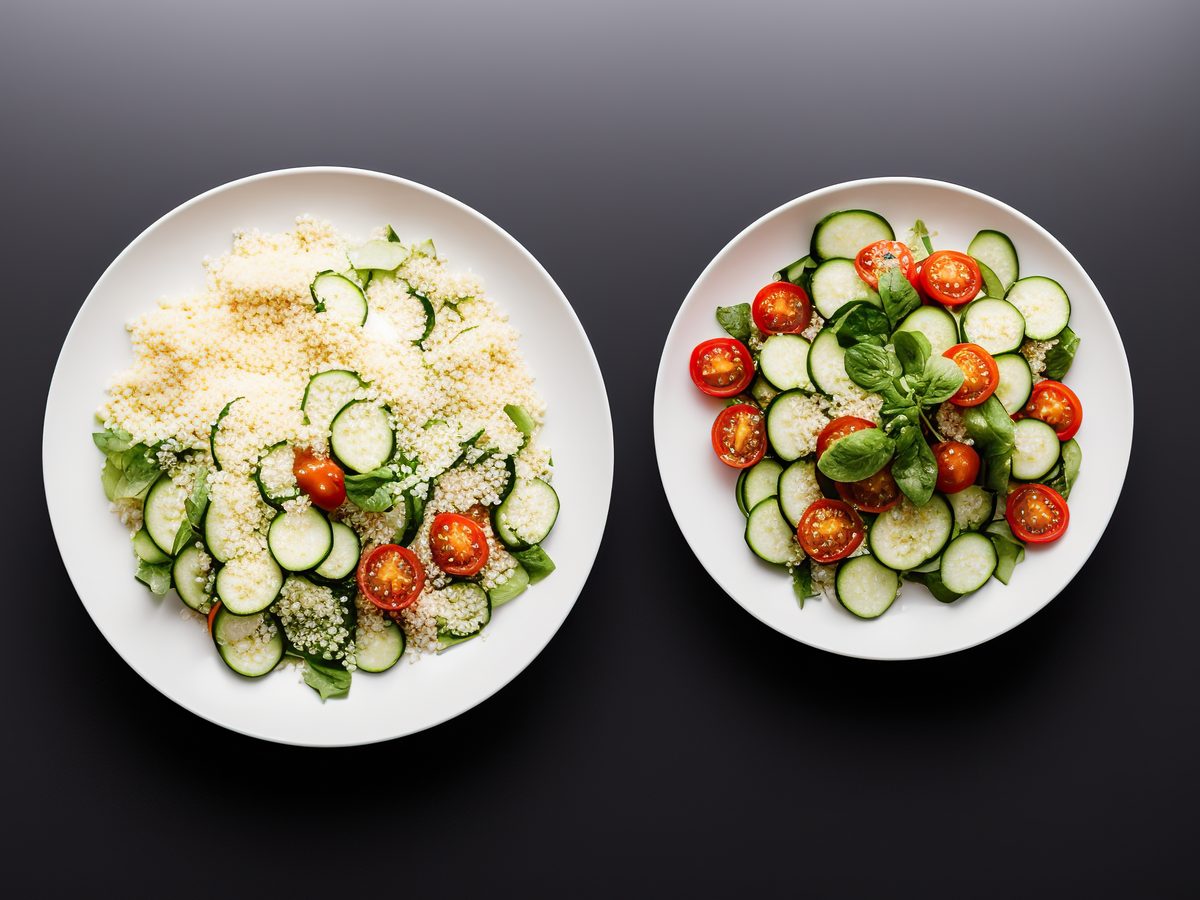
The difference between serving size vs portion size under FDA rules comes down to one fact, and it is not the one most people assume. A serving size printed on a Nutrition Facts panel is not advice about how much to eat. It is a figure the manufacturer is required to derive from the Reference Amount Customarily Consumed per eating occasion, the RACC, and FDA built those reference amounts from national surveys of how much people actually ate in one sitting. A portion is whatever you decide to put in the bowl. Nothing in 21 CFR 101.9 or 21 CFR 101.12 tells anyone how much they should eat.
That distinction decides real things: the serving size a manufacturer may print, how many servings a package declares, whether it needs one column of numbers or two, and how a shopper should read a panel that says 2/3 cup while holding a pint. For the full rule set governing the serving line itself, see FDA serving size requirements for nutrition labels.
Serving size vs portion size: FDA defines one of them and not the other
21 CFR 101.9(b)(1) defines the term precisely. A serving or serving size "means an amount of food customarily consumed per eating occasion by persons 4 years of age or older which is expressed in a common household measure that is appropriate to the food." Every operative word there is descriptive. Customarily consumed is an observation about behaviour. There is no "should", no "recommended", and no reference to a dietary pattern or a calorie target.
Portion size has no definition anywhere in Part 101, because a portion is not a labeling concept. It is the amount a person serves themselves. FDA does not regulate it and makes no statement about it on the panel.
That descriptive character is built into the reference amounts themselves. Under 101.12(a)(1) FDA calculated them for people 4 years of age or older "to reflect the amount of food customarily consumed per eating occasion by persons in this population group," from national food consumption surveys that under 101.12(a)(3) must be representative and "based on consumption data under actual conditions of use." Under 101.12(a)(4) FDA considered the mean, the median and the mode of the amount consumed per occasion: three measures of observed eating, with nothing about ideal eating in the list.
Recommendation-style input enters in exactly one place, as a fallback. 101.12(a)(5) says that where survey data were insufficient, FDA considered other sources: serving sizes used in dietary guidance or recommended by other authoritative systems, serving sizes recommended in comments, and serving sizes used by manufacturers, grocers and other countries. That clause fills gaps rather than turning the system into a set of recommendations.
Two further principles matter in practice. Reference amounts follow the major intended use of the food, which is why milk is referenced as a beverage and not as something poured on cereal (101.12(a)(7)). And foods with similar usage and similar consumed amounts get a uniform reference amount (101.12(a)(9)), so competitors cannot separate themselves on serving size alone.
From reference amount to the serving size on the package
The reference amounts live in 21 CFR 101.12(b) in two tables: Table 1 for foods for infants and children 1 through 3, Table 2 for the general food supply. Footnote 1 to Table 2 records their origin: primarily the USDA Nationwide Food Consumption Surveys of 1977-1978 and 1987-1988, updated with CDC NHANES data from 2003 through 2008.
The reference amount is not what you print. Footnote 3 to Table 2 is explicit: manufacturers are required to convert it to a label serving size in the household measure most appropriate to their product, using the procedures in 21 CFR 101.9(b). Here are six rows as Table 2 gives them.
| Product category in 101.12(b), Table 2 | Reference amount | Label statement form |
|---|---|---|
| Carbonated and noncarbonated beverages, wine coolers, water | 360 mL | 12 fl oz (360 mL) |
| Milk, milk-substitute beverages, milk-based drinks | 240 mL | 1 cup (240 mL); 8 fl oz (240 mL) |
| Yogurt | 170 g | cup (g) |
| Ice cream, frozen yogurt, sherbet, frozen novelties | 2/3 cup, including the volume for coatings and wafers | cup (g) |
| Bagels, toaster pastries, muffins (excluding English muffins) | 110 g | piece(s) (g) |
| Cheese, grated hard, e.g. Parmesan, Romano | 5 g | tbsp (g) |
Finding your row is harder than it looks, because the categories are drawn around how a food is used rather than what it is made of. The full tables and the rules for unlisted products are covered in FDA RACC reference amounts, and our RACC lookup tool searches the categories directly.
With the reference amount in hand, 101.9(b)(2) sends you down one of three routes. Products in discrete units, such as muffins or sliced bread, follow 101.9(b)(2)(i): a unit weighing 50 percent or less of the reference amount gives a serving of however many whole units come closest to it; a unit between 50 and 67 percent lets the manufacturer declare one unit or two; a unit from 67 percent up to but not including 200 percent gives a serving of one unit. Large discrete units usually divided for consumption, such as cake, pie or pizza, follow 101.9(b)(2)(ii): the serving is the fractional slice closest to the reference amount, using 1/2, 1/3, 1/4, 1/5, 1/6 or smaller fractions generated by dividing again by 2 or 3. Nondiscrete bulk products such as cereal and flour follow 101.9(b)(2)(iii): the household measure closest to the reference amount.
The household measure requirement and the metric equivalent
101.9(b)(7) sets the printed form: the serving size is expressed in common household measures and "shall be followed by the equivalent metric quantity in parenthesis," millilitres for fluids and grams for everything else, which is why a label reads 2/3 cup (88 g) rather than either half alone. The household measure itself is not a free choice.
Under 101.9(b)(5)(i) cups, tablespoons or teaspoons are used wherever possible and appropriate, except for beverages, where fluid ounces are allowed, and the permitted increments are fixed: cups in 1/4 or 1/3 cup steps, tablespoons only as 1, 1 1/3, 1 1/2, 1 2/3, 2 or 3. Where those do not fit, 101.9(b)(5)(ii) allows piece, slice, tray, jar and fraction. Ounces come last, and 101.9(b)(5)(iii) then requires a visual unit of measure, as in 1 oz (28 g/about 1/2 pickle).
The conversions in 101.9(b)(5)(viii) are labeling conventions rather than laboratory constants: a teaspoon means 5 mL, a tablespoon 15 mL, a cup 240 mL, 1 fl oz 30 mL, and 1 oz in weight 28 g. The metric figure then rounds to the nearest whole gram or millilitre under 101.9(b)(7)(ii). One exception catches people out: under 101.9(b)(7)(i) a single serving container does not need the parenthetical metric quantity in the serving line, because it already appears in the net quantity of contents statement on the principal display panel.
The metric equivalent is what keeps the household measure honest. Two ice creams can both declare 2/3 cup and differ meaningfully in grams, because density differs and the gram figure is the one tied to the analysis. Compare grams, not cups.
What the 2016 update did to serving sizes, and to calorie figures
FDA published two final rules on 27 May 2016. One revised the Nutrition and Supplement Facts labels; the other, at 81 FR 34000, revised serving sizes, and it is the one that matters here. Both took effect on 26 July 2016, with compliance, after a 2018 extension, on 1 January 2020 for firms with 10 million dollars or more in annual food sales and 1 January 2021 for smaller firms. The rule updated reference amounts where newer NHANES data showed the amount eaten per occasion had moved materially away from the 1993 figures, FDA's screen being a shift of roughly 25 percent or more. It also defined the single serving container and introduced the mandatory dual column.
The changes did not all run one way, which is the detail that gets lost. Ice cream went up, from 1/2 cup to 2/3 cup. Carbonated and noncarbonated beverages went from 8 fl oz to 12 fl oz, now stated as 360 mL. Bagels and muffins went from 55 g to 110 g. Yogurt went down, from 225 g to 170 g. The reference amounts followed the data wherever it led.
Raising a reference amount does not change the food. It changes the arithmetic printed on the food. Take the ice cream in the figure above. At 2/3 cup and 88 g it declares 260 calories. Under the old 1/2 cup reference amount the same product would have been a 66 g serving with an unrounded value of 195 calories, declared as 200 because 101.9(c)(1) rounds calories above 50 to the nearest 10-calorie increment. Same tub, same recipe, and the serving line went from 200 calories to 260, about a third higher. The portion is a separate question again: eat 1 1/3 cups of that ice cream, 176 g, and you have eaten two servings and 520 calories, an amount no part of 101.9 either endorses or forbids.
That is the opposite of a favour to the manufacturer. The 2016 rule made a number of products look worse on the shelf, because the older reference amounts had drifted below what people were eating. If a serving size were a recommendation, raising it would be FDA telling people to eat more ice cream. It is not. It is FDA updating a measurement.
Single serving and dual column come out of the same machinery
Once you see the serving size as a ratio against the reference amount, the packaging rules stop looking like a separate subject: everything turns on what percentage of the reference amount the package holds.
Below 200 percent, the package is a single serving. 101.9(b)(6) states that a product packaged and sold individually containing less than 200 percent of the applicable reference amount must be considered a single serving container, with the entire contents labeled as one serving. A 20 fl oz bottle of soda is 600 mL using the 30 mL per fluid ounce conversion in 101.9(b)(5)(viii), about 167 percent of the 360 mL reference amount, so the whole bottle is one serving and the calorie figure covers the bottle. Under the pre-2016 8 fl oz reference amount that same bottle read as about 2.5 servings, and almost nobody did the multiplication.
From 200 percent up to and including 300 percent, two columns are mandatory. 101.9(b)(12)(i) requires a product packaged and sold individually in that range to show a per serving column derived from the reference amount and a per container column for the entire package. The parallel rule for discrete units is 101.9(b)(2)(i)(D), which adds a per unit column instead.
The pint of ice cream lands exactly on this rule, and the 2016 change is what put it there. A US pint is 2 cups, which against a 2/3 cup reference amount is precisely 300 percent, so the pint must carry both columns. Against the old 1/2 cup reference amount the same pint was 4 servings, 400 percent, above the band, and carried a per serving column only. Above 300 percent, ordinary multiserving labeling applies and a second column is optional under 101.9(e).
What a small serving size does not mean
FDA says it plainly in its own consumer guidance on the Nutrition Facts label: the serving size is not a recommendation of how much to eat or drink. The regulation says it structurally, by defining the serving in terms of what is customarily consumed and deriving it from consumption surveys rather than from dietary guidance.
So a panel showing grated Parmesan at 1 tablespoon, from a 5 g reference amount, is not FDA suggesting you stop at a tablespoon. It is FDA recording roughly what lands on a plate of pasta.
The reading method is three steps: find the servings per container line, which the 2016 format rules moved to the top of the panel and enlarged; decide what you are actually going to eat; multiply. Where a package carries two columns, the right hand one has already done that for you.
The same discipline binds the manufacturer in reverse. You do not get to pick a flattering serving size: the reference amount for your category and the conversion procedure in 101.9(b) determine the answer between them, and the uniformity principle in 101.12(a)(9) binds your competitor to the same figure. To see that chain resolved for a real recipe, from reference amount to household measure to metric equivalent to a finished panel with the right number of columns, build it in our nutrition label generator.
Frequently asked questions
Is the FDA serving size a recommendation of how much I should eat?
No. 21 CFR 101.9(b)(1) defines a serving size as an amount customarily consumed per eating occasion, and 101.12(a)(1) and (a)(4) describe reference amounts built from the mean, median and mode of national food consumption survey data. Those describe behaviour, not targets, and FDA's consumer guidance on the Nutrition Facts label says directly that the serving size is not a recommendation of how much to eat or drink.
What is the actual difference between a serving and a portion?
A serving is a regulated figure, calculated from the reference amount in 21 CFR 101.12(b) using the conversion procedure in 101.9(b), and it is the basis for every other number in the panel. A portion is the amount an individual chooses to eat; it has no definition in Part 101 because it is not a labeling concept. The two coincide only by accident.
Why did serving sizes get bigger in 2016, and did that raise the calorie numbers?
Because the consumption data had moved. The serving size final rule at 81 FR 34000, published 27 May 2016, updated reference amounts where newer NHANES data showed a material shift from the 1993 figures: ice cream from 1/2 cup to 2/3 cup, beverages from 8 fl oz to 12 fl oz. Not everything rose; yogurt fell from 225 g to 170 g. Where a reference amount rose, declared calories rose with it: the ice cream above declares 260 calories per 2/3 cup where the same product on a 1/2 cup serving would have declared 200. Only the amount the calories are attributed to changed.
Can a manufacturer choose a smaller serving size to make the numbers look better?
No. The reference amount for the category is fixed in 101.12(b) and 101.9(b)(2) prescribes the conversion. The discrete unit thresholds in 101.9(b)(2)(i) leave one narrow choice, between one unit and two, when a unit weighs more than 50 but less than 67 percent of the reference amount. Everywhere else the answer follows from the rule, and 101.9(b)(12)(i) forces a whole-package column between 200 and 300 percent.
My drink bottle says one serving but it is clearly more than a glass. Is that right?
Probably, yes. Under 101.9(b)(6) any product packaged and sold individually holding less than 200 percent of the reference amount must be labeled as a single serving, whole container included. A 20 fl oz bottle is about 167 percent of the 360 mL beverage reference amount, so every figure on the panel already covers the whole bottle. No multiplication needed.