FDA Sodium Targets by Food Category
FDA does not publish a sodium number for your product. It publishes concentration targets for the category your product sits inside. How the categories are built, what is final and what is draft, and why none of it creates a labeling obligation.
FDA sodium target food categories are the unit the voluntary sodium reduction guidance is written in. FDA does not publish a sodium number for your product. It publishes two concentration numbers for a category of foods that your product sits inside, and it asks the category as a whole to move. That single design decision is what makes the guidance workable across tens of thousands of products, and it is also the thing most producers misread when a customer or a buyer asks whether they "meet the FDA sodium target".
This article covers how the category system is built, how many categories it covers, what Phase I finalised and what the Phase II draft would ask for, what a category number does and does not say about one individual product, and how to work out which category you belong to. For the surrounding picture, including the binding sodium claim definitions and the panel rules, see FDA sodium reduction targets. Everything below is voluntary guidance. None of it creates a labeling obligation.
How the FDA sodium target food categories are built
For each food subcategory, FDA publishes two numbers, both expressed as milligrams of sodium per 100 g of food.
- A sales-weighted mean target. The average sodium concentration FDA would like the category to reach, weighted by sales volume, so high-volume products count for more in the average than a low-volume specialty item. It is a statistic about a market, not a specification for a product.
- An upper bound concentration. The number aimed at the high end of the category, the products sitting well above everything else on the shelf. It is the closest thing in the guidance to a per-product figure, and it is still voluntary.
Two structural points follow from that, and both matter more than the numbers themselves.
First, the targets are concentrations, not per-serving amounts. Everything in the guidance is stated per 100 g of food, which is the only basis on which products with different serving sizes can be compared. Your Nutrition Facts panel declares sodium per labeled serving, so the two are never directly comparable until you convert. A category target says nothing at all about what number will print on your panel.
Second, a mean target cannot be met or missed by one product, because a mean is a property of a set. Some products will sit above it and some below, and what moves is the category average.
How many categories the guidance covers
Phase I set targets for 163 food subcategories. That figure is the one to rely on, and Phase II covers the same 163 subcategories of commercially processed, packaged and restaurant-prepared foods.
Those 163 subcategories are commonly described as sitting inside 16 overarching categories. Be careful with that second number: it circulates widely in trade and law firm summaries but does not come from the guidance text itself, so treat it as a convenient description rather than a sourced fact. In a specification or a customer questionnaire, cite 163 subcategories and leave the grouping count out.
The phrase "restaurant-prepared" in that scope is worth noting: the guidance is not confined to retail packaged goods, which is why a category name may describe a preparation rather than a package.
Phase I and Phase II: what is final, what is draft
The two editions are often discussed as one moving requirement. They are separate documents at different stages, and only one is currently in effect as guidance.
| Phase I (Edition 1) | Phase II (Edition 2) | |
|---|---|---|
| Status | Final guidance, voluntary | Draft guidance, voluntary |
| Issued | October 2021 | 15 August 2024, Federal Register notice 16 August 2024 |
| Intake goal | About 3,000 mg per day, from a baseline of about 3,400 mg, roughly a 12 percent reduction | About 2,750 mg per day, roughly 20 percent below the pre-Phase I baseline |
| Timeframe | Two and a half years from issuance, so roughly April 2024 | Three years after finalisation, a clock that has not started |
| Subcategories | 163 | 163 |
The Phase I document is titled "Voluntary Sodium Reduction Goals: Target Mean and Upper Bound Concentrations for Sodium in Commercially Processed, Packaged, and Prepared Foods." The word voluntary is in the title, which is a useful thing to point at when someone insists the targets are a rule.
Comments on the Phase II draft were originally due 14 November 2024 and were extended to 13 January 2025. The draft has not been finalised. FDA's guidance page states that once Edition 2 is finalised it will replace Edition 1, which means the Phase I category numbers are the operative set today and the Phase II numbers are a proposal you can read but should not treat as settled. FDA's 2026 Human Foods Program priority list and guidance agenda do not name sodium targets among the 2026 deliverables.
On whether any of it is working: FDA's 2022 data assessment found that roughly 40 percent of the Phase I targets had been reached or were within 10 percent, and FDA said it would reassess progress about every three years. A July 2026 conference analysis presented at NUTRITION 2026, which was not peer reviewed, reported little measurable effect of the 2021 targets on new product launches across nine categories, with sodium concentrations rising in dry soups, popcorn, breads and corn snacks.
What a category target says about your individual product
This is the point producers get wrong, so it is worth being blunt. A category target is not a per-product cap. There is no sodium number your product can exceed and thereby be in breach of anything, because the guidance has no breach to be in.
Read against a single product, the two numbers mean different things:
- The mean target is not about you. It describes where the sales-weighted average of a whole category should land. Your product sitting above it is expected. Somebody has to be above the average for an average to exist.
- The upper bound is about you, in a soft sense. It identifies the products at the top of a category's distribution. If you are above it, you are an outlier in your category and that is useful commercial information. It is still not a limit, and exceeding it makes a product neither misbranded nor adulterated.
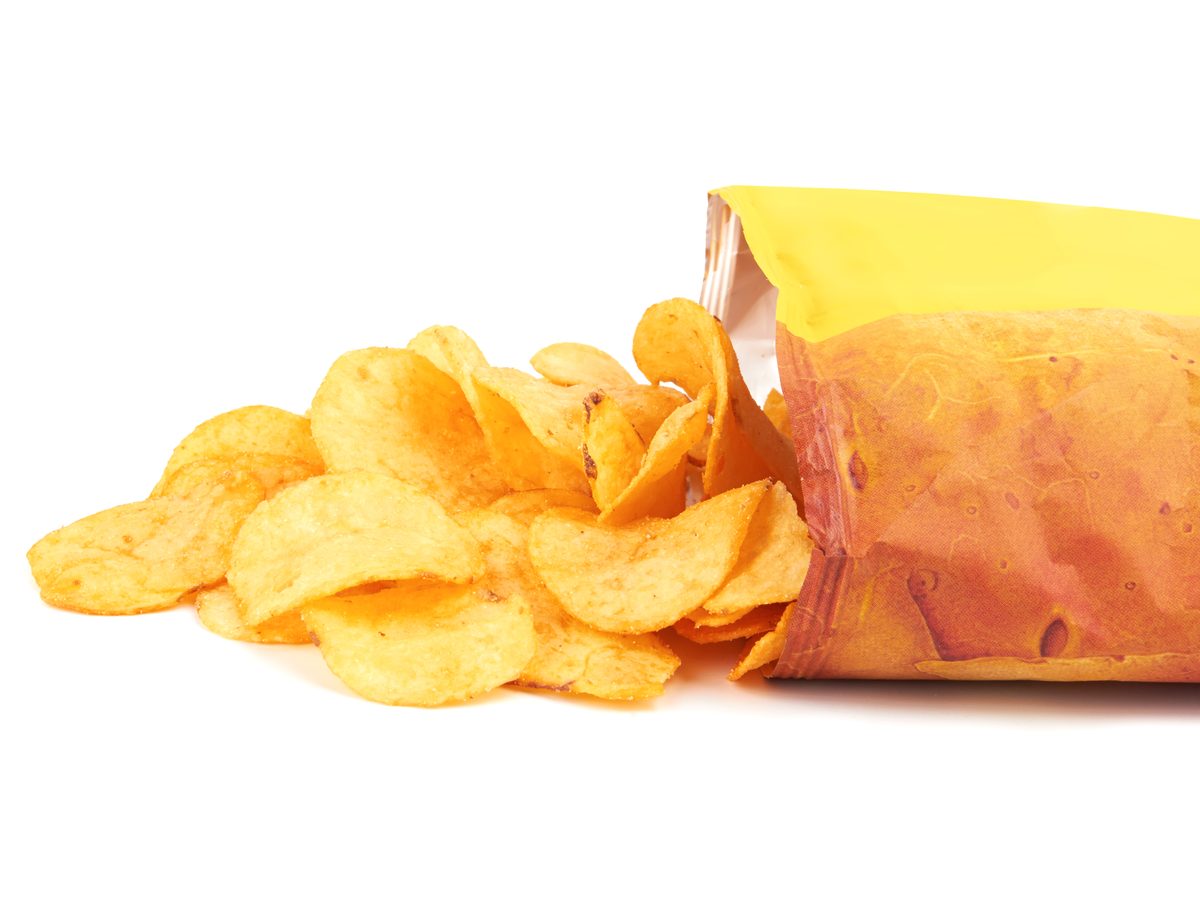
The one published subcategory example gives the shape of the arithmetic. In the Phase II draft, flavored potato and vegetable chips carry a target mean of 480 mg of sodium per 100 g and an upper bound of 670 mg per 100 g. Those are the only illustrative target values quoted here, because they are the only pair carried in the source used for this article; the rest of the 163 subcategory values live in the guidance document itself, which is the correct place to read your own numbers from.
Converting those two numbers shows how far they sit from anything on a label. At 480 mg per 100 g, a 50 g portion of food contains 240 mg of sodium. At 670 mg per 100 g, the same portion contains 335 mg. Both are well above the 140 mg threshold that 21 CFR 101.61 sets for a "low sodium" claim on an individual food, which applies per reference amount customarily consumed and, when the reference amount is 30 g or less or 2 tablespoons or less, per 50 g as well. In other words, a product sitting exactly on its category target mean can be a perfectly ordinary product that cannot honestly call itself low sodium. The two systems are not calibrated to each other, and there is no reason to expect them to be. You can check where a candidate claim actually lands with the claim validator.
How to find your own category
The category tables are inside the guidance documents, not in the Code of Federal Regulations, so there is no CFR section to look up. Finding your subcategory is a matching exercise, and it goes roughly like this.
- Start from the food, not the brand. Subcategories are defined by what the food is and how it is prepared, so describe your product the way a technologist would: a flavored extruded corn snack, a shelf-stable soup concentrate, a cured sliced meat.
- Decide which side of the retail and foodservice line you are on. Phase II covers commercially processed, packaged and restaurant-prepared foods, and some categories are written around a preparation rather than a package.
- Convert your own sodium to mg per 100 g before comparing. The targets are concentrations. If your analytical data is per serving, divide by the serving weight in grams and multiply by 100. Comparing a per-serving milligram figure to a per-100 g target is the most common arithmetic error in this whole exercise, and it usually flatters the product. The RACC lookup will give you the reference amount your serving size is built from if you need to work back to a gram weight.
- Accept that some products have no category. With 163 subcategories the coverage is broad but not universal, and a product that matches nothing has nothing to compare itself to. That is an acceptable answer to a customer questionnaire.
- Write down which subcategory you matched and why. If a buyer asks about sodium targets twice a year, a one-line record of the match and the date of the guidance edition you read saves repeating the work.
Multi-component products are the awkward case. A frozen meal of sauce, starch and protein may plausibly match a composite category or several component ones. Pick the one that best describes the food as sold, and note the alternative you rejected.
Nothing here creates a labeling obligation
Sodium targets change no part of your label. There is no disclosure to add, no symbol, no statement, no record you are required to keep. A product that ignores the guidance entirely carries exactly the same label as one reformulated to sit under its category upper bound.
What is binding about sodium sits elsewhere, in regulation rather than guidance:
- Declaring it. Sodium is a mandatory line on the Nutrition Facts panel, stated in milligrams per serving with a percent Daily Value against 2,300 mg for adults and children 4 and older under 21 CFR 101.9(c)(9).
- Rounding it correctly. Under 21 CFR 101.9(c)(4), sodium declares as zero when a serving contains less than 5 mg, to the nearest 5 mg increment from 5 to 140 mg, and to the nearest 10 mg increment above 140 mg. The rounding rules apply the same way whatever your category target is.
- Declaring it accurately. Under 21 CFR 101.9(g)(5), a food is misbranded if the sodium content of the composite is more than 20 percent in excess of the value declared on the label, subject to analytical method variability. This is the enforceable sodium number in your file, and it has nothing to do with the targets.
- Any claim you make about it. The definitions in 21 CFR 101.61 for sodium free, very low sodium, low sodium, reduced sodium and the rest are binding. Print one and the food must meet it.
The honest summary is that the targets are commercial rather than legal. Retail buyers and foodservice specifications reference them, which is reason enough to know your category and your concentration, but the regulator is not going to act on them. Once you have a sodium figure you trust, build the panel it belongs on in the nutrition label generator, which handles the per-serving conversion and the 101.9(c)(4) rounding for you.
Frequently asked questions
Are the FDA sodium targets mandatory for my category?
No. They are voluntary guidance in both editions. Phase I is final guidance, which describes the status of the document rather than any obligation, and Phase II is still a draft issued on 15 August 2024. No product is misbranded for sitting above a category target, and no enforcement action follows from missing one.
How many food categories do the sodium targets cover?
163 subcategories, in both Phase I and the Phase II draft. They are often described as grouped into 16 overarching categories, but that grouping figure comes from secondary summaries rather than the guidance text, so 163 is the number worth quoting.
My product is above the target mean for its category. Is that a problem?
Not in any regulatory sense, and not necessarily in any practical sense either. The mean target describes where the sales-weighted average of an entire category should land, so individual products sitting above it are a mathematical necessity. The number that would identify your product as unusual is the upper bound, and even that carries no legal consequence.
Why are the targets in mg per 100 g when my label is per serving?
Because a concentration is the only basis on which products with different serving sizes can be compared across a category. Convert your own analytical data to mg per 100 g before making any comparison. Comparing a per-serving milligram figure directly against a per-100 g target will usually make a product look far better than it is.
Does meeting my category target let me say "low sodium" on the pack?
No, and the two are unrelated. "Low sodium" is defined in 21 CFR 101.61 as 140 mg or less per reference amount customarily consumed, with an additional per 50 g test when the reference amount is 30 g or less or 2 tablespoons or less. A category target is a concentration goal for a market; the claim definition is a binding test on one food. A product can satisfy its category target and fail the claim test comfortably.
Should I reformulate now for Phase II, or wait?
That is a commercial decision, not a compliance one. Phase II remains draft, its three year timeframe only starts once it is finalised, and FDA's 2026 priority list does not name sodium targets among that year's deliverables. Against that, FDA's 2022 assessment found roughly 40 percent of the Phase I targets already reached or within 10 percent, so a good part of the market has moved regardless of what the draft does next.
Where do I get the actual number for my subcategory?
From the guidance document itself. The category tables are published with the guidance, not codified in the Code of Federal Regulations, so there is no CFR section to cite for a target value. Read your subcategory line from the edition you are working to, and keep a note of which edition with your specification.